
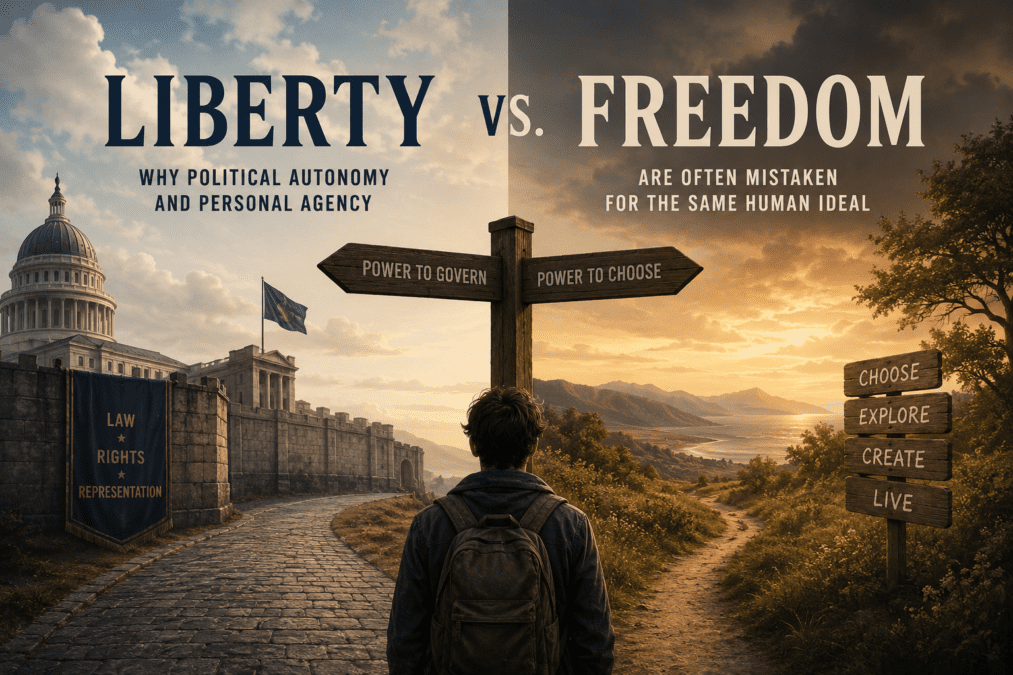

The debate surrounding liberty vs freedom has shaped constitutional law, political philosophy, economics, psychology, and social organization for centuries. Although the two concepts are frequently used interchangeably in public discourse, they represent different dimensions of human autonomy. Freedom generally refers to the absence of restraint, while liberty often describes a structured condition in which rights are protected within a legal or civic framework. This distinction becomes increasingly important in modern democracies, where individual desires must coexist with institutional stability.
A meaningful comparison between liberty and freedom requires more than dictionary definitions. Political theorists, constitutional scholars, sociologists, and behavioral psychologists analyze these ideas through separate frameworks. Freedom is commonly examined as a condition of action — the ability to choose without interference. Liberty, in contrast, is often interpreted as a protected civic status that exists through laws, institutions, and enforceable rights. The comparison therefore extends beyond language into governance, ethics, social behavior, and cultural development.
The central insight in the liberty vs freedom discussion is that unrestricted freedom can sometimes weaken liberty, while excessive regulation designed to preserve liberty may reduce individual freedom. Modern societies constantly negotiate this tension. Democracies survive not because citizens possess unlimited freedom, but because liberty creates boundaries that protect people from coercion, instability, and abuse of power. Understanding this balance explains why the two ideas remain philosophically connected yet structurally different.
Essential Comparative Metrics
| Attribute | Liberty | Freedom |
|---|---|---|
| Core Meaning | Protected rights within a legal framework | Ability to act without restraint |
| Primary Focus | Civic and institutional protection | Personal autonomy and choice |
| Dependence On Law | Highly dependent | Can exist outside formal systems |
| Political Association | Constitutional democracies | Individual expression and independence |
| Philosophical Tradition | Locke, Montesquieu, Mill | Existentialism, liberal individualism |
| Risk When Extreme | Overregulation and bureaucracy | Chaos or social instability |
| Collective Dimension | Strong | Variable |
| Legal Protection | Explicitly protected | Not always guaranteed |
| Relationship To Responsibility | Structured by duties and rights | Often framed as personal choice |
| Modern Application | Civil liberties and constitutional rights | Lifestyle autonomy and self-expression |
Defining Liberty And Freedom In Modern Context
The distinction between liberty vs freedom begins with how each term functions in modern political and social systems. Freedom is generally understood as the capacity to act according to one’s own will. A person is considered free when external restrictions are minimized. This idea appears prominently in discussions about speech, religion, movement, creativity, and lifestyle choices.
Liberty, however, carries a more institutional meaning. Liberty refers to rights protected under law and recognized within a political order. A society with liberty establishes legal mechanisms preventing arbitrary power from governments, corporations, or majorities. Constitutional protections, due process, and equal treatment under law are all examples of liberty in action.
Freedom is therefore more personal and psychological, while liberty is more civic and structural. One can theoretically experience moments of freedom without living in a society that protects liberty. Conversely, a society may establish liberty through laws while still limiting certain freedoms for collective security or social stability.
This distinction explains why political constitutions frequently emphasize liberty rather than unlimited freedom. Liberty is sustainable because it operates within enforceable boundaries.
Structural And Philosophical Foundations
The intellectual roots of liberty vs freedom stretch back to classical philosophy and Enlightenment political theory. Ancient Greek thinkers explored freedom in relation to citizenship and participation in public life, but modern liberty emerged more clearly during the seventeenth and eighteenth centuries.
Philosophers such as John Locke argued that liberty depended upon natural rights protected from state overreach. Montesquieu emphasized separation of powers as a safeguard for liberty, while John Stuart Mill focused on limiting social tyranny against individual expression. Their theories shaped constitutional democracies throughout Europe and North America.
Freedom evolved differently in philosophical literature. Existential thinkers later framed freedom as the burden and responsibility of personal choice. In this perspective, freedom exists internally as much as externally. Human beings are free because they possess agency, even under restrictive conditions.
The liberty vs freedom distinction therefore reflects two traditions: one institutional and political, the other personal and existential. Liberty seeks protection from arbitrary authority. Freedom seeks independence from constraint itself. The tension between these traditions continues to influence legal systems, education, economics, and digital governance.
Behavioral Patterns And Social Intelligence
Human societies rarely operate through unrestricted freedom alone. Behavioral research consistently shows that stable cooperation depends upon shared rules, predictable enforcement, and reciprocal obligations. Liberty provides these mechanisms by establishing accepted boundaries for behavior.
Freedom encourages experimentation, innovation, creativity, and individual expression. Highly free societies often produce strong artistic cultures, entrepreneurial activity, and rapid social change. However, excessive emphasis on unrestricted freedom can weaken social cohesion if collective responsibilities erode.
Liberty creates predictable systems that allow diverse populations to coexist peacefully. Courts, constitutions, voting rights, and civil protections enable individuals with conflicting beliefs to participate in the same society without constant conflict. This institutional trust becomes especially important in multicultural democracies.
The liberty vs freedom relationship becomes clearer in digital environments. Social media platforms promote unprecedented expressive freedom, yet debates over misinformation, harassment, surveillance, and privacy demonstrate why liberty-based regulations still matter. Without rules protecting rights and accountability, unrestricted freedom can enable manipulation and social fragmentation.
Social intelligence therefore requires balancing personal autonomy with collective order. Neither liberty nor freedom alone creates sustainable civilization. Societies flourish when individuals possess meaningful freedom inside systems that preserve liberty.
Liberty: Strengths And Constraints
Liberty’s greatest strength lies in its durability. Because liberty is embedded within institutions and laws, it can survive political transitions, economic crises, and social change more effectively than informal freedom. Constitutional protections create continuity that shields citizens from arbitrary authority.
Civil liberties such as freedom of speech, due process, property rights, and equal legal protection establish predictable expectations between citizens and governments. These protections reduce fear and encourage participation in civic life. Stable liberty also supports long-term economic development because individuals and businesses can operate with confidence in legal consistency.
Another strength in the liberty vs freedom debate is that liberty recognizes competing rights. Modern democracies must balance speech rights with public safety, religious liberty with anti-discrimination protections, and economic liberty with labor standards. Liberty provides mechanisms for negotiation rather than absolute dominance.
However, liberty also has limitations. Institutional systems can become bureaucratic, slow, and restrictive. Governments sometimes justify intrusive surveillance or excessive regulation in the name of preserving liberty and public order. Legal systems may also fail to protect marginalized populations equally.
Critics argue that liberty can become overly procedural, emphasizing compliance more than genuine autonomy. In such cases, citizens possess formal rights while experiencing limited practical freedom in economic or social life.
Freedom: Strengths And Constraints
Freedom’s primary advantage is its direct connection to human individuality. People naturally seek autonomy, self-expression, and control over personal choices. Freedom supports creativity, exploration, dissent, and innovation because it minimizes external limitations on behavior.
Historically, movements for independence, civil rights, artistic expression, and social reform often emerged through demands for greater freedom. Scientific progress and entrepreneurial experimentation also thrive in cultures where individuals feel free to challenge existing systems.
PTFE vs Teflon: Why a Trademarked Coating Is Often Mistaken for an Entire Material Class
In the context of liberty vs freedom, freedom excels at encouraging transformation. Liberty stabilizes societies, while freedom pushes societies to evolve. Without freedom, cultures risk stagnation and conformity.
Yet freedom also contains structural weaknesses when detached from responsibility or institutional balance. Unlimited freedom can undermine collective trust if individuals reject obligations toward others. Economic freedom without regulation may produce monopolies or exploitation. Absolute expressive freedom can enable disinformation, intimidation, or incitement.
Freedom also varies dramatically based on social conditions. Individuals may technically possess freedom while lacking education, healthcare, financial opportunity, or political influence. This creates debates about whether formal freedom alone is meaningful without broader social support systems.
For this reason, many political theorists argue that freedom becomes sustainable only when supported by liberty-based institutions that protect fairness and stability.
Comparative Advantages In Real-World Scenarios
The practical implications of liberty vs freedom become visible when societies confront real-world crises and policy decisions. During emergencies such as pandemics, wars, or economic collapses, governments often restrict certain freedoms temporarily in order to preserve broader civic liberty and public order.
For example, public health mandates may reduce immediate personal freedom while aiming to protect collective liberty by preventing societal collapse. Similarly, financial regulations limit some market freedoms to preserve long-term economic stability and protect citizens from systemic abuse.
Freedom performs especially well in environments requiring innovation and cultural experimentation. Creative industries, technological entrepreneurship, and scientific research benefit from minimal interference and strong intellectual independence. Liberty, however, performs better in contexts requiring institutional fairness, dispute resolution, and protection against concentrated power.
A concise answer to the liberty vs freedom question is this: freedom emphasizes the ability to act without restraint, while liberty emphasizes protected rights within an organized social and legal system. Freedom prioritizes autonomy; liberty prioritizes secure coexistence.
Modern democracies generally attempt to combine both. Citizens are granted freedom of thought, expression, and lifestyle, while constitutional liberty ensures that governments and institutions cannot arbitrarily remove those rights.
Liberty Vs Freedom In Political Systems
Different political systems emphasize liberty and freedom differently depending on their ideological foundations. Liberal democracies typically attempt to integrate both concepts through constitutions, elections, and civil rights protections. Citizens receive substantial personal freedoms while institutions enforce liberties through courts and legislation.
Authoritarian systems sometimes allow selective personal freedoms while limiting political liberty. Citizens may possess economic or lifestyle flexibility yet lack protections against government power. This demonstrates why freedom alone does not guarantee liberty.
Libertarian political philosophies strongly prioritize freedom by minimizing state intervention. Communitarian systems, in contrast, often prioritize collective liberty and social stability over unrestricted individual choice. Social democracies attempt a hybrid approach by protecting civic liberties while also regulating markets and supporting welfare systems.
The liberty vs freedom discussion therefore influences taxation, healthcare, education, digital regulation, environmental policy, and national security. Political disagreements frequently arise because groups define liberty and freedom differently rather than rejecting them entirely.
For some, liberty means protection from state overreach. For others, liberty includes protection from economic exploitation or discrimination. Similarly, freedom may refer to speech rights, market independence, cultural identity, or bodily autonomy depending on ideological perspective.
Psychological Dimensions Of Liberty And Freedom
Psychology adds another layer to the liberty vs freedom debate by examining how humans perceive autonomy and control. Studies in behavioral science consistently show that individuals value the feeling of self-determination even when objective choices remain limited.
Freedom often produces psychological empowerment because people associate autonomy with dignity and identity. The ability to make independent decisions strengthens motivation, creativity, and emotional well-being. Restrictions on freedom can therefore generate frustration, resistance, or alienation.
Liberty contributes differently to psychological stability. People tend to experience lower anxiety in environments where rules are predictable and rights are protected consistently. Trust in institutions allows individuals to plan for the future, participate socially, and cooperate economically.
Interestingly, humans often support restrictions on freedom when they believe liberty itself is threatened. Citizens may accept surveillance during security crises or temporary restrictions during emergencies if they perceive those measures as protecting collective stability.
This dynamic reveals an important insight: freedom satisfies emotional and personal needs, while liberty satisfies social and institutional needs. Sustainable societies require both psychological autonomy and civic security.
Economic Interpretations Of Liberty Vs Freedom
Economic theory offers one of the most influential modern interpretations of liberty vs freedom. Market economies generally celebrate economic freedom, including entrepreneurship, private ownership, voluntary exchange, and consumer choice. Economic freedom often correlates with innovation and productivity growth because individuals can pursue opportunities without excessive barriers.
However, economic liberty focuses more on stable rules protecting contracts, property rights, and fair legal processes. Investors and businesses rely on liberty-based institutions to ensure predictable enforcement and prevent corruption or arbitrary seizure of assets.
The distinction becomes important during debates over regulation. Advocates of deregulation often emphasize freedom, arguing that markets function best with minimal interference. Supporters of regulatory oversight emphasize liberty, arguing that unchecked power can undermine fairness and create systemic inequality.
The liberty vs freedom framework therefore shapes labor laws, antitrust policies, taxation, international trade, and digital economies. Pure economic freedom may produce rapid growth but also instability or concentration of wealth. Strong economic liberty attempts to preserve competitive fairness through legal protections.
Modern economies ultimately depend upon a balance between entrepreneurial freedom and institutional liberty. Too much restriction suppresses innovation, while too little oversight risks exploitation and systemic instability.
Scientific And Expert Consensus (2026)
Contemporary scholarship increasingly treats liberty vs freedom as complementary rather than opposing concepts. Political scientists, constitutional theorists, sociologists, and behavioral economists generally agree that stable democratic societies require both personal autonomy and institutional safeguards.
Research on democratic resilience shows that liberty-based institutions — independent courts, free elections, transparent governance, and civil protections — strongly correlate with long-term political stability. At the same time, societies with meaningful cultural and intellectual freedom tend to generate greater innovation, adaptability, and social mobility.
Experts also emphasize that liberty and freedom evolve alongside technology. Artificial intelligence, biometric surveillance, algorithmic governance, and digital monopolies are reshaping debates about privacy, expression, and state power. Many scholars argue that the twenty-first century challenge is not choosing between liberty and freedom, but redesigning institutions capable of protecting both simultaneously.
The expert consensus in 2026 suggests that freedom without liberty risks instability and manipulation, while liberty without freedom risks stagnation and authoritarian control. Sustainable governance depends on maintaining dynamic equilibrium between the two principles.
This balanced perspective increasingly dominates constitutional analysis, digital ethics, international law, and democratic theory.
Liberty Vs Freedom In Cultural Narratives
Cultural storytelling strongly influences how societies interpret liberty and freedom. National myths, literature, films, and political rhetoric frequently frame freedom as heroic resistance against oppression. Revolutionary movements across history have used the language of freedom to mobilize populations seeking independence or reform.
Liberty appears more often in constitutional and institutional narratives. Courts defend civil liberties; governments pledge to protect liberty under law. As a result, freedom tends to feel emotionally immediate, while liberty feels structurally enduring.
The liberty vs freedom distinction also differs culturally. Some societies prioritize collective harmony and social responsibility over radical individual freedom. Others celebrate personal independence as the highest political value. These cultural differences shape public attitudes toward censorship, privacy, healthcare, taxation, and social regulation.
Modern media environments further complicate these narratives. Digital culture amplifies demands for expressive freedom while simultaneously increasing concerns about misinformation, surveillance, and platform power. The global conversation increasingly centers on how liberty can survive in algorithm-driven societies where information itself becomes a form of influence.
Cultural interpretation therefore plays a major role in determining how liberty and freedom are defended, limited, or redefined over time.
Final Synthesis And Verdict
The debate surrounding liberty vs freedom persists because both concepts address essential but different human needs. Freedom represents personal autonomy — the ability to think, speak, move, and choose without unnecessary restraint. Liberty represents protected civic order — the legal and institutional framework that prevents arbitrary domination and preserves rights across society.
While freedom emphasizes independence, liberty emphasizes protection. Freedom encourages innovation, expression, and transformation. Liberty enables stability, fairness, and coexistence. Neither principle alone is sufficient for healthy democratic civilization.
The most important insight is that liberty and freedom are not enemies competing for dominance. They function as balancing forces. Excessive freedom without institutional safeguards can produce instability, manipulation, or inequality. Excessive liberty enforced through rigid systems can suppress creativity and individual agency.
Modern democracies succeed when they preserve broad personal freedoms while maintaining liberty through accountable institutions and enforceable rights. The future challenge is not deciding between liberty and freedom, but ensuring that technological, political, and economic systems protect both simultaneously.
In practical terms, freedom allows individuals to pursue meaningful lives, while liberty ensures those pursuits remain protected from coercion and abuse. That distinction explains why the conversation around liberty vs freedom remains central to law, governance, ethics, and human development in the twenty-first century.
Frequently Asked Questions
Is liberty the same thing as freedom?
No. Although the terms are closely related, liberty usually refers to protected rights within a legal or constitutional framework, while freedom refers more broadly to the ability to act without restraint. The liberty vs freedom distinction becomes especially important in political theory and constitutional law.
Why do constitutions often use the word liberty instead of freedom?
Constitutions emphasize liberty because liberty implies enforceable protections under law. Governments can guarantee civil liberties through institutions, courts, and legal rights, whereas unlimited freedom may conflict with public order or the rights of others.
Can a society have freedom without liberty?
Yes. Individuals may experience certain personal freedoms in a society that lacks institutional protections for rights. However, those freedoms remain vulnerable because there are no stable legal systems protecting them from arbitrary authority.
Which is more important: liberty or freedom?
Most modern scholars argue that both are necessary. Freedom supports individuality and innovation, while liberty provides stability and legal protection. The healthiest democratic systems balance personal autonomy with institutional safeguards rather than prioritizing one absolutely over the other.