
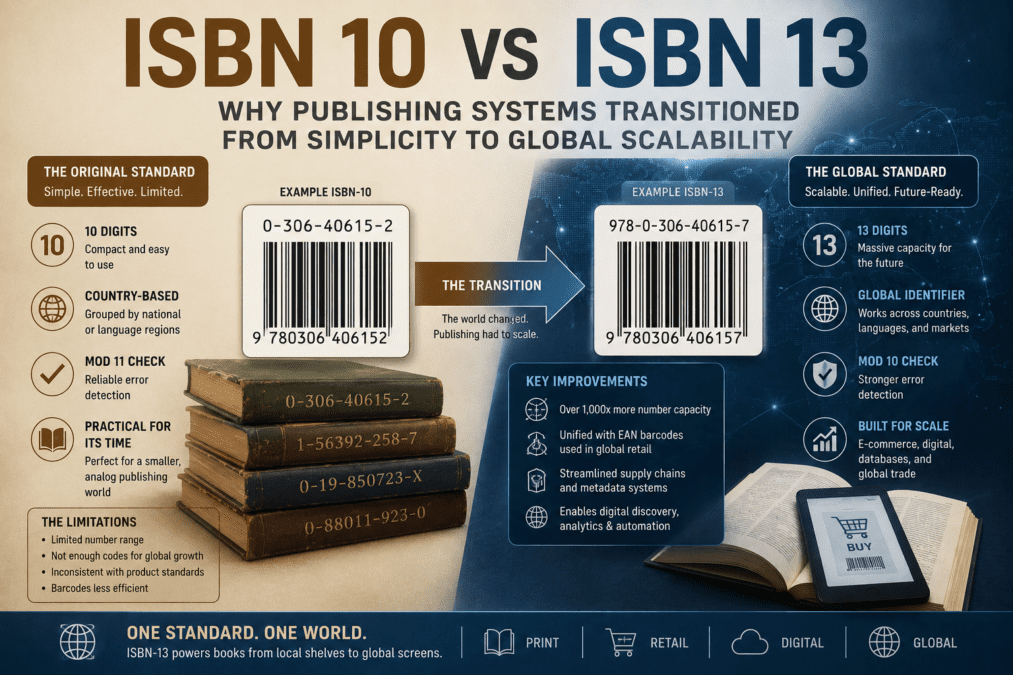

The debate around isbn 10 vs 13 is not simply about two different numbering formats. It reflects a deeper transformation in global publishing, inventory management, retail automation, and international book distribution systems. ISBN-10 emerged during a period when publishing databases were relatively small and regional. ISBN-13 was developed for a digital and globally interconnected marketplace where scalability and compatibility became essential.
Understanding isbn 10 vs 13 requires more than recognizing the difference in digit count. The comparison involves checksum mathematics, barcode integration, metadata compatibility, bookstore logistics, search indexing, and long-term publishing infrastructure. While both identifiers serve the same core purpose—uniquely identifying books—their operational efficiency differs substantially in modern ecosystems.
The surprising insight in the isbn 10 vs 13 discussion is that ISBN-13 was not created because ISBN-10 failed technically. ISBN-10 functioned effectively for decades. The transition occurred because the publishing industry outgrew the numerical capacity and retail limitations of the earlier structure. ISBN-13 represents scalability rather than correction.
Understanding ISBN Systems In Modern Publishing
An ISBN, or International Standard Book Number, is a globally recognized identifier assigned to books and related publications. ISBN-10 uses a 10-digit structure, while ISBN-13 expands the identifier into a 13-digit format aligned with international barcode systems.
In the modern publishing environment, the isbn 10 vs 13 comparison matters because bookstores, distributors, libraries, search engines, and e-commerce systems increasingly prioritize standardized metadata compatibility. ISBN-13 was specifically engineered to integrate with EAN-13 barcode systems used in global retail logistics.
While ISBN-10 remains historically significant and still appears in older catalogs, ISBN-13 has become the international publishing standard. Most books published after 2007 use ISBN-13 exclusively because it offers greater numbering capacity and stronger compatibility with worldwide retail infrastructure.
The transition from ISBN-10 to ISBN-13 can therefore be understood as a shift from a publishing-centered identification system to a globally networked commerce-oriented architecture.
Essential Comparative Metrics
| Attribute | ISBN-10 | ISBN-13 |
|---|---|---|
| Digit Length | 10 digits | 13 digits |
| Introduced | 1970 | 2007 global adoption |
| Primary Purpose | Book identification | Book identification + retail integration |
| Barcode Compatibility | Limited | Full EAN-13 compatibility |
| Numerical Capacity | Restricted | Significantly expanded |
| Checksum Method | Modulus 11 | Modulus 10 |
| Use In Modern Retail | Declining | Standardized globally |
| Support For Legacy Catalogs | Strong | Strong |
| Digital Database Efficiency | Moderate | High |
Structural And Mathematical Foundations
The structural distinction in isbn 10 vs 13 begins with numerical architecture. ISBN-10 consists of four primary components: group identifier, publisher code, title identifier, and checksum digit. ISBN-13 contains similar publishing metadata but introduces a three-digit prefix—usually 978 or 979—to align with global EAN retail systems.
The checksum calculation represents one of the most technically important differences. ISBN-10 uses a modulus 11 system, allowing the final digit to occasionally be represented by “X,” which signifies the value 10. ISBN-13 instead employs a modulus 10 algorithm using alternating multiplication weights of 1 and 3.
From an error-detection perspective, ISBN-10 is mathematically elegant and highly effective at identifying transcription mistakes. However, ISBN-13 offers broader systems compatibility across scanning devices, retail terminals, and international logistics software.
The isbn 10 vs 13 transition therefore reflects a trade-off between compact mathematical efficiency and industrial scalability. ISBN-10 optimized identification logic for publishers, while ISBN-13 optimized interoperability across global commerce systems.
Historical Evolution Of ISBN Standards
The historical context behind isbn 10 vs 13 reveals how rapidly publishing expanded during the late twentieth century. ISBN-10 originated from the Standard Book Numbering system developed in the United Kingdom during the 1960s. At the time, global publishing volume was manageable, and the 10-digit structure appeared more than sufficient.
However, globalization, self-publishing, academic publishing growth, digital marketplaces, and online retail radically increased the number of titles entering circulation. The numerical space available within ISBN-10 began approaching exhaustion in several regions and publishing categories.
Simultaneously, major retailers required compatibility with universal barcode systems already used for consumer goods. The publishing industry recognized that books needed integration with the same retail infrastructure used by supermarkets, warehouses, and multinational distribution networks.
This is why the isbn 10 vs 13 comparison is fundamentally tied to technological modernization rather than simple formatting preference. ISBN-13 emerged because publishing evolved into a data-intensive global industry dependent on machine-readable interoperability.
Barcode Compatibility And Retail Infrastructure
One of the most important aspects of isbn 10 vs 13 is barcode functionality. ISBN-13 directly integrates with EAN-13 barcode systems, which are widely used across global retail industries. This compatibility allows bookstores, warehouses, and online retailers to process books using universal scanning hardware.
ISBN-10 lacked this seamless integration. Although bookstores could still use ISBN-10 identifiers internally, the numbering format did not align naturally with international product barcode standards. As retail digitization accelerated, this became a significant operational limitation.
Modern inventory systems depend heavily on automated scanning, synchronized databases, and standardized metadata exchange. ISBN-13 supports these processes more effectively because it behaves like other globally recognized retail product identifiers.
In practical terms, the isbn 10 vs 13 distinction affects warehouse efficiency, stock management, supply chain automation, and checkout processing. ISBN-13 reduced friction between publishing databases and broader commercial infrastructure.
This explains why major retailers, including online marketplaces and library suppliers, rapidly standardized around ISBN-13 after the 2007 transition period.
Database Management And Search Indexing
The isbn 10 vs 13 comparison also influences digital discoverability. Search engines, bibliographic databases, and online retailers rely heavily on standardized identifiers for indexing and metadata consistency.
ISBN-13 improves database normalization because it aligns with universal retail identification frameworks. Systems designed around EAN-compatible structures can process ISBN-13 with fewer conversion layers, reducing indexing conflicts and duplication errors.
ISBN-10 still remains searchable in many systems because legacy records continue to exist across libraries, academic catalogs, and secondhand book markets. However, many databases now automatically convert ISBN-10 entries into ISBN-13 equivalents during processing.
A key insight in the isbn 10 vs 13 debate is that digital systems prioritize standardization over historical simplicity. ISBN-13 allows broader synchronization between publishers, distributors, retailers, and search engines operating across multiple countries and languages.
As publishing becomes increasingly algorithmic and metadata-driven, ISBN-13 provides structural advantages for long-term database stability and interoperability.
Behavioral Patterns And Industry Adoption
The publishing industry’s behavioral response to isbn 10 vs 13 demonstrates how standards evolve through institutional necessity rather than individual preference. Publishers initially resisted the transition because ISBN-10 was deeply embedded in catalogs, accounting systems, and archival records.
However, large retailers and distributors quickly accelerated ISBN-13 adoption by prioritizing compatible inventory systems. Once international supply chains standardized around EAN-13 integration, resistance became economically impractical.
Libraries adopted a more gradual transition strategy. Many catalog systems retained dual-field support for ISBN-10 and ISBN-13 to preserve compatibility with historical records. Academic institutions especially prioritized backward compatibility because millions of existing books carried only ISBN-10 identifiers.
Consumer behavior also shaped the evolution. Most readers never consciously differentiate between ISBN-10 and ISBN-13. Instead, they interact with bookstore search systems that automatically interpret either format.
The isbn 10 vs 13 shift therefore illustrates a broader principle in technological systems: infrastructure standards are often determined by interoperability demands rather than end-user awareness.
ISBN-10: Strengths And Constraints
In the isbn 10 vs 13 comparison, ISBN-10 retains several meaningful strengths despite its declining dominance. Its shorter structure is easier for humans to read, memorize, and manually transcribe. This compactness historically reduced clerical complexity in publishing environments.
Mathematically, ISBN-10 also possesses a highly respected checksum design. The modulus 11 algorithm is exceptionally effective at detecting typographical and digit transposition errors. Many information scientists consider it more elegant than the ISBN-13 checksum model.
Legacy compatibility remains another major advantage. Older publishing catalogs, library archives, and historical bibliographies frequently rely on ISBN-10 indexing. Researchers dealing with older academic or rare books often encounter ISBN-10 references more frequently than ISBN-13.
However, the limitations are substantial. ISBN-10 suffers from constrained numbering capacity, weaker retail integration, and reduced compatibility with modern global commerce systems. Its inability to naturally integrate with EAN retail infrastructure became increasingly problematic as publishing digitized internationally.
The isbn 10 vs 13 transition ultimately exposed ISBN-10’s greatest weakness: it was designed for an earlier era of publishing scale and technological complexity.
ISBN-13: Strengths And Constraints
ISBN-13 dominates the modern isbn 10 vs 13 discussion because it solved several large-scale operational problems simultaneously. Its expanded numbering capacity supports growing publishing output, including self-published works, international editions, digital formats, and print-on-demand production.
Its strongest advantage is universal compatibility. ISBN-13 integrates seamlessly with EAN-13 barcode systems, enabling efficient use across warehouses, retailers, shipping networks, and multinational inventory platforms.
ISBN-13 also supports improved metadata synchronization between publishers, distributors, libraries, and e-commerce platforms. This reduces catalog fragmentation and improves discoverability across digital ecosystems.
However, ISBN-13 is not without criticism. The longer structure is less human-friendly and more difficult to memorize manually. Some information theorists also argue that its checksum algorithm is mathematically less sophisticated than the ISBN-10 system.
Despite these drawbacks, the practical advantages overwhelmingly favor ISBN-13 in contemporary publishing infrastructure. The isbn 10 vs 13 comparison increasingly resembles the transition from analog systems to digital ecosystems: operational scalability outweighs nostalgic efficiency.
Comparative Advantages In Real-World Scenarios
Real-world applications reveal why the isbn 10 vs 13 discussion remains relevant across publishing sectors. For archival research and older academic references, ISBN-10 often remains useful because many pre-2007 books were cataloged exclusively under the older system.
For active publishing operations, however, ISBN-13 offers decisive advantages. Online retailers process ISBN-13 more efficiently because it integrates directly into standardized commercial inventory systems. Warehouses similarly benefit from universal barcode compatibility.
Self-publishing platforms also prioritize ISBN-13 because modern print distribution networks depend on globally compatible metadata structures. International sales channels especially benefit from standardized retail identification frameworks.
Libraries occupy a hybrid position within the isbn 10 vs 13 landscape. Many institutions maintain dual-format compatibility to preserve access across historical and contemporary collections simultaneously.
In practical terms, ISBN-10 still matters historically and academically, while ISBN-13 dominates commercially and technologically. The coexistence persists because publishing infrastructure evolves incrementally rather than instantaneously.
Conversion Mechanics Between ISBN-10 And ISBN-13
A common question in the isbn 10 vs 13 debate concerns conversion methods. Most ISBN-10 numbers can be converted into ISBN-13 by adding the “978” prefix and recalculating the checksum digit according to ISBN-13 rules.
For example, a standard ISBN-10 identifier becomes an ISBN-13 through prefix expansion and checksum restructuring. This conversion framework allowed publishers and retailers to transition gradually without abandoning existing bibliographic records.
The ability to convert between systems significantly reduced industry disruption during the adoption period. Databases could cross-reference both identifiers, enabling compatibility across legacy and modern systems simultaneously.
However, conversion is not merely cosmetic. The recalculated checksum changes the mathematical validation logic entirely. ISBN-13 therefore represents a structurally distinct identification framework rather than a simple numerical extension.
The isbn 10 vs 13 relationship can thus be understood as evolutionary rather than replacement-oriented. ISBN-13 absorbed ISBN-10 into a broader global commerce architecture while preserving continuity through systematic conversion mechanisms.
Scientific And Expert Consensus (2026)
The expert consensus surrounding isbn 10 vs 13 is remarkably consistent across publishing technology, bibliographic science, and retail logistics. ISBN-13 is universally recognized as the operational standard for modern publishing systems.
Researchers in information science generally agree that ISBN-13 offers superior scalability, retail integration, and long-term infrastructure sustainability. Publishing organizations also overwhelmingly support ISBN-13 because it aligns with international metadata and commerce protocols.
However, experts simultaneously acknowledge the historical importance and technical strengths of ISBN-10. Many bibliographic scholars still praise its checksum methodology for robust error detection and human readability.
The nuanced consensus is therefore not that ISBN-10 was inferior, but that ISBN-13 became necessary as publishing expanded globally. In expert analysis, the isbn 10 vs 13 transition represents a case study in how technological ecosystems evolve under pressure from scale, interoperability, and automation requirements.
Importantly, most experts now view dual compatibility as essential for preserving archival continuity while supporting future publishing infrastructure.
Why ISBN-13 Became Mandatory After 2007
Many readers researching isbn 10 vs 13 ask why the industry established a formal transition deadline. The answer lies in international synchronization. Global retailers, distributors, and barcode organizations required a unified identification framework to prevent fragmentation.
The January 2007 transition ensured that publishers across countries adopted ISBN-13 simultaneously. Without coordinated adoption, inventory systems would have faced extensive compatibility issues during international transactions.
The transition also aligned books with broader consumer goods infrastructure. Books effectively became interoperable retail products within universal scanning ecosystems.
While ISBN-10 identifiers did not disappear, ISBN-13 became mandatory for newly issued ISBN assignments. This created a stable global standard while preserving historical compatibility through conversion systems.
The isbn 10 vs 13 shift therefore demonstrates how industry-wide coordination can modernize infrastructure without erasing legacy records entirely.
Common Misconceptions About ISBN Systems
Several misconceptions continue to shape discussions around isbn 10 vs 13. One common myth is that ISBN-13 contains more publishing information than ISBN-10. In reality, the additional digits primarily support scalability and barcode integration rather than expanded descriptive metadata.
Another misconception is that ISBN-10 became invalid after 2007. Older ISBN-10 identifiers remain fully usable for catalog searches, academic references, and archival indexing. Most databases continue supporting them through automatic conversion mechanisms.
Some users also assume ISBN-13 is inherently more accurate. This is misleading. ISBN-10 actually possesses highly sophisticated error-detection properties. ISBN-13’s advantages are infrastructural rather than mathematical.
A final misunderstanding is that both systems compete equally today. In operational publishing, ISBN-13 overwhelmingly dominates modern workflows. The isbn 10 vs 13 discussion persists largely because historical catalogs and older publications still maintain ISBN-10 relevance.
Final Synthesis And Verdict
The most important conclusion in the isbn 10 vs 13 comparison is that the transition reflected industrial evolution rather than technical failure. ISBN-10 was exceptionally effective for the publishing environment in which it was created. Its structure was compact, mathematically elegant, and operationally sufficient for decades.
However, global publishing transformed dramatically through digitization, international retail expansion, automated logistics, and metadata-driven commerce. ISBN-13 emerged because the industry required a scalable identifier compatible with universal retail systems and expanding title volumes.
ISBN-10 remains valuable historically, academically, and archivally. ISBN-13 dominates commercially, technologically, and operationally. The two systems therefore represent different eras of publishing infrastructure rather than direct competitors.
For modern publishers, ISBN-13 is essential. For researchers and historians, ISBN-10 still retains practical significance. The broader lesson from isbn 10 vs 13 is that information systems evolve not only according to mathematical elegance, but according to the changing demands of global interoperability and scale.
Frequently Asked Questions
Is ISBN-10 still valid today?
Yes. ISBN-10 identifiers remain valid for older books and are still recognized by most databases, libraries, and online retailers. Many systems automatically convert ISBN-10 entries into ISBN-13 equivalents for compatibility.
Why did publishers switch from ISBN-10 to ISBN-13?
Publishers adopted ISBN-13 because ISBN-10 lacked sufficient numbering capacity and did not integrate efficiently with global EAN barcode systems. ISBN-13 improved scalability, retail compatibility, and international distribution efficiency.
Which is better for modern publishing: ISBN-10 or ISBN-13?
In modern publishing environments, ISBN-13 is generally superior because it supports international retail infrastructure, barcode integration, and large-scale metadata systems. ISBN-10 remains useful mainly for legacy catalogs and historical references.
Can an ISBN-10 always be converted into ISBN-13?
Most ISBN-10 identifiers can be converted into ISBN-13 by adding the 978 prefix and recalculating the checksum digit. This conversion process helped preserve compatibility during the publishing industry’s global transition.
Do libraries still use ISBN-10?
Many libraries still maintain ISBN-10 records for archival and cataloging purposes, especially for books published before 2007. However, most contemporary library systems prioritize ISBN-13 for new acquisitions and database synchronization.