
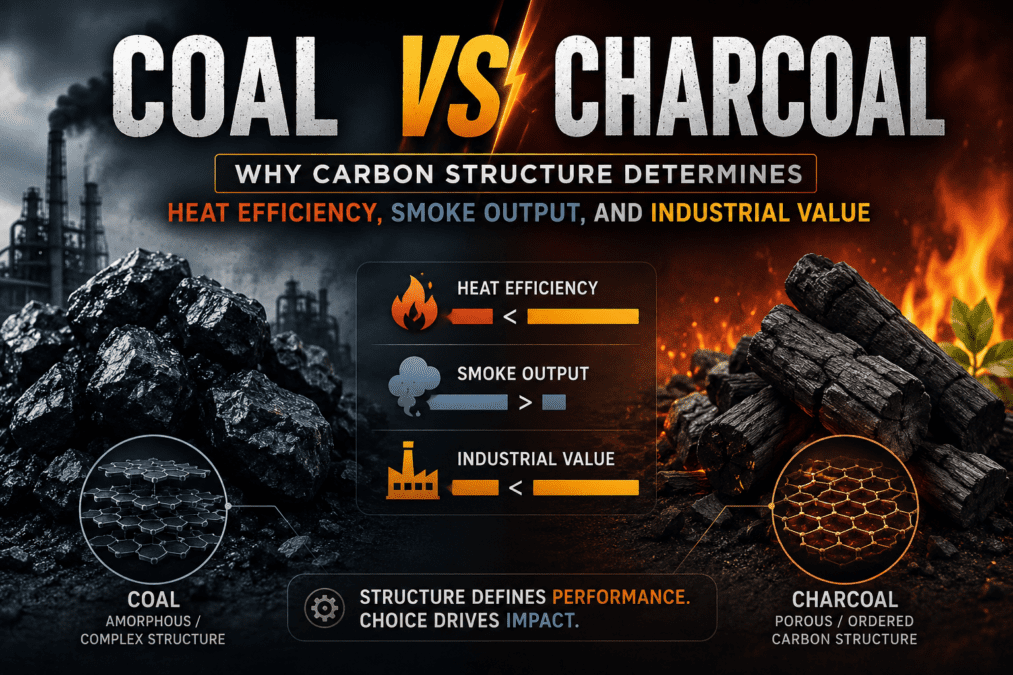

Coal and charcoal are both carbon-rich fuels, yet they originate from fundamentally different processes and perform very differently in industrial, domestic, and environmental applications. Coal is a fossil fuel formed over millions of years from compressed plant matter beneath the Earth’s surface, while charcoal is produced by heating wood or biomass in a low-oxygen environment. Although both materials generate heat through carbon combustion, their chemical composition, density, impurities, and combustion behavior differ substantially.
A serious coal vs charcoal analysis requires more than comparing which burns hotter or longer. The comparison must include combustion chemistry, environmental emissions, energy density, industrial utility, cooking performance, transportation economics, and sustainability. In modern energy discussions, the coal vs charcoal debate has expanded beyond household fuel choices into climate science, metallurgy, renewable biomass systems, and air-quality policy.
The surprising insight in the coal vs charcoal comparison is that the “better” fuel depends almost entirely on context. Coal dominates in large-scale industrial energy production because of its density and abundance, while charcoal often outperforms coal in controlled heating environments where lower sulfur content, cleaner combustion, and higher carbon purity matter more than raw fuel volume. The distinction between the two reveals how fuel structure influences efficiency more than simple burn temperature alone.
Essential Comparative Metrics
| Attribute | Coal | Charcoal |
|---|---|---|
| Origin | Fossilized plant material | Carbonized wood or biomass |
| Formation Time | Millions of years | Hours to days |
| Carbon Content | 45%–95% depending on type | 70%–90% |
| Primary Types | Lignite, bituminous, anthracite | Lump charcoal, briquettes, biochar |
| Smoke Production | High | Moderate to low |
| Sulfur Content | Often high | Usually very low |
| Ash Residue | Significant | Lower overall ash output |
| Industrial Usage | Power plants, steelmaking | Cooking, filtration, metallurgy |
| Renewability | Non-renewable | Potentially renewable |
| Typical Burn Duration | Long | Moderate |
| Combustion Odor | Heavy and sulfuric | Wood-like and lighter |
Coal is a sedimentary fossil fuel composed mainly of carbonized organic matter compressed under geological pressure. Charcoal is a lightweight carbon fuel created by pyrolyzing wood in limited oxygen conditions. While coal contains significant mineral impurities and volatile compounds, charcoal is generally purer carbon with fewer contaminants.
In the broader coal vs charcoal discussion, coal typically offers greater total energy reserves and industrial scalability, while charcoal provides cleaner combustion and more controllable heat for cooking and specialty manufacturing.
A direct answer to the coal vs charcoal question depends on intended use. Coal is usually superior for high-volume industrial energy production because of its abundance and energy density, whereas charcoal is often preferred for grilling, small-scale metallurgy, and low-smoke applications due to cleaner combustion, lower sulfur levels, and more responsive heat control. Environmental sustainability also favors responsibly produced charcoal over fossil-derived coal.
Structural And Biological Foundations
The structural differences between coal and charcoal begin with their formation pathways. Coal forms through geological carbonization. Ancient vegetation becomes buried under sediment, exposed to immense pressure and heat over millions of years, and gradually transforms into peat, lignite, bituminous coal, and eventually anthracite. Each stage increases carbon concentration while reducing moisture and volatile compounds.
Charcoal forms through pyrolysis, a far faster process involving controlled heating of biomass without sufficient oxygen for full combustion. During this process, water vapor, methane, tars, and volatile organic compounds escape, leaving behind porous carbon structures. This porous architecture explains why charcoal ignites relatively easily and responds quickly to airflow changes.
The coal vs charcoal distinction is therefore not simply about fuel type but about carbon architecture. Coal’s dense geological structure gives it long-duration combustion and higher mass energy storage. Charcoal’s porous cellular structure increases surface area, improving oxygen interaction and combustion responsiveness. These structural differences explain why charcoal is favored in cooking and blacksmithing while coal historically powered railroads, factories, and electrical grids.
Behavioral Patterns And Combustion Intelligence
Fuel behavior under combustion conditions is one of the most revealing aspects of the coal vs charcoal comparison. Coal burns progressively and often releases volatile gases during early combustion phases. Depending on coal grade, smoke output may contain sulfur dioxide, nitrogen oxides, particulate matter, and heavy hydrocarbons. Bituminous coal especially produces thick smoke because of its volatile content.
Charcoal behaves differently because pyrolysis has already removed many volatile compounds. Once ignited, charcoal generates more stable radiant heat with comparatively less smoke. This is why charcoal grilling produces cleaner flavor profiles than raw wood combustion. The predictable heat pattern also makes charcoal useful in traditional metallurgy and ceramic firing.
Another major coal vs charcoal difference lies in airflow sensitivity. Charcoal reacts rapidly to oxygen adjustments because of its porous composition. Opening a grill vent dramatically changes charcoal temperature within minutes. Coal is less responsive and better suited for steady, prolonged thermal output.
Combustion efficiency is also shaped by impurities. Coal frequently contains sulfur and mineral inclusions that reduce clean burn efficiency and increase ash formation. Charcoal, especially high-quality lump charcoal, often burns cleaner with lower ash production. However, charcoal generally burns faster than coal, meaning it requires more frequent replenishment during extended heating cycles.
Coal: Strengths And Constraints
Coal became the foundation of industrial civilization because it concentrates enormous amounts of stored solar energy in a dense and transportable form. In the coal vs charcoal debate, coal’s primary advantage remains scalability. Massive coal deposits exist worldwide, enabling sustained industrial use in power generation, steel production, cement manufacturing, and chemical processing.
Anthracite coal, with exceptionally high carbon content, burns hotter and cleaner than lower-grade coal varieties. Bituminous coal remains essential in coke production for blast furnaces. Coal also offers long-duration combustion, making it practical for systems requiring stable thermal output over many hours.
However, the limitations in the coal vs charcoal analysis are substantial. Coal combustion releases large quantities of carbon dioxide, sulfur dioxide, mercury compounds, and particulate pollution. Mining operations can devastate landscapes, contaminate groundwater, and generate methane emissions. Coal ash disposal also creates long-term environmental hazards.
Another weakness is combustion flexibility. Coal requires more controlled ignition systems and is less adaptable for small-scale applications. It is inefficient for cooking, produces stronger odors, and generates significantly more residue than charcoal. As renewable energy infrastructure expands globally, coal increasingly faces regulatory pressure and declining social acceptance.
The coal vs charcoal comparison therefore shows coal as an industrially dominant but environmentally burdensome fuel source.
Charcoal: Strengths And Constraints
Charcoal’s greatest strength lies in combustion purity and controllability. In the coal vs charcoal framework, charcoal offers lower sulfur emissions, cleaner burning characteristics, and superior heat responsiveness. These traits make it ideal for cooking, forging, activated carbon production, and artisanal manufacturing.
Lump charcoal can reach extremely high temperatures with proper airflow management. Because it burns with relatively little smoke after ignition stabilization, it enhances food flavor without overwhelming it with sulfurous compounds. Many traditional metallurgical techniques historically depended on charcoal because it introduced fewer contaminants into metal production than raw coal.
Modern biochar systems have also transformed the coal vs charcoal discussion by linking charcoal production with carbon sequestration and soil enhancement. Biochar can improve water retention, microbial activity, and nutrient stability in agricultural systems.
Still, charcoal has major constraints. Its lower density means larger storage volume relative to coal for equivalent long-term energy output. Charcoal is also mechanically fragile and can crumble during transportation. Poorly regulated charcoal production contributes to deforestation in many regions, especially where biomass harvesting exceeds forest regeneration rates.
splitting maul vs axe: Why Tool Geometry Matters More Than Raw Swing Force
In industrial energy systems, charcoal often lacks the economic scalability of coal. Large power plants require consistent fuel streams that coal infrastructure currently provides more efficiently. Thus, the coal vs charcoal comparison reveals charcoal as cleaner and more versatile on a smaller scale but less dominant in heavy industrial systems.
Comparative Advantages In Real-World Scenarios
The practical outcome of the coal vs charcoal debate changes dramatically depending on application. In electricity generation, coal still dominates in many developing economies because it provides reliable baseload power with established infrastructure. Coal’s energy density and supply chains make it economically competitive despite environmental costs.
In cooking applications, charcoal is overwhelmingly preferred. Charcoal generates radiant heat with fewer sulfur contaminants, improving taste quality and reducing unpleasant smoke. Professional grill operators often choose hardwood lump charcoal because it produces stable searing temperatures while preserving flavor integrity.
In metallurgy, the coal vs charcoal comparison becomes nuanced. Modern steel production depends heavily on metallurgical coal transformed into coke, which provides structural support and carbon chemistry inside blast furnaces. Yet traditional blacksmithing often favors charcoal because it burns cleaner and allows finer temperature control.
Environmental applications strongly favor charcoal derivatives. Activated charcoal is widely used in filtration systems, medical detoxification, water purification, and industrial adsorption because of its enormous internal surface area. Coal has no equivalent versatility in purification technologies.
In rural economies, charcoal frequently becomes the preferred domestic fuel due to easier storage, lower smoke output, and compatibility with small stoves. However, uncontrolled charcoal harvesting can create severe ecological stress if biomass management systems are weak.
Ultimately, the coal vs charcoal comparison demonstrates that each fuel evolved to serve different thermal and economic ecosystems rather than directly replacing one another.
Environmental And Climate Implications
Environmental impact is now central to any serious coal vs charcoal analysis. Coal is among the largest contributors to anthropogenic carbon dioxide emissions worldwide. Coal combustion also produces sulfur oxides, nitrogen oxides, particulate pollution, and toxic trace metals. Even advanced scrubber systems cannot fully eliminate coal’s climate burden.
Charcoal occupies a more complex environmental position. When produced sustainably from managed biomass systems, charcoal can approach carbon neutrality because replacement vegetation absorbs atmospheric carbon during regrowth. Biochar systems may even create net carbon sequestration under specific agricultural models.
However, not all charcoal production is environmentally responsible. In many regions, inefficient kilns waste biomass energy and release methane, carbon monoxide, and soot. Illegal logging for charcoal production also contributes to deforestation and biodiversity decline.
The coal vs charcoal conversation therefore cannot be reduced to “fossil fuel versus renewable fuel.” Production methods matter enormously. Sustainably produced charcoal can integrate into circular biomass economies, while destructive charcoal harvesting can become environmentally catastrophic.
Another critical distinction involves indoor air quality. Coal combustion indoors releases dangerous pollutants linked to respiratory disease and cardiovascular stress. Charcoal, though cleaner, can still produce carbon monoxide in poorly ventilated spaces. Neither fuel is inherently safe without proper combustion management.
From a climate-policy perspective, the coal vs charcoal comparison increasingly favors renewable biomass-derived charcoal systems, especially when integrated with reforestation and carbon capture strategies.
Heat Efficiency And Energy Density
Heat efficiency is one of the most misunderstood aspects of the coal vs charcoal debate. Many people assume charcoal burns hotter simply because grills reach high temperatures quickly. In reality, combustion behavior depends on fuel grade, oxygen availability, and thermal system design.
Coal generally contains greater energy per unit volume because of its density. Anthracite coal can sustain long-duration combustion with consistent heat output, making it efficient for industrial boilers and heating systems. Coal’s dense structure allows slower oxygen penetration, extending burn time.
Charcoal excels in thermal responsiveness rather than raw duration. Its porous matrix accelerates combustion kinetics, allowing rapid heat increases. This is why charcoal is highly effective in grilling environments where precise temperature adjustments matter.
The coal vs charcoal comparison also depends on ash behavior. Excess ash reduces combustion efficiency by insulating fuel surfaces from oxygen. Coal often generates heavier ash accumulation than charcoal, especially lower-grade varieties.
Moisture content is another important factor. Fresh charcoal generally contains less internal moisture than lower-grade coal, improving ignition performance. However, charcoal’s lower bulk density means more fuel volume may be required for extended industrial heating.
In practical terms, coal offers better long-term energy economy for large systems, while charcoal provides superior temperature responsiveness and cleaner radiant heat for controlled environments.
Industrial Economics And Supply Chains
Economics strongly influence the modern coal vs charcoal landscape. Coal infrastructure benefits from centuries of industrial investment, including rail transport systems, mining networks, export terminals, and combustion technologies. This scale advantage keeps coal economically competitive in many energy markets despite environmental regulations.
Charcoal production is more decentralized. It often relies on regional biomass availability, smaller processing facilities, and variable quality standards. This fragmentation creates inconsistent pricing and supply reliability.
Still, the coal vs charcoal comparison is evolving because environmental compliance costs increasingly affect coal economics. Carbon taxes, emission regulations, and pollution mitigation systems raise operational expenses for coal-dependent industries. Renewable energy competition also weakens coal’s long-term financial dominance.
Charcoal markets are simultaneously expanding into premium sectors. Restaurant industries, specialty metallurgy, activated carbon production, and sustainable agriculture all create demand for high-quality charcoal products. Biochar research has added scientific and commercial momentum to biomass carbon systems.
Transportation efficiency remains a major coal advantage. Coal’s density reduces shipping volume relative to charcoal. Bulk maritime coal logistics are highly optimized globally, whereas charcoal transportation can be more fragile and storage-intensive.
Thus, the future coal vs charcoal equation may depend less on combustion performance and more on carbon policy, sustainability certification, and regional biomass management systems.
Scientific And Expert Consensus (2026)
The scientific consensus surrounding the coal vs charcoal comparison has shifted significantly during the past decade. Energy researchers increasingly view coal as a declining but still strategically important industrial fuel. Its environmental costs, especially greenhouse gas emissions, are now considered incompatible with long-term global climate stabilization targets without large-scale carbon capture systems.
Experts in biomass energy systems see charcoal as more adaptable to transitional low-carbon economies when production is sustainable. Biochar research has become particularly influential because it reframes charcoal not merely as fuel but as a carbon-management technology with agricultural benefits.
Air-quality specialists consistently rank charcoal combustion as cleaner than coal combustion in sulfur emissions and particulate toxicity, though both require ventilation safeguards. Industrial metallurgists continue to rely heavily on coal-derived coke for steelmaking, yet experimental hydrogen and biomass alternatives are gradually emerging.
The modern coal vs charcoal discussion among scientists therefore centers less on which fuel is “stronger” and more on lifecycle sustainability, carbon accounting, and application-specific optimization.
Most experts agree on several core conclusions:
- Coal remains industrially powerful but environmentally costly
- Charcoal burns cleaner but depends heavily on sustainable sourcing
- Biochar technologies may expand charcoal’s environmental relevance
- Long-term energy transitions will likely reduce coal dependence globally
- Specialized industries may continue using both fuels for different purposes
The consensus increasingly favors diversified energy systems rather than universal dependence on either fuel source alone.
Final Synthesis And Verdict
The full coal vs charcoal comparison reveals two fuels shaped by entirely different evolutionary and industrial pathways. Coal represents geological energy concentration on a planetary timescale. Charcoal represents engineered biomass carbon optimized for responsive combustion and cleaner heat production.
Coal remains unmatched in certain large-scale industrial applications because of its density, availability, and entrenched infrastructure. Yet these advantages come with substantial environmental and health costs. Charcoal, by contrast, offers cleaner combustion, lower sulfur output, and greater versatility in cooking, filtration, and small-scale metallurgy.
The central insight from the coal vs charcoal debate is that combustion quality matters as much as combustion quantity. A fuel’s usefulness depends not merely on how much heat it generates but on how controllably, cleanly, and sustainably that heat can be produced.
For heavy industrial power systems, coal still provides practical advantages despite mounting environmental challenges. For culinary use, artisanal manufacturing, filtration technologies, and sustainable biomass applications, charcoal often proves superior.
As global energy systems transition toward lower-carbon models, the future of the coal vs charcoal relationship will likely involve declining coal dependence alongside more advanced and sustainable forms of charcoal production. Neither material fully replaces the other because each occupies a different technological and ecological niche.
Frequently Asked Questions
Is charcoal safer than coal for cooking?
Yes. In the coal vs charcoal comparison, charcoal is generally safer and more suitable for cooking because it contains fewer sulfur compounds and produces cleaner combustion. Coal smoke can introduce unpleasant flavors and harmful pollutants that are unsuitable for food preparation.
Does coal burn hotter than charcoal?
Certain coal grades, especially anthracite, can achieve extremely high combustion temperatures. However, charcoal often feels hotter in grilling environments because it responds rapidly to airflow and produces intense radiant heat near the cooking surface.
Why is charcoal considered more environmentally friendly?
Charcoal can be renewable when produced from sustainably managed biomass. Coal is a fossil fuel that releases ancient carbon into the atmosphere. The environmental outcome, however, depends heavily on how charcoal is sourced and processed.
Which lasts longer: coal or charcoal?
In most conditions, coal burns longer because of its density and slower combustion rate. Charcoal usually burns faster but offers more precise temperature control and cleaner heat output.