
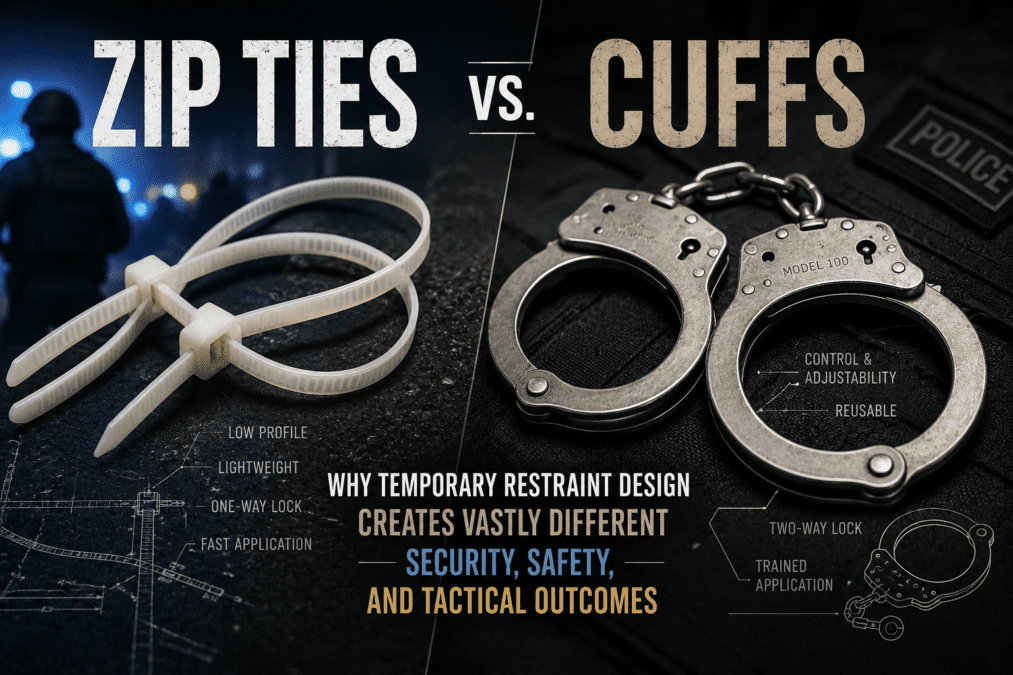

Modern restraint systems are designed for fundamentally different operational environments, yet the public often treats them as interchangeable tools. The comparison between zip ties and cuffs appears simple at first glance because both can restrict movement, secure objects, and control access. In reality, however, the engineering philosophy behind each system reveals major differences in durability, human safety, tactical control, legal acceptability, and long-term reliability.
The debate around zip ties vs cuffs is not merely about which device is stronger. It involves understanding material science, stress distribution, emergency deployment, ergonomics, and risk management. A plastic restraint optimized for lightweight utility behaves very differently from a mechanical restraint engineered specifically for repeated human control. This distinction becomes especially important in law enforcement, industrial safety, emergency preparedness, military operations, and civilian survival applications.
The most surprising insight in the zip ties vs cuffs comparison is that superiority depends almost entirely on operational context rather than raw restraining capability. Zip ties excel in portability, scalability, and disposable efficiency, while cuffs dominate in controlled restraint precision, repeatable security, and injury mitigation. The gap between them becomes clearer when analyzed through biomechanics, restraint psychology, and field performance rather than consumer assumptions.
Defining Zip Ties And Cuffs In Practical Terms
Zip ties are single-use fastening devices typically made from nylon polymers that tighten through a ratcheting locking mechanism. They are primarily designed for cable management, packaging, and industrial securing applications, although specialized restraint-grade variants exist for tactical or emergency use.
Cuffs are reusable mechanical restraint devices designed specifically to restrict human wrist movement through controlled locking systems. While zip ties prioritize simplicity and low manufacturing cost, cuffs prioritize controlled restraint, adjustability, durability, and subject management.
In the broader discussion of zip ties vs cuffs, the central distinction is purpose-built engineering versus adaptable utility. One evolved from industrial fastening systems, while the other evolved from custodial restraint technologies.
Comparative Metrics Table
| Attribute | Zip Ties | Cuffs |
|---|---|---|
| Primary Material | Nylon or polymer composite | Steel, aluminum, or reinforced alloys |
| Typical Usage | Industrial fastening and temporary restraint | Human restraint and law enforcement control |
| Reusability | Generally single-use | Designed for repeated use |
| Weight | Extremely lightweight | Moderate to heavy |
| Deployment Speed | Very fast | Moderate |
| Security Precision | Limited adjustability | High adjustability and locking control |
| Risk Of Circulation Damage | Higher if over-tightened | Lower with proper application |
| Escape Resistance | Moderate to high depending on grade | Very high |
| Cost Per Unit | Very low | Significantly higher |
| Storage Efficiency | Excellent | Limited by size and weight |
| Operational Longevity | Temporary | Long-term professional use |
| Environmental Resistance | Variable under heat and UV exposure | Generally strong environmental durability |
Structural And Biological Foundations
The structural distinction in zip ties vs cuffs begins with force distribution. Zip ties operate through progressive constriction. Once tightened, tension continuously concentrates inward unless manually cut. This can create uneven pressure points around soft tissue, particularly under movement or resistance. Because nylon lacks adaptive flexibility under load, circulation impairment becomes a genuine concern during prolonged restraint.
Cuffs function differently. Most professional restraint cuffs use articulated or hinged structures that distribute force more predictably across the wrist. Double-lock mechanisms prevent excessive tightening during movement, reducing unintended compression injuries. This feature alone dramatically changes their suitability for prolonged use.
From a biomechanical perspective, human wrists are highly vulnerable to nerve compression, tendon stress, and vascular restriction. The median nerve and radial structures can be compromised when pressure becomes concentrated in narrow zones. In the zip ties vs cuffs comparison, cuffs generally align more effectively with long-duration restraint safety standards because their geometry accounts for anatomical variability.
Material science also matters. Nylon weakens under high heat and UV exposure, whereas steel restraints maintain structural integrity under wider operational conditions. This difference becomes critical in outdoor tactical deployments, disaster response situations, or extended transport operations.
Behavioral Patterns And Social Intelligence
Human behavior under restraint significantly influences the outcome of zip ties vs cuffs applications. Restrained individuals instinctively test movement boundaries, adjust posture, and attempt leverage-based escapes. A restraint device must therefore manage both physical force and psychological response.
Zip ties tend to create uncertainty because tightening pressure can increase unpredictably during movement. This often causes restrained individuals to become more cautious or compliant initially, but prolonged discomfort may escalate panic or resistance. Since zip ties are not anatomically adaptive, agitation frequently increases physical stress injuries.
PTFE vs Teflon: Why a Trademarked Coating Is Often Mistaken for an Entire Material Class
Cuffs are psychologically different because they communicate institutional authority and procedural control. Their recognizable design has behavioral implications beyond mechanics. Subjects restrained with cuffs often understand the limits of movement immediately, reducing excessive struggling in many controlled environments.
Another overlooked factor in zip ties vs cuffs discussions is officer or operator confidence. Security professionals typically maintain greater situational control using cuffs because the device supports controlled repositioning, transport stability, and incremental adjustment. Zip ties, by contrast, are frequently viewed as temporary expedient tools rather than comprehensive restraint systems.
Social perception also matters. In humanitarian operations or civilian emergency settings, cuffs may be interpreted as formal enforcement tools, while zip ties can appear improvised or militarized depending on context. Public perception can influence escalation dynamics during crowd-control or crisis-response scenarios.
Subject A: Strengths And Constraints Of Zip Ties
The greatest strength of zip ties is logistical efficiency. They are compact, inexpensive, lightweight, and deployable at massive scale. In emergency environments where portability matters, zip ties offer unmatched convenience. A responder can carry dozens of restraints with minimal added weight, making them attractive in disaster zones, battlefield processing, or large-scale detainment situations.
Another advantage in the zip ties vs cuffs debate is deployment speed. Zip ties require minimal mechanical coordination and can be applied rapidly under chaotic conditions. This simplicity reduces training requirements and allows temporary control in unpredictable environments.
Zip ties also excel in non-human applications. Their versatility extends to construction, electrical organization, cargo stabilization, temporary repairs, agricultural use, and survival situations. Few fastening systems match their multi-role practicality.
However, the limitations are equally significant. Zip ties cannot easily be adjusted once tightened. This creates elevated risk of improper application, circulation compromise, and accidental tissue damage. Because they require cutting for removal, emergency medical access becomes slower and potentially hazardous.
Environmental sensitivity is another weakness. Standard nylon zip ties degrade under ultraviolet radiation, extreme cold, or prolonged heat exposure. In the context of zip ties vs cuffs, this means their long-term reliability varies substantially based on storage and climate conditions.
Escape vulnerabilities also exist. Improvised escape techniques exploiting body leverage or friction-based weakening are more feasible against low-grade zip ties than against professional restraints. High-tensile restraint ties improve this weakness but still lack the engineered locking sophistication of cuffs.
Subject B: Strengths And Constraints Of Cuffs
Cuffs are engineered specifically for controlled human restraint. Their strongest advantage is predictable restraint management. Double-lock systems, adjustable sizing, and rigid structural control create consistency that zip ties rarely achieve.
Professional cuffs are also optimized for repeat operational use. Unlike disposable restraints, cuffs can be inspected, maintained, sanitized, and redeployed repeatedly. This makes them economically practical over time despite higher initial cost.
The zip ties vs cuffs comparison becomes especially clear during prolonged transport scenarios. Cuffs maintain restraint integrity while minimizing accidental tightening. This reduces injury exposure during walking, vehicle movement, or repositioning.
Security reliability is another major strength. Escape resistance in professional cuffs is generally much higher because locking systems are mechanically complex and structurally reinforced. Hinged or chain-linked models further limit leverage-based escape attempts.
Yet cuffs have meaningful drawbacks. Weight and storage bulk are substantial disadvantages compared with zip ties. Large-scale deployments requiring dozens or hundreds of restraints become logistically challenging with metal cuffs alone.
Training demands are also higher. Improper cuffing technique can still produce injuries, positional instability, or tactical vulnerability. Effective cuff application requires procedural understanding, subject positioning awareness, and safety monitoring.
Another factor in zip ties vs cuffs is environmental signaling. Cuffs carry strong associations with criminal detention and formal law enforcement authority. In sensitive humanitarian environments, this symbolism can complicate public relations or escalate tensions.
Finally, cuffs are more expensive to manufacture, transport, and maintain. For temporary large-scale control operations, disposable restraint systems may appear operationally attractive despite their limitations.
Comparative Advantages In Real-World Scenarios
The outcome of the zip ties vs cuffs debate changes dramatically depending on operational conditions. In industrial environments, zip ties dominate because restraint of human subjects is not the primary objective. Their value comes from organizational efficiency, cable management, packaging security, and rapid deployment versatility.
In law enforcement or custodial transport, cuffs are overwhelmingly superior because they provide controlled restraint with lower injury risk and higher procedural reliability. Human restraint requires precision, not merely constriction.
Military and disaster-response environments create more nuanced conclusions. Zip ties become valuable when portability and mass deployment outweigh long-term custody concerns. During large-scale detainee processing, disposable restraints reduce logistical burden significantly.
While zip ties are superior for scalable temporary restraint and logistical efficiency, cuffs are superior for controlled, long-duration human management where safety, adjustability, and procedural accountability matter most.
Survival and preparedness communities often favor zip ties because of multifunctionality. A single bundle can support repairs, shelter construction, gear attachment, emergency restraint, and resource organization. Cuffs lack this adaptive versatility outside restraint-specific use.
Medical and humanitarian professionals generally prefer controlled restraint systems over improvised constriction devices because tissue safety becomes critical during prolonged immobilization. In these environments, the zip ties vs cuffs discussion increasingly favors anatomically considerate restraint engineering.
Engineering And Mechanical Reliability
Mechanical reliability represents one of the most technically important dimensions of zip ties vs cuffs. A restraint device must function consistently under stress, motion, environmental exposure, and repeated force application.
Zip ties rely on a simple ratchet-and-pawl locking mechanism. This simplicity is advantageous because fewer moving parts reduce manufacturing complexity and cost. However, simplicity also limits adaptability. Once deformation or stress concentration begins, failure can occur suddenly rather than progressively.
Cuffs employ more sophisticated locking architectures. Double-locking systems prevent accidental tightening, while metal alloys resist torsional distortion under load. This creates predictable performance under dynamic restraint conditions.
Another important distinction is fatigue resistance. Repeated stress cycling weakens polymer structures more rapidly than hardened metallic systems. Under prolonged tension, nylon may stretch microscopically before failure thresholds are reached.
Temperature response further separates the two systems. Cold conditions can make some polymers brittle, while extreme heat weakens tensile strength. Steel restraints maintain greater consistency across wider environmental ranges.
In high-risk operational analysis, zip ties vs cuffs ultimately reflects a tradeoff between disposable efficiency and engineered durability. One system prioritizes rapid scalability, while the other prioritizes repeatable mechanical integrity.
Safety, Ethics, And Injury Risk
The ethical dimension of zip ties vs cuffs cannot be separated from physical safety. Restraint systems inherently create risks involving circulation, nerve compression, positional asphyxia, and panic-induced injury escalation.
Zip ties carry elevated injury potential primarily because overtightening is difficult to reverse quickly. If swelling occurs after application, pressure may increase progressively without adjustment capability. This creates complications during extended restraint periods.
Cuffs are not risk-free, but professional designs incorporate mitigation features specifically intended to reduce unintended tightening and tissue damage. Double-lock systems are especially important because they stabilize cuff diameter after placement.
Medical literature on restraint injuries consistently emphasizes monitoring duration, positioning, and circulation regardless of device type. The device itself matters, but procedural oversight matters more.
Ethically, the zip ties vs cuffs debate also involves accountability. Reusable professional restraints usually exist within formal operational protocols. Disposable restraints are more common in emergency or improvised environments where procedural consistency may vary.
Another issue involves removal. Zip ties require cutting tools, which introduces delay and potential cutting injuries during emergency release situations. Cuffs can usually be removed rapidly with standardized keys and trained procedures.
The broader conclusion is that restraint safety depends less on restraint existence and more on training, oversight, duration, and physiological awareness.
Scientific And Expert Consensus (2026)
The expert consensus surrounding zip ties vs cuffs increasingly recognizes that the devices are not direct substitutes despite superficial similarities. Security specialists, biomechanics researchers, and tactical trainers generally classify them as solutions for different operational problems.
Professional restraint guidelines increasingly emphasize adjustable control systems over fixed constriction mechanisms for prolonged restraint situations. This trend favors cuffs in regulated environments where accountability, transport duration, and injury reduction are central concerns.
Industrial engineers, however, continue to value zip ties for unmatched utility efficiency. Their dominance in cable management, packaging systems, temporary stabilization, and field improvisation remains unquestioned because few alternatives offer comparable cost-to-function ratios.
Tactical professionals often adopt hybrid approaches. Zip ties may be used for temporary field control or emergency overflow scenarios, while cuffs remain preferred for transport and sustained detention operations.
Research into restraint-related injuries also shapes consensus. Medical evaluations consistently highlight the dangers of prolonged constrictive pressure without adjustability. This evidence influences policy recommendations favoring monitored restraint systems with controlled tension management.
By 2026, the prevailing expert view in the zip ties vs cuffs discussion is highly contextual: zip ties are efficient temporary control tools, whereas cuffs remain the professional standard for managed human restraint.
Economic And Logistical Considerations
Cost efficiency changes the practical outcome of zip ties vs cuffs more than many people realize. Disposable restraints can be manufactured at extremely low cost and transported in high volume. This creates enormous advantages in emergency preparedness, military logistics, and industrial operations.
A small container can hold hundreds of zip ties with negligible weight impact. Equivalent numbers of metal cuffs would require dramatically greater storage volume and transportation capacity.
Maintenance economics also differ sharply. Zip ties require no servicing because they are discarded after use. Cuffs demand cleaning, inspection, lubrication, and occasional component replacement.
However, lifecycle economics complicate the picture. Although cuffs cost far more initially, repeated reuse may reduce long-term operational expense in professional settings.
Another important issue is standardization. Professional restraint systems typically integrate with institutional protocols, training programs, and safety procedures. Disposable restraints may introduce variability depending on manufacturer quality and application technique.
The zip ties vs cuffs comparison therefore extends beyond physical mechanics into supply chain strategy, operational planning, and institutional resource management.
Psychological And Tactical Control Dynamics
Restraint effectiveness is partially psychological. Subjects respond differently depending on perceived permanence, authority, and discomfort.
Zip ties often create uncertainty because they appear improvised or temporary. This can produce unpredictable behavioral reactions. Some restrained individuals may panic due to increasing constriction sensations, while others may aggressively test structural weaknesses.
Cuffs communicate procedural authority more clearly. Their visibility alone often reduces uncertainty regarding the restraint situation. This psychological predictability can improve compliance during transport or detention.
Tactically, cuffs also provide better manipulation control. Officers or operators can reposition restrained individuals more safely due to rigid structure and predictable wrist orientation.
The zip ties vs cuffs distinction therefore includes behavioral management, not merely physical immobilization. Effective restraint systems influence decision-making, emotional response, and movement patterns simultaneously.
Environmental Durability And Long-Term Storage
Storage conditions heavily influence restraint reliability. Zip ties stored improperly may degrade silently through ultraviolet exposure, moisture variation, or thermal cycling. A restraint that appears visually intact may experience substantial tensile weakness.
Professional cuffs are generally more resistant to environmental degradation, although corrosion and mechanical wear remain concerns without proper maintenance.
For emergency preparedness communities evaluating zip ties vs cuffs, long-term storage stability becomes highly important. Vacuum-sealed or climate-controlled storage can preserve polymer integrity, but metal systems generally retain reliability longer under variable conditions.
Marine environments introduce another complication. Salt exposure accelerates metal corrosion but also weakens some plastics over time. Material coatings and manufacturing quality become decisive factors.
Durability analysis ultimately reinforces the broader conclusion that cuffs are engineered for longevity, while zip ties are engineered for disposable convenience.
Final Synthesis And Verdict
The comparison between zip ties vs cuffs reveals that these devices solve different categories of operational problems despite superficial similarities. Zip ties prioritize scalability, portability, low cost, and rapid deployment. Cuffs prioritize controlled restraint, injury mitigation, repeatable reliability, and professional custody management.
Zip ties are exceptionally effective when lightweight versatility matters more than prolonged restraint precision. Their value in industrial systems, emergency response, survival preparedness, and temporary field operations remains enormous. Few tools combine simplicity, affordability, and adaptability so efficiently.
Cuffs, however, remain the superior solution for structured human restraint. Their anatomical considerations, locking control, durability, and procedural compatibility make them the preferred option in professional environments requiring accountability and long-duration management.
The core lesson from the zip ties vs cuffs analysis is that context determines superiority. Treating either system as universally better ignores the engineering logic behind its design. Disposable polymer restraints excel in flexibility and scale, while mechanical cuffs excel in controlled, sustainable restraint operations.
Understanding that distinction is ultimately more important than declaring a single winner.
Frequently Asked Questions
Are zip ties actually strong enough for restraint use?
Some high-tensile restraint-grade zip ties are extremely strong and difficult to break manually. However, strength alone does not make them equivalent to professional cuffs. The major concerns involve adjustability, circulation safety, and long-duration control rather than raw tensile capacity.
Why do professionals still use cuffs instead of disposable restraints?
In the zip ties vs cuffs discussion, professionals generally favor cuffs because they provide controlled restraint with reduced injury risk and better procedural consistency. Reusable locking systems also support transport, repositioning, and accountability more effectively than disposable constriction devices.
Can zip ties cause more injuries than cuffs?
They can. Because zip ties tighten progressively and cannot easily be loosened, improper application may increase nerve compression or circulation restriction risks. Professional cuffs usually include mechanisms designed to prevent unintended tightening after application.
Are zip ties cheaper for large-scale operations?
Yes. Zip ties are dramatically less expensive and far easier to transport in bulk quantities. This makes them attractive in emergency, military, and disaster-response logistics where portability and scalability are major operational priorities.