
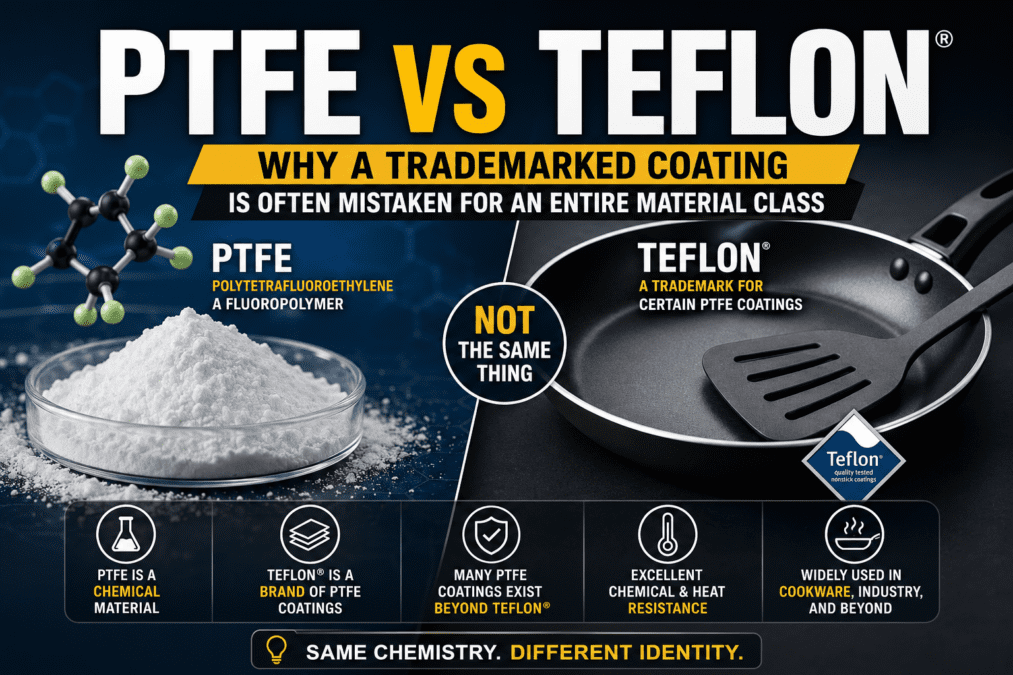

The debate around ptfe vs teflon is surprisingly common in manufacturing, cookware, engineering, electronics, and industrial design. Many people use the terms interchangeably, assuming they describe two different materials competing in the same category. In reality, the comparison is more nuanced because PTFE is a fluoropolymer material, while Teflon is a trademarked brand name historically associated with PTFE-based products.
Understanding ptfe vs teflon requires more than a simple dictionary distinction. The comparison involves chemistry, branding history, industrial processing, coating technologies, regulatory standards, durability performance, thermal behavior, and real-world application engineering. The confusion exists because the Teflon brand became so dominant during the twentieth century that it effectively entered public vocabulary as a synonym for PTFE itself.
The core insight is that PTFE represents the underlying polymer chemistry, while Teflon represents commercial formulations and applications built around that chemistry. This means the true discussion of ptfe vs teflon is not about two fundamentally different substances, but about the relationship between a scientific material and a branded implementation of that material in industrial and consumer markets.
Understanding PTFE And Teflon In Simple Terms
PTFE stands for polytetrafluoroethylene, a synthetic fluoropolymer known for its extremely low friction, chemical resistance, and thermal stability. Teflon is a trademark originally developed by the DuPont brand family for PTFE-based coatings and materials.
While PTFE refers to the raw polymer chemistry, Teflon refers to commercial products manufactured using PTFE or related fluoropolymer technologies. This distinction explains why discussions about ptfe vs teflon often become confusing in industrial procurement and consumer marketing.
A direct answer to the common question is this: PTFE is the actual material, whereas Teflon is a branded product line that historically used PTFE as its primary ingredient. In practical use, every Teflon PTFE coating contains PTFE chemistry, but not every PTFE product is necessarily sold under the Teflon brand. That subtle distinction shapes performance expectations, manufacturing standards, and market positioning across multiple industries.
Comparative Metrics Table
| Attribute | PTFE | Teflon |
|---|---|---|
| Definition | Synthetic fluoropolymer material | Trademarked brand using PTFE technologies |
| Chemical Identity | Polytetrafluoroethylene | Usually PTFE-based formulations |
| Ownership | Generic industrial polymer | Commercial trademark and coating system |
| Primary Use | Industrial components and engineering | Consumer coatings and specialty applications |
| Heat Resistance | Excellent | Excellent depending on formulation |
| Chemical Resistance | Extremely high | High due to PTFE composition |
| Friction Coefficient | Very low | Very low |
| Cookware Association | Indirect | Strong public recognition |
| Industrial Availability | Widely produced globally | Brand-specific licensing |
| Material Category | Polymer | Commercial product system |
| Market Recognition | Technical and engineering sectors | Mainstream consumer awareness |
| Customization Range | Broad industrial formulations | Controlled branded standards |
Structural And Chemical Foundations
The scientific distinction at the heart of ptfe vs teflon begins with molecular structure. PTFE is composed of carbon atoms fully surrounded by fluorine atoms, creating one of the strongest chemical bond arrangements in polymer science. This fluorinated shell gives PTFE exceptional inertness, meaning it reacts very little with surrounding chemicals, moisture, acids, or solvents.
Teflon, however, is not a separate molecular structure. It is a commercial identity attached to coatings, films, fabrics, seals, and industrial materials built primarily around PTFE chemistry. Historically, the Teflon name became associated with nonstick cookware, but industrial engineers also recognize it in aerospace seals, cable insulation, chemical piping, and precision bearings.
This explains why the ptfe vs teflon comparison is structurally asymmetric. PTFE exists independently as a material science category. Teflon exists as a market-facing implementation. One is chemistry; the other is branding combined with manufacturing standards. Confusion arises because the brand became culturally larger than the technical term itself.
Historical Development And Industrial Expansion
The history of ptfe vs teflon is closely connected to twentieth-century chemical innovation. PTFE was accidentally discovered in 1938 during refrigerant research. Scientists noticed that tetrafluoroethylene gas had polymerized into a slippery white solid with unusual resistance properties. The material quickly attracted military and industrial attention due to its stability under extreme conditions.
The Teflon trademark later transformed PTFE from a laboratory material into a globally recognized commercial product. During the mid-twentieth century, the Teflon name became heavily associated with cookware coatings because consumers immediately understood the practical benefit of nonstick surfaces. Over time, however, Teflon expanded beyond frying pans into aerospace, electronics, automotive engineering, and industrial fluid systems.
Man vs Nature: Why Human Progress Depends More on Ecological Adaptation Than Environmental Conquest
The historical lesson within ptfe vs teflon is that branding can shape public understanding more strongly than scientific terminology. Many consumers still believe Teflon is a unique substance separate from PTFE, even though PTFE chemistry forms the basis of most traditional Teflon coatings.
Mechanical Properties And Surface Performance
One of the most important technical aspects of ptfe vs teflon involves surface behavior. PTFE possesses one of the lowest coefficients of friction among solid materials. Objects slide across PTFE surfaces with minimal resistance, which is why engineers use it in bearings, seals, bushings, and sliding assemblies.
Teflon-coated surfaces inherit these same friction-reduction properties because the underlying chemistry remains PTFE-driven. However, branded Teflon products may also include additional processing technologies designed to improve adhesion, wear resistance, or coating durability. This means two PTFE products can perform differently depending on how they are manufactured and applied.
In practical engineering, the ptfe vs teflon discussion often becomes a question of specification control rather than chemistry alone. A generic PTFE sheet may behave differently from a multilayer Teflon coating optimized for cookware or aerospace applications. The base polymer remains similar, but formulation engineering changes the final performance characteristics.
Thermal Resistance And Heat Stability
Heat performance represents another major factor in ptfe vs teflon evaluations. PTFE maintains stability across an unusually broad temperature range. It resists degradation at temperatures that would damage many common plastics, making it useful in high-heat industrial environments.
Teflon-branded products typically preserve these thermal characteristics because they rely on PTFE chemistry. However, actual heat tolerance depends heavily on coating thickness, bonding methods, and the substrate beneath the coating. A Teflon-coated aluminum pan behaves differently from a solid PTFE industrial gasket because the supporting materials influence thermal transfer and mechanical durability.
The “while” comparison that often clarifies the issue is this: while PTFE describes the underlying fluoropolymer responsible for heat resistance, Teflon describes commercial systems that apply PTFE technology in specific industrial or consumer formats.
This distinction matters because users sometimes assume all Teflon products perform identically under extreme temperatures. In reality, manufacturing design and application context strongly influence results.
Chemical Resistance And Corrosion Protection
Chemical inertness is one of PTFE’s defining traits. Acids, solvents, alkalis, oils, and moisture have very limited effect on properly manufactured PTFE surfaces. This makes PTFE essential in chemical processing plants, pharmaceutical manufacturing systems, semiconductor production, and laboratory equipment.
In the context of ptfe vs teflon, the Teflon brand gained industrial trust largely because it leveraged this inherent chemical stability. Teflon-coated piping and seals became valuable where corrosion destroyed conventional materials. The coating could protect substrates without introducing reactive contamination into sensitive systems.
Yet there is an important nuance. PTFE itself is chemically resistant, but the total performance of a Teflon-coated product depends on coating integrity. If the coating becomes scratched, worn, or improperly bonded, the underlying material may become exposed to corrosion or contamination.
Therefore, professionals analyzing ptfe vs teflon must separate polymer chemistry from complete product engineering. PTFE provides the resistance mechanism, but coating design determines real-world reliability.
Electrical Insulation Characteristics
Electrical insulation performance adds another layer to the ptfe vs teflon discussion. PTFE exhibits outstanding dielectric properties, meaning it resists electrical conduction even under high-frequency conditions. This makes it highly valuable in aerospace wiring, telecommunications systems, radio-frequency equipment, and advanced electronics.
Teflon-insulated cables became especially important in environments requiring both heat resistance and electrical reliability. Aircraft systems, military electronics, and high-performance computing infrastructure benefited from PTFE-based insulation because conventional plastics often degraded under thermal stress.
One reason the ptfe vs teflon comparison remains relevant today is that engineers frequently encounter both terms in procurement documents. A specification might request PTFE insulation generically, while another might demand Teflon-certified materials due to brand assurance or historical standards compliance.
Thus, the distinction becomes partly technical and partly administrative. The chemistry may overlap substantially, but quality control expectations and supplier trust can vary depending on branding and certification.
Manufacturing Methods And Material Processing
Manufacturing differences significantly influence real-world outcomes in ptfe vs teflon products. PTFE itself is difficult to process compared with many thermoplastics because it does not flow easily during melting. Manufacturers often rely on compression molding, paste extrusion, or sintering methods rather than conventional injection molding.
Teflon-branded coatings typically involve proprietary application techniques that improve adhesion and consistency. Multiple coating layers may be applied and heat-cured to achieve uniform nonstick performance. In cookware manufacturing, primer layers help PTFE bond securely to metal surfaces.
This manufacturing distinction is critical because consumers often judge all PTFE products by their experience with inexpensive nonstick pans. However, industrial PTFE components can exhibit dramatically different lifespans and mechanical behaviors depending on formulation and processing precision.
The broader insight from ptfe vs teflon is that material science alone never determines performance. Processing technology, bonding quality, substrate selection, and environmental exposure all shape durability.
PTFE: Strengths And Constraints
PTFE’s greatest strength is its combination of low friction, chemical inertness, electrical insulation, and thermal stability within a single material. Few polymers can match this balance simultaneously. That versatility explains why PTFE appears in industries ranging from medical engineering to aerospace manufacturing.
Another major advantage in the ptfe vs teflon discussion is PTFE’s availability. Since PTFE is a generic polymer category, manufacturers worldwide produce it in sheets, rods, films, tapes, tubing, and engineered components. Buyers are not restricted to a single brand ecosystem.
However, PTFE also has limitations. It can deform under heavy mechanical loads, exhibit creep over time, and resist bonding to other materials because of its extremely nonreactive surface. These properties complicate manufacturing and structural integration.
Pure PTFE may also wear faster in abrasive environments unless reinforced with fillers such as glass fiber, carbon, or graphite. Consequently, engineers rarely select PTFE solely based on chemical resistance. They must evaluate the full operational environment.
Teflon: Strengths And Constraints
The Teflon brand’s greatest strength lies in standardized commercial performance and public trust. Consumers immediately recognize the name due to decades of exposure in cookware advertising and industrial applications. In many markets, the brand itself communicates expectations of smoothness, nonstick behavior, and chemical durability.
Within ptfe vs teflon, Teflon also benefits from formulation refinement. Certain branded coatings incorporate multilayer technologies or modified fluoropolymers designed for specific performance targets such as abrasion resistance or enhanced adhesion.
Yet the brand approach introduces limitations as well. Teflon products may cost more due to licensing, branding, and controlled manufacturing systems. Furthermore, consumers sometimes misunderstand the brand and assume all nonstick coatings are identical to genuine Teflon systems.
Another challenge is semantic confusion. Because “Teflon” became culturally synonymous with nonstick coatings, many people incorrectly label unrelated fluoropolymer technologies under the same term. This complicates technical discussions about material specifications and long-term reliability.
Food Safety And Consumer Concerns
Food safety debates have strongly influenced modern conversations around ptfe vs teflon. Earlier controversies involving certain manufacturing chemicals created public confusion about the safety of PTFE-coated cookware. Many discussions incorrectly treated PTFE itself as the hazardous substance rather than focusing on older processing compounds previously associated with some manufacturing methods.
Modern PTFE cookware systems are generally considered safe when used within recommended temperature ranges. Problems primarily emerge when coatings are severely overheated beyond operational guidelines. At extreme temperatures, polymer degradation can release fumes that may cause temporary irritation.
The ptfe vs teflon distinction matters here because consumers frequently confuse manufacturing history with material chemistry. PTFE itself is highly stable under normal cooking conditions. Regulatory improvements and updated production practices have significantly changed modern coating standards compared with earlier decades.
This topic also demonstrates how public perception often diverges from scientific nuance. Branding visibility amplified scrutiny around Teflon products, even though fluoropolymer chemistry remains widely used across medical, aerospace, and industrial systems requiring high reliability.
Comparative Advantages In Real-World Scenarios
Real-world applications reveal why ptfe vs teflon cannot be reduced to a simplistic “better versus worse” framework. The correct choice depends on context, scale, regulation, and engineering goals.
In industrial manufacturing, generic PTFE may offer greater flexibility and lower procurement costs. Engineers designing seals, gaskets, chemical tubing, or insulating components often prioritize raw material specifications rather than consumer-facing branding.
In consumer cookware, however, Teflon branding may provide reassurance regarding coating consistency and product testing. Buyers often associate branded systems with predictable nonstick performance and established manufacturing quality.
Medical industries frequently use PTFE in vascular grafts and specialized implants because of its biocompatibility and chemical inertness. Aerospace industries use PTFE and Teflon-coated systems where thermal extremes and friction reduction become mission-critical.
The practical conclusion from ptfe vs teflon is that the material-versus-brand distinction shapes purchasing logic differently depending on the operational environment.
Environmental Considerations And Sustainability
Environmental analysis has become increasingly important in the modern ptfe vs teflon conversation. Fluoropolymers are exceptionally durable, which creates both advantages and concerns. Their stability supports long product life and corrosion resistance, but that same persistence can complicate environmental degradation and waste management.
Manufacturers have responded by refining production methods and reducing reliance on controversial processing substances. Regulatory frameworks in North America, Europe, and Asia continue evolving around fluorochemical manufacturing oversight.
One overlooked insight in ptfe vs teflon discussions is that product longevity itself may reduce waste generation in some applications. A chemically resistant PTFE-lined industrial component that survives decades may prevent repeated replacement cycles associated with less durable materials.
At the same time, environmental researchers continue investigating fluoropolymer life cycles, disposal strategies, and emissions management. This ensures the subject remains scientifically and politically active rather than fully settled.
Scientific And Expert Consensus (2026)
The scientific consensus surrounding ptfe vs teflon in 2026 is relatively clear. PTFE is recognized as the foundational fluoropolymer material, while Teflon is understood as a trademarked commercial implementation historically linked to PTFE technologies.
Materials scientists generally avoid using the terms interchangeably in technical documentation because precision matters in engineering specifications. Procurement standards, regulatory filings, and industrial certifications typically reference PTFE when describing polymer chemistry.
Consumer culture, however, continues using “Teflon” as shorthand for nonstick coatings. This linguistic habit persists because branding achieved broader recognition than the underlying scientific terminology.
Experts also emphasize that performance variation depends heavily on manufacturing quality rather than terminology alone. A poorly produced PTFE coating may fail quickly, while a carefully engineered Teflon multilayer system may demonstrate exceptional durability under demanding conditions.
Therefore, modern expert consensus frames ptfe vs teflon not as a rivalry between different materials, but as a relationship between polymer science and branded engineering systems.
Misconceptions That Continue To Confuse Buyers
Several persistent myths shape public misunderstanding of ptfe vs teflon. One common misconception is that PTFE and Teflon are competing materials. In reality, Teflon traditionally relies on PTFE chemistry rather than replacing it.
Another misunderstanding is that all nonstick coatings are identical. Many modern coatings use ceramic systems, hybrid polymers, or alternative fluoropolymers with different durability profiles and heat behaviors. Consumers often incorrectly label all such coatings as Teflon regardless of chemistry.
A third misconception involves safety. Public discussions frequently combine unrelated chemical controversies into a single narrative, obscuring the distinction between polymer stability and historical manufacturing additives.
Understanding ptfe vs teflon accurately requires separating chemistry, branding, manufacturing history, and product engineering into distinct analytical categories rather than treating them as interchangeable concepts.
Why The Terminology Still Matters
Some may wonder why the ptfe vs teflon distinction matters if the underlying chemistry overlaps so heavily. The answer lies in engineering accuracy, procurement clarity, and performance expectations.
In industrial settings, specifying PTFE ensures buyers receive the required fluoropolymer chemistry regardless of supplier brand. In contrast, specifying Teflon may imply expectations tied to licensing, coating systems, or branded manufacturing standards.
Terminology also shapes legal compliance and technical communication. Engineers, chemists, and manufacturers rely on precise language because small material differences can affect safety, longevity, and operational reliability.
The persistence of the ptfe vs teflon debate therefore reflects a broader phenomenon in industrial culture: successful brands sometimes become so dominant that they overshadow the technical categories from which they originated.
Final Synthesis And Verdict
The most accurate conclusion about ptfe vs teflon is that the comparison is fundamentally about category versus brand rather than substance versus substance. PTFE is the actual fluoropolymer material known for low friction, thermal stability, and chemical resistance. Teflon is a trademarked commercial identity historically built around PTFE-based technologies.
This means PTFE represents the scientific foundation, while Teflon represents one highly recognizable implementation of that foundation. In everyday conversation, the terms may appear interchangeable, but in engineering and industrial contexts the distinction becomes important for specification accuracy and performance expectations.
PTFE offers flexibility, broad industrial availability, and material-level precision. Teflon offers branded consistency, consumer recognition, and commercially refined coating systems. Neither inherently “wins” because they occupy different conceptual roles within manufacturing and materials science.
Ultimately, understanding ptfe vs teflon requires recognizing how chemistry, branding, industrial processing, and public language evolved together over decades. The debate persists not because the materials are radically different, but because one became culturally larger than the scientific term behind it.
Frequently Asked Questions
Is PTFE the same thing as Teflon?
Not exactly. PTFE is the scientific name for polytetrafluoroethylene, a fluoropolymer material. Teflon is a trademarked brand historically associated with PTFE-based coatings and products. Most traditional Teflon coatings contain PTFE, but PTFE itself is not limited to the Teflon brand.
Which is better in the PTFE vs Teflon comparison?
The answer depends on context. PTFE is the underlying material used broadly across industrial applications, while Teflon refers to branded systems built around PTFE technology. Industrial engineers may prioritize PTFE specifications, whereas consumers may value Teflon brand consistency in cookware.
Is PTFE cookware safe for cooking?
Modern PTFE cookware is generally considered safe when used correctly within recommended temperature ranges. Extremely high overheating can degrade coatings and release fumes, but normal cooking conditions are typically well below those thresholds.
Why do people confuse PTFE and Teflon?
The confusion exists because the Teflon brand became globally associated with nonstick surfaces. Over decades, many consumers began using “Teflon” as a generic term for PTFE coatings, even though PTFE is the actual polymer material category.