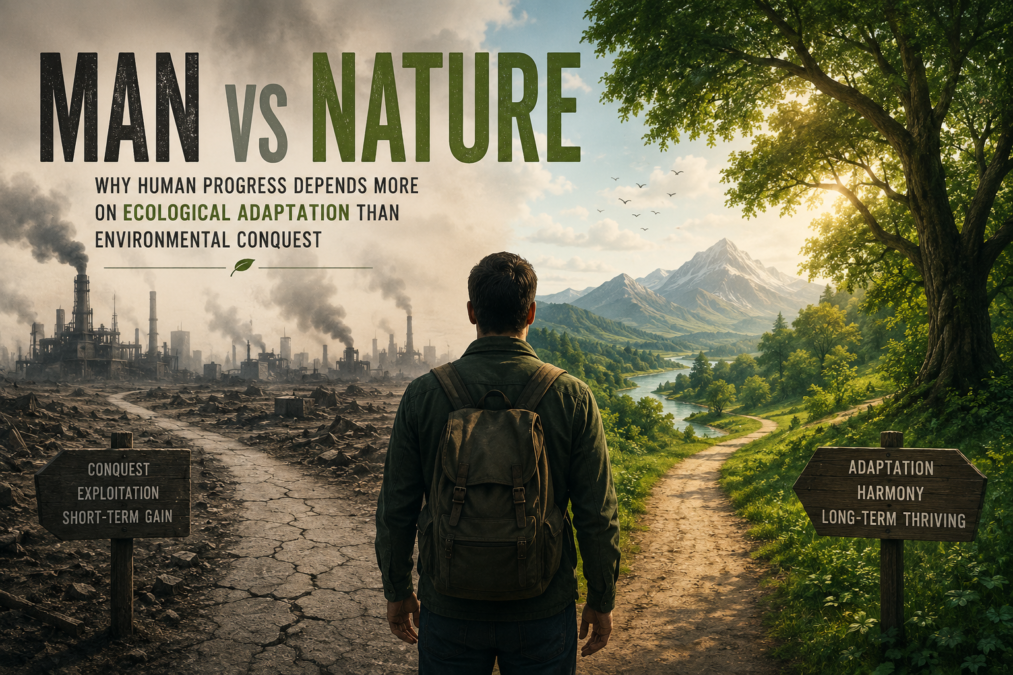

The phrase man vs nature describes the enduring conflict and interaction between human civilization and the natural world. In literature, science, history, and environmental studies, man vs nature represents humanity’s attempt to survive, control, modify, or adapt to environmental forces ranging from climate and disease to wildlife and geological disasters.
In the modern era, the meaning of man vs nature has evolved beyond simple physical survival. The comparison now includes technology, industrialization, sustainability, ecological collapse, renewable energy systems, climate engineering, biodiversity preservation, and the psychological relationship humans maintain with the environment they depend upon. Rather than a battle fought with primitive tools, man vs nature has become a global systems-level interaction involving economics, science, politics, and planetary stability.
This analysis argues that the traditional belief that humans can permanently dominate nature is increasingly unsupported by scientific evidence. While humanity has achieved extraordinary technological influence, nature continues to shape civilization through climate systems, biological adaptation, resource limitations, and ecological feedback loops. The modern reality of man vs nature is less about conquest and more about whether human intelligence can operate within environmental boundaries without destabilizing the very systems that sustain life.
Essential Comparative Metrics
| Comparative Factor | Human Civilization | Natural Systems |
|---|---|---|
| Adaptation Speed | Rapid through technology and innovation | Gradual through evolutionary processes |
| Energy Source | Industrial extraction and artificial systems | Solar-driven ecological cycles |
| Resilience | High in localized conditions | Extremely high across long geological periods |
| Dependency | Dependent on ecosystems for survival | Independent of human existence |
| Scale of Influence | Planetary through industry and technology | Planetary through climate and biological systems |
| Response to Disruption | Strategic and engineered | Adaptive and self-correcting |
| Longevity | Thousands of years of organized civilization | Billions of years of planetary evolution |
| Primary Limitation | Resource dependency and environmental fragility | Slow adaptation to abrupt artificial disruption |
Structural And Biological Foundations
The foundation of the man vs nature relationship begins with biology itself. Humans are biological organisms shaped by evolutionary pressures, yet humans differ from other species because they externalize adaptation through technology rather than relying exclusively on physical evolution. Clothing replaces fur, agriculture replaces migration, and medicine compensates for biological vulnerabilities. This technological layer allows civilization to function in deserts, polar regions, and megacities that would otherwise be hostile to human survival.
Nature, however, operates through interconnected systems that predate humanity by billions of years. Atmospheric regulation, water cycles, microbial ecosystems, ocean circulation, and biodiversity networks collectively maintain planetary balance. Human systems remain deeply dependent on these processes even when industrial societies appear independent from them.
A central insight in man vs nature analysis is that humans can temporarily override environmental constraints, but rarely eliminate them entirely. Urban infrastructure may reduce exposure to environmental forces, yet droughts still threaten food systems, rising temperatures alter economies, and natural pathogens continue to evolve. Human civilization exists inside nature rather than outside it.
Man vs nature therefore represents an unequal structural relationship. Humanity can reshape ecosystems rapidly, while ecosystems ultimately determine the conditions under which civilizations survive or collapse.
Behavioral Patterns And Social Intelligence
Human behavior in the man vs nature dynamic is strongly influenced by social intelligence and collective organization. Unlike most species, humans cooperate at massive scales using language, institutions, science, trade systems, and cultural transmission. This ability enables rapid environmental transformation. Entire rivers are redirected, forests cleared for agriculture, coastlines engineered, and climates influenced through industrial emissions.
Nature does not possess centralized intelligence in the human sense, yet natural systems display distributed resilience. Ecosystems self-regulate through feedback loops. Predator-prey balances, nutrient cycles, forest regeneration, and atmospheric stabilization mechanisms operate without conscious planning. This decentralized adaptability gives nature remarkable persistence over long timescales.
While human systems prioritize efficiency and expansion, natural systems prioritize equilibrium and continuity. This difference explains many modern environmental crises. Industrial societies often maximize short-term production, whereas ecosystems operate according to long-term sustainability principles refined over evolutionary history.
One reason the man vs nature debate remains unresolved is because both sides possess different forms of intelligence. Human intelligence excels at innovation and rapid problem-solving, while natural intelligence excels at systemic balance and long-term resilience.
The modern environmental challenge emerges when human activity disrupts ecological processes faster than ecosystems can recover. Deforestation, ocean acidification, biodiversity decline, and climate instability demonstrate that technological capability does not automatically produce ecological wisdom.
Subject A: Strengths And Constraints
Human civilization possesses extraordinary strengths within the man vs nature framework. The greatest advantage is cumulative knowledge. Scientific understanding allows humans to predict hurricanes, develop vaccines, genetically modify crops, build earthquake-resistant structures, and extract energy from multiple sources. Humanity’s capacity for abstract reasoning and technological innovation has transformed survival probabilities in ways unmatched by any known species.
Another major strength is environmental flexibility. Humans inhabit nearly every ecosystem on Earth because tools and infrastructure compensate for biological limitations. Air conditioning enables desert cities, modern agriculture sustains dense populations, and transportation networks connect distant environments into integrated economic systems.
However, the constraints facing humanity are increasingly visible. Industrial systems require immense resource extraction, including freshwater, minerals, fossil fuels, and fertile land. Human societies also depend heavily on ecological stability. Agricultural productivity relies on predictable climate patterns, pollinators, soil fertility, and freshwater availability.
In the broader man vs nature relationship, civilization’s greatest vulnerability may be complexity itself. Advanced societies rely on interconnected supply chains, electrical infrastructure, digital communication, and global trade. Natural disruptions such as pandemics, floods, droughts, or severe storms can therefore trigger cascading failures across economies and political systems.
Another limitation is psychological distance from ecological reality. Urban populations often experience nature indirectly, reducing awareness of environmental dependence. This disconnect can encourage policies that prioritize short-term economic expansion over long-term sustainability.
The paradox of man vs nature is that humanity’s greatest strengths—technology, industrialization, and expansion—can also amplify its weaknesses when ecological consequences are ignored.
Subject B: Strengths And Constraints
Nature’s greatest strength in the man vs nature comparison is durability across time. Ecosystems have survived asteroid impacts, volcanic winters, ice ages, continental shifts, and mass extinctions. While individual species disappear, life itself continually reorganizes and adapts. This resilience operates on timescales far beyond human political or economic planning.
Natural systems are also energetically efficient. Forests recycle nutrients, oceans regulate heat distribution, and biological organisms function through solar-based energy networks refined over millions of years. Human industry often produces enormous waste, whereas ecosystems typically convert outputs into new biological inputs.
Another strength is evolutionary adaptability. Pathogens evolve resistance, invasive species exploit new conditions, and ecosystems reorganize following disturbances. Nature continuously experiments through variation and selection.
Yet nature has constraints as well. Ecological systems can be destabilized by rapid human-driven changes. Climate warming, habitat fragmentation, pollution, and biodiversity loss are occurring at rates faster than many species can adapt. Coral reefs, polar ecosystems, and tropical forests are particularly vulnerable.
Nature also lacks intentional coordination. Ecosystems do not strategically defend themselves against industrial expansion. Instead, environmental responses emerge indirectly through changing climate patterns, species migration, disease spread, and resource depletion.
In the context of man vs nature, natural systems often appear passive until thresholds are crossed. Once tipping points emerge, however, recovery becomes difficult. Desertification, fishery collapse, glacier loss, and rainforest decline can become self-reinforcing processes.
A direct answer to the question “Who wins in man vs nature?” requires nuance. Humanity can dominate local environments temporarily through technology and engineering, while nature ultimately controls the long-term biological and climatic conditions required for civilization to exist. The relationship is therefore interdependent rather than purely competitive.
Comparative Advantages In Real-World Scenarios
The outcome of man vs nature depends heavily on context. In localized and short-term scenarios, humans often demonstrate superiority through planning, engineering, and scientific intervention. Flood barriers protect cities, satellites improve disaster prediction, and modern medicine reduces mortality from diseases that once devastated populations.
In agricultural systems, humans reshape landscapes with irrigation, fertilizers, and mechanization. Modern food production supports billions of people, illustrating humanity’s extraordinary capacity to manipulate environmental productivity.
However, long-term scenarios reveal a more balanced reality. Climate change demonstrates that environmental systems react to cumulative industrial activity in ways that are difficult to fully control. Rising sea levels, altered rainfall patterns, intensifying heatwaves, and biodiversity decline illustrate how ecological feedback loops can undermine human infrastructure and economic stability.
The COVID-era pandemic also reinforced lessons within the man vs nature framework. Despite advanced medical systems, a microscopic biological agent disrupted global trade, healthcare, transportation, education, and politics simultaneously. Human innovation eventually produced vaccines and treatments, yet the event exposed civilization’s dependence on biological stability.
Another real-world example involves water systems. Many industrial societies rely on groundwater depletion rates that exceed natural replenishment cycles. This creates a delayed environmental debt that may reshape future agricultural and urban development.
While humans dominate through speed and invention, nature dominates through scale and permanence. Civilization can alter landscapes within decades, but ecosystems and climate systems determine whether those changes remain sustainable across centuries.
The Philosophical Evolution Of Man vs Nature
Historically, man vs nature was interpreted as a heroic struggle for survival. Ancient societies feared storms, predators, disease, famine, and harsh climates because humans lacked the technological tools to manage environmental risks effectively. Myths, religions, and cultural traditions often portrayed nature as a powerful force requiring respect or appeasement.
The Industrial Revolution fundamentally changed this perception. Fossil fuel energy, mechanized production, and scientific advancement created the impression that humanity could permanently transcend natural limits. Cities expanded rapidly, transportation accelerated globalization, and industrial agriculture transformed food systems. During this period, many societies embraced the belief that progress meant controlling nature.
In the twenty-first century, however, the man vs nature narrative has shifted again. Environmental science increasingly demonstrates that ecological systems cannot be treated as infinite resources without consequences. Sustainability has therefore become a central concept in economics, urban planning, agriculture, and energy policy.
Modern interpretations of man vs nature focus less on domination and more on coexistence. Renewable energy, regenerative agriculture, biodiversity conservation, and climate adaptation strategies reflect recognition that civilization functions best when aligned with ecological realities rather than in opposition to them.
This philosophical evolution is significant because it changes the definition of success. Earlier models measured success through extraction and expansion, while modern environmental frameworks increasingly measure success through resilience, efficiency, and long-term sustainability.
The deeper insight emerging from contemporary man vs nature analysis is that ecological stability is not an obstacle to human progress. It is a prerequisite for enduring human progress.
Pitaya vs Dragon Fruit: Why Global Markets Created Two Names for the Same Nutritional Phenomenon
Climate Change As The Defining Modern Example
No issue illustrates man vs nature more clearly than climate change. Human industrial activity has altered atmospheric chemistry on a planetary scale through greenhouse gas emissions. This demonstrates humanity’s unprecedented environmental influence, but it also reveals the unintended consequences of technological expansion.
Climate systems are extraordinarily complex. Small atmospheric changes can produce large-scale impacts across oceans, agriculture, weather patterns, and biodiversity. Heatwaves intensify, glaciers melt, rainfall shifts, and marine ecosystems experience increasing stress. These changes affect economies, migration patterns, food security, and geopolitical stability.
The climate crisis also exposes an important contradiction within the man vs nature relationship. Humans possess the scientific knowledge required to understand environmental risks, yet political and economic systems often struggle to respond collectively. Nature reacts according to physical laws, while human societies respond through negotiation, ideology, and economic incentives.
A while-comparison sentence helps clarify the contrast: while humanity can engineer technological systems capable of altering the atmosphere itself, nature still determines the climatic boundaries within which agriculture, infrastructure, and civilization can function safely.
Climate adaptation strategies now represent a major frontier in the ongoing man vs nature dynamic. Nations are investing in seawalls, drought-resistant crops, renewable energy systems, urban cooling strategies, and carbon reduction technologies. These efforts suggest that future success may depend less on defeating nature and more on understanding environmental thresholds before irreversible damage occurs.
Scientific And Expert Consensus (2026)
Scientific consensus in 2026 increasingly rejects the simplistic idea that man vs nature is a zero-sum conflict. Environmental researchers, climate scientists, ecologists, and systems theorists generally argue that human survival depends on integrating technological progress with ecological sustainability.
One major area of agreement involves planetary boundaries. Research indicates that climate stability, biodiversity integrity, freshwater systems, soil fertility, and ocean health are interconnected foundations supporting civilization. Exceeding ecological thresholds increases the risk of systemic instability.
Experts also emphasize that resilience matters more than maximum extraction. Economies optimized only for short-term efficiency often become fragile when environmental disruptions occur. Sustainable infrastructure, diversified energy systems, and ecosystem restoration are therefore viewed not merely as environmental ideals but as strategic necessities.
Another important consensus concerns adaptation. Scientists recognize that some environmental changes are already unavoidable. Coastal cities, agricultural regions, and water systems must therefore adapt to changing climatic conditions rather than relying exclusively on prevention strategies.
Within the broader man vs nature debate, modern scientific thinking increasingly views humans as participants in ecological systems rather than external controllers of them. This perspective reshapes policy discussions around energy, conservation, urban design, and food production.
Importantly, expert consensus does not portray humanity as powerless. Human innovation remains a powerful tool for addressing environmental challenges. However, scientific analysis consistently warns that technological capability alone cannot replace stable ecosystems indefinitely.
Technological Innovation And Ecological Responsibility
Technology occupies a complicated position within man vs nature discussions because it functions as both solution and source of environmental disruption. Industrial machinery, fossil fuel extraction, and large-scale manufacturing accelerated ecological degradation, yet technological innovation also offers tools for sustainability and adaptation.
Renewable energy technologies illustrate this duality. Solar, wind, geothermal, and advanced battery systems reduce dependence on fossil fuels while maintaining industrial productivity. Precision agriculture decreases water waste and fertilizer overuse. Artificial intelligence improves environmental monitoring and climate modeling.
At the same time, technology can create new environmental pressures through mineral extraction, electronic waste, energy consumption, and habitat disruption. The effectiveness of innovation therefore depends on whether systems are designed around long-term ecological compatibility rather than short-term expansion alone.
One of the most important developments in modern man vs nature analysis is biomimicry. Engineers increasingly study ecosystems to design efficient structures, materials, and energy systems. Forest nutrient cycles, insect movement patterns, and marine hydrodynamics inspire technologies that align more closely with natural efficiency principles.
This shift represents a subtle but profound transformation. Instead of assuming that nature must be overcome, many modern scientific fields now treat natural systems as models of optimization refined over evolutionary timescales.
The future of man vs nature may therefore depend on whether technological advancement becomes increasingly cooperative with ecological systems rather than oppositional toward them.
Cultural Representations Of Man vs Nature
The theme of man vs nature has long dominated literature, cinema, mythology, and philosophy because it reflects universal human anxieties about survival and control. Stories involving storms, wilderness, disease, exploration, and environmental catastrophe often symbolize humanity’s vulnerability within a larger natural order.
Classic literature frequently portrayed nature as unpredictable and morally indifferent. Survival narratives emphasized endurance, adaptation, and humility. Modern media, however, often frames man vs nature through environmental collapse, climate disasters, or technological overreach.
These cultural shifts mirror changing historical realities. Earlier societies feared scarcity and immediate environmental threats, whereas contemporary societies increasingly fear ecological instability created by industrial systems themselves.
The persistence of man vs nature in global storytelling demonstrates that the conflict is not purely scientific or economic. It is also psychological and philosophical. Humans seek security, permanence, and control, while nature continually reminds civilization of uncertainty, impermanence, and interdependence.
Interestingly, many modern narratives no longer portray victory over nature as desirable. Instead, the most respected environmental philosophies emphasize coexistence, stewardship, and balance. This reflects a broader recognition that ecological destruction ultimately threatens human prosperity as much as environmental integrity.
The cultural evolution of man vs nature therefore parallels scientific evolution. Both increasingly reject simplistic domination narratives in favor of systems thinking and mutual dependence.
Final Synthesis And Verdict
The enduring relevance of man vs nature lies in its complexity. Humanity possesses extraordinary intelligence, technological power, and adaptive capacity. Civilization has transformed landscapes, extended life expectancy, connected continents, and reshaped planetary systems in remarkably short periods of time.
Yet nature remains the foundational framework within which all human activity occurs. Climate systems regulate habitability, ecosystems sustain food production, oceans stabilize temperatures, and biodiversity supports biological resilience. Human societies may temporarily suppress environmental constraints, but they cannot permanently escape ecological dependence.
The evidence suggests that the central question in man vs nature is no longer whether humanity can dominate the environment in isolated contexts. Clearly, it can. The more important question is whether civilization can maintain long-term stability while operating within ecological boundaries.
The strongest conclusion emerging from modern research is that sustainable adaptation consistently outperforms unchecked conquest. Societies that align technological development with environmental realities tend to achieve greater resilience than systems built on permanent extraction and ecological disregard.
Man vs nature is therefore not a battle with a final winner. It is an evolving relationship that determines the future of civilization itself. Humanity’s greatest advantage is intelligence and innovation, while nature’s greatest advantage is scale, resilience, and the ability to define the conditions required for life.
The ultimate verdict is paradoxical but increasingly clear: in the long run, humanity succeeds not by defeating nature, but by learning how to function intelligently within it.
Frequently Asked Questions
What does man vs nature mean?
Man vs nature refers to the conflict, interaction, or struggle between human beings and the natural environment. The concept includes survival against environmental forces, ecological adaptation, resource use, climate challenges, and humanity’s attempt to influence or control natural systems.
Is man stronger than nature?
Humans are stronger than nature in specific short-term and localized situations because technology allows environmental modification and disaster management. However, nature remains stronger at planetary and long-term scales because ecosystems and climate systems ultimately determine the conditions necessary for civilization to survive.
Why is man vs nature important today?
The man vs nature relationship is critically important today because climate change, biodiversity loss, water scarcity, and environmental degradation directly affect economies, public health, agriculture, and geopolitical stability. Understanding this relationship helps societies develop sustainable strategies for future growth.
Can technology solve the man vs nature conflict?
Technology can reduce environmental risks and improve sustainability, but it cannot fully eliminate humanity’s dependence on ecological systems. Most scientific research suggests that long-term success requires combining innovation with conservation, resilience planning, and ecological balance rather than relying on technology alone.