
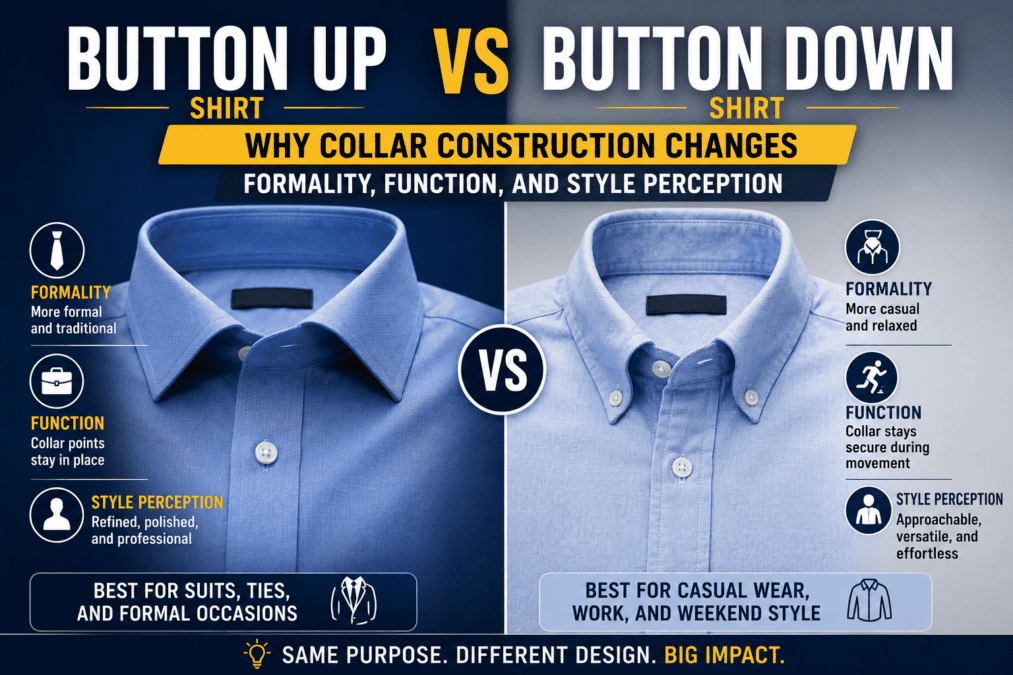

The debate around button up vs button down shirt styling has evolved far beyond simple fashion terminology. In modern menswear and contemporary office culture, these shirts represent two different approaches to structure, versatility, and social signaling. Although many people use the terms interchangeably, they describe distinct shirt categories with separate design origins and practical purposes. Understanding the difference matters because collar construction directly affects how a shirt performs in formal, business, and casual environments.
A proper button up vs button down shirt comparison requires more than identifying visible buttons. The analysis must include collar engineering, historical evolution, dress-code adaptability, fabric behavior, aesthetic psychology, and long-term wardrobe functionality. While both garments share front-button closures, the defining distinction lies in collar architecture and the contextual expectations attached to each design.
The most surprising insight in the button up vs button down shirt discussion is that the button-down collar was originally created for sports practicality rather than fashion elegance. Over time, however, it became associated with American business-casual culture, while traditional button-up shirts without collar buttons retained stronger ties to formalwear. This historical divergence still shapes modern perception, influencing everything from hiring impressions to social dress interpretation.
Understanding The Core Difference
A button-up shirt is any shirt that closes using a vertical row of buttons along the front opening. A button-down shirt is a specific type of button-up shirt featuring collar points fastened to the shirt with buttons.
In a practical button up vs button down shirt comparison, all button-down shirts are technically button-up shirts, while not all button-up shirts are button-downs. That distinction explains why the terminology often creates confusion among consumers and even retail brands.
While a standard button-up shirt prioritizes collar flexibility and formal elegance, a button-down shirt stabilizes the collar through visible fastening points that create a more relaxed visual structure. The difference may appear minor, but it significantly affects silhouette behavior, tie compatibility, and social interpretation.
For most professional environments, the choice between a button up vs button down shirt depends on formality level, movement requirements, and desired style messaging. Traditional button-up shirts generally project sharper refinement, whereas button-down shirts communicate approachable professionalism and relaxed sophistication.
Essential Comparative Metrics
| Attribute | Button-Up Shirt | Button-Down Shirt |
|---|---|---|
| Collar Structure | Free-floating collar | Collar points secured with buttons |
| Formality Level | Higher | Moderate to semi-formal |
| Origin Purpose | Formal tailoring | Sport and polo functionality |
| Tie Compatibility | Excellent | Good but less formal |
| Collar Movement | More flexible | More controlled |
| Business Suit Pairing | Ideal | Acceptable in business-casual settings |
| Wrinkle Visibility | Higher around collar | Lower due to anchored points |
| Style Personality | Sharp and refined | Relaxed and approachable |
| Casual Wear Adaptability | Moderate | Excellent |
| Traditional Dress Codes | Preferred | Less preferred |
Historical Origins And Evolution
The historical background behind the button up vs button down shirt distinction reveals why these garments still carry different cultural meanings today. Traditional button-up shirts emerged from European tailoring traditions centered on aristocratic dress standards. Their collars were designed to remain elegant beneath waistcoats, jackets, and neckwear.
The button-down collar, however, originated from British polo players during the nineteenth century. Riders needed a solution to prevent collar points from flapping during movement. American clothing company Brooks Brothers later adapted the concept for mainstream menswear, transforming a sporting innovation into an iconic business-casual staple.
This divergence created two parallel style identities. In the modern button up vs button down shirt conversation, the button-up shirt retains associations with ceremony, authority, and precision. Meanwhile, the button-down shirt symbolizes adaptability, collegiate culture, and approachable professionalism.
Historical context matters because clothing carries inherited social meanings. Even consumers unfamiliar with tailoring subconsciously interpret collar styles through decades of media, workplace norms, and cultural exposure. That explains why the same suit can appear more formal or relaxed depending solely on collar configuration.
Structural And Biological Foundations
From a garment engineering perspective, the button up vs button down shirt comparison centers on collar mechanics and body interaction. The collar functions as a framing device for the face and neck, influencing both visual balance and perceived posture.
Traditional button-up shirts allow collar points to move naturally with body motion. This flexibility creates softer draping and accommodates structured tie knots more elegantly. However, unrestricted collars are also more susceptible to curling, shifting, and asymmetrical folding during extended wear.
Button-down shirts solve that instability through anchored collar points. The fastening mechanism reduces uncontrolled motion and keeps the collar aligned even during active movement. Biomechanically, this creates a more stable neckline appearance and reduces visual disorder during walking, commuting, or prolonged sitting.
In the button up vs button down shirt debate, collar behavior also affects perceived facial structure. Structured collars visually sharpen jawlines and elongate neck proportions, while softer collars create a more relaxed and approachable appearance. Small structural differences therefore produce measurable changes in social perception and personal presentation.
Fabric Interaction And Performance
Fabric selection dramatically changes outcomes in a button up vs button down shirt analysis. Heavier Oxford cloth fabrics naturally complement button-down collars because the anchored points control bulk and maintain symmetry. This pairing became foundational to Ivy League and American prep aesthetics.
Lighter fabrics such as poplin, twill, and broadcloth generally perform better with traditional button-up collars. These textiles emphasize crispness and allow formal tailoring lines to remain clean beneath jackets and ties. When paired with button-down collars, lightweight fabrics can sometimes appear overly casual or structurally unbalanced.
The button up vs button down shirt distinction also affects wrinkle management. Button-down collars distribute tension more evenly, reducing visible collar distortion throughout the day. Traditional button-up collars, while visually elegant, demand more maintenance and pressing precision to preserve their shape.
Climate considerations matter as well. In warm environments, button-down shirts often maintain cleaner collar positioning during perspiration and movement. Meanwhile, formal button-up shirts excel in climate-controlled professional settings where appearance stability is easier to maintain.
Behavioral Patterns And Social Intelligence
Clothing functions as social communication, making behavioral interpretation central to the button up vs button down shirt discussion. People unconsciously assess competence, authority, creativity, and friendliness based on wardrobe signals, including collar styles.
Traditional button-up shirts typically communicate discipline, hierarchy awareness, and professional seriousness. Because these shirts dominate formal corporate environments, they are often associated with leadership roles, negotiations, and ceremonial occasions. The cleaner collar line reinforces psychological perceptions of precision and control.
Button-down shirts, by contrast, project accessibility and adaptive professionalism. They suggest competence without excessive rigidity. In many creative industries and technology sectors, button-down collars align more closely with collaborative workplace culture and modern management styles.
The button up vs button down shirt distinction becomes especially important during first impressions. Research in consumer psychology consistently shows that subtle clothing cues influence judgments within seconds. Collar design can therefore affect hiring interviews, networking interactions, and client trust formation even when observers cannot consciously identify the technical difference.
Subject A: Strengths And Constraints
Traditional button-up shirts possess several strengths that continue to preserve their relevance in professional and ceremonial wardrobes. Their greatest advantage lies in versatility across formal environments. They pair naturally with structured suits, silk ties, and luxury tailoring, making them indispensable for weddings, executive meetings, legal settings, and upscale events.
Another major strength in the button up vs button down shirt comparison is visual cleanliness. Without visible collar buttons, traditional button-up shirts create uninterrupted lines that appear refined in photographs and professional presentations. This simplicity enhances elegance and timelessness.
However, traditional button-up shirts also present limitations. Their collars require careful maintenance, particularly after laundering. Without reinforcement, collar points may shift or curl during extended wear. The shirts can also feel overly formal in relaxed environments, potentially creating social distance in casual workplaces.
The rigidity associated with formal button-up styling may not align with contemporary business culture in industries emphasizing creativity, innovation, or informality. Consequently, although button-up shirts dominate traditional luxury dress standards, they are not universally optimal in every professional context.
Subject B: Strengths And Constraints
Button-down shirts excel in adaptability and ease of integration into modern lifestyles. Their collar stability makes them practical for commuting, travel, and long workdays. Unlike formal collars that demand constant adjustment, button-down designs retain visual consistency with minimal intervention.
In the broader button up vs button down shirt analysis, button-down shirts also demonstrate superior casual versatility. They pair effectively with chinos, denim, knitwear, and unstructured blazers, allowing wearers to transition between professional and social settings without changing outfits.
Another advantage involves perceived approachability. Button-down collars soften visual intensity, helping wearers appear more collaborative and less intimidating. This characteristic explains their popularity in academic institutions, startups, and business-casual offices.
Despite these strengths, button-down shirts face limitations in high-formality environments. Visible collar buttons inherently reduce ceremonial elegance. When worn with highly structured suits or formal evening attire, button-down collars may appear stylistically inconsistent. Some traditional dress codes explicitly discourage them for black-tie-adjacent occasions and executive-level formalwear.
Therefore, in the button up vs button down shirt comparison, button-down shirts prioritize practicality and adaptability over maximum refinement.
Comparative Advantages In Real-World Scenarios
The practical value of the button up vs button down shirt distinction becomes most visible in everyday application. Different environments reward different collar behaviors and aesthetic signals.
For corporate law, finance, luxury hospitality, and diplomatic settings, traditional button-up shirts remain superior. Their clean collars reinforce institutional professionalism and align with conservative dress expectations. They also photograph better under formal lighting and maintain visual harmony with structured tailoring.
In contrast, button-down shirts dominate hybrid workplaces, creative industries, and business-casual offices. Their adaptability allows professionals to appear polished without seeming excessively formal. This balance has become increasingly valuable in post-pandemic work culture, where rigid dress codes continue to soften.
Travel represents another important scenario in the button up vs button down shirt discussion. Button-down collars resist shifting during movement, making them more resilient during flights, conferences, and long commutes. Traditional button-up shirts, while elegant, often require more frequent adjustment and steaming.
Social events also influence the optimal choice. Formal dinners and ceremonies generally favor traditional button-up shirts, while weekend gatherings, smart-casual dates, and informal networking events often benefit from the relaxed sophistication of button-down styling.
The Psychology Of Collar Perception
One overlooked aspect of the button up vs button down shirt debate involves cognitive perception. Human beings instinctively interpret symmetry, order, and rigidity as indicators of authority and competence. Because collar structures frame the face, they strongly influence these impressions.
Traditional button-up collars create cleaner vertical lines that visually sharpen posture and facial definition. This contributes to impressions of discipline and seriousness. The absence of visible collar buttons also minimizes visual distraction, reinforcing aesthetic simplicity.
Button-down collars introduce softer geometry and more visible detail. These features subtly reduce perceived social distance, making wearers appear approachable and conversational. That psychological effect partially explains why button-down shirts became deeply associated with American collegiate culture and collaborative professional environments.
In the larger button up vs button down shirt analysis, neither perception is universally superior. The effectiveness of each style depends on the social objective. Authority-focused environments may reward sharper formality, while relationship-oriented settings often benefit from approachable elegance.
Global Fashion Interpretations
Different regions interpret the button up vs button down shirt distinction through unique cultural frameworks. In the United States, button-down shirts became foundational to Ivy League fashion and business-casual dress codes. They symbolize relaxed professionalism and accessible sophistication.
European tailoring traditions generally place greater emphasis on formal button-up collars. Italian and British suiting cultures especially favor cleaner collar structures that integrate seamlessly with precise tailoring and luxury fabrics.
Asian business fashion often combines both approaches depending on industry and generational trends. Younger professionals increasingly embrace button-down versatility, while executive leadership environments still favor traditional button-up styling for high-stakes meetings and ceremonial occasions.
These regional differences matter because globalized workplaces frequently blend dress expectations. Understanding the international context of button up vs button down shirt usage helps professionals navigate multicultural business environments more effectively.
Styling Integration With Modern Wardrobes
Wardrobe integration represents a critical dimension of the button up vs button down shirt comparison. The value of a shirt depends not only on isolated aesthetics but also on compatibility with existing clothing systems.
Traditional button-up shirts integrate best with structured wardrobes centered on suits, tailored trousers, dress shoes, and refined accessories. Their clean lines support minimalist sophistication and timeless styling principles.
Button-down shirts thrive within modular wardrobes emphasizing versatility. They combine effectively with denim, knitwear, sneakers, loafers, and unstructured jackets. This flexibility allows fewer garments to create a wider range of outfit combinations.
The button up vs button down shirt choice also affects layering strategies. Button-down collars remain stable beneath sweaters and casual outerwear, reducing collar displacement. Traditional collars, while elegant under suits, can shift unpredictably during layered casual styling.
As wardrobes increasingly prioritize multifunctionality and efficiency, many consumers maintain both shirt categories to address different situational demands.
Scientific And Expert Consensus (2026)
By 2026, menswear experts, image consultants, and workplace-style analysts broadly agree that the button up vs button down shirt debate is not about superiority but contextual optimization. Each shirt category fulfills distinct social and functional roles.
Tailoring specialists consistently recommend traditional button-up shirts for environments requiring maximum formality, visual sharpness, and ceremonial refinement. Their clean collar architecture remains the benchmark for executive dress and luxury tailoring integration.
Conversely, modern style consultants increasingly favor button-down shirts for daily professional wear due to their practicality and adaptive styling range. Workplace culture shifts toward hybrid professionalism have elevated the importance of clothing that balances authority with accessibility.
Consumer behavior research also suggests that versatility increasingly influences purchasing decisions. In the evolving button up vs button down shirt landscape, consumers prioritize garments capable of functioning across multiple social settings rather than serving narrowly defined dress codes.
Experts therefore emphasize strategic wardrobe balance rather than exclusive loyalty to one style category.
Material Quality And Longevity
Long-term performance is another essential factor in the button up vs button down shirt comparison. Construction quality significantly influences durability, collar retention, and overall garment aging.
Traditional button-up shirts often rely heavily on collar interfacing quality. Inferior construction can lead to curling edges, warping, or structural collapse after repeated laundering. High-end tailoring addresses these issues through reinforced stitching and premium interlining materials.
Button-down shirts benefit from additional mechanical support through collar fastening points. This design distributes stress more evenly and helps preserve collar symmetry over time. As a result, mid-range button-down shirts frequently maintain acceptable appearance quality longer than equally priced formal collars.
However, premium versions of both styles can deliver exceptional longevity when properly maintained. In the broader button up vs button down shirt analysis, construction standards ultimately matter more than collar type alone.
Consumers seeking maximum value should therefore evaluate stitching density, fabric composition, collar construction, and button reinforcement rather than focusing exclusively on stylistic labels.
Gender-Neutral And Contemporary Fashion Adaptation
Modern fashion increasingly applies the button up vs button down shirt distinction across gender-neutral styling frameworks. Oversized tailoring, relaxed silhouettes, and fluid wardrobe construction have expanded how these garments function beyond traditional menswear categories.
Button-up shirts without collar buttons often appear in minimalist fashion aesthetics emphasizing clean geometry and refined layering. Their simplicity supports monochromatic styling and architectural silhouettes.
Button-down shirts, meanwhile, contribute to relaxed contemporary fashion through their approachable structure and adaptable layering potential. They integrate especially well into oversized streetwear-inspired styling and casual-professional hybrid wardrobes.
This evolution demonstrates that the button up vs button down shirt conversation now extends beyond traditional dress codes into broader discussions about identity, flexibility, and modern presentation.
Common Misconceptions
One of the most persistent misconceptions in the button up vs button down shirt debate is the belief that the terms are completely interchangeable. Although casual speech frequently treats them as synonyms, their technical definitions remain distinct.
Another misunderstanding involves formality assumptions. Many consumers incorrectly believe button-down shirts are inherently informal. In reality, high-quality button-down shirts can function effectively in numerous professional environments, especially when paired with appropriate tailoring.
Conversely, some assume all traditional button-up shirts are automatically formal. Fabric choice, fit, and styling context can significantly reduce or enhance perceived formality regardless of collar design.
The button up vs button down shirt discussion also suffers from oversimplified internet advice that ignores industry variation. Technology startups, financial firms, creative agencies, and luxury hospitality sectors all interpret dress standards differently. Effective shirt selection therefore depends on contextual awareness rather than rigid universal rules.
Final Synthesis And Verdict
The complete button up vs button down shirt comparison reveals that these garments succeed for different reasons rather than competing for absolute dominance. Traditional button-up shirts excel in precision, formality, and timeless sophistication. They remain unmatched for executive tailoring, ceremonial dress, and environments where authority and refinement carry maximum importance.
Button-down shirts, however, outperform in versatility, practicality, and modern professional adaptability. Their stable collars, approachable aesthetic, and casual compatibility align closely with contemporary lifestyle demands and evolving workplace culture.
Ultimately, the most intelligent wardrobe strategy is not choosing one category exclusively but understanding when each delivers superior functional and social performance. The best-dressed individuals rarely rely on a single style formula. Instead, they align garment structure with environmental expectations and interpersonal goals.
In the enduring button up vs button down shirt debate, the true distinction lies not merely in collar buttons but in how subtle structural decisions shape perception, comfort, and social communication.
Frequently Asked Questions
Is a button-down shirt more casual than a regular button-up shirt?
Generally, yes. In a standard button up vs button down shirt comparison, button-down shirts are perceived as more casual because their collar buttons originated from sportswear design. However, high-quality button-down shirts can still appear highly professional in business-casual and smart-casual settings.
Can you wear a tie with a button-down shirt?
Yes. A button-down shirt can be worn with a tie, especially in business-casual environments. However, traditional button-up shirts without collar buttons usually provide a cleaner and more formal appearance when paired with structured suits and formal neckwear.
Why do people confuse button-up and button-down shirts?
People often confuse the terms because both shirts use front-button closures. Technically, all button-down shirts are button-up shirts, but only button-down shirts include collar buttons that fasten the collar points to the shirt.
Which option is better for office wear?
The best choice depends on workplace culture. In conservative industries, traditional button-up shirts generally perform better. In modern offices with relaxed dress standards, button-down shirts often provide a stronger balance of professionalism and comfort within the broader button up vs button down shirt discussion.