
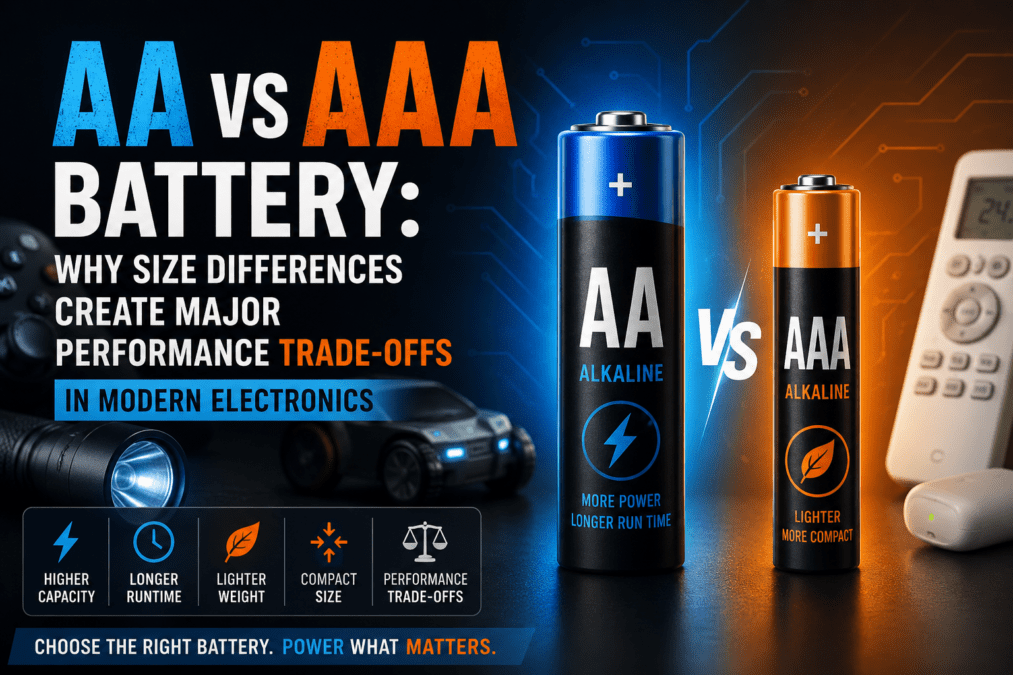

The debate surrounding aa vs aaa battery performance has become increasingly relevant as consumer electronics continue shrinking while demanding more power efficiency. Both battery types remain foundational to portable energy systems, yet their differences extend far beyond physical dimensions. From gaming controllers and digital cameras to wireless mice and smart home accessories, choosing between these two formats affects runtime, voltage stability, heat generation, portability, and long-term operating cost.
A meaningful aa vs aaa battery comparison requires more than examining size alone. Capacity, internal resistance, discharge characteristics, energy density, device compatibility, and manufacturing design all influence real-world outcomes. While both battery types usually provide the same nominal voltage, their ability to sustain high-drain applications differs dramatically under continuous use conditions.
The most surprising insight in the modern aa vs aaa battery discussion is that smaller devices are not always more energy efficient. In many electronics, the reduced capacity of AAA batteries forces more frequent recharge cycles or replacements, which can increase operational cost and environmental impact over time. Meanwhile, AA batteries often outperform expectations because their larger chemistry volume enables more stable power delivery under stress.
Understanding AA And AAA Batteries In Practical Terms
An AA battery is a cylindrical portable power cell designed with larger physical dimensions and greater energy storage capacity than an AAA battery. AAA batteries are thinner and shorter cells engineered primarily for compact electronics where minimizing size and weight matters more than maximizing runtime.
In an aa vs aaa battery comparison, both formats generally provide the same voltage output—typically 1.5 volts for alkaline versions and 1.2 volts for rechargeable NiMH variants—while differing substantially in capacity and sustained power performance. AA batteries usually operate longer and handle higher current demands, while AAA batteries prioritize portability and space efficiency.
When evaluating aa vs aaa battery performance for daily electronics, AA batteries typically deliver superior runtime and better support for high-drain devices such as gaming accessories, portable speakers, and digital cameras. AAA batteries remain advantageous for lightweight electronics like TV remotes, compact sensors, and slim wireless peripherals because their smaller size reduces overall device bulk without significantly affecting low-power operation.
Essential Comparative Metrics
| Attribute | AA Battery | AAA Battery |
|---|---|---|
| Standard Diameter | 14.5 mm | 10.5 mm |
| Standard Length | 50.5 mm | 44.5 mm |
| Average Alkaline Capacity | 1800–3000 mAh | 800–1200 mAh |
| Typical Weight | 23–31 grams | 11–15 grams |
| Voltage (Alkaline) | 1.5V | 1.5V |
| Voltage (Rechargeable NiMH) | 1.2V | 1.2V |
| High-Drain Performance | Strong | Moderate |
| Heat Resistance Under Load | Better | Lower |
| Ideal Device Types | Cameras, controllers, toys | Remotes, compact electronics |
| Average Runtime | Longer | Shorter |
| Portability Advantage | Moderate | Excellent |
| Recharge Cycle Longevity | Often higher | Moderate |
Structural And Electrochemical Foundations
The core distinction in the aa vs aaa battery comparison originates from internal volume allocation. AA batteries contain significantly more active chemical material, allowing them to store larger energy reserves and sustain higher discharge currents. This expanded internal structure reduces stress during high-drain operation and contributes to improved voltage consistency over longer periods.
AAA batteries, while chemically similar, compress the same fundamental electrochemical principles into a smaller shell. Their reduced internal volume limits capacity and increases susceptibility to voltage drop under demanding loads. As devices attempt to draw sustained current, AAA cells may experience faster depletion and greater thermal stress.
The engineering philosophy behind each format reflects intended usage patterns. AA batteries are optimized for endurance and power stability, whereas AAA batteries prioritize compact integration into slim devices. In many modern electronics, manufacturers deliberately choose AAA compatibility to reduce product dimensions, even if it compromises operational duration. This trade-off defines much of the real-world aa vs aaa battery decision-making process consumers encounter daily.
Behavioral Patterns And Energy Delivery Characteristics
Battery behavior changes substantially depending on discharge intensity. In the aa vs aaa battery debate, AA cells generally maintain stable voltage for longer periods because their larger chemical reserve reduces rapid depletion during current spikes. Devices requiring intermittent bursts of energy—such as camera flashes or wireless gaming controllers—benefit from this stability.
AAA batteries behave differently under equivalent stress conditions. Their smaller internal structure causes voltage sag to appear sooner, especially in high-drain applications. While many low-power electronics operate perfectly with AAA batteries, demanding systems may experience reduced responsiveness or shorter usable runtime before voltage falls below operational thresholds.
Temperature response also differs between formats. AA batteries usually tolerate heavier loads with less heat accumulation, while AAA cells can warm more quickly during intensive discharge cycles. Heat buildup accelerates chemical degradation and may shorten long-term lifespan in rechargeable variants.
Interestingly, modern low-power chipsets have narrowed some historical differences in the aa vs aaa battery conversation. Efficient Bluetooth peripherals, LED lighting systems, and energy-optimized sensors now allow AAA batteries to operate effectively in roles previously dominated by AA formats. Nevertheless, high-energy applications still reveal clear structural limitations inherent to smaller cells.
Manufacturing Evolution And Battery Chemistry Trends
The modern aa vs aaa battery market has evolved far beyond simple alkaline technology. Manufacturers now produce lithium, nickel-metal hydride (NiMH), and hybrid rechargeable variants designed for increasingly specialized electronics. These chemistry innovations have altered performance expectations and consumer buying patterns.
AA lithium batteries have become particularly popular in extreme-temperature environments because they maintain voltage stability better than alkaline alternatives. They also offer significantly longer shelf life, making them valuable for emergency equipment and backup devices. AAA lithium variants provide similar advantages but remain constrained by smaller energy capacity.
Rechargeable technology has transformed the aa vs aaa battery ecosystem even more dramatically. High-capacity AA NiMH cells can exceed 2500 mAh, enabling performance levels suitable for professional photography equipment, audio devices, and heavy-use electronics. AAA rechargeables, while effective for moderate-drain devices, generally cannot sustain comparable endurance under continuous load.
Another major development involves leakage prevention engineering. Earlier alkaline batteries often failed due to internal corrosion and electrolyte leakage. Modern manufacturing improvements have reduced these issues considerably, though AAA cells remain somewhat more vulnerable because tighter internal spacing increases chemical stress concentration during prolonged storage.
Subject A: Strengths And Constraints Of AA Batteries
AA batteries dominate many portable power applications because they balance energy density, durability, and accessibility exceptionally well. In the broader aa vs aaa battery comparison, AA cells consistently excel in runtime-sensitive scenarios. Their larger internal chemistry reservoir supports prolonged operation in devices with motors, wireless transmitters, speakers, and displays.
One major advantage involves high-drain resilience. AA batteries sustain stronger current output without rapid voltage collapse, making them suitable for digital cameras, portable gaming accessories, flashlights, and battery-powered toys. Rechargeable AA batteries also tend to achieve longer service lives because larger cells distribute chemical stress more effectively across charge cycles.
However, AA batteries introduce trade-offs. Their increased size adds bulk and weight, limiting their usefulness in ultra-compact devices. Product designers seeking minimalist form factors often avoid AA integration because battery compartments require more internal space.
Another limitation involves portability efficiency. While AA batteries deliver better endurance, they reduce ergonomic flexibility in slim electronics such as stylus pens, compact remote controls, and wearable accessories. In these situations, AAA formats often provide a better balance between usability and physical design.
Still, from a purely performance-oriented perspective, AA batteries generally outperform AAA batteries across most demanding operational conditions.
Subject B: Strengths And Constraints Of AAA Batteries
AAA batteries succeed because modern electronics increasingly prioritize miniaturization. In the continuing aa vs aaa battery discussion, AAA cells represent the engineering preference for compact portability over raw energy capacity. Their smaller dimensions enable thinner remote controls, lightweight wireless keyboards, digital thermometers, and compact medical devices.
Low Fantasy vs High Fantasy: Why World Structure Determines Emotional Realism and Mythic Scale
A major strength of AAA batteries is ergonomic efficiency. Devices powered by AAA cells often feel lighter, easier to carry, and more visually streamlined. For low-drain applications operating intermittently, AAA batteries can deliver surprisingly long practical lifespans despite reduced capacity.
Another advantage involves reduced manufacturing weight in consumer electronics. Companies designing portable accessories frequently choose AAA compatibility because lower mass improves user comfort and decreases shipping costs at scale.
Yet the limitations remain significant. AAA batteries struggle under heavy current demands and typically require more frequent replacement in active-use devices. In the aa vs aaa battery performance hierarchy, AAA cells rarely compete effectively with AA batteries in sustained power delivery.
Rechargeable AAA batteries also tend to experience more noticeable degradation under repeated high-drain cycles. Because less chemical material exists inside each cell, repeated stress can accelerate capacity loss over time. Consequently, while AAA batteries excel in compact low-power electronics, they are less suitable for demanding continuous-use applications.
Comparative Advantages In Real-World Scenarios
The practical outcome of the aa vs aaa battery comparison depends heavily on device behavior rather than theoretical specifications alone. In gaming controllers, AA batteries usually outperform AAA batteries because wireless connectivity and vibration motors require sustained current stability. Users often experience noticeably longer play sessions before recharge or replacement becomes necessary.
Remote controls present the opposite scenario. These devices consume minimal energy during standby periods and brief signal transmissions, allowing AAA batteries to function efficiently for months or even years. Here, the smaller form factor becomes a more valuable attribute than additional capacity.
Portable audio equipment creates another interesting distinction. Bluetooth speakers powered by AA batteries generally maintain louder output and longer playback duration. AAA-powered speakers, while lighter and more compact, may reduce volume consistency as battery levels decline.
In emergency preparedness kits, AA batteries typically offer broader compatibility with flashlights, radios, and survival equipment. Their higher capacity also reduces the number of spare cells required during extended outages.
Medical devices reveal perhaps the most nuanced aa vs aaa battery relationship. Compact diagnostic tools often depend on AAA batteries for portability, while critical high-reliability systems favor AA cells for stable operation and reduced maintenance frequency.
Environmental And Economic Considerations
The environmental dimension of the aa vs aaa battery conversation extends beyond disposal volume alone. Because AA batteries generally last longer per cycle, fewer units may be consumed over equivalent operational periods. This can reduce packaging waste, transportation emissions, and manufacturing demand over time.
However, AAA batteries contribute to smaller material usage per individual unit. Their lighter construction requires fewer raw resources, potentially lowering environmental impact during production. The sustainability balance therefore depends largely on usage frequency and device efficiency.
Rechargeable technology substantially changes this equation. High-quality rechargeable AA batteries can replace hundreds of disposable cells during their lifespan, dramatically reducing waste generation. Rechargeable AAA batteries offer similar environmental benefits, though their shorter runtime may increase charging frequency and energy consumption.
Economically, the aa vs aaa battery comparison also varies by application. AA batteries often deliver lower cost-per-hour operation because their larger capacity extends replacement intervals. AAA batteries may appear cheaper individually, but frequent replacement in power-hungry electronics can increase long-term expenses.
Consumers increasingly evaluate batteries based not only on purchase price but also on reliability, recharge longevity, and compatibility across multiple devices. This broader ownership perspective has strengthened demand for premium rechargeable systems in both formats.
Why Voltage Similarity Does Not Mean Equal Performance
One of the most misunderstood aspects of the aa vs aaa battery comparison is the assumption that identical voltage ratings indicate equivalent power capability. Both AA and AAA alkaline batteries usually provide 1.5 volts, yet their practical behavior differs substantially because voltage alone does not determine energy availability.
Capacity, measured in milliamp-hours, represents the total charge a battery can deliver over time. AA batteries store considerably more charge than AAA batteries due to their larger chemical volume. As a result, devices drawing identical current loads will typically operate far longer using AA cells.
Internal resistance also plays a crucial role. AAA batteries generally exhibit higher resistance relative to their size, causing greater voltage drop during high-current demands. This means a device may stop functioning properly even when theoretical charge remains inside the cell.
The misconception persists because consumers often equate voltage with strength. In reality, the aa vs aaa battery difference reflects endurance and current sustainability more than raw voltage output. Understanding this distinction helps explain why two batteries with identical voltage ratings can produce dramatically different real-world experiences.
Device Engineering And Manufacturer Design Choices
Manufacturers do not select battery formats randomly. In the aa vs aaa battery landscape, engineering decisions reflect intended user behavior, cost targets, product dimensions, and energy requirements. Every battery compartment represents a compromise between runtime, portability, and design efficiency.
Devices intended for continuous or intensive use frequently adopt AA batteries because larger cells reduce customer frustration associated with frequent replacements. Wireless gaming controllers, high-output flashlights, and portable radios commonly use AA formats for this reason.
AAA batteries dominate products emphasizing slim aesthetics and lightweight handling. Television remotes, wireless presentation clickers, compact keyboards, and grooming devices often prioritize reduced bulk over extended runtime.
Modern electronics design has also introduced hybrid optimization strategies. Some manufacturers improve efficiency through advanced chipsets and power management systems, enabling AAA batteries to achieve surprisingly long operational periods. Others deliberately engineer around AA batteries to market superior endurance as a premium feature.
The aa vs aaa battery decision therefore reflects broader industrial design philosophy. Products emphasizing power consistency tend toward AA integration, while products prioritizing compact ergonomics usually favor AAA compatibility.
Scientific And Expert Consensus (2026)
Current engineering consensus suggests that AA batteries remain the superior option for high-drain and long-duration applications, while AAA batteries excel in compact, low-energy electronics. Most laboratory discharge analyses continue demonstrating that AA cells sustain voltage stability more effectively under demanding current loads.
Battery researchers increasingly emphasize efficiency matching rather than declaring one format universally superior. The modern aa vs aaa battery framework focuses on application optimization. Oversized batteries in low-drain devices may waste space unnecessarily, while undersized batteries in high-drain electronics compromise user experience.
Experts also note that rechargeable adoption continues accelerating due to environmental regulations and consumer cost awareness. High-quality NiMH AA batteries consistently receive strong recommendations for heavy-use devices because their cycle longevity offsets higher upfront cost. Rechargeable AAA batteries remain effective for moderate-demand electronics but generally require more attentive charging management.
Another emerging consensus involves device power optimization. As electronics become more energy efficient, the performance gap between AA and AAA batteries narrows in some categories. Nevertheless, physics still favors larger cells for sustained energy delivery, meaning AA batteries retain clear advantages where endurance and reliability matter most.
The Psychological Factor Behind Consumer Battery Preferences
Consumer behavior introduces an overlooked dimension to the aa vs aaa battery discussion. Many buyers unconsciously associate larger batteries with reliability and smaller batteries with convenience. These assumptions influence purchasing habits even when technical realities vary by device category.
AA batteries often create a perception of durability and long-term performance. Consumers using them in cameras, toys, or emergency flashlights develop confidence from fewer interruptions and longer operational cycles. This psychological reinforcement strengthens loyalty toward AA-powered devices.
AAA batteries generate a different type of satisfaction centered on portability and elegance. Slim remotes, lightweight wireless accessories, and compact gadgets feel modern partly because AAA batteries enable refined industrial design. Users may tolerate more frequent replacement because convenience and aesthetics outweigh endurance concerns.
Marketing strategies reinforce these perceptions. Manufacturers frequently position AA-powered products as “high-performance” or “professional-grade,” while AAA-powered electronics emphasize portability and minimalist styling.
The result is that the aa vs aaa battery choice becomes partially emotional rather than purely technical. Consumers often select devices based on how battery format aligns with expectations surrounding reliability, comfort, and usability.
Final Synthesis And Verdict
The broader aa vs aaa battery comparison ultimately reveals a fundamental engineering truth: battery design is always a compromise between power capacity and physical efficiency. AA batteries dominate where endurance, current stability, and high-drain reliability matter most. AAA batteries succeed where compactness, lightweight construction, and ergonomic convenience take priority.
Neither format universally replaces the other because each serves distinct operational purposes. AA batteries consistently provide better runtime, stronger performance under load, and greater suitability for demanding electronics. AAA batteries, meanwhile, remain indispensable for compact consumer devices where minimizing size outweighs maximizing energy storage.
The most important insight is that voltage similarity can mislead consumers into assuming equal capability. In reality, the larger physical structure of AA batteries creates substantial advantages in energy delivery and sustained performance. Yet those same dimensions can become disadvantages in devices optimized for portability.
For most high-usage applications, the evidence favors AA batteries. For lightweight, low-drain electronics, AAA batteries remain highly practical and efficient. The modern aa vs aaa battery debate is therefore not about identifying a universal winner, but understanding which design philosophy aligns best with specific real-world demands.
Frequently Asked Questions
Is AA battery better than AAA battery?
In most high-drain applications, AA batteries perform better because they store more energy and sustain voltage more effectively under load. However, AAA batteries are better for compact electronics where portability and reduced size matter more than runtime.
Why do AA and AAA batteries have the same voltage?
Both battery types are designed around similar electrochemical systems, which produce the same nominal voltage. The main difference in the aa vs aaa battery comparison is capacity and current delivery, not voltage output.
Can I replace AA batteries with AAA batteries?
Not directly. AA and AAA batteries differ in physical dimensions and capacity. Some adapters allow AAA batteries to fit AA compartments, but performance usually declines because AAA cells cannot deliver equivalent runtime or sustained current.
Which lasts longer in everyday electronics?
AA batteries generally last longer because they contain more active chemical material. In the aa vs aaa battery comparison, AA cells consistently provide greater operational duration in devices with moderate to high power demands.
Are rechargeable AA batteries better than rechargeable AAA batteries?
Rechargeable AA batteries usually offer higher capacity, better endurance, and improved high-drain performance. Rechargeable AAA batteries remain useful for compact devices but often require more frequent charging cycles under continuous use conditions.