
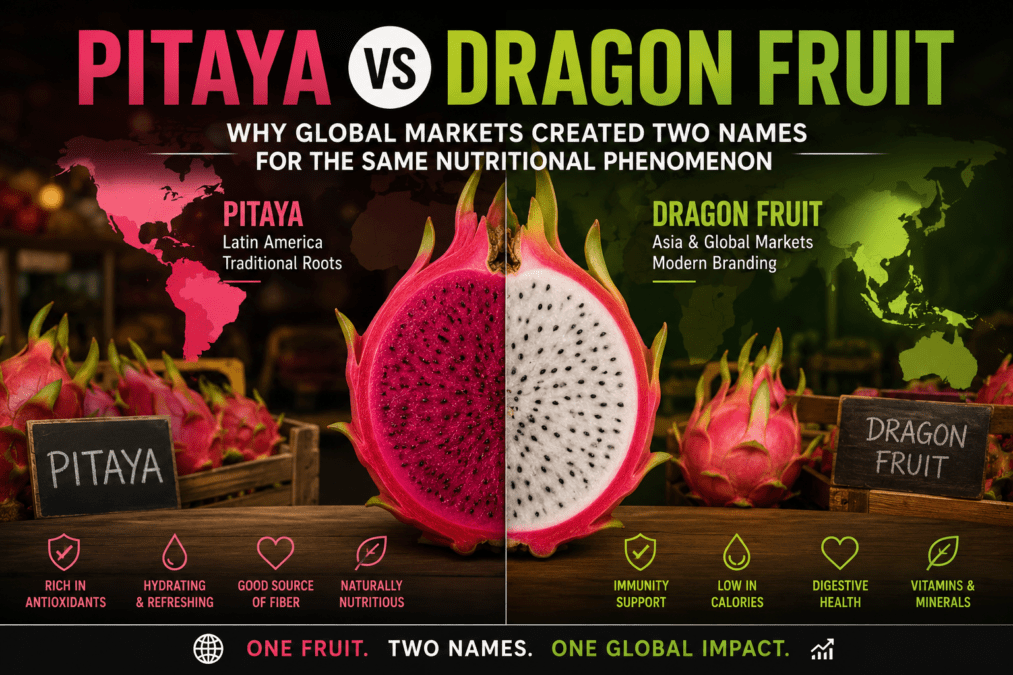

The phrase pitaya vs dragon fruit often creates confusion because many consumers assume the two terms describe completely different fruits. In reality, both names are commonly used for fruits from the Hylocereus and Selenicereus cactus genera, though regional usage, species classification, and commercial branding have created subtle distinctions over time. What began as a botanical classification issue eventually evolved into a global marketing phenomenon shaped by agriculture, export economics, and culinary culture.
A proper pitaya vs dragon fruit comparison requires more than simple naming clarification. The analysis must examine botanical origins, nutritional composition, farming practices, commercial distribution, flavor chemistry, consumer psychology, and health research. In some countries, “pitaya” refers specifically to traditional Latin American varieties, while “dragon fruit” became the dominant international retail label due to its visual appeal and marketability.
The surprising insight in the pitaya vs dragon fruit debate is that the difference is often linguistic and cultural rather than biological. While many consumers search for major nutritional or structural differences, the real distinction lies in regional terminology, cultivar selection, and how the fruit is positioned in modern health-food markets. Understanding this distinction explains why the same fruit can occupy different cultural identities across continents.
Essential Comparative Metrics
| Attribute | Pitaya | Dragon Fruit |
|---|---|---|
| Primary Meaning | Traditional Spanish-derived term | Commercial English-market term |
| Botanical Family | Cactaceae | |
| Main Species | Selenicereus undatus, S. costaricensis | Selenicereus undatus, S. megalanthus |
| Origin Regions | Central and South America | Global tropical cultivation |
| Typical Flesh Colors | White, red, magenta | White, red, yellow |
| Flavor Profile | Subtle sweetness with floral notes | Mild sweetness marketed as exotic |
| Texture | Soft, seed-speckled pulp | Kiwi-like texture |
| Global Market Identity | Regional authenticity | Premium wellness branding |
| Common Culinary Use | Juices, fresh fruit, desserts | Smoothie bowls, retail produce |
| Export Dominance | Latin American markets | Asia-Pacific export markets |
Structural And Biological Foundations
The biological discussion behind pitaya vs dragon fruit begins with taxonomy. Both names generally refer to climbing cactus fruits belonging to the Cactaceae family. These plants evolved in arid and semi-arid environments where water retention and nighttime pollination became essential survival mechanisms. Unlike many tropical fruits, pitaya plants use specialized stems instead of traditional leaves for photosynthesis.
Pitaya is technically a cactus fruit characterized by thick skin, fleshy pulp, and numerous edible black seeds. Dragon fruit is the commercial term widely used in English-speaking markets for the same fruit categories. While the names overlap significantly, agricultural producers occasionally distinguish between regional cultivars. Yellow-skinned varieties, for example, are often marketed differently from red-skinned export types.
The pitaya vs dragon fruit distinction becomes more complex when examining cultivation genetics. Hybridization programs in Vietnam, Israel, Mexico, Colombia, and Thailand have produced dozens of commercially viable cultivars with varying sugar levels, acidity profiles, and pigment concentrations. These variations influence shelf life, export durability, and antioxidant content far more than the name itself.
Another important biological factor is pollination. Some pitaya varieties are self-pollinating, while others require cross-pollination or nocturnal pollinators like bats and moths. This reproductive diversity affects agricultural efficiency and explains why certain cultivars dominate commercial production.
Behavioral Patterns And Social Intelligence
Although fruits do not possess intelligence in the traditional sense, the pitaya vs dragon fruit conversation reveals fascinating patterns in consumer behavior and agricultural adaptation. Global food markets often reshape natural products according to psychological appeal rather than botanical accuracy. “Dragon fruit” became commercially successful partly because the name evokes rarity, fantasy, and exoticism.
Consumer purchasing behavior strongly favors visually distinctive produce. The bright pink skin and green-tipped scales associated with dragon fruit generate higher social media engagement and premium pricing compared with more traditionally named tropical fruits. In modern retail environments, aesthetic identity influences consumer decisions almost as much as nutritional value.
The pitaya vs dragon fruit branding divide also reflects regional cultural identity. In Latin America, “pitaya” carries historical and indigenous agricultural associations. The term connects directly to traditional cultivation systems and local food heritage. In contrast, “dragon fruit” emerged as a globally exportable identity designed for international supermarkets and wellness industries.
Modern food culture intensified this distinction through smoothie bowls, plant-based diets, and wellness marketing. Dragon fruit became associated with detox programs, antioxidant beverages, and visually vibrant culinary trends. Social media platforms accelerated this transformation by rewarding visually striking foods with higher engagement rates.
This evolution demonstrates how agricultural commodities increasingly function as cultural symbols. The pitaya vs dragon fruit discussion therefore extends beyond biology into branding psychology, globalization, and digital consumer culture.
Nutritional Composition And Metabolic Value
One of the most searched aspects of pitaya vs dragon fruit concerns nutritional differences. Scientifically, nutritional variation depends more on cultivar color and growing conditions than on the actual name used. Both forms are generally low in calories and rich in hydration, fiber, vitamin C, magnesium, and plant antioxidants.
Red-fleshed varieties contain betalains, pigments associated with antioxidant activity and cellular protection. White-fleshed varieties usually contain lower pigment concentrations but maintain similar hydration and fiber levels. Yellow pitaya often contains slightly higher natural sugar concentrations and a more intense sweetness profile.
The pitaya vs dragon fruit nutritional debate is particularly relevant in digestive health research. The fruit contains prebiotic fiber compounds that may support beneficial gut bacteria. The edible seeds also provide small amounts of omega fatty acids, contributing modest cardiovascular benefits.
While pitaya is traditionally consumed fresh in local markets, dragon fruit is frequently incorporated into commercial health products, protein blends, and functional beverages. This commercial integration helped elevate its reputation as a “superfruit,” though many health claims exceed current scientific evidence.
A direct answer to a common question is important here: Pitaya and dragon fruit are usually the same fruit, but nutritional differences can emerge between specific cultivars based on flesh color, sugar concentration, antioxidant levels, and farming conditions rather than the terminology itself. Red-fleshed varieties generally contain more antioxidant pigments, while yellow varieties often have higher sweetness levels.
The fruit’s relatively low glycemic load also contributes to its popularity among health-conscious consumers seeking alternatives to higher-sugar tropical fruits.
Flavor Chemistry And Sensory Experience
The sensory dimension of pitaya vs dragon fruit reveals why the fruit generates mixed consumer reactions. Many first-time buyers expect intensely tropical sweetness because of the dramatic appearance. Instead, the flavor is often subtle, mildly floral, and lightly refreshing.
Flavor chemistry studies show that pitaya contains relatively delicate aromatic compounds compared with fruits like mango, pineapple, or passion fruit. This mildness explains why some consumers describe dragon fruit as “beautiful but bland,” while others appreciate its clean and hydrating profile.
Texture plays an equally important role in the pitaya vs dragon fruit experience. The pulp resembles a softer kiwi texture with evenly distributed seeds that provide slight crunch without disrupting smoothness. This texture makes the fruit versatile for smoothies, chilled desserts, fruit salads, and frozen products.
Temperature significantly affects flavor perception. Refrigerated dragon fruit often tastes sweeter and more refreshing because cooling enhances textural crispness while reducing muted vegetal notes. Ripeness also matters enormously. Under-ripe fruit can taste watery and neutral, whereas properly ripened fruit develops more floral sweetness.
Color psychology further shapes sensory perception. Consumers frequently perceive red-fleshed dragon fruit as sweeter even when sugar measurements are nearly identical to white-fleshed varieties. Visual expectation strongly influences taste interpretation.
The pitaya vs dragon fruit discussion therefore demonstrates how flavor perception combines chemistry, texture, visual cues, and marketing expectations into a unified sensory experience.
Agricultural Production And Environmental Adaptation
The agricultural side of pitaya vs dragon fruit reveals why the crop expanded rapidly in global tropical farming systems. Pitaya cactus plants are highly adaptable, drought-resistant, and capable of producing fruit in environments unsuitable for many conventional crops.
Vietnam emerged as one of the world’s largest exporters after recognizing the fruit’s international commercial potential. Intensive cultivation methods, artificial lighting systems, and export-focused logistics transformed dragon fruit into a major agricultural commodity. Similar expansion occurred in Thailand, Israel, Colombia, Ecuador, and Mexico.
Unlike water-intensive fruit crops, pitaya plants require comparatively moderate irrigation once established. This resilience makes them attractive in regions facing climate instability and water scarcity. However, commercial-scale production still demands careful nutrient management, pruning systems, and disease monitoring.
The pitaya vs dragon fruit agricultural distinction also reflects different farming philosophies. Traditional pitaya cultivation in Latin America often uses smaller-scale diversified farming systems integrated with local ecosystems. Modern dragon fruit export operations tend to emphasize standardized appearance, yield optimization, and transport durability.
Climate adaptation remains one of the crop’s greatest strengths. Pitaya tolerates heat effectively, though excessive humidity can increase fungal disease risk. The plant’s climbing growth habit additionally allows vertical farming systems that maximize land efficiency.
As climate pressures intensify globally, researchers increasingly study pitaya as a sustainable future crop capable of supporting food diversification in warming agricultural zones.
Subject A: Strengths And Constraints
In the pitaya vs dragon fruit comparison, pitaya as the traditional identity offers several important strengths. The term preserves historical continuity with indigenous cultivation and Latin American agricultural heritage. This authenticity appeals strongly to consumers seeking culturally rooted foods rather than heavily commercialized wellness products.
Pitaya varieties often display greater diversity in local farming systems because regional producers maintain heirloom cultivars less influenced by export standardization. These traditional varieties may possess distinctive flavor nuances, unique pigmentation, or improved adaptation to local climates.
Another advantage involves biodiversity preservation. Smaller-scale pitaya farming frequently supports mixed agricultural ecosystems rather than monoculture export fields. This diversity can improve pollinator activity and reduce ecological vulnerability.
However, pitaya also faces limitations. The terminology lacks universal recognition in many English-speaking consumer markets. International buyers frequently understand “dragon fruit” immediately while remaining unfamiliar with “pitaya.” This branding gap reduces global retail visibility.
The pitaya vs dragon fruit market divide also affects pricing and scalability. Products labeled as dragon fruit often achieve stronger premium positioning in wellness-oriented markets. Pitaya branding, while authentic, may struggle to generate equivalent mass-market excitement outside regions where the term already carries cultural familiarity.
In practical commercial terms, pitaya’s greatest strength is authenticity, while its greatest constraint is inconsistent global recognition.
Subject B: Strengths And Constraints
Dragon fruit possesses exceptional global marketing power within the pitaya vs dragon fruit comparison. The name itself creates immediate visual and emotional impact. Associating the fruit with dragons enhances perceptions of rarity, vibrancy, and exotic appeal.
This branding success dramatically accelerated international market penetration. Dragon fruit became a staple in smoothie chains, luxury grocery stores, and wellness branding campaigns partly because the terminology was memorable and commercially adaptable.
Another major strength involves visual marketing compatibility. The fruit’s bright pigmentation and striking appearance perform exceptionally well in digital food photography and social media content. Modern consumer culture rewards foods that are visually distinctive, and dragon fruit benefits heavily from this dynamic.
Commercial dragon fruit systems also support standardized exports. Uniform appearance, packaging consistency, and supply-chain efficiency allow producers to scale production for international distribution networks.
Yet the pitaya vs dragon fruit comparison also reveals constraints on the dragon fruit side. Commercialization occasionally creates unrealistic consumer expectations regarding flavor intensity or health benefits. Some buyers anticipate dramatic sweetness or transformational wellness effects that the fruit cannot consistently deliver.
Mass-market production may additionally prioritize shelf life and appearance over flavor complexity. Standardized export cultivars can sometimes taste milder than locally grown traditional varieties.
Thus, dragon fruit’s greatest strength is global branding power, while its greatest limitation is the risk of aesthetic marketing overshadowing actual sensory experience.
Comparative Advantages In Real-World Scenarios
The practical side of pitaya vs dragon fruit depends largely on context. In culinary authenticity and traditional regional cuisine, pitaya terminology generally offers stronger cultural accuracy. Latin American chefs and agricultural historians often prefer the original naming structure because it preserves botanical heritage and regional identity.
In international retail and wellness marketing, dragon fruit clearly dominates. The term performs better in consumer recall studies, supermarket branding, and export promotion campaigns. For businesses targeting premium health-food audiences, dragon fruit provides superior commercial positioning.
Nutritionally, the pitaya vs dragon fruit distinction matters far less than cultivar selection. Red-fleshed varieties typically outperform white-fleshed varieties in antioxidant density regardless of naming convention. Yellow varieties frequently provide superior sweetness and aromatic intensity.
For sustainable agriculture, pitaya cultivation offers important climate resilience advantages. The cactus-based growth system supports lower water dependency compared with many tropical fruits. This characteristic may become increasingly valuable in future agricultural planning.
From a culinary standpoint, dragon fruit excels visually in plated desserts, smoothie bowls, and frozen beverages because of its dramatic coloration. Pitaya, particularly local heirloom varieties, may offer more nuanced flavor experiences in fresh consumption settings.
A useful comparison sentence clarifies the issue directly: While pitaya emphasizes botanical heritage and regional authenticity, dragon fruit emphasizes commercial identity and global consumer appeal.
Ultimately, the pitaya vs dragon fruit discussion demonstrates that context determines which terminology and cultivation approach delivers the greatest advantage.
Scientific And Expert Consensus (2026)
Scientific consensus surrounding pitaya vs dragon fruit has become increasingly clear by 2026. Most botanists agree that the terms largely overlap and usually describe the same fruit family. The distinction is primarily linguistic, regional, and commercial rather than biologically absolute.
Nutritional researchers continue studying betalain pigments found in red-fleshed cultivars because of potential antioxidant and anti-inflammatory properties. Early findings remain promising, though experts caution against exaggerated “superfood” claims unsupported by long-term clinical evidence.
Agricultural scientists increasingly value pitaya crops for climate adaptability. Their drought tolerance, vertical growth capability, and relatively low resource demands position them as important future crops in regions facing environmental instability.
The pitaya vs dragon fruit discussion also appears frequently in food anthropology research. Scholars note how naming conventions influence consumer psychology and global trade patterns. Dragon fruit became commercially dominant partly because English-language markets favored imaginative branding over taxonomic precision.
Food industry experts further acknowledge that visual marketing transformed dragon fruit into a digitally optimized produce category. Bright pigmentation and unusual morphology generate unusually high engagement in online culinary media.
Importantly, scientific consensus does not support major nutritional differences solely based on terminology. Experts consistently emphasize cultivar variation, ripeness, and farming conditions as the real determinants of quality and nutrient composition.
By 2026, the prevailing expert position is straightforward: pitaya and dragon fruit are functionally overlapping terms shaped more by culture and commerce than by fundamental biological separation.
Economic Influence And Global Trade Expansion
The global economic dimension of pitaya vs dragon fruit reveals how rapidly niche agricultural products can become international commodities. Over the past two decades, dragon fruit transformed from a relatively regional crop into a premium export category serving supermarkets, beverage companies, and wellness brands worldwide.
Vietnam’s production expansion dramatically reshaped the market. Through intensive cultivation systems and export-oriented logistics, the country established itself as a dominant supplier to Asia, Europe, and North America. Other nations responded by increasing production capacity to compete in growing health-food sectors.
The pitaya vs dragon fruit terminology difference also affects trade positioning. Products marketed as dragon fruit generally command stronger recognition in English-speaking retail environments, allowing exporters to justify premium pricing strategies. In contrast, pitaya labeling often performs better in specialty food markets emphasizing authenticity and regional heritage.
International demand additionally stimulated value-added product development. Freeze-dried powders, antioxidant beverages, cosmetic ingredients, natural food colorants, and frozen puree products all emerged from the expanding commercial ecosystem surrounding dragon fruit branding.
However, rapid market growth introduced challenges. Oversupply periods occasionally reduced profitability for farmers, especially when production increased faster than consumer demand. Disease outbreaks and transportation disruptions also exposed vulnerabilities in highly export-dependent supply chains.
The pitaya vs dragon fruit economic story therefore illustrates a broader agricultural trend: modern food products increasingly derive value not only from nutritional utility but also from branding narratives, visual identity, and consumer lifestyle associations.
Culinary Applications And Gastronomic Evolution
The culinary evolution of pitaya vs dragon fruit demonstrates how chefs and food industries reinterpret ingredients for different audiences. Traditionally, pitaya was consumed fresh, juiced, or incorporated into simple regional desserts across parts of Central and South America.
Modern gastronomy transformed dragon fruit into a visually strategic ingredient. Its bright magenta pigments and striking contrast patterns made it especially attractive for high-end dessert plating, smoothie culture, and social-media-driven food presentation. Restaurants and wellness cafes frequently use dragon fruit less for flavor dominance and more for aesthetic enhancement.
In savory applications, the fruit’s mild sweetness allows versatility. Chefs incorporate pitaya into salads, ceviche accompaniments, chilled soups, and fruit salsas because its flavor profile does not overpower stronger ingredients. This subtlety creates balance in fusion cuisine.
The pitaya vs dragon fruit distinction also appears in beverage innovation. Dragon fruit has become a major ingredient in functional drinks, kombucha blends, mocktails, and hydration-focused products. The fruit’s vibrant color naturally enhances visual appeal without requiring synthetic additives.
Frozen desserts represent another rapidly expanding category. Dragon fruit sorbets and pitaya smoothie bases became commercially successful because the fruit maintains appealing pigmentation after freezing.
Importantly, culinary professionals increasingly recognize that flavor quality depends heavily on ripeness and cultivar selection. A properly ripened red-fleshed pitaya can deliver nuanced sweetness and floral complexity that contradict the fruit’s reputation for blandness.
This gastronomic evolution shows how the pitaya vs dragon fruit conversation extends beyond agriculture into aesthetics, presentation strategy, and modern food culture.
Consumer Psychology And Branding Influence
One of the most revealing aspects of pitaya vs dragon fruit involves consumer psychology. Food branding significantly shapes expectations, and few fruits illustrate this better than dragon fruit.
The word “dragon” instantly creates associations with mythology, rarity, and intensity. Consumers subconsciously anticipate something powerful, unusual, or dramatically flavorful before even tasting the fruit. This psychological priming helps explain why dragon fruit achieved such rapid visibility in premium grocery markets.
By contrast, “pitaya” feels more regionally grounded and less commercially engineered. The term appeals to consumers interested in authenticity, traditional agriculture, and Latin American culinary heritage. Thus, the pitaya vs dragon fruit divide reflects two separate branding strategies targeting different emotional responses.
Color psychology intensifies these effects. Red-fleshed dragon fruit appears more nutritionally potent because deep pigmentation is commonly associated with antioxidants and health benefits. Even when nutritional differences are moderate, consumers frequently perceive brighter fruits as healthier and sweeter.
Social media accelerated this phenomenon dramatically. Foods with visually striking colors and textures generate disproportionate engagement online. Dragon fruit smoothie bowls became iconic partly because they photograph exceptionally well under modern digital aesthetics.
Interestingly, sensory studies suggest that expectation can alter perceived taste intensity. Consumers often rate “dragon fruit” samples as more exotic or flavorful than identical samples labeled differently.
The pitaya vs dragon fruit comparison therefore reveals a central truth of modern food culture: naming and presentation influence perception nearly as much as biological reality.
Health Research And Functional Food Potential
Health research surrounding pitaya vs dragon fruit continues expanding because of growing interest in functional foods. Scientists have focused especially on antioxidant compounds, fiber content, and metabolic health implications associated with different cultivars.
Red-fleshed varieties attract the most attention due to betalains, pigments also found in beets. These compounds may help combat oxidative stress and inflammation, though researchers emphasize that human clinical evidence remains limited compared with laboratory findings.
The fiber profile in pitaya contributes to digestive health by supporting gut microbiota diversity. Some studies suggest that regular consumption may improve bowel regularity and support beneficial bacterial populations. This prebiotic potential has become central to dragon fruit marketing campaigns.
Hydration is another underappreciated advantage in the pitaya vs dragon fruit discussion. The fruit contains high water content combined with electrolytes and modest mineral levels, making it attractive in sports nutrition and recovery beverages.
Researchers are also studying seed oils extracted from pitaya because they contain small quantities of essential fatty acids. While concentrations are relatively low compared with nuts or seeds specifically grown for oil production, the presence still contributes nutritional diversity.
Importantly, health experts consistently warn against exaggerated claims. Dragon fruit is nutritious, but it is not a miracle cure or uniquely transformative superfood. Balanced dietary patterns matter far more than individual ingredients.
The emerging consensus in pitaya vs dragon fruit research is that the fruit offers legitimate nutritional benefits, particularly in hydration, fiber intake, and antioxidant support, but should be understood within realistic scientific boundaries.
Final Synthesis And Verdict
The deeper analysis of pitaya vs dragon fruit reveals that the debate is less about biological opposition and more about cultural framing, agricultural globalization, and commercial identity. In most cases, the two names refer to the same cactus fruit family, yet each term carries a distinct historical and psychological meaning.
Pitaya represents heritage, regional authenticity, and traditional agricultural identity rooted in Latin American history. Dragon fruit represents globalization, branding innovation, and modern wellness marketing optimized for international audiences. The fruit itself bridges both worlds simultaneously.
From a nutritional standpoint, the pitaya vs dragon fruit comparison depends far more on cultivar type than terminology. Red-fleshed varieties generally provide stronger antioxidant pigmentation, yellow varieties often deliver higher sweetness, and white-fleshed varieties emphasize hydration and mild flavor balance.
Commercially, dragon fruit clearly dominates global retail recognition. However, pitaya retains stronger cultural authenticity and botanical continuity. Neither term is inherently more correct; each reflects different priorities and market contexts.
The ultimate verdict is surprisingly simple: pitaya vs dragon fruit is primarily a linguistic and cultural distinction rather than a nutritional or biological conflict. Consumers searching for meaningful differences should focus on cultivar color, ripeness, farming quality, and freshness instead of assuming the names indicate separate fruits.
Understanding this distinction transforms the conversation from a misleading comparison into a clearer appreciation of how food identity evolves across languages, cultures, and global markets.
Frequently Asked Questions
Is pitaya the same thing as dragon fruit?
Yes, in most cases pitaya and dragon fruit refer to the same family of cactus fruits. “Pitaya” is the traditional Spanish-derived name, while “dragon fruit” became the dominant commercial term in international English-speaking markets.
Why do some people call it pitaya instead of dragon fruit?
The term pitaya has historical roots in Latin America and indigenous agricultural traditions. Dragon fruit became popular later because marketers believed the name sounded more exotic and appealing to global consumers.
Which is healthier in the pitaya vs dragon fruit comparison?
There is usually no major health difference based solely on the name. Nutritional value depends more on the specific cultivar. Red-fleshed varieties generally contain more antioxidant pigments, while yellow varieties often contain more natural sugars.
Why does dragon fruit sometimes taste bland?
Dragon fruit has a naturally mild flavor compared with intensely sweet tropical fruits like mango or pineapple. Under-ripe fruit can taste especially watery. Proper ripeness and cultivar selection greatly improve sweetness and aroma in the pitaya vs dragon fruit experience.