
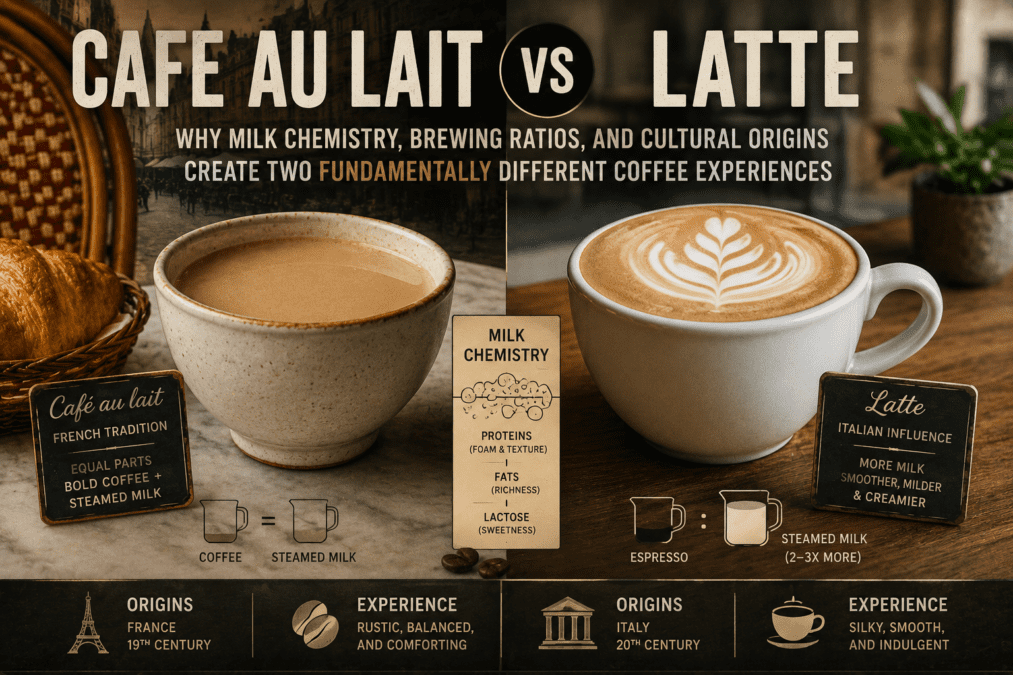

Opening Context: Two Drinks, One Misconception
At first glance, cafe au lait vs latte may seem like interchangeable café orders—both are coffee-based drinks mixed with milk, both are served warm, and both appeal to consumers who prefer smoother, less acidic coffee experiences. However, this surface similarity hides a deeper divergence in preparation philosophy, cultural origin, and chemical composition.
In modern coffee culture, cafe au lait vs latte is not simply a question of taste preference but a study in brewing logic. One originates from brewed coffee traditions, while the other is anchored in espresso extraction science. This distinction alone fundamentally alters caffeine concentration, texture, and even digestion speed.
The central insight of this comparison is that cafe au lait vs latte represents two entirely different frameworks of coffee-making: infusion-based dilution versus pressure-based emulsification. Once this is understood, every other difference—from foam structure to flavor persistence—becomes predictable rather than subjective.
Comparative Overview Table
| Attribute | Cafe au Lait | Latte |
|---|---|---|
| Base Coffee | Drip coffee or French press | Espresso |
| Milk Type | Warm milk (no foam or minimal foam) | Steamed milk with microfoam |
| Ratio | 1:1 coffee to milk | 1:3 espresso to milk |
| Texture | Light, fluid | Creamy, velvety |
| Flavor Intensity | Moderate, coffee-forward | Milder, milk-forward |
| Origin | France | Italy |
| Caffeine Level | Variable, often higher volume-based | More concentrated per ounce |
| Preparation Method | Brewing + milk heating | Espresso extraction + steaming |
This table highlights the structural divergence at the heart of cafe au lait vs latte, showing that similarity is largely aesthetic rather than functional.
Structural And Biological Foundations
The structural foundation of cafe au lait vs latte begins with the type of coffee extraction. Cafe au lait relies on brewed coffee, typically made using drip filtration or French press immersion. This produces a beverage rich in aromatic oils but relatively low in emulsified body. Milk is added afterward, creating dilution rather than integration.
In contrast, a latte is built on espresso, where pressurized water forces solubles and oils into a concentrated shot. This base is then combined with steamed milk, creating a micro-emulsion that fundamentally changes texture and mouthfeel. In cafe au lait vs latte, this is the most important structural distinction: separation versus integration.
From a biological perspective, digestion also differs. Cafe au lait tends to enter the system faster due to its lighter body, while latte’s fat-protein emulsion slows gastric absorption. This means cafe au lait vs latte can even influence energy release patterns, with latte providing a slower caffeine curve and cafe au lait offering quicker stimulation.
Ultimately, structural differences define everything else in cafe au lait vs latte, from flavor perception to physiological response.
Behavioral Patterns And Social Intelligence
Consumer behavior around cafe au lait vs latte reflects broader cultural psychology. Cafe au lait is often associated with morning routines, especially in European contexts where slow breakfasts and extended coffee consumption are normalized. It is a beverage of simplicity and tradition.
Latte, however, is deeply embedded in modern café culture. It is frequently customized with syrups, alternative milks, and flavor additions. In cafe au lait vs latte, this makes latte the more socially expressive beverage, while cafe au lait remains functionally minimalistic.
Socially, latte consumption often signals café participation—ordering, customizing, and photographing drinks as part of identity expression. Cafe au lait consumption, by contrast, is less performative and more habitual. This behavioral split is crucial in understanding cafe au lait vs latte as not just beverages but cultural artifacts.
Interestingly, surveys in coffee culture studies suggest that latte drinkers are more likely to experiment with flavor profiles, while cafe au lait drinkers prioritize consistency. This reinforces the idea that cafe au lait vs latte reflects personality tendencies as much as taste preference.
Cafe au Lait: Strengths And Constraints
In evaluating cafe au lait vs latte, cafe au lait stands out for its simplicity and brewing transparency. One of its primary strengths is control over coffee strength. Because it uses brewed coffee, the flavor can be adjusted by grind size, brew time, and bean origin.
Another advantage is accessibility. Cafe au lait does not require espresso machines, making it widely replicable in home environments. This positions cafe au lait vs latte as a comparison between low-equipment and high-equipment preparation systems.
However, cafe au lait also has limitations. Its flavor integration is less refined, often resulting in a layered rather than unified taste. Milk does not emulsify with brewed coffee in the same way it does in espresso-based drinks. As a result, cafe au lait vs latte often favors latte in texture sophistication.
Additionally, temperature stability can be an issue. Cafe au lait cools faster due to larger liquid volume and lower foam insulation. Despite this, its strength lies in authenticity and minimal processing, which appeals to traditional coffee drinkers.
Latte: Strengths And Constraints
Within the cafe au lait vs latte framework, latte represents technical refinement. Its primary strength lies in microfoam integration, which produces a smooth, velvety texture that is difficult to replicate with brewed coffee systems.
The espresso base also provides consistency. Unlike brewed coffee, which varies significantly depending on method, espresso extraction is highly controlled. This gives latte a predictable profile across cafés globally, reinforcing its dominance in commercial coffee culture. In cafe au lait vs latte, this consistency is a major competitive advantage.
However, latte has constraints. It requires specialized equipment such as espresso machines and steam wands, limiting accessibility. It also tends to mask coffee origin characteristics due to high milk ratio. Thus, in cafe au lait vs latte, latte often sacrifices bean complexity for texture harmony.
Another limitation is caloric density. Because of higher milk volume, latte contains more calories, which may be a consideration for health-conscious consumers. Still, its sensory richness makes it one of the most popular global coffee formats.
magna carta psp vs ps2: A Platform Divide That Reshaped Tactical RPG Experience
Comparative Advantages In Real-World Scenarios
When evaluating cafe au lait vs latte in real-world contexts, usage scenario becomes the deciding factor. In home brewing environments, cafe au lait is typically more practical due to equipment simplicity and faster preparation time.
In café or specialty coffee shop environments, latte dominates because of its visual appeal and customizable structure. The foam artistry associated with latte also enhances its experiential value, something absent in cafe au lait. This is a critical divergence in cafe au lait vs latte.
For caffeine delivery efficiency, cafe au lait may provide a more immediate boost due to larger coffee volume. Latte, however, offers smoother energy release because milk slows absorption. Thus, cafe au lait vs latte also becomes a question of energy kinetics.
In social environments, latte clearly leads due to aesthetic presentation and personalization culture. Cafe au lait remains more utilitarian. This means cafe au lait vs latte is not just a taste comparison but a situational optimization problem.
Scientific And Expert Consensus (2026)
Current coffee science perspectives in 2026 emphasize extraction chemistry as the key differentiator in cafe au lait vs latte. Experts agree that espresso-based drinks like latte produce higher emulsification of lipids, which alters both flavor perception and mouthfeel.
Meanwhile, brewed coffee systems used in cafe au lait retain more chlorogenic acids and volatile aromatics, contributing to a sharper but less creamy profile. This chemical divergence is central to understanding cafe au lait vs latte from a scientific standpoint.
Nutritional studies also indicate that milk fat integration in lattes slows caffeine absorption, which may reduce jitteriness compared to cafe au lait in sensitive individuals. However, overall caffeine content depends heavily on brew volume and bean strength, making cafe au lait vs latte highly variable in physiological impact.
Consensus among baristas and food scientists suggests that neither drink is superior universally; rather, cafe au lait vs latte represents two optimized systems designed for different sensory outcomes.
Final Synthesis And Verdict
The broader conclusion of cafe au lait vs latte is that these drinks are not competitors in a traditional sense but parallel solutions to different coffee design problems. Cafe au lait prioritizes clarity, simplicity, and brewing transparency. Latte prioritizes texture, integration, and sensory smoothness.
When all factors are considered—structure, culture, chemistry, and usability—cafe au lait vs latte reveals a deeper truth: coffee evolution is not linear but divergent. Each drink represents a different philosophy of consumption rather than a hierarchy of quality.
In practical terms, choosing between cafe au lait vs latte depends entirely on whether the priority is coffee expression or milk integration. Neither replaces the other; they simply serve different cognitive and sensory preferences.
Featured Definition Insight (Featured Snippet Style)
Cafe au lait is a coffee beverage made from brewed coffee mixed with hot milk, typically in equal proportions. A latte is an espresso-based drink combined with steamed milk and microfoam, resulting in a creamier texture and more integrated flavor.
While cafe au lait vs latte may appear similar visually, they differ fundamentally in brewing method, texture formation, and flavor chemistry.
In essence, cafe au lait vs latte compares a dilution-based coffee system with an emulsification-based espresso system, leading to entirely different sensory experiences despite shared ingredients.
FAQ: Cafe au lait vs latte
1. Is cafe au lait stronger than latte?
In most cases, cafe au lait vs latte strength depends on preparation. Cafe au lait can taste stronger due to larger brewed coffee volume, while latte has more milk dilution and smoother intensity.
2. Which has more caffeine: cafe au lait or latte?
The answer to cafe au lait vs latte caffeine levels is variable. Cafe au lait often contains more total caffeine because it uses full brewed coffee, while latte relies on concentrated espresso shots.
3. Why does latte taste creamier than cafe au lait?
In cafe au lait vs latte, creaminess comes from microfoam integration in latte. The steaming process emulsifies milk proteins and fats, creating a smoother texture than simple milk mixing.
4. Is cafe au lait healthier than latte?
Health comparisons in cafe au lait vs latte depend on milk quantity and sugar additions. Cafe au lait is often lower in calories, while latte may contain more dairy fats depending on size and recipe.