
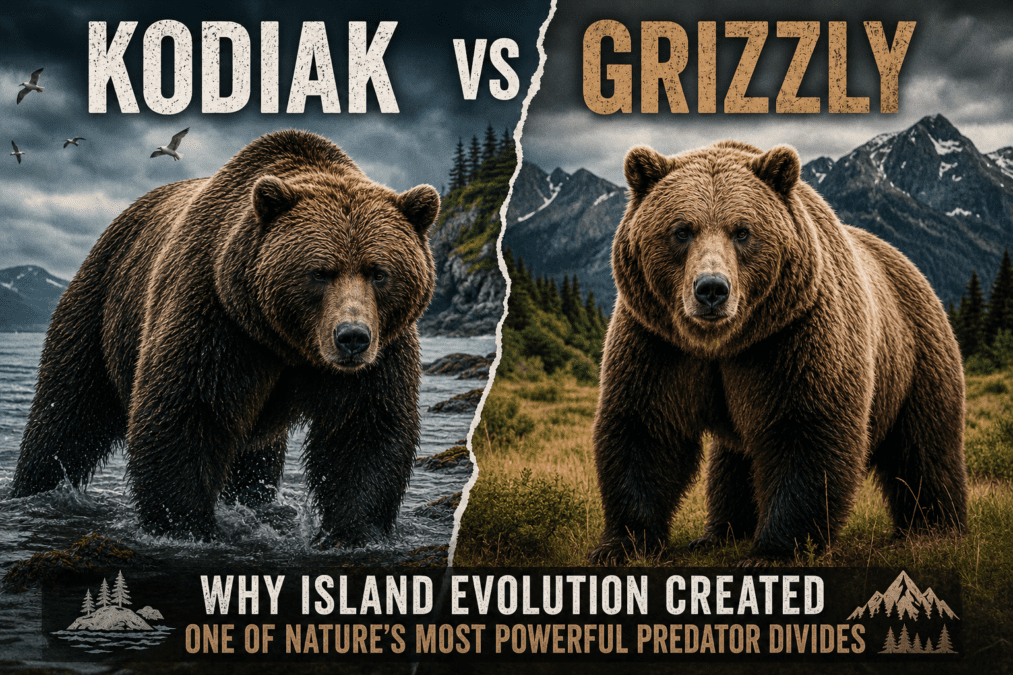

The kodiak vs grizzly debate is often treated as a simple comparison between two massive brown bears, yet the scientific reality is far more nuanced. Both animals belong to the brown bear species Ursus arctos, but geographic isolation, environmental pressure, food abundance, and evolutionary adaptation have produced meaningful differences in size, behavior, territoriality, and ecological dominance. In modern wildlife analysis, the distinction between these bears matters not only for zoology but also for conservation science, predator ecology, and behavioral research.
A serious kodiak vs grizzly comparison requires more than asking which bear is bigger or stronger. The framework must include skeletal structure, caloric access, muscle density, aggression thresholds, social tolerance, habitat pressure, and survival efficiency across distinct ecosystems. Kodiak bears evolved in relative isolation on the Kodiak Archipelago of Alaska, while grizzly bears adapted across broader continental environments with greater competition and environmental variability.
The surprising conclusion in the kodiak vs grizzly discussion is that raw physical dominance does not automatically determine ecological superiority. Kodiak bears possess overwhelming mass advantages, while grizzlies often demonstrate greater adaptive flexibility, territorial responsiveness, and survival resilience under harsher inland conditions. The result is not a simple winner-and-loser narrative but a contrast between specialized gigantism and versatile predatory intelligence.
Essential Comparative Metrics
| Attribute | Kodiak Bear | Grizzly Bear |
|---|---|---|
| Classification | Coastal brown bear population | Inland brown bear population |
| Scientific Name | Ursus arctos middendorffi | Ursus arctos horribilis |
| Average Weight (Male) | 600–1,400 lbs | 400–900 lbs |
| Maximum Weight | 1,500+ lbs | ~1,200 lbs |
| Habitat | Kodiak Archipelago (Alaska) | North America (mainland) |
| Diet | Salmon-heavy, coastal omnivore | Highly varied omnivore |
| Body Size | Larger, bulkier build | Leaner, more mobile build |
| Aggression Level | Generally lower (resource-rich zones) | Higher territorial defensiveness |
| Mobility | Moderate | High (long-range roaming) |
| Strength Advantage | Raw power & mass | Agility & endurance |
| Adaptability | Specialized ecosystem | Highly adaptable across environments |
Structural And Biological Foundations
The most obvious element in the kodiak vs grizzly comparison is body mass. Kodiak bears rank among the largest terrestrial carnivorous mammals on Earth because their isolated ecosystem provides extraordinary caloric abundance through salmon runs, coastal vegetation, and relatively stable food access. Over generations, this abundance enabled larger skeletal frames, denser muscle development, and substantial fat accumulation.
Grizzly bears, while genetically close to Kodiaks, evolved under more competitive and fluctuating mainland conditions. Their bodies reflect mobility and adaptability rather than maximum bulk. A grizzly must often travel longer distances for food, survive inconsistent prey cycles, and defend territory more aggressively. Consequently, the grizzly’s physiology balances strength with endurance and environmental responsiveness.
A Kodiak bear is a geographically isolated population of brown bears native to the Kodiak Archipelago. A grizzly bear is a North American brown bear adapted to inland and mountainous ecosystems. Those definitions appear simple, but they explain much of the divergence seen in the kodiak vs grizzly debate.
Bone density also differs subtly between the two. Kodiaks generally possess broader skull structures and thicker forelimb musculature optimized for power generation. Grizzlies maintain powerful builds as well, but their proportions often favor sustained movement and rapid terrain adaptation rather than overwhelming static force.
Behavioral Patterns And Social Intelligence
One of the least understood aspects of kodiak vs grizzly analysis involves social behavior. Popular media often portrays all large bears as uniformly aggressive solitary predators, yet ecological pressure strongly influences behavioral patterns.
Kodiak bears live in environments where salmon abundance can temporarily reduce resource competition. Because food availability is seasonally concentrated and relatively predictable, Kodiaks display surprisingly tolerant social spacing near fishing areas. Multiple bears may feed within visible proximity without constant violent escalation. This does not mean Kodiaks are harmless; rather, their ecosystem reduces the evolutionary necessity for perpetual territorial conflict.
Grizzlies evolved in landscapes where food competition is less predictable. Inland prey sources fluctuate dramatically depending on weather, migration cycles, human encroachment, and seasonal vegetation changes. As a result, grizzlies tend to exhibit heightened territorial caution and more defensive aggression. Their behavioral profile reflects survival under uncertainty.
In the broader kodiak vs grizzly comparison, this difference matters because intelligence is not merely cognitive complexity but adaptive behavioral efficiency. Kodiaks maximize energy conservation within stable ecological systems, while grizzlies demonstrate dynamic risk assessment across unstable environments.
Researchers studying bear-human interactions frequently note that grizzlies are statistically associated with more defensive encounters in continental wilderness zones. However, this pattern may reveal environmental pressure rather than innate hostility.
Kodiak Bear: Strengths And Constraints
The defining strength in the kodiak vs grizzly discussion is the Kodiak bear’s extraordinary physical dominance. Mature males can exceed 1,400 pounds and generate immense striking force through heavily muscled forelimbs and massive shoulder structures. In direct-force scenarios, few terrestrial mammals rival an adult Kodiak bear.
Another major advantage is caloric efficiency. Kodiaks benefit from nutrient-rich salmon ecosystems that support rapid seasonal weight gain and prolonged fat storage. This abundance contributes to reproductive stability, larger body development, and lower starvation risk relative to many inland predators.
The Kodiak’s sheer size also discourages predatory competition. Very few animals challenge a fully grown Kodiak bear. Even other bears often avoid direct confrontation unless mating or food stress becomes severe.
Yet the same evolutionary specialization that grants strength also creates limitations. Kodiaks are deeply tied to coastal resource systems. Their gigantism depends on ecological abundance that may become vulnerable to climate disruption, changing fish migration patterns, or habitat degradation.
In a strict kodiak vs grizzly survival analysis, specialization can reduce adaptability. A highly optimized predator thrives under stable conditions but may struggle when those conditions change rapidly. The Kodiak bear’s enormous caloric demands represent both its greatest advantage and a potential ecological vulnerability.
Grizzly Bear: Strengths And Constraints
The grizzly’s greatest strength in the kodiak vs grizzly comparison is adaptability. Grizzlies occupy forests, alpine environments, river valleys, tundra edges, and semi-arid regions across North America. This ecological flexibility reflects behavioral versatility rather than dependence on a single abundant food source.
Grizzlies are efficient opportunistic omnivores. They consume berries, roots, carrion, fish, elk calves, insects, rodents, and vegetation depending on seasonal opportunity. This broad dietary range increases resilience during environmental fluctuation.
Mobility is another underappreciated advantage. Grizzlies generally maintain leaner builds relative to Kodiaks, enabling more efficient long-distance movement across rugged terrain. Their behavioral caution and territorial responsiveness further improve survival under competitive inland conditions.
While Kodiak bears dominate in mass, grizzlies often exhibit faster reactive aggression and heightened environmental awareness. In wilderness encounters, this can make grizzlies more unpredictable and potentially more dangerous.
However, the grizzly’s constraints are equally important in any balanced kodiak vs grizzly assessment. Smaller average body size reduces absolute physical power. Inland food instability also produces greater seasonal stress. Grizzlies frequently expend far more energy securing calories than Kodiaks do within salmon-rich ecosystems.
Human encroachment creates additional challenges. Because grizzlies occupy broader continental ranges, they experience more road expansion, livestock conflict, and habitat fragmentation than isolated Kodiak populations.
Comparative Advantages In Real-World Scenarios
The central question in most kodiak vs grizzly debates is straightforward: which bear would hold the advantage in real-world conditions? The answer depends entirely on environmental context.
In direct physical confrontation, the Kodiak bear usually possesses the advantage due to overwhelming body mass, muscular density, and superior striking force. Size matters enormously in mammalian combat, particularly among bears where momentum and leverage determine dominance. A large Kodiak can outweigh a mature grizzly by several hundred pounds.
However, wilderness survival is not merely about fighting. Grizzlies often outperform in environmental adaptability, long-distance resource acquisition, and rapid ecological adjustment. A grizzly can survive across far broader habitat conditions than a Kodiak bear.
Kodiak bears thrive in ecosystems with concentrated nutrition, while grizzly bears excel in variable landscapes demanding flexibility and behavioral adaptation. That single comparison captures the essence of the broader kodiak vs grizzly analysis.
Climate resilience also deserves attention. As ecosystems shift under warming conditions, adaptable feeding behavior may become increasingly valuable. Some ecologists argue that generalized survival strategies historically outperform specialized gigantism during periods of environmental instability.
Still, under stable ecological conditions with abundant coastal food access, Kodiaks remain among the most physically dominant terrestrial predators alive today.
Scientific And Expert Consensus (2026)
Modern wildlife biology generally rejects simplistic “which is better” narratives in the kodiak vs grizzly conversation. Instead, experts evaluate evolutionary fitness relative to habitat pressures and survival efficiency.
Consensus research supports several clear conclusions. First, Kodiak bears are typically larger due to prolonged geographic isolation and superior nutritional access. Second, grizzlies demonstrate broader ecological adaptability and territorial flexibility. Third, behavioral aggression is heavily context-dependent rather than fixed by subspecies identity alone.
Genetic studies continue to show that both animals remain closely related populations within the broader brown bear lineage. Their differences emerged primarily through environmental separation and ecological specialization rather than radical evolutionary divergence.
Wildlife management agencies also emphasize that human perceptions of aggression are often distorted. Grizzly encounters receive more attention because mainland overlap with human activity is significantly greater. Kodiak bears, despite their immense size, inhabit more isolated territory with comparatively lower human density.
Current ecological modeling suggests future environmental shifts could reshape the kodiak vs grizzly balance in subtle ways. Changes in salmon populations, warming temperatures, habitat fragmentation, and altered migration systems may disproportionately affect large specialized predators over the coming decades.
Scientists increasingly view these bears as complementary evolutionary case studies: one optimized for abundance-driven gigantism and the other for adaptive continental survival.
Predatory Efficiency And Hunting Mechanics
Although both animals are classified as omnivores, the kodiak vs grizzly comparison becomes especially interesting when examining predatory mechanics. Neither bear functions like a dedicated pursuit predator such as a wolf or big cat. Instead, both rely on overwhelming force, environmental familiarity, and opportunistic feeding strategies.
Kodiak bears benefit from energy-rich salmon ecosystems that dramatically reduce the need for high-risk predation. During peak salmon runs, a Kodiak can consume enormous calorie volumes while expending relatively little energy. This efficiency partially explains how Kodiaks maintain extraordinary body mass year after year.
Grizzlies, meanwhile, operate under more variable nutritional conditions. Inland environments require constant behavioral adjustment. Grizzlies often forage across massive territories, exploiting temporary opportunities ranging from carrion to newborn ungulates. This creates a predator profile built around flexibility rather than abundance specialization.
In direct predatory encounters, both bears demonstrate explosive short-range power. Their shoulder humps store muscle mass specifically designed for digging, striking, and overpowering prey. However, the grizzly’s leaner frame sometimes provides better mobility across uneven terrain.
The broader kodiak vs grizzly distinction is therefore not simply about raw hunting ability but about energy economics. Kodiaks dominate through abundance-driven efficiency, while grizzlies survive through behavioral versatility.
Habitat Pressure And Environmental Adaptation
Habitat shapes nearly every dimension of the kodiak vs grizzly debate. Kodiak bears evolved within the isolated Kodiak Archipelago, where coastal resources created relatively predictable ecological cycles. This environmental stability encouraged larger body size and reduced the need for extensive territorial migration.
Grizzlies inhabit far more demanding landscapes. Mountain ranges, dense forests, tundra systems, and inland river valleys create constantly shifting survival conditions. Food sources vary seasonally and geographically, forcing grizzlies to become adaptive generalists.
This distinction explains why grizzlies often appear more reactive and defensive. Environmental unpredictability rewards caution and rapid threat assessment. Kodiaks, by contrast, can conserve energy more effectively because their ecosystems historically offered higher resource consistency.
The kodiak vs grizzly comparison also highlights how isolation changes evolution. Geographic separation limited gene flow for Kodiak populations over thousands of years, amplifying traits associated with gigantism and resource exploitation.
Environmental adaptation influences reproduction as well. Female bears in stable ecosystems generally achieve better cub survival rates because nutritional stress is lower. Consequently, Kodiak populations historically maintained stronger average body development.
Yet specialized ecosystems carry risk. Climate disruption, declining salmon populations, or habitat alteration could disproportionately affect Kodiaks because their evolutionary strategy depends heavily on coastal abundance. Grizzlies may prove more resilient under rapidly changing continental conditions.
Human Interaction And Risk Assessment
Public fascination with kodiak vs grizzly comparisons often centers on danger to humans. Yet risk assessment requires nuance rather than sensationalism. Both bears are capable of lethal force, but encounter dynamics differ significantly.
Grizzly incidents occur more frequently because grizzlies occupy larger mainland territories with greater human overlap. Hikers, hunters, ranchers, and campers regularly enter grizzly habitat across North America. Many defensive attacks happen when bears perceive threats to cubs, carcasses, or personal space.
Kodiak bears encounter humans less often due to geographic isolation. Despite their immense size, they are not statistically associated with dramatically higher attack rates. This supports the broader ecological principle that aggression frequency depends heavily on environmental context.
While Kodiak bears are generally larger, grizzly bears often display faster territorial escalation during surprise encounters. This makes grizzlies appear more behaviorally volatile in wilderness scenarios.
Modern bear management strategies focus heavily on minimizing surprise interactions, securing food storage, and reducing habituation. Wildlife experts consistently emphasize that human behavior strongly influences encounter outcomes.
In the wider kodiak vs grizzly discussion, danger should not be reduced to simplistic rankings. Both animals are apex omnivores shaped by ecological pressures, not mindless aggressors driven solely by violence.
Evolutionary Divergence And Genetic Similarity
One of the most misunderstood elements of the kodiak vs grizzly comparison is taxonomy. Many people assume Kodiak bears and grizzly bears are entirely separate species. Scientifically, that is incorrect.
Both belong to the brown bear species Ursus arctos. Kodiak bears represent an isolated population that evolved distinct physical tendencies through geographic separation and ecological abundance. Grizzlies represent broader continental brown bear populations adapted to inland environments.
This means the kodiak vs grizzly distinction is evolutionary rather than species-level. Their differences emerged gradually through selective pressures involving diet, climate, territory size, and reproductive isolation.
Island gigantism likely played a major role in Kodiak development. When predators occupy resource-rich isolated ecosystems with reduced external competition, larger body size can become advantageous. Over time, those traits compound genetically.
Grizzlies followed a different adaptive path. Mainland survival favored flexibility, mobility, and behavioral responsiveness over maximum size accumulation. Evolution optimized them for unpredictability rather than abundance specialization.
Despite these differences, genetic overlap remains substantial. Interbreeding would still be biologically possible because they remain closely related brown bear populations.
The kodiak vs grizzly debate therefore reflects a broader evolutionary principle: environmental conditions shape physical and behavioral outcomes even within the same overarching species lineage.
Final Synthesis And Verdict
The most accurate conclusion in the kodiak vs grizzly debate is that each bear represents a different evolutionary solution to apex survival. Kodiak bears embody the power of ecological abundance. Grizzly bears embody the resilience of adaptive flexibility.
If the comparison focuses strictly on size, mass, and direct-force dominance, the Kodiak bear generally holds the advantage. Its larger skeletal structure, heavier musculature, and superior calorie access create one of the most formidable terrestrial predators on Earth.
If the focus shifts toward environmental adaptability, territorial resilience, and survival under unstable conditions, the grizzly often demonstrates greater versatility. Grizzlies evolved to navigate uncertainty across diverse landscapes, making them exceptionally durable continental predators.
The deeper lesson from the kodiak vs grizzly comparison is that dominance in nature is contextual rather than absolute. Specialized giants can rule stable ecosystems, while adaptable generalists frequently prevail under environmental volatility.
Rather than asking which bear is universally superior, modern wildlife science asks a more meaningful question: which evolutionary strategy performs best under specific ecological pressures? That perspective transforms the kodiak vs grizzly discussion from internet mythology into a serious study of adaptation, survival, and predator evolution.
Frequently Asked Questions
Is a Kodiak bear bigger than a grizzly bear?
Yes. In most verified measurements, Kodiak bears are significantly larger than grizzly bears. Adult male Kodiaks can exceed 1,400 pounds under ideal conditions, largely because of abundant salmon-based nutrition and geographic isolation.
Are Kodiak bears more aggressive than grizzlies?
Not necessarily. The kodiak vs grizzly comparison shows that aggression depends heavily on environmental context. Grizzlies often display stronger territorial defensiveness because mainland ecosystems involve greater competition and human overlap.
Could a grizzly bear defeat a Kodiak bear?
A particularly large grizzly could theoretically challenge a smaller Kodiak, but in most direct physical scenarios the Kodiak’s greater mass and strength would provide a substantial advantage.
Why are Kodiak bears so large?
Kodiak bears evolved in a nutrient-rich island ecosystem with abundant salmon and relatively stable food access. Over generations, this environment favored larger body size, greater fat storage, and massive muscular development.