
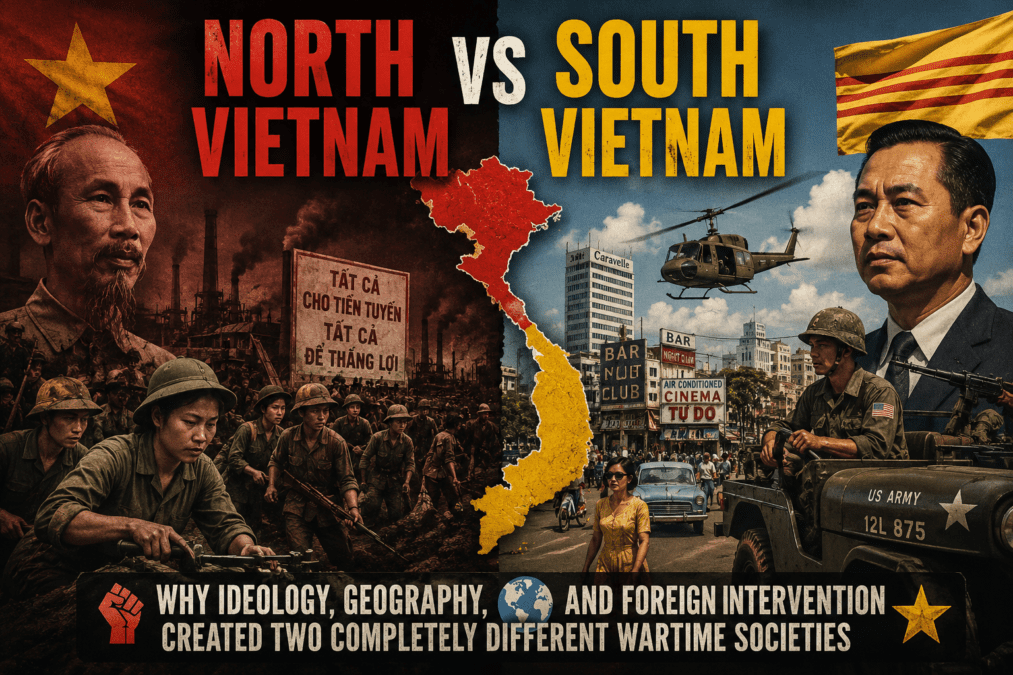

The phrase north vs south vietnam refers to the political, military, economic, and ideological division of Vietnam between 1954 and 1975. North Vietnam operated under a communist system aligned with the Soviet Union and China, while South Vietnam developed as an anti-communist republic heavily supported by the United States and Western allies.
Understanding north vs south vietnam requires more than examining military conflict alone. The comparison involves governance structures, social organization, economic planning, geography, foreign alliances, propaganda systems, and civilian life under radically different political models. Although both regions shared language, culture, and historical identity, they evolved into contrasting wartime societies shaped by Cold War pressures.
The most surprising insight in the north vs south vietnam debate is that military outcomes were not determined solely by battlefield strength. Political cohesion, rural integration, ideological discipline, supply adaptability, and long-term strategic endurance ultimately mattered more than technological superiority. South Vietnam possessed stronger financial and military backing, while North Vietnam maintained deeper ideological unity and strategic persistence over time.
Essential Comparative Metrics: North vs South Vietnam
| Category | 🇻🇳 North Vietnam | 🇻🇳 South Vietnam |
|---|---|---|
| Political System | Communist state under single-party rule | Anti-communist republic with multiparty influences |
| Capital | Hanoi | Saigon (Ho Chi Minh City) |
| Main Ideology | Marxism–Leninism | Liberal capitalism / anti-communism |
| Foreign Allies | Soviet Union, China | United States, Western allies |
| Military Strategy | Guerrilla + hybrid conventional warfare | Conventional warfare with U.S. support |
| Economic Model | Centralized planned economy | Market-oriented mixed economy |
| Rural Control | Strong revolutionary integration | Weak rural governance in many regions |
| Military Strength | High endurance, adaptable insurgency tactics | Superior technology and air power |
| Political Stability | High internal cohesion | Frequent coups and instability |
| War Outcome (1975) | Victory and reunification | Collapse of government |
Structural And Political Foundations
The division central to north vs south vietnam emerged after the 1954 Geneva Accords, which temporarily separated Vietnam at the 17th parallel following the defeat of French colonial forces. North Vietnam, led by Ho Chi Minh, sought national reunification under communist governance. South Vietnam, supported by the United States, aimed to prevent communist expansion in Southeast Asia.
North Vietnam built a centralized revolutionary state emphasizing collectivism, ideological discipline, and rural political organization. Government institutions functioned through strict party hierarchy, allowing coordinated national mobilization. The leadership prioritized long-term strategic goals over short-term economic comfort.
South Vietnam developed under a more fragmented political environment. Multiple coups, leadership changes, and competing power centers weakened institutional continuity. While South Vietnam promoted electoral governance and capitalist development, the state struggled to establish legitimacy across rural regions.
A core reality in north vs south vietnam is that institutional coherence often outweighed material advantage. North Vietnam’s political consistency created strategic continuity, while South Vietnam’s repeated instability undermined public confidence and military coordination.
Geographic And Economic Differences
Geography profoundly shaped the dynamics of north vs south vietnam. North Vietnam contained mountainous terrain and dense jungle corridors that supported defensive warfare, logistical concealment, and guerrilla mobility. The famous Ho Chi Minh Trail enabled supplies and troop movement through Laos and Cambodia despite extensive bombing campaigns.
South Vietnam possessed more agriculturally productive regions, especially the Mekong Delta. Urban centers such as Saigon experienced stronger commercial growth, foreign investment, and modernization during American involvement. Consumer markets and infrastructure expanded rapidly compared to the austere northern economy.
However, economic appearance did not necessarily translate into strategic resilience. North Vietnam accepted hardship as part of revolutionary sacrifice. The economy operated under rationing and centralized planning, but social expectations aligned with wartime mobilization. South Vietnam’s economy became heavily tied to U.S. funding, military spending, and foreign aid flows.
The north vs south vietnam economic contrast demonstrates how wartime sustainability depends not only on wealth but also on public tolerance for deprivation, ideological commitment, and logistical adaptability under prolonged conflict conditions.
Military Doctrine And Battlefield Strategy
Military doctrine represented one of the clearest distinctions in north vs south vietnam. North Vietnam embraced flexible warfare combining guerrilla tactics, political insurgency, infiltration, sabotage, and eventually conventional military offensives. This hybrid approach prevented opponents from fighting on predictable terms.
The Viet Cong insurgency in the south blended into rural populations, complicating American and South Vietnamese operations. Small-scale attacks exhausted enemy morale while forcing resource-intensive counterinsurgency campaigns. Over time, North Vietnam integrated larger coordinated offensives supported by regular army units.
South Vietnam relied heavily on conventional military structure supported by American technology, helicopters, artillery, intelligence systems, and air superiority. The Army of the Republic of Vietnam possessed advanced equipment, but operational effectiveness varied significantly across leadership structures.
A direct explanation of north vs south vietnam military outcomes can be summarized this way: North Vietnam optimized endurance warfare and political integration, while South Vietnam depended on technological superiority and external support. Once American military withdrawal accelerated, the southern defensive system weakened dramatically.
The conflict also illustrated that superior firepower does not guarantee strategic success when facing decentralized insurgency networks with long-term political objectives.
Behavioral Patterns And Social Intelligence
The social psychology behind north vs south vietnam reveals how wartime populations adapt differently under competing ideological systems. North Vietnam cultivated collective sacrifice through propaganda, educational messaging, youth mobilization, and revolutionary identity. Citizens were encouraged to view hardship as patriotic contribution.
Social discipline became a strategic asset. Communities often participated directly in logistics, tunnel construction, food supply systems, and intelligence networks. The integration between civilians and military operations blurred conventional distinctions between combatant and noncombatant support structures.
South Vietnam experienced a more diverse social environment with stronger urban consumer culture, religious plurality, and political fragmentation. While many citizens strongly opposed communism, others distrusted the government or felt disconnected from elite political leadership in Saigon.
The north vs south vietnam comparison demonstrates that social cohesion can become a force multiplier in prolonged conflicts. North Vietnam successfully aligned ideology, civilian participation, and military objectives into a unified national narrative. South Vietnam struggled to create equally powerful collective identity across all social classes and rural populations.
This difference in wartime psychology heavily influenced recruitment, morale, intelligence gathering, and resistance endurance throughout the conflict.
North Vietnam: Strengths And Constraints
North Vietnam’s greatest strength in the north vs south vietnam conflict was strategic patience. The leadership accepted extraordinary casualties and economic strain in pursuit of reunification. Long-term persistence allowed them to outlast stronger opponents materially.
Another major advantage was organizational discipline. Communist Party structures maintained centralized control while coordinating military operations, propaganda campaigns, agricultural production, and foreign diplomacy. This coherence reduced internal fragmentation during periods of crisis.
North Vietnam also mastered asymmetric warfare adaptation. When facing bombing campaigns, it decentralized logistics. When conventional battles became possible, it shifted toward larger offensives. Flexibility became one of its defining advantages.
Yet North Vietnam faced severe constraints. Industrial capacity remained limited, infrastructure suffered extensive destruction, and food shortages periodically threatened stability. Dependence on Soviet and Chinese aid created geopolitical vulnerabilities as communist allies pursued their own strategic interests.
The north vs south vietnam struggle therefore was not a simple story of northern dominance. North Vietnam endured massive hardship and sacrifice, but its political endurance and adaptive warfare strategies ultimately compensated for material limitations.
South Vietnam: Strengths And Constraints
South Vietnam possessed significant advantages during much of the north vs south vietnam conflict. American military support provided advanced aircraft, heavy artillery, intelligence technology, economic aid, and extensive training programs. Urban modernization accelerated under U.S. partnership.
The southern economy also benefited from international trade access and consumer market growth. Saigon became one of Southeast Asia’s most dynamic wartime cities, reflecting cultural globalization, media expansion, and commercial development.
However, these strengths contained structural weaknesses. Political instability severely damaged continuity of governance. Leadership transitions, corruption allegations, and uneven military command structures weakened public confidence.
Rural legitimacy represented another major problem. In many provinces, government control remained fragile outside urban centers. The Viet Cong exploited these gaps through local recruitment and underground political networks.
One of the central lessons from north vs south vietnam is that external military support cannot fully compensate for internal legitimacy challenges. South Vietnam often appeared militarily powerful but politically fragile. Once U.S. combat involvement decreased after the Paris Peace Accords, systemic vulnerabilities became increasingly visible.
The collapse of South Vietnam in 1975 reflected accumulated structural weaknesses rather than a sudden military failure alone.
Comparative Advantages In Real-World Scenarios
Examining north vs south vietnam through practical scenarios reveals why the conflict evolved as it did over two decades.
In conventional battlefield engagements, South Vietnam and its American allies usually possessed superior firepower, mobility, and air dominance. Large-scale operations could inflict devastating casualties on communist forces.
However, in long-duration insurgency environments, North Vietnam held critical advantages. Guerrilla networks required fewer resources, adapted rapidly to terrain, and leveraged civilian integration for concealment and intelligence gathering.
In political warfare, North Vietnam consistently framed the conflict as a nationalist liberation struggle against foreign influence. This narrative strengthened domestic commitment and international anti-war sympathy.
South Vietnam performed more effectively in urban administration, economic modernization, and infrastructure development. Yet these gains remained vulnerable because rural insecurity prevented fully stable national integration.
A concise answer to the north vs south vietnam comparison is this: North Vietnam excelled at endurance-based revolutionary warfare, while South Vietnam performed better in conventional modernization and technological capability. The final outcome depended on which system could sustain political legitimacy and military resilience longer.
Foreign Intervention And Cold War Dynamics
No analysis of north vs south vietnam is complete without understanding Cold War geopolitics. Vietnam became one of the defining proxy conflicts between communist and anti-communist global blocs.
North Vietnam received weapons, advisors, engineering support, and financial assistance from both the Soviet Union and China. Although tensions existed between those allies, Hanoi effectively balanced their support while preserving independent strategic priorities.
South Vietnam depended heavily on American intervention. At peak involvement, hundreds of thousands of U.S. troops operated in Vietnam alongside massive bombing campaigns and aid programs. American policymakers feared that communist victory would trigger the “domino theory” across Southeast Asia.
Foreign intervention transformed north vs south vietnam from a regional civil conflict into an international ideological battleground. The war influenced global protest movements, military doctrine, media reporting, and diplomatic strategy throughout the Cold War era.
Ironically, the scale of American involvement sometimes strengthened North Vietnam’s nationalist messaging. The conflict increasingly became framed not merely as communism versus capitalism, but as resistance against foreign domination.
This narrative advantage proved strategically powerful in sustaining morale and international sympathy.
Media, Propaganda, And Information Warfare
Information warfare played a decisive role in north vs south vietnam. North Vietnam tightly controlled domestic media while using propaganda to reinforce sacrifice, unity, and revolutionary legitimacy. Messaging remained consistent across political and military structures.
South Vietnam operated within a far more open media environment, especially because of American journalistic presence. Graphic war coverage reached global audiences through television, newspapers, and photography. This transformed public perception of modern warfare.
The Tet Offensive of 1968 illustrates the importance of perception. Militarily, communist forces suffered severe losses. Politically and psychologically, however, the offensive undermined confidence in claims that victory was near.
The north vs south vietnam conflict became one of the first wars where media exposure directly influenced international political sustainability. Public opinion in the United States shifted dramatically as casualty figures increased and strategic clarity weakened.
North Vietnam understood that absolute battlefield victory was unnecessary in every engagement. Eroding enemy morale, political consensus, and long-term willingness to continue fighting could achieve strategic success indirectly.
This lesson continues to influence modern military and political communication strategies worldwide.
Scientific And Expert Consensus (2026)
Modern historical consensus on north vs south vietnam has become more nuanced compared to earlier Cold War interpretations. Contemporary scholars generally reject simplistic portrayals of the conflict as purely ideological or purely nationalist.
Most experts now view the war as a layered conflict involving decolonization, civil war dynamics, Cold War competition, revolutionary mobilization, and geopolitical containment simultaneously.
Military historians emphasize that North Vietnam succeeded through integrated political warfare rather than military force alone. Strategic endurance, rural integration, decentralized logistics, and ideological cohesion collectively shaped victory conditions.
Researchers studying South Vietnam increasingly argue that the republic possessed greater social complexity and political diversity than older narratives acknowledged. However, institutional instability and dependence on foreign support remained persistent structural vulnerabilities.
The modern north vs south vietnam scholarly perspective also highlights civilian suffering. Millions of civilians experienced displacement, bombing, food insecurity, trauma, and long-term environmental consequences from chemical defoliants and unexploded ordnance.
Rather than framing the conflict as simple good-versus-evil binary politics, contemporary analysis focuses on how competing state-building systems struggled under extreme geopolitical pressure.
Human Cost And Long-Term Legacy
The long-term legacy of north vs south vietnam extends far beyond military reunification. The war caused immense human loss, environmental destruction, refugee displacement, and generational trauma across the region.
After reunification in 1975, Vietnam faced major reconstruction challenges. Economic hardship continued for years before later market-oriented reforms gradually transformed the country’s economy. The postwar government also confronted issues involving political reeducation, migration, and international isolation.
For the United States, the Vietnam War reshaped military doctrine, foreign policy skepticism, media relations, and public trust in government. The phrase “Vietnam syndrome” emerged to describe reluctance toward prolonged foreign military intervention.
The north vs south vietnam conflict also influenced modern insurgency theory. Military academies worldwide continue studying the war to understand asymmetric conflict, counterinsurgency limitations, political legitimacy, and information warfare.
Today, Vietnam exists as a unified state with rapidly expanding economic development and global trade integration. Yet the historical division between north and south still shapes cultural memory, diaspora identity, and political interpretation among different communities worldwide.
Final Synthesis And Verdict
The enduring importance of north vs south vietnam lies in how the conflict revealed the limits of conventional power against politically integrated revolutionary warfare. North Vietnam did not possess overwhelming economic or technological superiority. Instead, it combined ideological discipline, rural mobilization, strategic endurance, and adaptive military doctrine into a coherent long-term strategy.
South Vietnam demonstrated stronger modernization capacity, international partnerships, urban growth, and technological sophistication. Yet these advantages depended heavily on external military support and were weakened by internal instability and inconsistent rural legitimacy.
In the final analysis, the outcome of north vs south vietnam was determined less by raw military hardware and more by political cohesion, strategic patience, and societal integration under prolonged wartime pressure.
The conflict remains one of the clearest historical examples showing that wars are rarely decided by weapons alone. Systems capable of sustaining morale, legitimacy, and adaptive endurance often outlast materially superior opponents in long-duration geopolitical struggles.
Frequently Asked Questions
What was the main difference between north and south Vietnam?
The main difference in north vs south vietnam was political ideology. North Vietnam operated under communist leadership seeking reunification through revolutionary governance, while South Vietnam functioned as an anti-communist republic supported heavily by the United States and Western allies.
Why did North Vietnam ultimately win the war?
North Vietnam won because it maintained stronger long-term political cohesion, effective guerrilla warfare integration, rural support networks, and strategic endurance. South Vietnam relied heavily on American military assistance, and its structural weaknesses became more visible after U.S. withdrawal.
Was the Vietnam War mainly a civil war or a Cold War conflict?
The north vs south vietnam conflict was both a civil war and a Cold War proxy struggle. Vietnamese political factions fought for national control, while global superpowers intervened to advance broader ideological and geopolitical objectives.
Did South Vietnam have a stronger military?
In conventional terms, South Vietnam and its American allies possessed superior technology, air power, and heavy weaponry. However, North Vietnam proved more effective in asymmetric warfare, political mobilization, and long-term strategic persistence.