
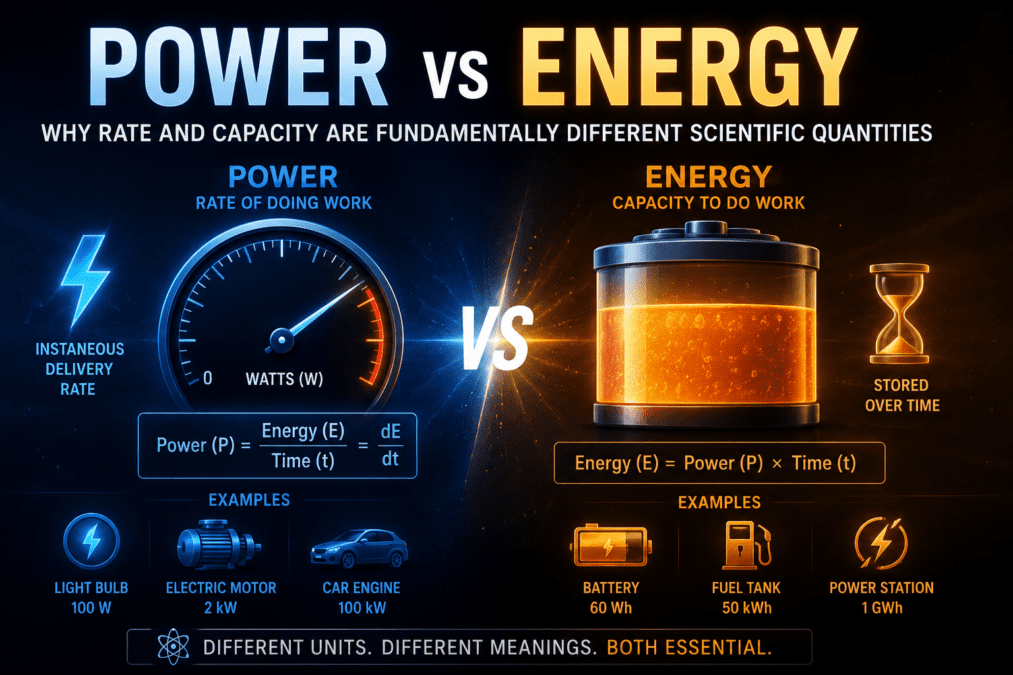

The distinction between power and energy shapes nearly every modern technological system, from electrical grids and vehicle engineering to human metabolism and industrial production. Although the two concepts are closely related, confusion between them remains widespread because both are associated with work, electricity, motion, and performance. In physics and engineering, however, the difference is precise and mathematically unavoidable. Understanding power vs energy is essential for interpreting everything from electricity bills and battery storage to athletic performance and renewable infrastructure.
A rigorous comparison framework requires examining how each quantity functions in science, engineering, economics, and real-world systems. Energy represents the total capacity to perform work, while power measures the rate at which that energy is transferred or used. The relationship resembles distance versus speed: distance measures how far something can go, whereas speed measures how fast it travels. This distinction becomes critical in systems where timing, efficiency, and resource delivery matter.
The most surprising insight in the power vs energy debate is that high-energy systems are not always high-power systems, and vice versa. A battery may store enormous energy yet release it slowly, while a lightning strike delivers extraordinary power despite lasting only fractions of a second. Modern civilization increasingly depends on optimizing both simultaneously, especially in renewable energy, computing, transportation, and industrial automation.
Defining Power and Energy in Scientific Terms
Energy is the measurable capacity of a system to perform work or produce change. It exists in forms such as kinetic, thermal, chemical, electrical, gravitational, and nuclear energy. The SI unit of energy is the joule, although kilowatt-hours are commonly used in electrical systems.
Power is the rate at which energy is transferred, converted, or consumed over time. The SI unit of power is the watt, defined as one joule per second.
While energy describes how much total work can be done, power describes how quickly that work occurs. This distinction forms the central analytical framework behind power vs energy across every scientific discipline.
In practical terms, a large water tank represents energy storage, while the width of the pipe delivering water represents power. A system can possess immense stored energy but still provide low power if the release rate is limited.
A direct answer often used in engineering education is this: energy measures total capacity, whereas power measures delivery speed. A battery’s size determines energy capacity, but its discharge rate determines power output. This explains why two devices with equal stored energy can perform dramatically differently under high-demand conditions.
Essential Comparative Metrics
| Attribute | Power | Energy |
|---|---|---|
| Scientific Definition | Rate of energy transfer or work | Capacity to perform work |
| SI Unit | Watt (W) | Joule (J) |
| Time Dependency | Explicitly dependent on time | Can exist independent of transfer rate |
| Mathematical Expression | P = E ÷ t | E = P × t |
| Common Electricity Unit | Kilowatt (kW) | Kilowatt-hour (kWh) |
| Automotive Example | Horsepower of engine | Fuel stored in tank |
| Battery Interpretation | Discharge capability | Total storage capacity |
| Human Physiology | Exercise intensity output | Caloric reserves |
| Grid Infrastructure | Instant supply capability | Total electricity delivered |
| Engineering Priority | Performance speed | Operational endurance |
| Measurement Focus | How fast | How much |
Structural And Scientific Foundations
The scientific foundation of power vs energy originates in classical mechanics and thermodynamics. Energy emerged historically as a conserved quantity describing the ability of systems to perform work, while power developed later as a way to measure how rapidly energy transformations occurred. This distinction became essential during the Industrial Revolution when steam engines needed evaluation not only for total output but also for operational speed.
Mathematically, energy is scalar and accumulative. It can be stored, transferred, converted, and conserved across systems. Power, by contrast, is fundamentally temporal because it measures change over time. A power equation always includes time explicitly or implicitly.
This structural distinction explains why energy systems and power systems are engineered differently. Batteries, fuel tanks, hydro reservoirs, and food calories emphasize storage capacity. Turbines, engines, processors, and electric motors emphasize delivery rate. In many modern systems, the engineering challenge lies in balancing both simultaneously.
The deeper insight within power vs energy is that neither quantity is inherently superior. Their value depends entirely on context. Emergency response equipment prioritizes power delivery, while long-duration storage systems prioritize energy capacity.
Behavioral Patterns And System Dynamics
The operational behavior of power and energy differs dramatically in dynamic systems. Energy tends to accumulate gradually and dissipate over longer periods, whereas power often fluctuates rapidly according to immediate demand. Electrical grids demonstrate this distinction clearly: energy consumption may remain predictable over a day, but power demand spikes suddenly during peak usage periods.
In transportation systems, energy determines range while power determines acceleration. An electric vehicle with a large battery stores substantial energy, but motor power determines how quickly the vehicle reaches speed. This is why two cars with identical battery capacities can produce entirely different driving experiences.
The power vs energy relationship also shapes computing infrastructure. Data centers consume enormous total energy over time, yet their performance bottlenecks frequently involve power density and thermal transfer rates rather than total energy availability. High-performance processors require rapid energy delivery within extremely short intervals.
Human physiology offers another revealing comparison. The body stores energy chemically through fat and glycogen reserves, but muscular power output depends on how quickly that energy can be converted into mechanical action. Sprinters emphasize explosive power, while endurance athletes optimize sustained energy efficiency.
These behavioral differences show why modern engineering rarely evaluates energy or power in isolation.
Power: Strengths And Constraints
Power provides immediate operational capability. Systems with high power output can perform tasks rapidly, overcome resistance efficiently, and respond dynamically to changing conditions. In industrial environments, high-power machinery increases throughput, acceleration, and productivity.
One major strength in the power vs energy comparison is responsiveness. High-power systems excel where speed matters more than duration. Examples include fighter jet engines, emergency backup generators, supercomputers, and industrial robotics. These technologies prioritize rapid energy transfer over long operational endurance.
Power is also critical in infrastructure stability. Electrical grids require adequate power generation capacity to maintain voltage and frequency stability during sudden demand fluctuations. Even if total energy reserves remain sufficient, insufficient power availability can trigger blackouts or instability.
However, high-power systems face important limitations. Rapid energy transfer generates heat, mechanical stress, and efficiency losses. High power density often increases wear, cooling requirements, and infrastructure costs. Batteries optimized for extreme power discharge may sacrifice long-term storage capacity or lifespan.
Another limitation involves sustainability. High-power consumption patterns strain energy infrastructure because demand peaks require oversized generation systems that may remain underutilized during normal conditions. This imbalance becomes particularly important in renewable energy transitions.
The broader lesson from power vs energy is that maximizing power alone rarely produces optimal system efficiency.
Energy: Strengths And Constraints
Energy provides endurance, continuity, and storage capability. Systems with large energy reserves can operate for extended durations even when instantaneous output remains modest. This characteristic makes energy central to transportation, electrical storage, food systems, and planetary climate processes.
A primary strength in the power vs energy relationship is persistence. High-energy systems support long-term operations without requiring constant replenishment. Large hydroelectric reservoirs, chemical fuels, and grid-scale battery systems derive value primarily from accumulated capacity rather than instantaneous delivery rates.
Energy storage also enables temporal flexibility. Renewable infrastructure increasingly depends on storing energy when production exceeds demand and releasing it later when generation falls. This function becomes essential in solar and wind systems where natural variability affects supply consistency.
Yet energy-focused systems also face constraints. Large energy reserves do not guarantee rapid usability. Coal contains immense chemical energy, but converting it into electricity requires complex thermal processes. Similarly, certain batteries store significant energy but cannot discharge quickly enough for high-performance applications.
Another challenge involves transport and conversion efficiency. Energy storage systems inevitably experience losses through heat, friction, chemical degradation, or transmission resistance. These inefficiencies shape global economics and infrastructure planning.
The critical insight in power vs energy is that energy abundance without adequate power delivery can render systems operationally ineffective despite large reserves.
Comparative Advantages In Real-World Scenarios
Real-world applications reveal why the power vs energy distinction matters beyond theoretical physics. In renewable energy infrastructure, solar farms are often evaluated in megawatts of power capacity, yet their economic value depends heavily on total annual energy production measured in megawatt-hours.
Electric vehicles provide another practical example. A car with high motor power accelerates rapidly and handles steep terrain effectively. However, its driving range depends on stored battery energy. Consumers often misunderstand this distinction, assuming larger horsepower automatically means longer operational duration.
Consumer electronics also demonstrate the relationship clearly. Smartphone batteries emphasize energy density because users prioritize runtime, while gaming processors emphasize power delivery for computational performance. Device design becomes an exercise in balancing thermal constraints, storage limits, and performance expectations.
In athletics, power output determines explosive performance in activities such as sprinting or weightlifting, while energy efficiency governs endurance sports like marathon running or cycling. Elite athletes train these capabilities differently because the physiological demands differ fundamentally.
The power vs energy comparison becomes even more important in national infrastructure planning. Countries require enough energy generation annually to meet total demand, but they also need sufficient power capacity during peak hours. A nation may possess adequate yearly energy resources yet still experience rolling blackouts if peak power supply fails.
The Mathematical Relationship Between Power And Energy
The mathematical framework underlying power vs energy is elegant yet deeply influential across science and engineering. Power equals energy divided by time:
P = E ÷ t
Conversely, energy equals power multiplied by time:
E = P × t
These equations explain why identical energy transfers can produce radically different outcomes depending on duration. Delivering 1,000 joules over one second creates far greater power than delivering the same energy over one hour.
This relationship is visible in electrical systems. A 100-watt bulb operating for ten hours consumes the same total energy as a 1,000-watt device operating for one hour. The energy expenditure is identical, but the power requirements differ dramatically.
The power vs energy distinction also explains infrastructure sizing. Transmission lines, transformers, and engines must handle peak power demands even when average energy usage remains relatively low. This is one reason energy systems often appear oversized relative to normal operational conditions.
Importantly, the equations reveal that power and energy are inseparable conceptually yet non-interchangeable operationally. Confusing the two leads to flawed engineering assumptions, inaccurate policy discussions, and misleading consumer interpretations.
Power vs Energy In Electricity Systems
Electricity provides one of the clearest real-world demonstrations of power vs energy because both quantities appear directly in utility infrastructure and consumer billing. Power in electrical systems is measured in watts or kilowatts, representing instantaneous consumption or production rates. Energy consumption, however, is measured in kilowatt-hours.
A household appliance labeled 2,000 watts draws energy rapidly. If operated for one hour, it consumes 2 kilowatt-hours of energy. Consumers frequently confuse these measurements because both relate to electricity use, but they answer entirely different questions.
Electrical grids must maintain constant balance between generated and consumed power in real time. Unlike many other resources, electricity cannot be stored economically at large scale without specialized infrastructure. This means power stability becomes as important as total energy availability.
Renewable energy transitions have intensified the importance of power vs energy analysis. Solar panels may generate substantial annual energy output, yet their power availability varies by weather and daylight conditions. Grid-scale storage systems attempt to bridge this gap by converting intermittent generation into reliable dispatchable power.
The challenge of balancing energy abundance with power reliability now defines much of modern energy policy and infrastructure investment.
Power vs Energy In Human Physiology
Human biology offers a compelling natural model for understanding power vs energy because the body continuously manages both simultaneously. Food provides chemical energy stored as glycogen and fat, while muscles convert that energy into mechanical power during movement.
Short-duration explosive activities such as sprinting, jumping, or heavy lifting emphasize power output. Athletes in these disciplines train neuromuscular coordination and fast-twitch muscle fibers to maximize rapid energy conversion.
Endurance sports emphasize energy efficiency instead. Marathon runners and cyclists optimize oxygen utilization, metabolic pathways, and pacing strategies to sustain performance over extended periods. Their success depends less on peak power and more on maintaining steady energy expenditure.
The power vs energy distinction also appears in fatigue dynamics. High-power activities rapidly deplete available energy reserves because the body cannot sustain maximal output indefinitely. Endurance activities conserve power to preserve long-duration energy availability.
Even human cognition reflects this relationship. Intense mental concentration temporarily increases brain power consumption, but long-term cognitive endurance depends on sustained metabolic energy supply and recovery processes.
This biological perspective demonstrates that power and energy are universal operational principles rather than merely abstract engineering concepts.
Scientific And Expert Consensus (2026)
Scientific consensus strongly supports maintaining a strict conceptual distinction between power and energy because misinterpretation produces errors in education, infrastructure planning, environmental policy, and technological communication. Physics education standards globally emphasize that energy measures quantity while power measures rate.
Engineering organizations increasingly highlight the power vs energy distinction in renewable transition discussions. Grid experts warn that focusing exclusively on total renewable energy generation can obscure critical power reliability challenges during peak demand periods or low-generation intervals.
Battery researchers similarly separate energy density from power density. Energy density determines how much energy can be stored per unit mass, while power density determines how rapidly that energy can be delivered. Different applications prioritize these variables differently.
Climate scientists also stress the importance of distinguishing energy consumption from power infrastructure. Decarbonization strategies require both adequate clean energy generation and sufficient power delivery systems capable of handling fluctuating demand.
Across disciplines, expert consensus increasingly frames power vs energy as a systems-level optimization problem rather than a simple definitional distinction. Modern civilization depends on managing both efficiently and sustainably.
Misconceptions That Distort The Power vs Energy Debate
One of the most persistent misconceptions in power vs energy discussions is treating the terms as interchangeable. Media reporting frequently contributes to confusion by describing energy shortages when the actual problem involves power delivery constraints.
Another common misunderstanding is assuming larger energy storage automatically improves performance. In reality, applications such as aviation, motorsports, and computing often prioritize power density over total stored energy because operational responsiveness matters more than endurance.
Consumers also frequently misinterpret electrical ratings. A high-wattage appliance does not necessarily consume more total energy overall if operated briefly. Conversely, low-power devices used continuously may consume substantial energy over time.
In renewable discussions, some observers mistakenly assume high annual energy production guarantees grid stability. Yet power reliability requires consistent delivery capability even during unfavorable environmental conditions.
Correcting these misconceptions is essential because policy, engineering, and consumer decisions increasingly depend on accurate understanding of power vs energy relationships.
Final Synthesis And Verdict
The comparison between power and energy ultimately reveals one of the most important distinctions in physics and engineering. Energy represents total capacity, endurance, and stored potential, while power represents speed, intensity, and delivery rate. Neither concept is inherently dominant because each serves fundamentally different operational purposes.
The deeper lesson from power vs energy is that modern systems require balance rather than maximization of one variable alone. Transportation systems need both sufficient energy range and adequate acceleration power. Electrical grids require both large-scale energy generation and stable real-time power delivery. Human performance depends on both endurance energy and explosive power capacity.
As technology evolves toward electrification, renewable infrastructure, artificial intelligence, and advanced industrial automation, understanding power vs energy becomes increasingly essential. The distinction influences battery design, infrastructure economics, athletic science, climate policy, and consumer technology.
In scientific terms, energy determines how much is possible, while power determines how quickly possibility becomes reality. That difference shapes the architecture of both natural systems and human civilization.
Frequently Asked Questions
What is the main difference between power and energy?
The main difference in power vs energy is that energy measures total capacity to perform work, while power measures how quickly that energy is transferred or used. Energy answers “how much,” whereas power answers “how fast.”
Why do people confuse power and energy?
People often confuse power vs energy because both relate to work, electricity, and performance. In everyday language, the terms are frequently used interchangeably even though they represent different scientific quantities with distinct units and operational meanings.
Is a battery an example of power or energy?
A battery represents both concepts simultaneously. Its storage capacity reflects energy, usually measured in watt-hours, while its discharge capability reflects power, often measured in watts. The power vs energy distinction becomes critical in battery engineering because some batteries prioritize endurance while others prioritize rapid output.
Which is more important: power or energy?
Neither is universally more important in the power vs energy comparison. Importance depends entirely on application. Endurance systems prioritize energy capacity, while high-performance systems prioritize rapid power delivery. Most advanced technologies require careful optimization of both.