
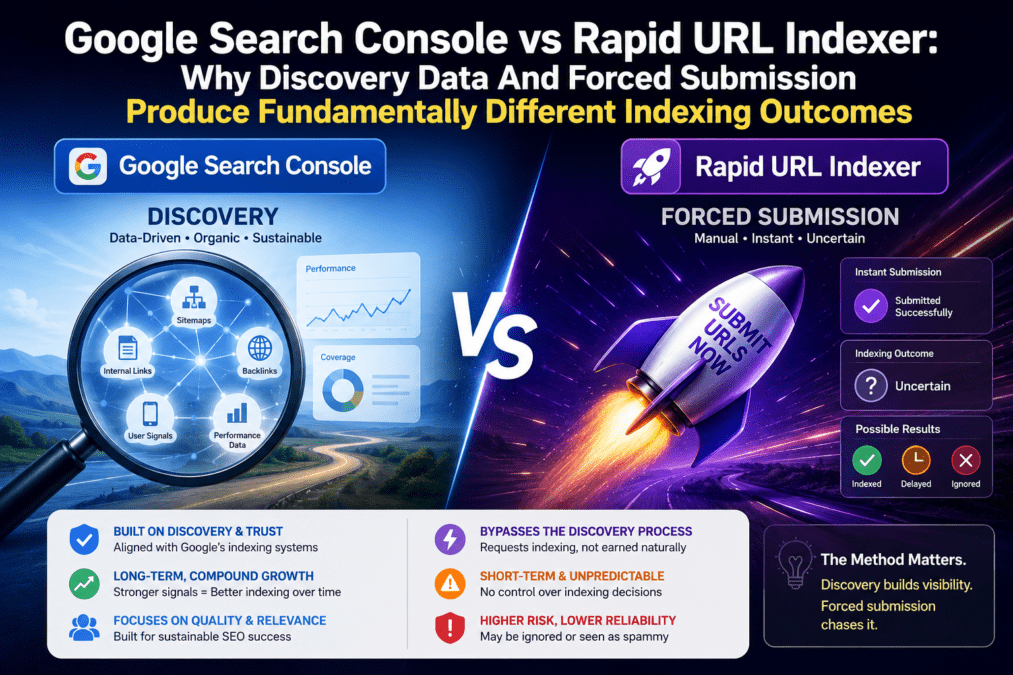

The modern search ecosystem depends heavily on how quickly and accurately web pages enter Google’s index. In this environment, the debate around google search console vs rapid url indexer has become increasingly important for publishers, SEO agencies, affiliate marketers, SaaS brands, and enterprise content teams. Both systems aim to improve visibility in search results, yet they operate using radically different philosophies, infrastructures, and expectations.
At first glance, the comparison appears simple. Google Search Console is Google’s official webmaster platform, while Rapid URL Indexer is a third-party indexing acceleration tool. However, the real comparison is not merely “official vs unofficial.” The deeper issue is whether indexing should be approached as a diagnostic ecosystem or as an active submission acceleration process. That distinction changes how SEO professionals design publishing workflows, monitor crawl efficiency, and scale content production.
The core insight behind google search console vs rapid url indexer is that the two systems are solving different problems. Google Search Console primarily helps site owners understand how Google naturally discovers and processes content, while Rapid URL Indexer attempts to accelerate discovery signals externally. One focuses on transparency and search infrastructure intelligence. The other focuses on speed and indexing stimulation. Understanding this difference is essential because many site owners incorrectly assume indexing tools directly guarantee rankings, which is not how modern search systems operate.
Defining The Two Platforms
Google Search Console is Google’s official website management platform that helps site owners monitor indexing status, crawl activity, search performance, and technical SEO health.
Rapid URL Indexer is a third-party indexing acceleration tool designed to increase the likelihood that URLs are discovered and processed faster by search engines.
While Google Search Console emphasizes reporting, diagnostics, and compliance with Google’s ecosystem, Rapid URL Indexer emphasizes external indexing stimulation and submission velocity. This distinction explains why the debate around google search console vs rapid url indexer continues to divide technical SEO professionals.
Comparative Metrics Table
| Attribute | Google Search Console | Rapid URL Indexer |
|---|---|---|
| Primary Purpose | Search visibility monitoring and diagnostics | Indexing acceleration and URL discovery stimulation |
| Ownership | Third-party SEO platform | |
| Core Function | Performance reporting and indexing oversight | Fast URL submission workflows |
| Indexing Guarantee | No | No |
| Data Reliability | Direct Google data | Indirect indexing indicators |
| Best Use Case | Long-term SEO management | Rapid content discovery support |
| Technical Transparency | High | Limited |
| Enterprise Suitability | Excellent | Conditional |
| Scalability | Very high | Depends on pricing and infrastructure |
| Risk Profile | Minimal | Varies by methodology |
| Integration With Google Ecosystem | Native | External |
| Crawl Diagnostics | Comprehensive | Limited |
| Primary Audience | Webmasters and SEO teams | Aggressive publishers and indexing-focused marketers |
Structural And Technical Foundations
The most important factor in understanding google search console vs rapid url indexer is infrastructure design. Google Search Console operates directly inside Google’s search ecosystem. That means the platform receives first-party information about crawling, indexing, search impressions, structured data errors, mobile usability, Core Web Vitals, and sitemap processing. Its architecture is diagnostic rather than manipulative. The system exists to help site owners align their websites with Google’s technical expectations.
Rapid URL Indexer operates differently. Rather than providing visibility into Google’s internal systems, it attempts to create external discovery signals that encourage crawlers to revisit submitted pages. Depending on the provider’s methodology, this may involve API submissions, ping systems, backlink generation patterns, RSS syndication triggers, or indexing network signals. The exact mechanisms are often partially proprietary.
This creates a foundational divide. In google search console vs rapid url indexer, one platform explains how indexing behaves, while the other attempts to influence indexing behavior externally. That distinction matters because indexing acceleration does not automatically translate into ranking durability. A rapidly indexed page can still disappear if content quality, authority, or user value remain weak.
Behavioral Patterns And Search Engine Interpretation
Search engines evaluate more than URL existence. Modern indexing systems assess crawl prioritization, topical relevance, freshness, authority patterns, duplication risk, internal linking quality, and engagement potential. This is why the discussion around google search console vs rapid url indexer extends beyond simple indexing speed.
Google Search Console aligns with natural crawler behavior. It encourages publishers to improve site architecture, optimize crawl paths, maintain clean sitemaps, and resolve technical issues that reduce indexing efficiency. In this model, indexing becomes the outcome of strong technical SEO and useful content ecosystems.
Rapid URL Indexer addresses a different behavioral problem: delayed discovery. Many websites, especially newer domains, struggle because crawlers revisit them infrequently. Indexing accelerators attempt to solve that lag. They do not necessarily improve quality signals; instead, they aim to increase crawler attention.
This creates an important “while” comparison sentence often overlooked in SEO discussions:
While Google Search Console improves understanding of how Google processes websites, Rapid URL Indexer focuses on increasing the probability that URLs receive faster crawl attention.
That difference explains why experienced SEO professionals rarely treat the tools as interchangeable. Instead, they often use them for entirely separate operational objectives.
Why Indexing Speed Is Frequently Misunderstood
One of the most dangerous misconceptions in the google search console vs rapid url indexer debate is the assumption that indexing speed equals SEO success. In reality, fast indexing can sometimes expose weak content more quickly rather than improve rankings.
Search systems today prioritize quality evaluation layers far beyond crawl discovery. A page may be indexed within hours yet still fail to rank because of poor authority signals, thin topical depth, weak internal linking, or insufficient trust indicators. Conversely, slower-indexed pages on authoritative domains frequently outperform aggressively submitted pages over time.
Google Search Console indirectly reinforces sustainable SEO principles because it exposes diagnostic weaknesses. Publishers can identify coverage exclusions, canonical conflicts, rendering failures, and crawl inefficiencies. Rapid URL Indexer does not usually provide that level of technical analysis. Its role is narrower.
This is why mature SEO teams increasingly frame google search console vs rapid url indexer as a workflow distinction rather than a binary replacement decision. One platform supports infrastructure optimization. The other supports indexing stimulation.
Google Search Console: Strengths And Constraints
Google Search Console remains one of the most authoritative SEO platforms available because it originates directly from Google’s ecosystem. The tool provides verified search data rather than estimated third-party metrics. This gives publishers visibility into impressions, clicks, ranking queries, coverage reports, and mobile usability performance.
A major advantage in google search console vs rapid url indexer is trustworthiness. Search Console carries virtually no strategic risk because it operates within Google’s official webmaster framework. Site owners can safely submit sitemaps, inspect URLs, validate fixes, and monitor crawl behavior without uncertainty about compliance concerns.
Another critical strength is scalability. Enterprise organizations managing millions of URLs can use Search Console data to identify crawl waste, indexing anomalies, and structural inefficiencies at scale. This diagnostic depth becomes increasingly valuable as websites grow more complex.
However, limitations exist. Google Search Console does not guarantee rapid indexing. The URL inspection request feature may encourage crawling, but Google still decides whether and when to index pages. Additionally, reporting delays can reduce real-time responsiveness for publishers operating in fast-moving news or affiliate environments.
Therefore, within the google search console vs rapid url indexer comparison, Search Console excels at transparency and ecosystem integration but is less effective for publishers demanding immediate indexing acceleration.
Rapid URL Indexer: Strengths And Constraints
Rapid URL Indexer tools appeal primarily to publishers prioritizing speed. Affiliate marketers, programmatic SEO operators, local lead generation networks, and aggressive publishing models often value faster discovery more than diagnostic reporting. This is where the attraction of google search console vs rapid url indexer becomes commercially significant.
The strongest advantage of Rapid URL Indexer systems is operational efficiency. Large batches of URLs can often be submitted quickly through automated workflows. For websites publishing hundreds or thousands of pages daily, this acceleration layer can reduce discovery lag.
Another advantage involves experimental publishing. SEO teams testing new content clusters sometimes use indexing accelerators to evaluate ranking potential rapidly before allocating long-term resources. Faster discovery can improve testing velocity.
OPNsense vs pfSense: Why Architecture Philosophy Matters More Than Raw Firewall Features
Yet the limitations are substantial. Third-party indexing systems lack direct visibility into Google’s internal decision-making. Many platforms can confirm submission activity but cannot guarantee durable indexing outcomes. Furthermore, aggressive indexing methodologies may create inconsistent results depending on algorithmic changes.
In the context of google search console vs rapid url indexer, Rapid URL Indexer performs best as a tactical acceleration mechanism rather than a comprehensive SEO management platform. Publishers who mistake indexing acceleration for ranking authority often experience unstable results.
Crawl Budget And Discovery Efficiency
Crawl budget management has become increasingly important for large websites. Search engines allocate finite crawl resources, particularly for domains with extensive URL inventories. This makes the google search console vs rapid url indexer discussion especially relevant for enterprise SEO.
Google Search Console provides insight into crawl behavior indirectly through indexing reports, sitemaps, and page status diagnostics. SEO teams can identify orphaned pages, duplicate content clusters, redirect chains, and soft 404 patterns that waste crawler attention.
Rapid URL Indexer systems do not typically optimize crawl budget structurally. Instead, they attempt to stimulate individual URL discovery externally. This may help temporarily, but it does not solve architectural inefficiencies.
For example, a poorly organized site with weak internal linking may receive temporary indexing boosts through external submissions. However, long-term crawl efficiency still depends on technical structure, information hierarchy, and content quality. This is why advanced technical SEO professionals usually prioritize architecture before acceleration tactics.
The deeper lesson in google search console vs rapid url indexer is that discovery velocity cannot permanently compensate for structural weakness.
Real-World Publishing Scenarios
The practical value of google search console vs rapid url indexer becomes clearer when evaluated through real operational environments.
Scenario 1: Enterprise SaaS Website
A SaaS company publishing authoritative documentation, support content, and educational resources benefits more from Google Search Console. Long-term crawl consistency, structured data monitoring, and search performance diagnostics matter more than rapid indexing bursts.
Scenario 2: News Publishing Environment
A digital news publisher competing in hourly search cycles may value Rapid URL Indexer tools for faster content discovery during breaking stories. In this context, indexing delays can directly reduce traffic opportunity.
Scenario 3: Affiliate Marketing Operation
Affiliate sites frequently prioritize publishing velocity and experimental content scaling. Rapid indexing tools may support testing workflows effectively, although long-term ranking stability still depends on authority and trust.
Scenario 4: Local Business SEO
Local businesses generally gain greater value from Search Console because sustainable visibility depends more on technical accuracy and content trust than aggressive indexing stimulation.
These examples demonstrate why google search console vs rapid url indexer should not be reduced to “better vs worse.” The optimal choice depends heavily on publishing model, content velocity, and operational objectives.
Data Accuracy And Reporting Reliability
Data reliability represents one of the largest contrasts in google search console vs rapid url indexer comparisons. Google Search Console provides first-party reporting directly from Google’s search systems. Although reporting delays exist, the underlying information originates from the actual search environment.
Rapid URL Indexer platforms generally rely on indirect signals. Some may track indexing appearance through search queries, crawl detection systems, or monitoring databases. However, these signals are approximations rather than native search engine reporting.
This distinction matters because SEO decisions increasingly depend on accurate diagnostic interpretation. Enterprise organizations cannot rely exclusively on probabilistic indexing indicators when managing large content ecosystems.
Another issue involves transparency. Google openly documents many Search Console features and webmaster guidelines. Third-party indexers often maintain proprietary methodologies, which can create uncertainty regarding sustainability and compliance.
Therefore, when evaluating google search console vs rapid url indexer, the question is not merely whether URLs become indexed. It is also whether publishers can trust the reporting framework guiding strategic decisions.
The Psychology Of Fast Indexing
The popularity of indexing accelerators also reflects psychological factors within SEO culture. Faster indexing creates a sense of momentum. Publishers feel their work is being recognized immediately. This emotional reinforcement explains part of the growing interest in google search console vs rapid url indexer.
However, indexing visibility can produce misleading confidence. Many publishers celebrate indexed pages without evaluating ranking persistence, traffic quality, or conversion performance. In some cases, rapid indexing merely exposes content to quality evaluation faster.
Google Search Console promotes a more analytical mindset because its dashboards emphasize performance trends, coverage issues, and long-term search behavior rather than instant gratification. This difference subtly shapes SEO strategy itself.
The comparison therefore extends beyond software mechanics into behavioral economics. One system rewards patience and optimization. The other rewards acceleration and immediacy.
Scientific And Expert Consensus (2026)
The emerging professional consensus surrounding google search console vs rapid url indexer is increasingly nuanced. Technical SEO experts generally agree on several key principles in 2026.
First, indexing acceleration tools can improve discovery timing under certain conditions, especially for low-authority or infrequently crawled domains. Second, no indexing tool can permanently compensate for weak content quality or poor site architecture. Third, first-party search diagnostics remain essential for sustainable SEO growth.
Industry analysis increasingly suggests that Google’s systems have become more selective rather than simply slower. Modern indexing algorithms evaluate quality thresholds before allocating persistent crawl attention. This means acceleration alone offers diminishing returns if content ecosystems lack authority.
Experts also note that Search Console’s value extends beyond indexing. It functions as a strategic intelligence platform revealing search demand patterns, query performance shifts, and technical health indicators. Rapid indexing tools do not replace that function.
As a result, the dominant expert position in the google search console vs rapid url indexer discussion is hybrid usage. Many advanced publishers use Search Console for diagnostics and governance while selectively using indexing accelerators tactically for time-sensitive publishing workflows.
Which Platform Performs Better For Different SEO Models?
A direct answer to the google search console vs rapid url indexer question depends entirely on operational priorities.
For sustainable SEO governance, Google Search Console performs better because it integrates directly with Google’s ecosystem and provides actionable technical intelligence.
For aggressive publishing velocity and rapid discovery testing, Rapid URL Indexer tools may provide faster operational feedback loops.
For enterprise organizations, Search Console is usually indispensable.
For experimental publishers operating at extreme scale, indexing accelerators may supplement discovery processes.
For beginners, Search Console offers significantly more educational value because it teaches how search systems actually behave.
For highly competitive niches where timing matters, rapid indexing tools can create short-term tactical advantages.
The key insight is that the tools address different stages of the search lifecycle rather than identical functions.
Direct Answer: Which Is Better?
Here is the concise answer many publishers search for:
In the comparison between google search console vs rapid url indexer, Google Search Console is generally better for long-term SEO management and technical reliability, while Rapid URL Indexer is better suited for accelerating URL discovery in fast-paced publishing environments. The best choice depends on whether the primary goal is sustainable search intelligence or rapid indexing stimulation.
Final Synthesis And Verdict
The debate around google search console vs rapid url indexer ultimately reflects two competing philosophies within modern SEO. One philosophy prioritizes alignment with search engine systems, technical transparency, and long-term authority building. The other prioritizes operational speed, discovery acceleration, and indexing responsiveness.
Google Search Console represents the institutional model of SEO. It encourages structured optimization, diagnostic precision, and ecosystem compliance. Its greatest strength is not indexing acceleration but strategic visibility into how Google interprets websites.
Rapid URL Indexer represents the tactical model of SEO. It focuses on overcoming discovery delays and increasing indexing responsiveness. Its greatest strength is speed, particularly for publishers operating in highly competitive or rapidly changing environments.
Neither platform independently guarantees rankings, traffic, or authority. Search success still depends on content quality, topical relevance, user value, technical structure, and trust signals. That is the most important conclusion often lost in simplistic comparisons.
The smartest SEO organizations in 2026 no longer ask whether google search console vs rapid url indexer has a universal winner. Instead, they evaluate how each tool fits into broader search infrastructure strategy. In mature workflows, diagnostic intelligence and tactical acceleration are not enemies. They are complementary layers within a much larger search visibility ecosystem.
Frequently Asked Questions
Is Google Search Console enough for indexing pages?
For many websites, yes. Google Search Console can effectively support indexing through sitemap submission, URL inspection, and technical diagnostics. However, newer or lower-authority websites may still experience slow discovery cycles despite proper setup.
Does Rapid URL Indexer guarantee Google indexing?
No. Rapid URL Indexer tools may improve discovery speed, but they cannot guarantee permanent indexing or rankings. Google still determines whether pages meet quality and relevance thresholds.
Why do SEO professionals use both tools together?
Many professionals combine the diagnostic strengths of Google Search Console with the acceleration benefits of indexing tools. This hybrid approach helps balance long-term technical SEO management with short-term publishing speed.
Which is safer in the long term: google search console vs rapid url indexer?
Google Search Console is generally safer because it operates directly within Google’s official ecosystem. Third-party indexing methods vary significantly, and their effectiveness can change as search algorithms evolve.