
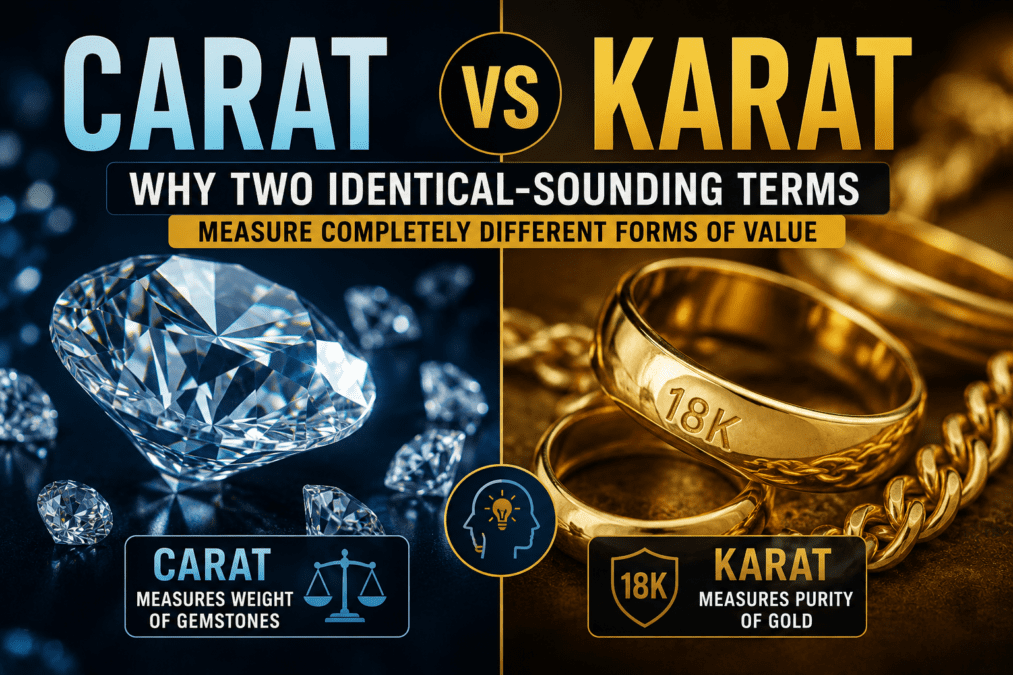

The debate around carat vs karat is surprisingly common because the two words sound identical, are often abbreviated similarly, and both are heavily associated with jewelry. Yet despite their phonetic similarity, they represent entirely different measurement systems. One evaluates gemstone weight, while the other measures gold purity. Confusing them can lead to misunderstandings about quality, value, and even purchasing decisions.
A meaningful carat vs karat comparison requires examining their origins, scientific definitions, industry applications, and economic implications. Rather than treating them as interchangeable jewelry terminology, it is more accurate to view them as separate standards developed to quantify different physical characteristics.
The central insight in the carat vs karat discussion is that neither term is inherently more important than the other. A diamond’s value depends significantly on carat weight, while a gold item’s value depends heavily on karat purity. One measures mass; the other measures composition. Understanding this distinction eliminates one of the most persistent misconceptions in the jewelry industry.
Essential Comparative Metrics
| Attribute | Carat | Karat |
|---|---|---|
| Primary Purpose | Measures gemstone weight | Measures gold purity |
| Abbreviation | ct | K or kt |
| Used For | Diamonds and gemstones | Gold jewelry and gold products |
| Scientific Basis | Mass measurement | Composition measurement |
| International Standard | 1 carat = 200 milligrams | 24 karats = pure gold |
| Higher Number Means | Heavier gemstone | Purer gold |
| Maximum Standard Value | No fixed maximum | 24K |
| Value Influence | Size and rarity | Gold content |
| Industry Sector | Gemology | Precious Metals |
What Is the Difference Between Carat and Karat?
A carat is a unit of weight used to measure diamonds and other gemstones. One carat equals exactly 200 milligrams.
A karat is a unit that measures the purity of gold. Twenty-four karat gold represents pure gold, while lower karat values indicate gold mixed with other metals.
In the simplest carat vs karat explanation, carat measures how heavy a gemstone is, while karat measures how much pure gold exists within a metal alloy.
While carat determines gemstone weight, karat determines gold purity, making them fundamentally different measurement systems despite their nearly identical pronunciation.
Direct Answer
The difference between carat vs karat is straightforward: carat measures gemstone weight and karat measures gold purity. A one-carat diamond weighs 200 milligrams, whereas 24-karat gold contains nearly 100% pure gold. The two terms are unrelated scientifically and serve distinct purposes within the jewelry and precious-metals industries.
Structural And Historical Foundations
The origins of the carat vs karat distinction reveal why the two terms developed separately despite sharing linguistic roots. Historically, gemstone traders used carob tree seeds as reference weights because the seeds were relatively uniform in mass. Over time, this practice evolved into the standardized carat system used globally today.
Karat emerged from a different commercial need. Goldsmiths required a reliable way to describe the proportion of pure gold within an alloy. Because pure gold is soft and often impractical for everyday jewelry, artisans mixed it with metals such as silver, copper, nickel, or zinc. The karat system became the accepted method for communicating purity.
Modern international standards transformed both concepts into precise measurements. The gemstone industry standardized the carat at exactly 200 milligrams, while the precious-metals industry formalized purity percentages based on a 24-part scale. These developments reinforced the essential difference in the carat vs karat comparison: one concerns weight, the other composition.
Measurement Science And Technical Framework
From a scientific perspective, carat vs karat represents two completely different measurement categories.
Carat belongs to the field of mass measurement. Like grams, kilograms, and ounces, it quantifies physical weight. A two-carat diamond weighs twice as much as a one-carat diamond, although it may not appear twice as large due to variations in shape, cut, and density.
Karat belongs to material composition analysis. Instead of measuring weight, it measures the percentage of pure gold within a piece of metal. The calculation follows a simple formula:
Gold Purity Percentage = (Karat ÷ 24) × 100
Using this framework:
- 24K gold = 99.9%+ gold
- 22K gold = approximately 91.7% gold
- 18K gold = 75% gold
- 14K gold = 58.3% gold
- 10K gold = 41.7% gold
This scientific distinction lies at the heart of every carat vs karat discussion. One answers “How much does it weigh?” while the other answers “How pure is it?”
Economic Value And Market Influence
The economic implications of carat vs karat are substantial because each measurement affects value differently.
For gemstones, increasing carat weight often produces exponential increases in price. Large diamonds are significantly rarer than small diamonds. Consequently, a two-carat diamond may cost considerably more than twice the price of a one-carat diamond of equivalent quality.
Gold valuation follows a different logic. Karat directly influences intrinsic metal value because higher purity means more gold content. A 24K gold item generally contains more valuable gold than an 18K item of equal weight.
The market therefore evaluates carat vs karat according to separate principles:
- Carat influences rarity and gemstone desirability.
- Karat influences precious-metal content.
- Carat affects visual presence.
- Karat affects material composition.
- Carat contributes to diamond grading.
- Karat contributes to gold valuation.
These distinctions explain why jewelers discuss both measurements simultaneously when evaluating complex pieces containing gemstones and gold settings.
Behavioral Patterns And Consumer Understanding
Consumer behavior surrounding carat vs karat reveals a fascinating pattern of misunderstanding. Many buyers assume both terms indicate quality, yet they indicate different forms of quality.
When consumers hear “higher carat,” they often think of a larger diamond. When they hear “higher karat,” they usually think of purer gold. Both assumptions are generally correct, but the underlying mechanisms differ dramatically.
Research into purchasing behavior shows that buyers frequently prioritize visible characteristics. A larger diamond attracts immediate attention because size is visually apparent. Gold purity, by contrast, is harder to assess visually and often requires hallmarks or certification.
This creates an interesting dynamic in the carat vs karat conversation. Carat often influences emotional and aesthetic appeal, whereas karat frequently influences perceived luxury, investment value, and long-term worth.
Understanding these psychological factors helps explain why both measurements remain central to jewelry marketing and consumer decision-making.
Carat: Strengths And Constraints
In the carat vs karat comparison, carat possesses several unique strengths.
The primary advantage of carat is standardization. Every gemstone can be measured precisely using the same unit. This creates transparency and consistency across international markets.
Carat weight also helps consumers compare stones objectively. A 1.5-carat diamond is universally recognized as weighing more than a one-carat diamond regardless of geographic location.
However, carat has limitations. Many consumers incorrectly assume larger automatically means better. In reality, gemstone quality depends on multiple factors, including cut, clarity, color, and overall craftsmanship.
A poorly cut two-carat diamond may appear less brilliant than a well-cut one-carat diamond. Consequently, relying exclusively on carat weight can result in distorted value assessments.
The carat vs karat discussion highlights this limitation clearly: weight alone does not determine overall gemstone quality, just as purity alone does not determine overall jewelry performance.
Karat: Strengths And Constraints
Karat’s greatest strength is its ability to communicate gold purity quickly and accurately.
Within the carat vs karat framework, karat provides consumers with a direct understanding of precious-metal content. Higher karat values generally indicate greater gold concentration, which often correlates with increased intrinsic value.
Yet higher purity is not always preferable for practical use. Pure gold is relatively soft and susceptible to scratching, bending, and wear. This characteristic introduces important trade-offs.
For example:
- 24K offers maximum purity.
- 22K balances purity with moderate durability.
- 18K provides luxury and strength.
- 14K offers excellent everyday durability.
- 10K maximizes toughness but contains less gold.
As a result, the highest karat rating is not automatically the best choice for every application. Wedding rings, engagement rings, and frequently worn jewelry often benefit from lower-karat alloys due to improved resilience.
This practical reality makes the carat vs karat distinction especially important for informed purchasing decisions.
Comparative Advantages In Real-World Scenarios
The real-world relevance of carat vs karat becomes evident when examining common jewelry-buying situations.
Diamond Engagement Rings
Carat weight strongly influences visual impact and prestige. Buyers frequently compare one-carat, two-carat, and three-carat diamonds when evaluating engagement rings.
At the same time, the ring setting may be 14K, 18K, or 22K gold. Here, carat and karat operate simultaneously but independently.
Investment Purchases
Gold investors typically focus on karat because purity directly affects bullion value.
Gemstone investors, meanwhile, prioritize carat because larger stones tend to command premium prices due to rarity.
Luxury Jewelry
Luxury brands often optimize both measurements. They combine high-carat gemstones with high-karat gold to create pieces that maximize visual appeal and material value.
Everyday Jewelry
Durability becomes more important than maximum purity. Many consumers choose 14K or 18K gold while selecting gemstone sizes based on budget and style preferences.
These examples demonstrate that the carat vs karat comparison is not about superiority. Instead, it is about understanding which metric matters most in a given context.
Common Myths And Misconceptions
The persistence of confusion surrounding carat vs karat has produced several widespread myths.
Myth 1: Carat and Karat Mean the Same Thing
This is the most common misconception. They measure entirely different characteristics.
Myth 2: Higher Carat Always Means Better Jewelry
Carat measures gemstone weight, not craftsmanship, brilliance, or overall quality.
Myth 3: 24K Gold Is Always Superior
While 24K contains more gold, lower-karat alloys may perform better for everyday wear.
Myth 4: Larger Diamonds Are Automatically More Valuable
Two diamonds with identical carat weights can have dramatically different values based on cut, color, and clarity.
Myth 5: Karat Measures Gold Weight
Karat measures purity rather than weight. A heavier piece of lower-karat gold may contain more total gold than a lighter piece of higher-karat gold.
Correcting these misconceptions is essential for a meaningful understanding of carat vs karat.
Scientific And Expert Consensus (2026)
The scientific and professional consensus in 2026 is remarkably clear regarding carat vs karat.
Gemologists universally recognize carat as the standardized weight measurement for gemstones. Its precision enables accurate grading, valuation, and international trade.
Metallurgists and precious-metals experts universally recognize karat as the accepted gold-purity standard. The 24-part system remains the dominant framework for assessing gold composition across major markets.
Industry experts generally agree on several conclusions:
- Carat and karat should never be used interchangeably.
- Carat affects gemstone rarity and market pricing.
- Karat affects gold purity and intrinsic metal value.
- Both measurements are essential for jewelry evaluation.
- Neither metric independently determines overall quality.
The modern jewelry industry therefore treats carat vs karat as complementary concepts rather than competing ones.
Future Trends And Industry Evolution
Technological advances are changing how consumers engage with the carat vs karat distinction.
Digital certification systems now allow buyers to verify gemstone weight and gold purity instantly through online databases and QR-linked documentation. Advanced spectroscopy tools have also improved gold-purity verification.
Meanwhile, laboratory-grown diamonds have increased consumer awareness of carat measurements because buyers compare stone size more carefully against production methods and pricing structures.
The gold industry is similarly evolving through enhanced purity testing and greater transparency in international supply chains.
Despite these technological changes, the core definitions underlying carat vs karat remain unchanged. Weight continues to define gemstones, and purity continues to define gold.
Final Synthesis And Verdict
The most important conclusion in the carat vs karat discussion is that the two terms answer fundamentally different questions.
Carat measures gemstone weight. Karat measures gold purity.
A higher carat number indicates a heavier gemstone, while a higher karat number indicates a greater proportion of pure gold. Neither system is superior because each serves a distinct purpose within jewelry evaluation.
When comparing carat vs karat, consumers should focus on context. If assessing diamonds or gemstones, carat is the critical metric. If evaluating gold jewelry, karat becomes the relevant standard. In many premium jewelry pieces, both measurements matter simultaneously.
Ultimately, the confusion surrounding carat vs karat disappears once their functions are understood. One quantifies mass, the other quantifies composition. Together, they form two of the most important measurement standards in the global jewelry industry.
Frequently Asked Questions
Is carat the same as karat?
No. In the carat vs karat comparison, carat measures gemstone weight, while karat measures gold purity. They are separate measurement systems used for different materials.
Which is more valuable: higher carat or higher karat?
They measure different things. Higher carat gemstones may be more valuable because of rarity and size, while higher karat gold contains more pure gold and therefore often has greater intrinsic metal value.
Why do carat and karat sound the same?
The terms share historical linguistic roots that evolved over centuries. Although their pronunciation is nearly identical, their meanings diverged into separate commercial standards.
Is 24K gold better than 18K gold?
Not necessarily. Twenty-four-karat gold offers higher purity, but 18K gold often provides greater durability and resistance to everyday wear. The best choice depends on intended use.
Can a diamond have a karat rating?
No. Diamonds are measured in carats, not karats. Karat ratings apply only to gold purity. This distinction is central to understanding carat vs karat correctly.