
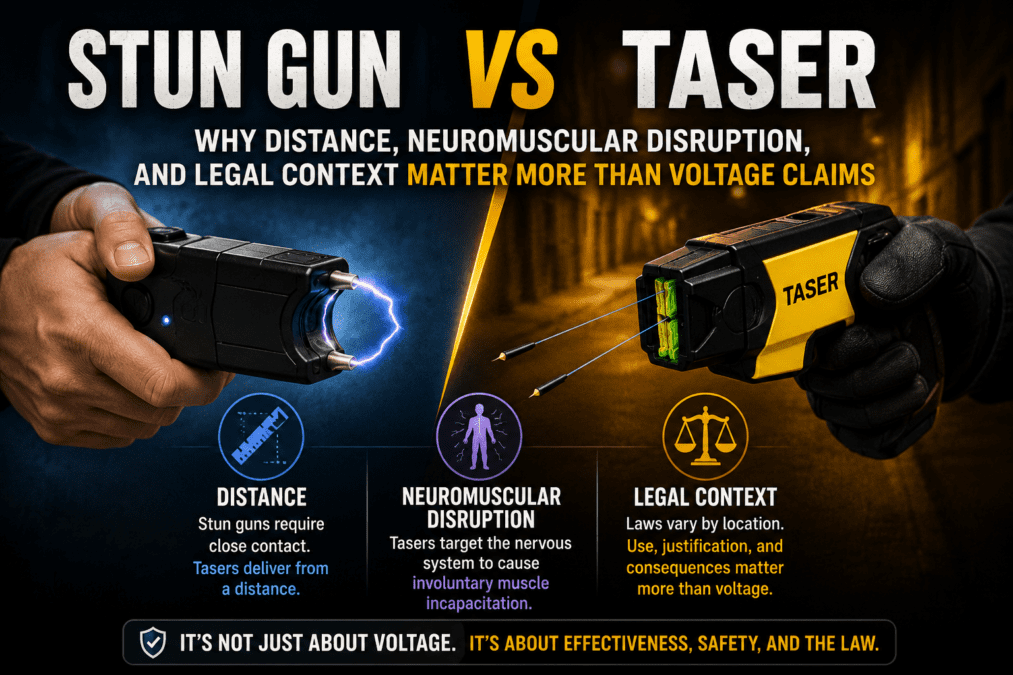

The debate around stun gun vs taser technology has evolved far beyond simple discussions about voltage or pain compliance. Both devices are categorized as conducted electrical weapons, yet they operate through fundamentally different delivery systems, tactical assumptions, and physiological effects. In modern civilian security, law enforcement, and personal defense conversations, the comparison increasingly centers on reliability, distance management, incapacitation capability, and risk mitigation rather than raw electrical output.
A meaningful stun gun vs taser comparison requires analyzing engineering design, behavioral outcomes, deployment conditions, legal restrictions, and real-world usability. While both devices use electrical energy to disrupt or discourage aggression, they do so through very different mechanisms. A stun gun generally requires direct physical contact with the target, whereas a taser commonly deploys probes attached to wires that can incapacitate an individual from several feet away. That difference alone changes the tactical role of each tool.
The most surprising insight in the stun gun vs taser discussion is that higher voltage numbers often matter less than pulse modulation, neuromuscular disruption, and situational control. Marketing frequently emphasizes dramatic voltage claims, but experts in defensive technology and law enforcement training consistently focus more on reliability under stress, muscle incapacitation capability, and the ability to create distance during an encounter. In many real-world scenarios, distance and precision determine effectiveness more than electrical intensity.
Essential Comparative Metrics
| Category | Stun Gun | Taser |
|---|---|---|
| Device Type | Contact-based electrical defense device | Projectile-based conducted electrical weapon |
| Main Purpose | Pain compliance | Neuromuscular incapacitation |
| Contact Requirement | Requires direct physical contact | Can work from a distance |
| Typical Range | 0 feet | 7–25 feet |
| Delivery System | Metal electrodes | Wired probes |
| Physical Distance Safety | Low | High |
| Ease Of Use | Simple | Requires more training |
| Effect On Target | Pain and disorientation | Temporary muscle disruption |
| Reliability Against Aggressive Threats | Moderate | Higher |
| Performance Under Stress | Depends on close access | Depends on aiming accuracy |
| Effectiveness Through Clothing | Usually effective with direct contact | May be reduced by thick clothing |
| Number Of Immediate Uses | Repeated contact possible | Usually one cartridge before reload |
| Cost | Lower | Higher |
| Civilian Availability | More common | More regulated |
| Maintenance | Battery charging | Battery and cartridge maintenance |
| Common Users | Civilians and security guards | Police and trained civilians |
| Best Environment | Tight indoor spaces | Open environments |
| Major Advantage | Compact and affordable | Distance control |
| Major Weakness | Requires close proximity | Probe failure risk |
| Overall Tactical Role | Emergency escape tool | Distance incapacitation tool |
A stun gun is a handheld electrical self-defense device that requires direct physical contact to deliver an electrical shock intended to cause pain and temporary disorientation. A taser is a conducted electrical weapon that fires probes connected by wires to disrupt voluntary muscle control from a distance.
In practical defensive situations, stun gun vs taser effectiveness depends less on advertised voltage and more on range management, reliability, stress performance, and the user’s ability to deploy the device accurately under pressure.
For most security experts, the central difference in the stun gun vs taser debate is that stun guns primarily create pain compliance while tasers are designed to achieve temporary neuromuscular incapacitation. That distinction affects tactical safety, escape opportunities, and overall defensive outcomes in unpredictable encounters.
Structural And Technological Foundations
The engineering differences between stun guns and tasers explain why they perform differently under stress. A stun gun is structurally simple. It usually contains a rechargeable battery, capacitor system, safety switch, and exposed electrodes. When activated against a person’s body, the electrical current travels through localized tissue, creating pain, muscle contraction, and confusion. The simplicity of this architecture contributes to lower cost and widespread consumer availability.
A taser uses a more sophisticated system involving compressed gas or propellant mechanisms that launch probes connected to conductive wires. The probes attach to clothing or skin and complete a circuit over a broader area of the body. This larger electrical pathway allows the device to interfere with neuromuscular signaling. Instead of merely producing pain, the system attempts to interrupt voluntary motor control.
This technological distinction changes how experts evaluate stun gun vs taser performance. A stun gun functions primarily as a close-contact deterrent, while a taser functions as a distance-management incapacitation system. The hardware itself reflects these different objectives. Tasers require more calibration, probe alignment, and energy regulation, whereas stun guns emphasize portability and immediate accessibility.
Electrical Mechanics And Physiological Impact
One of the most misunderstood aspects of the stun gun vs taser conversation involves the role of voltage. Many consumers incorrectly assume that higher voltage automatically means greater stopping power. In reality, amperage, pulse frequency, waveform design, and delivery duration matter more in determining physiological effects.
Stun guns typically create intense localized pain by stimulating sensory nerves and causing superficial muscle contractions. The electrical current is concentrated near the point of contact. Although the experience can be extremely painful and psychologically disorienting, it may not reliably stop a determined attacker, particularly someone under the influence of stimulants, adrenaline, or alcohol.
Tasers operate differently because they are engineered to induce neuromuscular incapacitation. By sending pulsed electrical signals through a broader region of the body, the device can override communication between the brain and skeletal muscles. This temporary disruption often causes the target to lose coordinated movement and collapse.
The physiological distinction is critical in stun gun vs taser evaluations. Pain compliance depends partly on the target’s psychological response, while neuromuscular incapacitation relies more heavily on involuntary muscular disruption. That is why law enforcement agencies historically favored tasers for suspect control in high-risk encounters.
Behavioral Patterns And Psychological Response
Human behavior during violent encounters is unpredictable, which is why the stun gun vs taser comparison extends beyond electrical engineering into behavioral science. Threat response patterns vary based on stress hormones, intoxication levels, pain tolerance, mental state, and situational awareness.
A stun gun often relies on psychological deterrence before physical contact even occurs. The visible electrical arc and crackling sound can discourage aggression in some situations. Researchers and security trainers frequently note that auditory intimidation alone sometimes alters attacker behavior. However, deterrence is not guaranteed. Highly aggressive individuals may continue advancing despite the threat display.
Tasers influence behavior differently because the target understands that distance no longer guarantees safety. The ability to incapacitate someone from several feet away changes the psychological dynamics of confrontation. In many documented encounters, the visible laser aiming system and awareness of incapacitation capability produce immediate compliance before deployment becomes necessary.
In the broader stun gun vs taser analysis, behavioral outcomes matter because real-world confrontations rarely unfold in controlled environments. Fear, chaos, confined spaces, and rapid escalation can affect whether a defensive tool succeeds. Devices that reduce the need for physical struggle often provide psychological advantages for users facing larger or more aggressive attackers.
Historical Development And Adoption Trends
The historical evolution of conducted electrical weapons provides additional context for the stun gun vs taser debate. Early stun gun devices became commercially popular in the late twentieth century because they offered civilians a non-lethal defensive option that was portable and relatively inexpensive.
Taser technology followed a different trajectory. Although early concepts existed decades earlier, modern tasers gained widespread institutional adoption when law enforcement agencies sought alternatives to firearms during suspect apprehension. The ability to incapacitate individuals without immediate lethal force aligned with changing public expectations surrounding police use-of-force protocols.
As technology improved, tasers became integrated into law enforcement training programs across multiple countries. Agencies emphasized controlled escalation models, situational judgment, and reduced firearm reliance. Meanwhile, civilian stun guns remained more common in personal defense markets due to lower pricing and fewer regulatory barriers.
This historical divergence shaped public perception in the stun gun vs taser conversation. Stun guns became associated with accessible civilian self-defense, while tasers became associated with professional tactical deployment. Those associations continue influencing consumer trust, training standards, and legal classification today.
Subject A: Strengths And Constraints Of Stun Guns
The primary strength of a stun gun lies in simplicity. Most models are compact, rechargeable, and easy to carry. Users generally require minimal training to understand basic operation. In sudden emergencies, straightforward controls may reduce hesitation and confusion.
Another advantage in the stun gun vs taser comparison is affordability. Stun guns are typically far less expensive than taser systems because they lack cartridges, compressed propulsion systems, and sophisticated targeting technology. This lower cost expands accessibility for consumers seeking non-lethal self-defense tools.
However, stun guns have substantial limitations. The requirement for direct physical contact creates major tactical disadvantages. A user must be within arm’s reach of the aggressor, which increases the risk of injury, weapon loss, or escalation into physical struggle. Against multiple attackers, close-range dependency becomes even more problematic.
Effectiveness also varies considerably based on contact duration, electrode placement, clothing thickness, and the target’s pain tolerance. In many stun gun vs taser case analyses, stun guns succeed best as escape-assistance tools rather than guaranteed incapacitation devices. They can create valuable seconds for disengagement, but they are less reliable for immediate threat immobilization.
Subject B: Strengths And Constraints Of Tasers
The greatest strength of a taser is distance control. Maintaining separation from an aggressor dramatically changes defensive dynamics. Instead of entering grappling range, the user can respond while preserving mobility and reaction time.
Tasers are also designed for greater incapacitation reliability. When probes spread effectively across the body and establish a complete circuit, the device can temporarily override muscular coordination. This capability explains why tasers became standard equipment in many policing environments.
Yet the stun gun vs taser comparison also reveals meaningful weaknesses for tasers. They are technologically complex, expensive, and more dependent on proper deployment technique. Probe spread, clothing thickness, movement, environmental obstacles, and cartridge limitations can reduce effectiveness.
A taser generally offers only one primary shot before reload. If the probes miss or fail to connect properly, the user may lose a crucial opportunity during a rapidly evolving threat encounter. Additionally, legal restrictions surrounding tasers are stricter in some jurisdictions, and training expectations are often higher.
Therefore, while tasers offer superior range and incapacitation potential in the stun gun vs taser discussion, they also require greater preparation, maintenance, and situational awareness.
Comparative Advantages In Real-World Scenarios
Real-world application is where the stun gun vs taser comparison becomes most meaningful. Controlled testing environments cannot fully replicate the unpredictability of actual defensive encounters.
In confined spaces such as elevators, narrow hallways, or crowded rooms, a stun gun may retain practical utility because engagement distances are already extremely short. The device can sometimes be deployed quickly during close-contact emergencies where there is little opportunity to create distance.
Tasers excel in scenarios involving advancing threats at moderate range. Parking lots, sidewalks, residential entrances, and security checkpoints are examples where maintaining separation may improve survivability. Distance gives the defender more time to assess behavior, retreat, or seek assistance.
Environmental conditions also matter. Heavy winter clothing can interfere with taser probe penetration, while rain and physical movement may complicate both devices. In multi-attacker scenarios, neither tool guarantees control, but tasers may provide better initial disruption opportunities due to range advantage.
Experts evaluating stun gun vs taser effectiveness consistently emphasize context over marketing claims. The best device depends on environment, training, physical ability, threat type, and legal limitations.
Training Requirements And Human Performance Under Stress
Stress physiology significantly affects defensive tool performance. During high-adrenaline encounters, fine motor skills deteriorate, tunnel vision increases, and reaction time changes. As a result, defensive technology cannot be evaluated independently from human performance.
A stun gun’s operational simplicity can be advantageous for inexperienced users. Most involve basic activation and contact application. However, reaching an attacker while under stress remains psychologically difficult for many individuals.
Tasers require more structured training because users must understand probe trajectory, cartridge replacement, target distance, and aiming principles. Misjudging spacing can reduce probe spread and limit neuromuscular disruption. Under stress, even trained users may struggle with accuracy.
The human-performance dimension complicates simplistic stun gun vs taser conclusions. A theoretically superior device may fail if the user cannot deploy it effectively. Many self-defense instructors therefore prioritize situational awareness, avoidance, and escape planning alongside tool selection.
Research in defensive behavior also shows that familiarity and repetition improve performance. Individuals who regularly practice safe handling and scenario awareness are generally more effective than those relying solely on device ownership.
Legal Classification And Regulatory Differences
Legal regulation is one of the most important yet overlooked dimensions of the stun gun vs taser conversation. Jurisdictional rules vary dramatically across countries, states, and municipalities.
In some regions, stun guns are widely legal for civilian possession with minimal restrictions. Elsewhere, they may require permits or be prohibited entirely. Tasers often face stricter oversight because regulators perceive projectile-based incapacitation systems as more tactically powerful.
Legal frameworks frequently distinguish between possession, concealed carry, transportation, and use. A device that is lawful to own may still carry restrictions regarding public carry or defensive deployment. Courts also evaluate whether force usage was proportionate to the threat level.
Another important issue in stun gun vs taser analysis is liability. Improper use can lead to criminal charges or civil lawsuits, especially if excessive force claims arise. Security professionals and civilian users alike are expected to understand local regulations and use-of-force principles.
The legal environment ultimately influences adoption patterns. Consumers often choose devices not only based on performance but also on regulatory accessibility and perceived legal risk.
Scientific And Expert Consensus (2026)
By 2026, expert consensus surrounding conducted electrical weapons has become more nuanced than earlier public debates suggested. Researchers generally agree that tasers provide more reliable incapacitation potential than traditional stun guns because of their ability to disrupt neuromuscular control from a distance.
At the same time, experts also acknowledge that no conducted electrical weapon guarantees immediate incapacitation in every scenario. Probe placement, physiological variability, mental state, and environmental conditions all influence outcomes.
Medical researchers continue examining cardiovascular risks, secondary injuries from falls, and complications involving vulnerable populations. Most studies conclude that serious injury remains relatively uncommon when devices are used appropriately, but risks are not nonexistent. This balanced perspective has replaced earlier narratives portraying conducted electrical weapons as either completely harmless or universally dangerous.
Security trainers increasingly frame the stun gun vs taser discussion around layered defense strategies rather than miracle solutions. Awareness, de-escalation, escape routes, communication, and emergency planning remain foundational principles.
The expert consensus in 2026 also emphasizes realistic expectations. Stun guns are generally viewed as deterrence and pain-compliance tools, while tasers are viewed as distance-based incapacitation systems with greater tactical effectiveness but more operational complexity.
Marketing Myths And Consumer Misunderstanding
Marketing language has contributed significantly to confusion in the stun gun vs taser market. Manufacturers often advertise extreme voltage numbers that create misleading impressions about stopping power.
In reality, voltage alone does not determine effectiveness. Electrical delivery pattern, pulse duration, target physiology, and contact quality are more important. A device with dramatic voltage marketing may still perform inconsistently in actual confrontations.
Another widespread myth is that all conducted electrical weapons function identically. Consumers frequently use “taser” as a generic term for all electrical defense devices, even though the underlying technologies differ substantially. This misunderstanding can lead buyers to assume they are purchasing distance incapacitation capability when they are actually buying a contact-based stun device.
Experts analyzing stun gun vs taser products also caution against unrealistic expectations created by online demonstration videos. Controlled demonstrations often involve cooperative subjects and ideal conditions. Real defensive encounters involve movement, fear, clothing barriers, and unpredictable resistance.
Consumers benefit most from understanding realistic strengths and limitations rather than relying on exaggerated marketing narratives.
Ethical Considerations And Public Debate
The stun gun vs taser conversation also intersects with ethical questions regarding force, compliance, and public safety. Advocates argue that conducted electrical weapons provide alternatives to more lethal methods and can reduce firearm usage during dangerous encounters.
Critics, however, raise concerns about misuse, overreliance, and deployment against vulnerable individuals. Civil liberties organizations have questioned whether some agencies used tasers too quickly in situations that may have been resolved through de-escalation.
This ethical debate has influenced policy reforms, mandatory reporting standards, and body-camera integration in many jurisdictions. Training increasingly emphasizes proportional response, communication skills, and accountability.
For civilians, ethical concerns are somewhat different but still important. Defensive tools should ideally prioritize escape and personal safety rather than punishment or confrontation. Many instructors stress that avoidance remains preferable whenever possible.
The ethical dimension of stun gun vs taser analysis reminds consumers that technology alone cannot replace judgment. Responsible use depends on context, restraint, and understanding the consequences of force deployment.
Reliability, Maintenance, And Operational Readiness
Reliability becomes critically important during emergencies because defensive tools are often used under severe time pressure. A device that functions inconsistently may create false confidence.
Stun guns generally benefit from mechanical simplicity. Fewer moving parts and straightforward charging systems can reduce maintenance complexity. However, battery neglect remains common among civilian owners. Devices stored for long periods without charging may fail unexpectedly.
Tasers involve additional maintenance considerations including cartridge replacement, probe inspection, battery monitoring, and electronic diagnostics. Because they rely on projectile deployment, they contain more components that can malfunction.
Operational readiness therefore plays a major role in the stun gun vs taser debate. Experts often recommend regular function checks, familiarity drills, and secure storage practices. Ownership without maintenance undermines defensive reliability.
Environmental durability also matters. Exposure to moisture, extreme temperatures, or impact damage can affect both device categories. Professional users typically follow scheduled inspection routines to ensure readiness.
Gender, Physical Strength, And Defensive Accessibility
One reason conducted electrical weapons remain popular is that they may help reduce physical strength disparities during violent encounters. This factor appears frequently in the stun gun vs taser discussion, especially in personal safety contexts.
For individuals with limited upper-body strength, maintaining distance can be especially important. Tasers may therefore offer psychological reassurance because they reduce reliance on close-range physical confrontation.
Stun guns, however, remain attractive due to affordability and compactness. Some users prefer smaller devices that fit discreetly into bags or pockets. Accessibility and portability can influence whether a defensive tool is actually carried consistently.
Experts caution that no device fully compensates for situational disadvantages. Awareness, escape planning, verbal boundary-setting, and environmental scanning remain essential regardless of physical strength or chosen tool.
Still, the stun gun vs taser comparison highlights how defensive technology attempts to address asymmetrical threat dynamics. Devices that create time and distance can improve opportunities for escape and emergency response.
Future Innovations In Conducted Electrical Weapons
Emerging technology is likely to reshape the stun gun vs taser landscape over the next decade. Manufacturers are already integrating smart diagnostics, digital evidence systems, improved battery efficiency, and enhanced targeting support.
Law enforcement-focused tasers increasingly incorporate camera systems and data recording features designed to improve accountability and post-incident review. Civilian models may eventually adopt simplified versions of these capabilities.
Miniaturization trends are also changing product design. Smaller yet more energy-efficient systems could improve portability without sacrificing functionality. Advances in battery chemistry may allow longer operational life and faster charging.
Artificial intelligence-assisted targeting remains speculative but technologically plausible. Future systems may incorporate sensors capable of improving probe alignment or analyzing deployment conditions.
At the same time, ethical and regulatory debates will likely intensify as capabilities expand. The future of stun gun vs taser technology will depend not only on engineering progress but also on evolving societal expectations surrounding force, accountability, and civilian self-defense.
Consumer Decision Factors And Practical Selection Criteria
Choosing between a stun gun and a taser requires realistic self-assessment rather than emotional marketing influence. Buyers should consider training willingness, local laws, carrying habits, budget, and probable defensive scenarios.
Individuals seeking a low-cost emergency deterrent may prefer stun guns because they are accessible and mechanically simple. Those prioritizing distance control and higher incapacitation potential may view tasers as more strategically valuable.
However, defensive tools should never substitute for broader safety planning. Personal security experts consistently recommend layered approaches involving awareness, communication, emergency contacts, and avoidance strategies.
The practical reality of stun gun vs taser ownership is that deployment opportunities are rare for most civilians. Therefore, ease of storage, maintenance discipline, and confidence under stress may matter more than theoretical technical superiority.
A device that remains charged, legally compliant, and familiar to the owner is generally more useful than a technologically advanced system that is poorly understood or inconsistently carried.
Final Synthesis And Verdict
The modern stun gun vs taser debate is ultimately a comparison between contact-based pain compliance and distance-based neuromuscular incapacitation. Although both technologies belong to the broader category of conducted electrical weapons, their tactical roles differ substantially.
Stun guns prioritize simplicity, portability, affordability, and accessibility. They can serve as close-range emergency tools capable of creating pain, confusion, and escape opportunities. Their limitations center on the requirement for direct physical contact and less predictable incapacitation outcomes.
Tasers emphasize distance management, muscular disruption, and greater incapacitation reliability. They provide important tactical advantages in many real-world scenarios but require more training, higher financial investment, and greater operational awareness.
The most evidence-based conclusion in the stun gun vs taser comparison is that effectiveness depends less on dramatic voltage claims and more on deployment conditions, user competence, legal context, and behavioral unpredictability. Neither device guarantees safety, and neither replaces situational awareness or sound judgment.
For consumers, the best choice depends on personal circumstances rather than universal superiority. For professionals, especially in structured security environments, tasers generally provide broader tactical capability. For civilians prioritizing affordability and straightforward operation, stun guns may remain practical defensive options.
The central lesson from the stun gun vs taser analysis is that defensive technology works best when combined with preparation, restraint, and realistic expectations rather than fear-driven assumptions or marketing mythology.
Frequently Asked Questions
Is a taser more effective than a stun gun?
In most controlled evaluations, a taser is considered more effective because it can incapacitate a target from a distance through neuromuscular disruption. A stun gun primarily relies on pain compliance and requires direct contact, making outcomes less predictable during highly aggressive encounters.
Why do people confuse stun guns and tasers?
Many consumers use the word “taser” generically to describe all electrical self-defense devices. In reality, a taser fires probes connected by wires, while a stun gun requires physical contact with the target. The technologies operate differently despite sharing electrical principles.
Are stun guns legal everywhere?
No. Laws regarding stun guns and tasers vary significantly by country, state, and municipality. Some jurisdictions allow civilian possession freely, while others impose permit requirements, transportation restrictions, or complete bans.
Does higher voltage mean a better defensive device?
Not necessarily. Voltage is only one factor in conducted electrical weapon performance. Pulse frequency, amperage, circuit completion, probe spread, and deployment conditions often matter more than advertised voltage numbers.
Can a stun gun or taser guarantee personal safety?
No defensive tool can guarantee safety in every situation. Experts consistently emphasize that awareness, avoidance, escape planning, and responsible decision-making remain more important than relying entirely on any single device.