
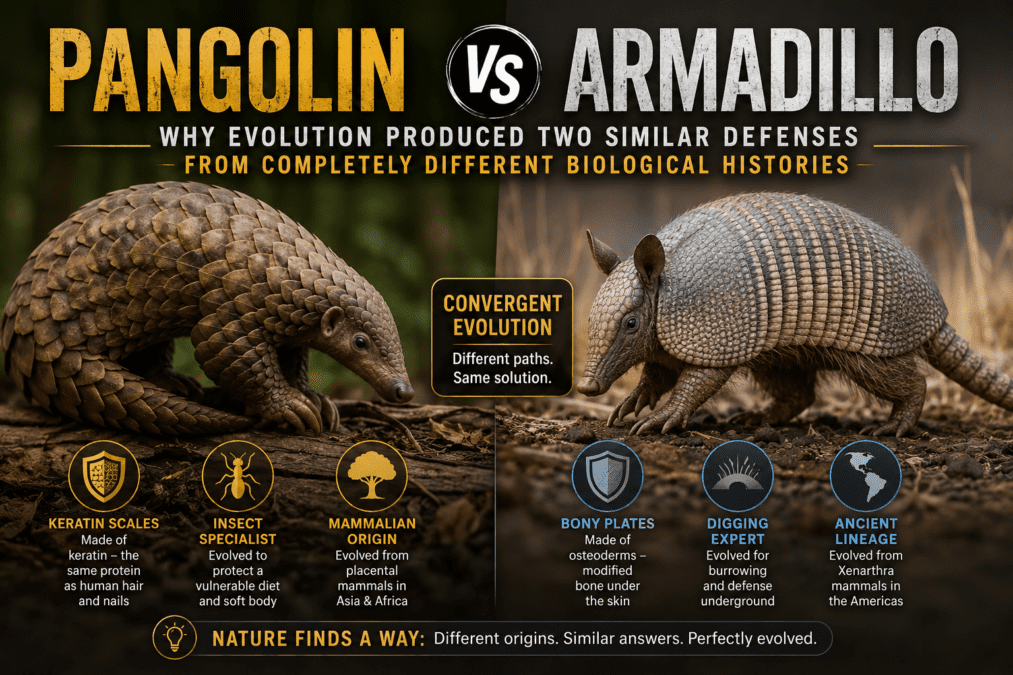

The pangolin and the armadillo are among the most visually confusing examples of convergent evolution in the animal kingdom. At first glance, both appear to be armored, ground-dwelling mammals designed for defense against predators. Their overlapping features—protective outer coverings, digging behavior, insect-heavy diets, and curled defensive postures—often lead people to assume they are close relatives. In reality, the pangolin vs armadillo comparison reveals two species separated by millions of years of independent evolution, distinct biological lineages, and radically different ecological strategies.
A serious pangolin vs armadillo analysis requires more than surface-level comparison. These animals evolved on different continents under different predator systems and environmental pressures. Pangolins emerged primarily in Africa and Asia as specialized scale-covered insectivores, while armadillos evolved in the Americas with flexible armor plating and a broader adaptive profile. Their similarities are therefore not inherited traits but functional solutions to comparable survival problems.
The most surprising insight in the pangolin vs armadillo debate is that pangolins are biologically more specialized yet ecologically more vulnerable, whereas armadillos are less physically refined but significantly more adaptable. One evolved toward extreme defensive specialization; the other evolved toward environmental flexibility. That divergence explains why armadillos have expanded into new territories while pangolins face severe conservation crises across much of their native range.
Essential Comparative Metrics
| Attribute | Pangolin | Armadillo |
|---|---|---|
| Scientific Order | Pholidota | Cingulata |
| Native Range | Africa and Asia | North, Central, and South America |
| Main Protective Feature | Keratin scales | Bony armor plates |
| Average Length | 30–100 cm depending on species | 13–150 cm depending on species |
| Primary Diet | Ants and termites | Insects, larvae, small vertebrates, plants |
| Tongue Adaptation | Extremely elongated and sticky | Long but less specialized |
| Defensive Strategy | Curl into armored ball | Burrowing, armor defense, rapid movement |
| Reproductive Rate | Low | Moderate to high |
| Habitat Flexibility | Limited | High |
| Conservation Status | Highly threatened globally | Varies by species |
A pangolin is a scale-covered mammal specialized for consuming ants and termites using an elongated tongue and defensive curling behavior. An armadillo is an armored mammal from the Americas that combines digging adaptations with flexible feeding and habitat strategies.
While pangolins rely heavily on passive armor and stealth, armadillos combine physical protection with mobility, burrowing efficiency, and broader environmental adaptability.
In the pangolin vs armadillo comparison, the pangolin demonstrates superior biological specialization for insect consumption and defensive armor efficiency, but the armadillo proves more evolutionarily resilient because of its dietary flexibility, reproductive advantages, and ability to survive across wider ecological conditions. The comparison ultimately highlights specialization versus adaptability as two competing evolutionary survival strategies.
Structural And Biological Foundations
The structural differences between pangolins and armadillos begin at the level of anatomy and evolutionary design. Pangolins possess overlapping keratin scales made from the same protein found in human fingernails. These scales cover most of the body and act as an integrated shield against predators. Armadillos, by contrast, possess osteoderms—bony plates embedded beneath the skin and covered by keratinized tissue. This distinction is critical because it means the pangolin’s armor is lightweight and scale-based, whereas the armadillo’s armor is skeletal and structurally rigid.
The pangolin vs armadillo contrast also extends into locomotion. Pangolins often walk with curved foreclaws tucked inward to protect their digging appendages. Their movements can appear cautious and deliberate. Armadillos move more efficiently across open terrain and are generally faster relative to body structure. Many species are excellent diggers and capable swimmers despite their heavy armor.
Their skeletal systems further reveal different evolutionary paths. Pangolins exhibit spinal flexibility optimized for curling into tight defensive formations. Armadillos possess segmented armor bands that allow mobility without sacrificing protection. In evolutionary biology, these similarities are considered convergent traits rather than signs of close genetic relation.
Behavioral Patterns And Social Intelligence
Behaviorally, pangolins and armadillos occupy surprisingly different ecological roles despite sharing insectivorous tendencies. Pangolins are typically solitary, nocturnal, and highly secretive. Their sensory world relies heavily on smell rather than vision. They avoid confrontation whenever possible and depend on stealth combined with defensive curling behavior when threatened.
The pangolin vs armadillo comparison becomes particularly interesting when examining adaptive intelligence. Pangolins display narrow but highly refined behavioral specialization. They memorize termite routes, detect insect colonies with remarkable olfactory precision, and conserve energy through highly efficient feeding routines. However, this specialization limits behavioral flexibility in changing environments.
Armadillos demonstrate broader adaptive behavior. Many species alter feeding habits based on seasonal availability, exploit human-modified landscapes, and rapidly expand territorial ranges. The nine-banded armadillo, for example, has dramatically extended its distribution across parts of the United States over recent decades. This suggests stronger ecological plasticity than seen in pangolins.
Social structures remain limited in both groups, but armadillos appear more behaviorally opportunistic overall. Pangolins function like precision survival specialists, whereas armadillos behave more like generalized environmental survivors. That distinction explains much of their differing conservation outcomes in the modern world.
Pangolin Strengths And Constraints
The pangolin’s greatest strength is defensive specialization. In the pangolin vs armadillo debate, no mammal possesses a more refined passive armor strategy than the pangolin. When threatened, the animal curls tightly into a scale-covered sphere that is extremely difficult for natural predators to penetrate. Lions, leopards, and hyenas often struggle to injure adult pangolins effectively.
Pangolins also possess one of the most advanced insect-feeding systems among mammals. Their tongues can extend astonishing distances relative to body size and are coated with sticky saliva ideal for capturing ants and termites. Because pangolins lack teeth, their digestive systems evolved to process prey using muscular stomach structures and ingested grit.
Yet the same specialization that makes pangolins extraordinary also makes them fragile. Their diet is highly restrictive, reducing adaptability during habitat disruption. Reproductive rates are relatively low, limiting population recovery. Most importantly, their defensive instinct to curl into a ball becomes tragically ineffective against human poachers, who can simply pick them up by hand.
The pangolin vs armadillo comparison repeatedly shows that biological perfection in one ecological niche may reduce resilience in rapidly changing environments. Pangolins are masterpieces of specialization but poor generalists. That imbalance has become increasingly dangerous in the Anthropocene era.
Armadillo Strengths And Constraints
Armadillos succeed through versatility rather than extreme specialization. In the pangolin vs armadillo framework, the armadillo represents evolutionary adaptability at work. Although their armor is less elegant than pangolin scales, it remains highly effective against many predators and environmental hazards.
One of the armadillo’s greatest advantages is habitat flexibility. Armadillos occupy forests, grasslands, deserts, wetlands, and suburban environments. Their diets are similarly broad, including insects, worms, fruits, carrion, and even small vertebrates. This opportunistic feeding behavior provides resilience during ecological fluctuations.
Armadillos are also exceptional diggers. Their burrows regulate temperature, provide predator escape routes, and support reproductive security. Some ecosystems even benefit from armadillo digging because soil turnover improves nutrient cycling and seed distribution.
However, armadillos face important limitations. Their metabolic systems are relatively weak in cold climates, restricting expansion into harsh northern regions. Armor protection is incomplete compared with pangolins, leaving soft undersides vulnerable. Many species also suffer from road mortality because they react unpredictably to vehicle vibrations and headlights.
Fur vs Hair: Why Mammalian Coat Biology Reflects Function More Than Simple Terminology
In the pangolin vs armadillo comparison, the armadillo’s core evolutionary advantage is not superiority in any single trait but moderate competence across many survival variables. This broader adaptability often outperforms narrow specialization over long ecological timescales.
Defensive Mechanisms And Predator Interactions
Defense is the defining visual theme of the pangolin vs armadillo comparison, but the mechanics differ significantly. Pangolins rely primarily on immobility and armor integrity. Their scales overlap like biological chainmail, creating a nearly impenetrable defensive shell. Some species can also lash predators with muscular tails edged by sharp scales.
Armadillos employ a more dynamic defensive system. Only a few species, such as the three-banded armadillo, can fully roll into a ball. Most rely on rapid digging, erratic movement, or escape into burrows. Their armor functions as supplemental protection rather than total defense.
Predator interactions further expose these differences. Pangolins evolved under intense pressure from large African and Asian carnivores capable of overpowering prey physically. Consequently, their defense became concentrated into maximum passive resistance. Armadillos evolved in ecosystems with different predator dynamics and therefore retained greater emphasis on mobility and evasion.
Another important distinction involves energy expenditure. Pangolins conserve energy by minimizing movement and relying on armor. Armadillos expend more energy through active escape behaviors and environmental manipulation. Evolutionarily, the pangolin represents defense through fortress-like protection, while the armadillo represents defense through tactical flexibility.
This defensive divergence is central to understanding why the pangolin vs armadillo comparison fascinates evolutionary biologists. Two animals solved similar survival problems using fundamentally different biomechanical philosophies.
Feeding Ecology And Hunting Efficiency
Feeding behavior reveals perhaps the clearest distinction in the pangolin vs armadillo relationship. Pangolins are elite insect specialists. Their claws tear into termite mounds with precision, and their tongues harvest thousands of insects within minutes. Every aspect of their anatomy supports this feeding niche.
The pangolin vs armadillo comparison shows that pangolins sacrificed versatility for efficiency. They cannot chew food, possess limited dietary range, and depend heavily on stable insect populations. In undisturbed ecosystems, this strategy works remarkably well because ants and termites provide dense protein sources year-round.
Armadillos maintain broader ecological feeding strategies. Although insects remain important, many species opportunistically consume fruits, eggs, amphibians, and carrion. This dietary diversity reduces vulnerability to seasonal shortages. It also allows armadillos to colonize disturbed habitats more successfully than pangolins.
Interestingly, pangolins often outperform armadillos in raw insect extraction efficiency. Their sensory adaptations, tongue mechanics, and digestive specialization are exceptionally refined. However, ecological resilience favors armadillos because survival depends not only on feeding efficiency but also on flexibility during environmental instability.
The pangolin vs armadillo contrast therefore mirrors a broader evolutionary principle: highly optimized specialists can dominate stable ecosystems, while adaptable generalists often survive environmental disruption more effectively.
Habitat Distribution And Environmental Adaptation
Habitat adaptability is one of the strongest points separating these mammals. Pangolins generally require relatively intact ecosystems with abundant insect colonies, suitable shelter, and limited disturbance. Many species are tied closely to forested or savanna environments where ecological balance remains stable.
Armadillos tolerate far greater environmental variation. In the pangolin vs armadillo analysis, this flexibility is arguably the armadillo’s greatest long-term advantage. Some species thrive in dry scrublands, while others inhabit tropical forests or semi-urban landscapes. The nine-banded armadillo’s northward expansion into the southern United States illustrates remarkable adaptive capacity.
Climate also plays a major role. Pangolins are more sensitive to habitat fragmentation because their feeding specialization limits relocation opportunities. Armadillos, despite some cold-weather limitations, can shift ranges and alter behaviors more readily.
Human infrastructure affects these species differently as well. Pangolins suffer heavily from deforestation and illegal wildlife trade. Armadillos more commonly face vehicle collisions and habitat encroachment but often persist near human settlements.
The pangolin vs armadillo comparison demonstrates that ecological resilience depends not only on physical defense but also on the ability to exploit diverse habitats. Armadillos succeed because they adapt to environmental change; pangolins struggle because they depend on ecological consistency.
Reproduction, Longevity, And Population Stability
Reproductive biology strongly influences species survival. Pangolins reproduce slowly, typically producing one offspring at a time after relatively long gestation periods. Young pangolins remain dependent on maternal care and are vulnerable during early development. Low reproductive output severely limits population recovery after poaching or habitat loss.
In the pangolin vs armadillo comparison, armadillos possess clear demographic advantages. Some species reproduce more efficiently and exhibit unique reproductive mechanisms. The nine-banded armadillo famously produces genetically identical quadruplets from a single fertilized egg, increasing population expansion potential.
Longevity patterns also differ. Pangolins can live relatively long lives under stable conditions, but survival rates decline sharply under human pressure. Armadillos often experience shorter average lifespans in the wild due to predation and environmental hazards, yet their higher reproductive turnover compensates for these losses.
Population stability therefore favors armadillos. Species capable of reproducing faster generally recover more effectively from ecological stress. Pangolins, despite sophisticated biological adaptations, struggle because their life-history strategy evolved for stable ecosystems with lower mortality pressures than modern environments now impose.
The pangolin vs armadillo discussion ultimately highlights how reproductive strategy shapes evolutionary resilience more profoundly than physical armor alone.
Comparative Advantages In Real-World Scenarios
If survival were tested strictly in predator-heavy wilderness conditions, pangolins might outperform armadillos defensively. Their armor system is exceptionally efficient against natural carnivores, and their specialized feeding minimizes unnecessary exposure during foraging.
However, the pangolin vs armadillo comparison changes dramatically in unstable or human-altered environments. Armadillos possess broader dietary tolerance, faster population recovery, greater habitat flexibility, and more opportunistic behavior. These traits provide substantial survival advantages in ecosystems shaped by climate change, urbanization, and land conversion.
In drought scenarios, armadillos benefit from flexible feeding habits. In fragmented habitats, they relocate more successfully. In changing climates, behavioral adaptability improves survival probabilities. Pangolins remain more dependent on ecological continuity and stable insect ecosystems.
Interestingly, armadillos also demonstrate higher tolerance for environmental unpredictability because they evolved under fluctuating conditions across the Americas. Pangolins evolved toward specialization in ecosystems where efficient insect extraction and passive defense provided sufficient survival value for millions of years.
The modern world increasingly rewards adaptability over specialization. Consequently, the pangolin vs armadillo comparison becomes not merely a zoological contrast but an evolutionary lesson about resilience under rapid environmental change.
Conservation Status And Human Impact
Human influence has transformed the pangolin vs armadillo comparison into a conservation story. Pangolins are now among the most trafficked mammals on Earth due to illegal demand for scales and meat. All eight pangolin species face significant conservation threats, with several critically endangered.
Their biological defenses provide almost no protection against organized poaching networks. In many cases, the same curling response that deters predators makes capture easier for humans. Habitat destruction further compounds population collapse because pangolins depend heavily on stable ecological systems.
Armadillos face different challenges. Some species remain vulnerable or threatened due to habitat loss, but overall the group demonstrates stronger survival resilience. Certain armadillo populations are even expanding geographically despite human encroachment.
The pangolin vs armadillo contrast therefore exposes an important ecological paradox. The more evolutionarily specialized animal became less resilient under anthropogenic pressure, while the more generalized species adapted more effectively to environmental transformation.
Conservation scientists increasingly emphasize that protecting pangolins requires ecosystem-level strategies rather than isolated anti-poaching measures alone. Habitat integrity, trafficking enforcement, and ecological restoration are all essential for long-term survival.
Scientific And Expert Consensus (2026)
Current scientific consensus strongly supports the idea that pangolins and armadillos are classic examples of convergent evolution. Despite visual similarities, genetic analysis confirms they belong to entirely separate mammalian orders and evolved their defensive characteristics independently.
Researchers studying the pangolin vs armadillo relationship frequently use these animals to demonstrate how similar ecological pressures can produce comparable anatomical outcomes across unrelated species. Both evolved armor, digging capacity, elongated tongues, and insectivorous tendencies because those traits solved parallel survival challenges.
Experts also increasingly emphasize that pangolins represent extreme specialization, whereas armadillos embody adaptive versatility. This distinction influences modern conservation priorities because specialized species generally face greater extinction risk during rapid environmental disruption.
Another growing research focus involves ecosystem engineering. Armadillo burrowing significantly alters soil composition and microhabitats, while pangolins regulate insect populations that influence forest and savanna ecology. Both therefore contribute disproportionately to ecological balance relative to their population sizes.
The scientific consensus in 2026 views the pangolin vs armadillo comparison not as a question of superiority but as an evolutionary study in contrasting survival strategies shaped by geography, predator systems, and environmental stability.
Cultural Perception And Public Misunderstanding
Public understanding of pangolins and armadillos often remains surprisingly shallow. Many people assume pangolins are simply “Asian armadillos” or interpret both animals as primitive armored mammals occupying identical ecological roles. This misconception oversimplifies their evolutionary histories and ecological significance.
The pangolin vs armadillo confusion largely arises from visual resemblance. Human cognition tends to group organisms by external appearance rather than genetic lineage. Yet biologically, these animals are no more closely related than many other distantly evolved mammals with analogous adaptations.
Cultural exposure also differs dramatically. Armadillos appear frequently in North and South American folklore, roadside encounters, and ecological discussions. Pangolins, by contrast, remained relatively unknown globally until conservation campaigns highlighted illegal trafficking crises.
Media representation further shapes perception. Armadillos are often portrayed as quirky or resilient, whereas pangolins are framed as rare and endangered. These narratives influence public empathy and funding priorities for conservation initiatives.
Understanding the true pangolin vs armadillo relationship matters because accurate ecological literacy improves conservation awareness. Misunderstanding convergent evolution can obscure the unique environmental pressures shaping different species and reduce appreciation for biodiversity complexity.
Final Synthesis And Verdict
The pangolin vs armadillo comparison ultimately reveals one of evolution’s most fascinating lessons: similar environmental pressures can create remarkably similar animals through entirely different biological pathways. Both species developed armor, digging adaptations, elongated tongues, and insectivorous lifestyles, yet they arrived at those traits independently across separate continents and evolutionary timelines.
Pangolins represent the pinnacle of defensive specialization. Their scale armor, feeding efficiency, and stealth-based survival strategy make them uniquely optimized for stable insect-rich ecosystems. However, this same specialization created fragility under modern ecological disruption and human exploitation.
Armadillos represent evolutionary flexibility. Their armor is less sophisticated, but their adaptability, reproductive advantages, and broader ecological tolerance provide greater resilience in changing environments. They survive not because they excel overwhelmingly in one category, but because they remain competent across many.
From a purely biomechanical perspective, pangolins may possess the superior defensive design. From an evolutionary survival perspective, armadillos currently demonstrate greater long-term resilience. That distinction explains why the pangolin vs armadillo debate cannot be reduced to simple strength or intelligence comparisons.
The deeper insight is that evolution does not pursue perfection universally. It produces solutions tailored to specific ecological contexts. Pangolins evolved for precision and protection. Armadillos evolved for adaptability and persistence. In stable ecosystems, specialization can dominate. In unstable worlds, flexibility often wins.
Frequently Asked Questions
Are pangolins and armadillos related?
No. The pangolin vs armadillo comparison often confuses people because both animals have armor and insect-eating adaptations, but they belong to entirely different mammalian orders. Pangolins belong to Pholidota, while armadillos belong to Cingulata. Their similarities evolved independently through convergent evolution.
Which animal has stronger armor in the pangolin vs armadillo comparison?
Pangolins generally possess more effective defensive armor. Their overlapping keratin scales create a highly resistant protective shell that many predators struggle to penetrate. Armadillo armor is durable but usually less comprehensive and more dependent on mobility and burrowing for survival.
Why are pangolins more endangered than armadillos?
Pangolins face intense illegal trafficking pressure for their scales and meat, combined with low reproductive rates and habitat specialization. In the pangolin vs armadillo comparison, armadillos are more adaptable, reproduce faster, and tolerate environmental changes more effectively.
Can armadillos curl into a ball like pangolins?
Only certain armadillo species, especially the three-banded armadillo, can fully curl into a defensive ball. Pangolins are much more specialized for complete defensive curling and rely on that behavior as their primary anti-predator strategy.
Which animal is more intelligent in the pangolin vs armadillo comparison?
Neither species demonstrates advanced social intelligence comparable to primates or dolphins, but armadillos generally display greater behavioral flexibility. Pangolins excel in specialized feeding efficiency, while armadillos adapt more effectively to changing environments and food sources.