
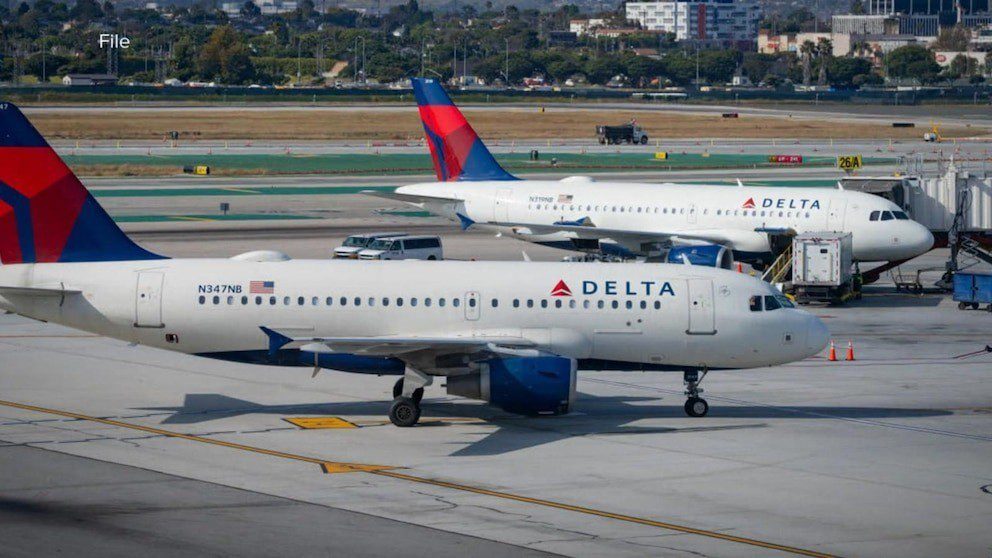

When passengers board a routine international flight, they anticipate a seamless journey across continents and oceans. However, unexpected technical anomalies can transform a standard commercial trip into an unforgettable aviation event. The recent incident involving the Delta flight DL275 diverted LAX routing serves as a prime example of how modern flight crews handle unexpected mid-air challenges. Operating across long-haul international corridors demands constant vigilance, split-second decision-making, and absolute adherence to strict aviation safety regulations.
This extraordinary journey began at Detroit Metropolitan Wayne County Airport, where hundreds of travelers settled in for a long-anticipated transpacific flight to Tokyo Haneda Airport. Utilizing a state-of-the-art Airbus A350-900 wide-body aircraft, the trip was expected to follow a standard great-circle route across Canada and the high-latitude regions of the North Pacific. Instead, a series of invisible operational hurdles high above the frozen airspace forced a dramatic course alteration, completely changing the trajectory of the aircraft and turning a routine journey into a masterclass in modern aviation risk management.
The In-Flight Emergency and the Decision to Turn Back
The primary catalyst behind the Delta flight DL275 diverted LAX diversion originated deep within the aircraft’s crucial environmental and thermal control architecture. While cruising steadily at high altitudes over the remote expanses of the Bering Sea, the flight deck instrumentation flagged a malfunction within the Rolls-Royce Trent XWB engine anti-ice system. This specialized system is vital for preventing hazardous ice accumulation on the engine cowlings when flying through freezing moisture-laden clouds at sub-zero temperatures.
Cruising across transpacific routes without fully functional anti-ice protection presents unacceptable operational risks that no commercial carrier is willing to take. Severe ice buildup inside the engine intakes can disrupt smooth airflow, cause severe compressor stalls, or trigger unexpected power loss. Consequently, the flight crew exercised ultimate caution by initiating a precautionary U-turn, prioritizing passenger and crew safety above the original schedule.
Why Delta Flight DL275 Diverted to LAX Instead of Closer Airports
A frequent point of discussion regarding the Delta flight DL275 diverted LAX operation involves the geographical logic behind choosing Los Angeles over much closer northern airfields. While cities like Anchorage in Alaska or various Canadian hubs were technically closer when the warning light triggered, wide-body diversion strategy encompasses far more than simple proximity. Transpacific twin-engine aircraft operate under stringent regulatory frameworks that require careful evaluation of support infrastructure.
Los Angeles International Airport functions as a massive hub for Delta Air Lines, providing indispensable engineering and logistical capabilities. Landing at a primary operating base ensures immediate access to specialized Airbus A350 mechanics, proprietary spare parts, and heavy maintenance equipment. Furthermore, a major hub offers vast logistical networks needed to easily rebook stranded passengers onto alternative international flights without prolonged delays.
The Complex Timeline of a Flight to Nowhere

The sheer duration of the Delta flight DL275 diverted LAX episode captured global media attention because of its unusual physical progression. Passengers spent more than twelve cumulative hours strapped into their seats, enduring an airborne marathon that ultimately brought them back to the exact coast they had departed hours earlier. This unique flight profile underscores the vast distances involved in modern intercontinental travel routes.
Following the initial departure from Detroit, the aircraft cruised northward for roughly six hours before the mechanical warning interrupted the flight path. Once the decision to turn back was finalized, the pilots navigated the massive twin-engine jet southward along the western coastline of North America. After nearly twelve and a half hours of continuous flying, the Airbus A350 touched down smoothly on the tarmac at LAX, where ground support teams were waiting to assist.
Safety Standards and ETOPS Protocols in Modern Aviation
While an unplanned twelve-hour detour is undoubtedly exhausting for travelers, the Delta flight DL275 diverted LAX outcome highlights the remarkable resilience engineered into modern commercial aircraft. Long-haul transpacific routes are governed by Extended-range Twin-engine Operational Performance Standards, which dictate that aircraft must remain within a certified time-distance window from designated emergency diversion airports throughout their journey.
Modern wide-body jets feature extensive redundancy across all critical systems, ensuring that pilots can maintain complete control even when secondary systems experience faults. The Airbus A350-900 performed admirably throughout its prolonged southern descent, demonstrating how robust engineering safeguards protect passengers from unexpected mechanical setbacks. By following conservative operational parameters, the flight crew converted a potential crisis into a controlled, routine diversion.
Industry Impact and Predictive Maintenance Advancements
Incidents like the Delta flight DL275 diverted LAX scenario emphasize the growing importance of advanced predictive maintenance across the commercial airline sector. Today’s advanced jet engines transmit real-time telemetry data to ground stations via satellite connections, allowing engineers to monitor component health continuously. Airlines are increasingly relying on sophisticated machine-learning algorithms to identify subtle wear patterns before aircraft ever leave the gate.
Looking forward, the integration of predictive analytics aims to minimize costly oceanic turnarounds by flagging potential valve or sensor failures during routine ground turnarounds. By catching minor mechanical discrepancies early, airlines can enhance overall fleet reliability, reduce unexpected disruptions, and ensure that transpacific travelers reach their international destinations smoothly and safely.
Conclusion
The remarkable narrative surrounding the Delta flight DL275 diverted LAX event stands as a clear testament to the unwavering commitment to safety that defines commercial aviation. Although spending half a day in the air only to land back on the United States mainland was undoubtedly frustrating for passengers, safety protocols always take absolute precedence over schedule adherence. Through meticulous pilot training, rigorous regulatory frameworks, and the robust support of major airline hubs, potential mechanical threats are managed effectively every single day.
Frequently Asked Questions
Why was Delta flight DL275 diverted to LAX?
A: The flight was forced to divert due to a technical fault detected within the engine anti-ice system of its Airbus A350 aircraft while traversing the high-latitude airspace of the North Pacific. The flight crew chose to divert to Los Angeles to leverage the airline’s major maintenance facilities, technical expertise, and extensive passenger reaccommodation options.
Was the Delta flight DL275 diversion considered an emergency?
A: The course alteration was executed strictly as a precautionary safety measure rather than an immediate emergency landing. While the engine anti-ice system is a crucial feature for flying through sub-zero moisture clouds, the aircraft remained stable, fully controllable, and structurally sound throughout its multi-hour descent toward California.
You may also read: Personal Life: Marriage to Peter Thiel and Family