
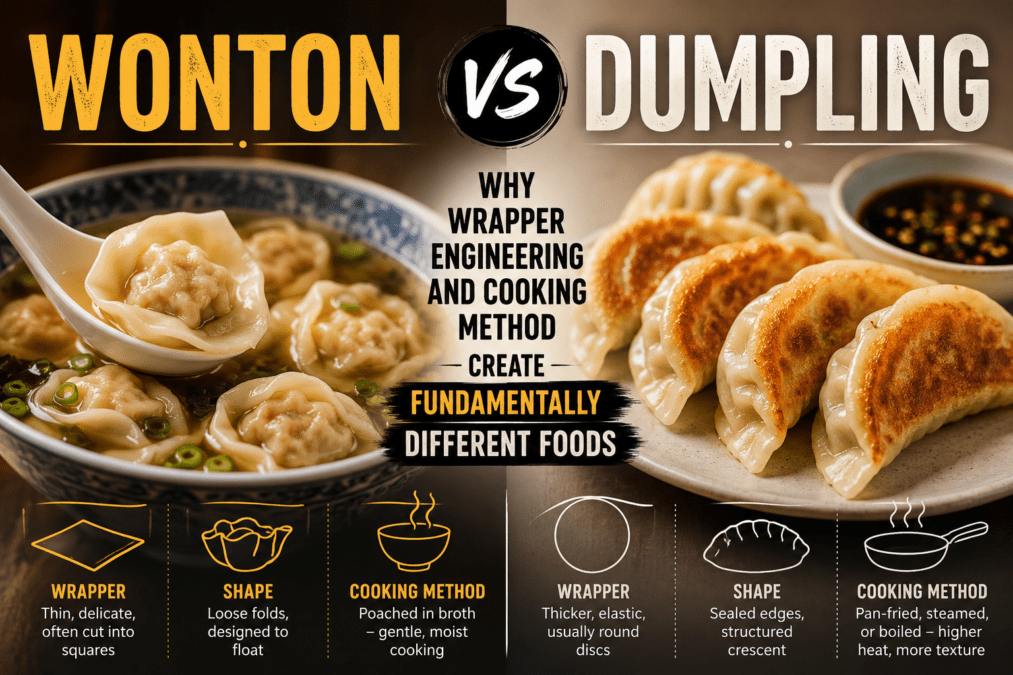

The debate surrounding wonton vs dumpling often begins with a simple assumption: that wontons are merely a subtype of dumpling. Technically, that assumption is partly correct, but it ignores the deeper culinary, structural, and cultural distinctions that separate the two in modern gastronomy. Dumplings exist across nearly every major food civilization, from Eastern Europe to East Asia, while wontons evolved within a far more specialized branch of Chinese culinary tradition. What appears similar on the surface actually reflects different priorities in texture, cooking mechanics, broth interaction, and ingredient balance.
A meaningful wonton vs dumpling comparison requires more than identifying fillings or wrapper shapes. The distinction emerges through dough composition, hydration behavior, protein density, cooking response, and even serving context. Dumplings are typically designed as standalone starch-protein combinations with structural resilience, whereas wontons are engineered for delicacy, rapid cooking, and broth integration. The comparison therefore becomes less about appearance and more about food architecture.
The central insight in the wonton vs dumpling discussion is this: wontons prioritize fluidity, softness, and soup compatibility, while dumplings prioritize versatility, density, and structural endurance. That single difference influences everything from wrapper thickness to regional preparation methods. Understanding this contrast reveals why the two foods occupy different culinary roles despite sharing historical ancestry.
Essential Comparative Metrics
| Attribute | Wonton | Dumpling |
|---|---|---|
| Primary Culinary Origin | Chinese cuisine | Global multi-cultural category |
| Wrapper Thickness | Thin and delicate | Usually thicker and sturdier |
| Common Cooking Methods | Boiled or served in soup | Boiled, steamed, fried, baked, or pan-fried |
| Texture Goal | Silky and soft | Chewy, dense, or crisp depending on style |
| Typical Filling Ratio | Higher filling-to-wrapper delicacy balance | More variable and often heavier |
| Serving Environment | Broth-focused presentations | Standalone meals or side dishes |
| Shape Diversity | Usually folded into pouch-like forms | Extremely diverse worldwide |
| Cooking Time | Short due to thin wrapper | Varies widely |
| Structural Durability | Lower under prolonged heat | Generally higher |
| Cultural Range | Narrower regional specialization | Broad international category |
What Is The Difference Between Wonton And Dumpling?
A wonton is a specific Chinese dumpling made with thin wheat wrappers and commonly served in broth or lightly sauced dishes. A dumpling is a broader food category that includes filled dough preparations from many global cuisines.
In practical wonton vs dumpling analysis, the key distinction lies in culinary function. Wontons are optimized for softness and soup absorption, while dumplings are engineered for broader cooking versatility, including frying, steaming, and pan-searing.
A direct answer to the wonton vs dumpling question is that all wontons are dumplings, but not all dumplings are wontons. Wontons represent one specialized branch within the enormous dumpling family, distinguished primarily by wrapper thinness, serving style, and texture philosophy. While dumplings can range from dense pierogi to crisp potstickers, wontons maintain a relatively consistent identity centered around delicate dough and broth compatibility.
Structural And Biological Foundations
The structural differences in wonton vs dumpling begin at the molecular level of dough construction. Wonton wrappers are typically made with wheat flour, water, egg, and salt, producing a thinner and more elastic sheet. Egg content contributes both color and tensile flexibility, allowing the wrapper to remain delicate without immediately breaking apart in hot broth. Dumpling doughs, by contrast, are often simpler and thicker, designed for mechanical durability during steaming, frying, or extended boiling.
Hydration behavior also matters. In the wonton vs dumpling comparison, wonton wrappers absorb liquid rapidly, becoming silky and soft within minutes. Dumpling wrappers usually resist hydration longer, preserving chewiness and shape integrity. This difference changes mouthfeel dramatically. A wonton tends to dissolve gently during chewing, while many dumplings maintain structural resistance.
Protein distribution within fillings further separates the two. Wonton fillings are frequently smoother and lighter, emphasizing finely minced shrimp or pork. Dumpling fillings can be chunkier, denser, and more vegetable-heavy. The result is that wontons create a more integrated bite, whereas dumplings often create layered texture contrasts.
Historical Evolution Across Culinary Cultures
The history behind wonton vs dumpling reveals how geography shapes food evolution. Dumplings emerged independently across multiple civilizations because wrapping food in dough is an efficient preservation and cooking method. Eastern European pierogi, Central Asian manti, Japanese gyoza, Korean mandu, and Italian ravioli all reflect similar culinary logic despite cultural separation.
Wontons evolved more specifically within Chinese cuisine, especially in southern regions where lighter broths and delicate textures became culinary priorities. Historically, wontons served as refined urban food rather than dense rural sustenance. Their thinner wrappers reflected access to finely milled flour and advanced dough-handling techniques.
In many ancient food systems, dumplings functioned as calorie-dense labor food. The wonton vs dumpling divide therefore partly reflects economic and social culinary evolution. Dumplings often prioritized satiety and portability, while wontons emphasized refinement and balance.
Migration also transformed the relationship between the two. Modern global restaurants frequently blur distinctions for commercial simplicity. Many menus label nearly any filled dough item as a dumpling, even when preparation techniques align more closely with wontons. This has expanded public familiarity but reduced precision in culinary terminology.
Wrapper Engineering And Texture Dynamics
One of the most overlooked aspects of wonton vs dumpling is wrapper engineering. Dough thickness affects not only texture but also heat transfer, moisture retention, and flavor delivery. Wonton wrappers are intentionally thin because they are designed to cook rapidly in boiling liquid without dominating the filling.
This thinness creates a high surface-area-to-volume ratio. In culinary physics, that means the wrapper contributes less chew resistance and more hydration responsiveness. Dumpling wrappers, especially in northern Chinese or Central Asian traditions, are thicker because they must survive aggressive cooking methods such as pan-frying or steaming.
Texture dynamics become especially noticeable during cooling. In the wonton vs dumpling comparison, wontons degrade faster after cooking because the thin dough continues absorbing liquid. Dumplings generally maintain integrity longer. That durability explains why dumplings adapt better to frozen food manufacturing and industrial transport.
Another important difference is edge sealing. Wontons rely on lighter folds and simpler closure systems because the wrapper itself cooks rapidly and evenly. Dumplings often require more elaborate pleating to secure fillings during longer cooking exposure. This engineering difference changes both appearance and cooking performance.
Behavioral Patterns And Social Intelligence
Food behavior may sound abstract, but in culinary science it refers to how foods interact with diners, environments, and serving rituals. In the wonton vs dumpling discussion, wontons behave as companion foods, while dumplings often act as centerpiece foods.
Wontons integrate into soups and broths, meaning their flavor profile is intentionally cooperative rather than dominant. They absorb aromatic compounds from stock and release filling flavors into surrounding liquid. Dumplings, meanwhile, frequently function as self-contained flavor systems. A pan-fried dumpling is expected to retain distinct textural and flavor boundaries.
Social dining patterns also differ. Wontons commonly appear in lighter meals, quick lunches, or broth-oriented dining traditions. Dumplings are more associated with communal feasting, family gatherings, and celebratory cooking. Large-scale dumpling production is deeply embedded in many cultures because folding dumplings collectively becomes a social ritual.
The wonton vs dumpling comparison therefore extends beyond ingredients into human behavior. Dumplings encourage participation and abundance. Wontons encourage refinement and fluidity. Even restaurant presentation reflects this difference, with dumplings often plated independently while wontons arrive submerged within larger flavor ecosystems.
Carbs in Sweet Potato vs Potato: Why Glycemic Response Matters More Than Total Carbohydrate Numbers
Nutritional Composition And Digestive Impact
Nutritionally, the wonton vs dumpling comparison depends heavily on preparation style, but several trends remain consistent. Wontons generally contain fewer carbohydrates per unit because the wrappers are thinner. However, sodium levels may increase significantly when served in seasoned broth.
Dumplings vary enormously. Fried dumplings can become calorie-dense because oil absorption adds fat content, while steamed vegetable dumplings may remain relatively light. The broader dumpling category therefore resists universal nutritional conclusions.
Digestive response differs because of dough density. Wontons are often easier to digest quickly due to thinner wrappers and softer textures. Dense dumplings require longer mechanical chewing and slower gastric processing. This affects satiety perception. Many diners feel fuller after dumplings even when calorie counts appear similar.
Protein distribution also matters in wonton vs dumpling nutrition analysis. Wontons usually emphasize smaller but more concentrated fillings, while dumplings often incorporate larger vegetable proportions. Fiber content therefore tends to be higher in vegetable-heavy dumplings than in traditional wontons.
Subject A: Strengths And Constraints Of Wontons
The greatest strength in the wonton vs dumpling comparison for wontons is textural elegance. Thin wrappers create a smooth, delicate mouthfeel that integrates seamlessly with broth-based cuisine. Wontons excel in flavor absorption, allowing chefs to create layered soup environments where stock quality becomes central.
Cooking efficiency is another advantage. Wontons cook rapidly, making them ideal for fast-service environments without sacrificing freshness. Their lighter structure also appeals to diners seeking less dense meals.
However, the same delicacy that defines wontons also creates limitations. Structural fragility makes them less suitable for heavy frying or prolonged holding periods. Overcooking can quickly destroy texture integrity. Wontons also offer less variety in cooking methods compared with broader dumpling traditions.
Storage presents another constraint. In industrial food systems, wontons can become soggy or tear during freezing and reheating more easily than thicker dumplings. Their narrower textural range limits adaptability across culinary contexts.
Still, within soup-oriented cuisine, wontons achieve a refinement level that many heavier dumplings cannot replicate. That specialization explains their enduring popularity despite structural limitations.
Subject B: Strengths And Constraints Of Dumplings
The primary advantage of dumplings in the wonton vs dumpling debate is versatility. Dumplings adapt to virtually every cooking method, from steaming and boiling to deep frying and baking. Their thicker wrappers support extensive filling diversity and broader culinary experimentation.
Structural resilience gives dumplings superior portability and storage stability. This durability made dumplings historically valuable in agricultural societies and remains important in frozen-food manufacturing today. Dumplings also maintain texture longer after cooking, making them better suited for large gatherings and commercial food service.
Another major strength is cultural adaptability. The dumpling category evolved independently across civilizations because it accommodates local grains, meats, vegetables, and spices with remarkable efficiency. Few food structures are as globally adaptable.
The main weakness of dumplings is inconsistency. Because the category is so broad, quality varies dramatically. Some dumplings become overly dough-heavy, masking filling flavors. Others rely excessively on oil or sodium for flavor enhancement.
Compared with wontons, dumplings can also feel denser and less refined in broth applications. Thick wrappers sometimes overpower delicate soups, reducing flavor balance. This is why wontons remain dominant in certain soup traditions despite the broader popularity of dumplings overall.
Comparative Advantages In Real-World Scenarios
The practical side of wonton vs dumpling becomes clearer when examining real-world culinary situations. In cold-weather environments requiring calorie-dense meals, dumplings hold a major advantage. Their thicker wrappers and heavier fillings provide greater satiety and thermal comfort.
In refined soup cuisine, however, wontons outperform most dumplings because they integrate more naturally into liquid-based flavor systems. Their softness complements broth rather than competing with it.
Commercial scalability also differs. Frozen dumplings dominate supermarket distribution because they tolerate transportation and reheating efficiently. Wontons require tighter quality control due to wrapper fragility. That industrial advantage partly explains why dumplings achieved wider international commercialization.
Restaurant workflow matters as well. Dumplings offer broader menu flexibility because the same dough can support multiple cooking methods. Wontons are more specialized but provide faster soup assembly during high-volume service.
The wonton vs dumpling comparison even affects consumer psychology. Diners often associate dumplings with comfort food abundance, while wontons signal lighter sophistication. These emotional associations influence restaurant branding and menu positioning across global markets.
Regional Variations And Culinary Identity
Regional diversity complicates the wonton vs dumpling conversation because definitions shift across cultures. Northern Chinese dumplings emphasize thicker dough and hearty fillings, reflecting colder climates and wheat-heavy agriculture. Southern Chinese wontons emphasize lighter wrappers and seafood integration.
Japanese gyoza evolved from Chinese dumpling traditions but adopted thinner wrappers and crisp pan-frying techniques. Korean mandu expanded filling diversity with kimchi and glass noodles. Italian ravioli and Polish pierogi reflect entirely separate historical pathways while still fitting the broader dumpling framework.
This global variation demonstrates an important point: dumpling is a structural category, while wonton is a culturally specific subtype. The wonton vs dumpling distinction therefore resembles comparing “sports car” with “vehicle.” One is broad; the other is specialized.
Modern fusion cuisine increasingly blends characteristics from both categories. Chefs now create oversized wontons, soup dumplings with ultra-thin wrappers, and hybrid fried wontons that challenge traditional boundaries. Yet even these innovations usually preserve the core distinction between delicacy-oriented wontons and versatility-oriented dumplings.
Cooking Science And Thermal Behavior
Cooking science reveals why wonton vs dumpling differences become so noticeable during eating. Heat penetrates wonton wrappers rapidly because they are thinner and contain less structural mass. This produces uniform internal cooking in a shorter time frame.
Dumplings experience more complex thermal gradients. Thick dough slows heat transfer, meaning fillings may cook at different rates from the outer wrapper. Skilled dumpling preparation therefore requires balancing dough thickness with filling moisture.
Steam behavior also differs. Wontons release steam quickly after cooking, preventing prolonged internal pressure buildup. Dumplings can trap steam more effectively, especially in sealed pleated designs. This creates juicier interiors but also increases rupture risk if improperly folded.
Oil interaction is another major difference in wonton vs dumpling preparation. Thin wonton wrappers crisp rapidly when fried, creating brittle textures similar to chips. Dumpling wrappers brown more gradually, producing chewy-crisp surfaces instead of brittle crunch.
These thermal behaviors explain why certain cooking methods naturally favor one category over the other. Soup environments enhance wontons, while multi-stage cooking techniques often favor dumplings.
Scientific And Expert Consensus (2026)
Current culinary science and food anthropology largely agree that the wonton vs dumpling comparison should not be framed as two equal categories. Wontons are best understood as a specialized dumpling subtype with distinct engineering priorities.
Experts in food texture analysis increasingly focus on hydration mechanics and gluten behavior to explain why wontons and dumplings feel fundamentally different despite similar ingredients. Studies in sensory science show diners consistently associate wontons with softness and fluidity, while dumplings are associated with density and fullness.
Modern gastronomy also recognizes the importance of context. In soup-centered cuisines, wontons are often considered superior because they enhance broth complexity without overwhelming it. In standalone meal applications, dumplings usually provide greater versatility and satiety.
The strongest expert consensus within wonton vs dumpling analysis is that wrapper thickness functions as the defining variable. That single characteristic influences cooking speed, texture, structural integrity, flavor integration, and serving style more than any other factor.
As food globalization continues, chefs increasingly blend techniques from both traditions. Yet the core scientific distinctions remain stable because they are rooted in dough physics rather than branding or cultural perception alone.
Why The Confusion Persists
The confusion surrounding wonton vs dumpling persists because many restaurants simplify terminology for international audiences. Menus frequently use “dumpling” as a universal category to improve customer familiarity, even when dishes are technically wontons.
Language translation also contributes to misunderstanding. In some culinary traditions, local words for dumplings encompass multiple subcategories that English speakers separate more aggressively. Globalization has therefore flattened distinctions that regional cuisines once maintained carefully.
Visual similarity creates another issue. To inexperienced diners, both foods appear as folded dough surrounding fillings. The deeper structural and textural differences become noticeable only through eating experience and preparation analysis.
Media culture amplifies simplification. Food videos and social media platforms prioritize visual appeal over culinary precision, often grouping all filled dough items together. As a result, nuanced wonton vs dumpling distinctions receive less public attention than broader aesthetic trends.
Despite this confusion, professional chefs and food historians generally maintain a clear distinction because preparation mechanics differ substantially. The culinary industry increasingly emphasizes these differences as diners become more educated about regional food traditions.
Frequently Asked Questions
Is a wonton technically a dumpling?
Yes. In the wonton vs dumpling hierarchy, a wonton is technically a specific type of dumpling. However, wontons differ enough in wrapper design, serving style, and culinary function that chefs often discuss them separately.
Why are wontons usually served in soup?
Wontons are designed with thin wrappers that absorb broth quickly and create a silky texture. Their delicate structure works especially well in liquid-based dishes, unlike many dumplings that are built for frying or steaming.
Are dumplings healthier than wontons?
Health differences depend more on cooking method and filling composition than category alone. Steamed vegetable dumplings may contain more fiber, while broth-based wontons may contain fewer calories due to thinner wrappers.
Which has a thinner wrapper in wonton vs dumpling comparisons?
In nearly every traditional preparation, wontons use thinner wrappers than dumplings. That thinness is the defining characteristic separating wontons from many sturdier dumpling varieties.
Can wontons be fried like dumplings?
Yes, fried wontons exist and are popular in many cuisines. However, because wonton wrappers are thinner, frying produces a lighter and crispier texture than the chewy-crisp result associated with many fried dumplings.
Final Synthesis And Verdict
The most important conclusion in the wonton vs dumpling debate is that the comparison is not truly symmetrical. Dumpling is a broad structural category spanning multiple civilizations, while wonton is a highly specialized Chinese expression within that category. Yet specialization often produces precision, and that precision explains why wontons maintain such a strong culinary identity.
Wontons excel through delicacy, rapid cooking, and broth integration. Their thin wrappers create elegance and fluidity that heavier dumplings rarely achieve. Dumplings, meanwhile, dominate through versatility, durability, and global adaptability. They survive more cooking methods, support broader ingredient variation, and function effectively as standalone meals.
The deeper insight behind wonton vs dumpling is that both foods solve different culinary problems. Dumplings maximize flexibility and satiety. Wontons maximize refinement and integration. Neither is universally superior because each evolved around distinct environmental, cultural, and sensory priorities.
Ultimately, the distinction comes down to food architecture. Wontons are engineered for softness and immersion, while dumplings are engineered for endurance and versatility. Understanding that structural philosophy transforms the comparison from a simple naming debate into a fascinating study of how culinary design shapes human eating experience.