
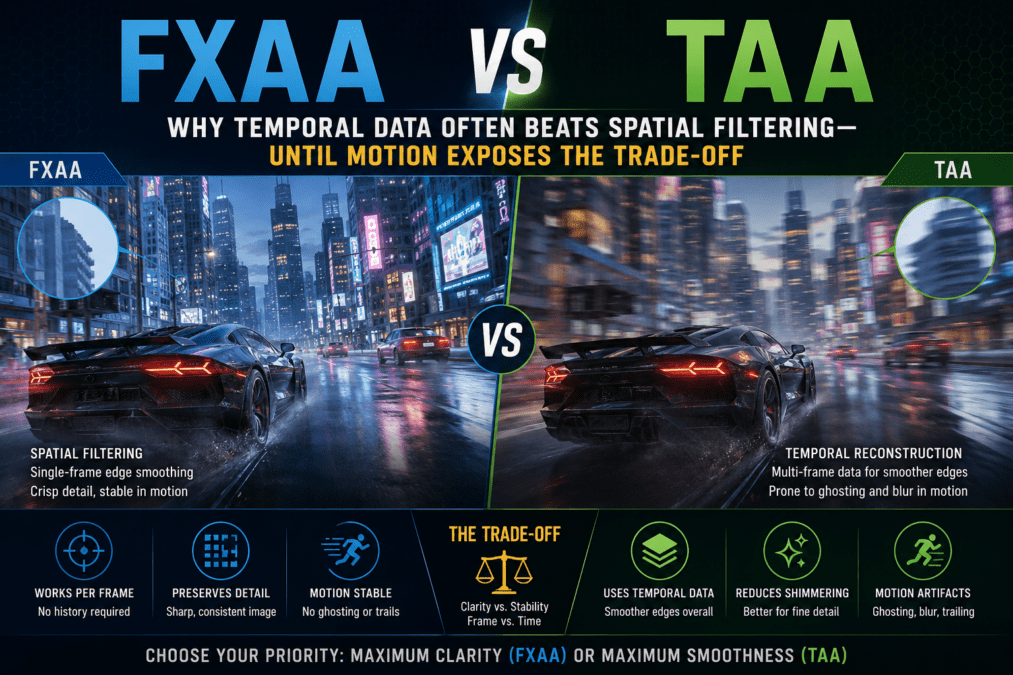

Modern video games rely heavily on anti-aliasing technologies to reduce jagged edges, shimmering textures, and visual artifacts that emerge when high-detail graphics are displayed on finite-resolution screens. Among the most widely used techniques are FXAA (Fast Approximate Anti-Aliasing) and TAA (Temporal Anti-Aliasing), two fundamentally different approaches that attempt to solve the same visual problem through entirely different methods.
The comparison between fxaa vs taa is not merely a discussion of image quality. It is a study of how rendering engines balance performance, temporal stability, sharpness, and motion fidelity. While both technologies seek to smooth edges, they operate at different stages of the rendering pipeline and prioritize different visual outcomes. Understanding these differences reveals why developers choose one method over another and why players often disagree about which looks better.
The central insight emerging from the fxaa vs taa debate is that neither technique is universally superior. FXAA excels at preserving clarity and responsiveness, while TAA often produces a more stable image by leveraging information from multiple frames. The trade-off is that the strengths of one method frequently correspond to the weaknesses of the other. This tension explains why modern game engines continue to experiment with hybrid solutions rather than abandoning either approach completely.
Essential Comparative Metrics
| Comparison Factor | FXAA (Fast Approximate Anti-Aliasing) | TAA (Temporal Anti-Aliasing) |
|---|---|---|
| Primary Approach | Single-frame post-processing edge smoothing | Multi-frame temporal data accumulation |
| Rendering Method | Analyzes the current frame only | Uses current and previous frames |
| Performance Cost | Very low | Moderate |
| GPU Demand | Minimal | Higher than FXAA |
| Image Sharpness | Generally sharper image | Can appear softer or slightly blurred |
| Edge Smoothing | Good | Excellent |
| Shimmer Reduction | Limited effectiveness | Very effective |
| Subpixel Aliasing Control | Weak | Strong |
| Motion Stability | Moderate | High |
| Ghosting Risk | Almost none | Possible in some implementations |
| Texture Clarity | Usually preserved better | May lose some fine detail |
| Visual Noise Reduction | Moderate | Excellent |
| Implementation Complexity | Simple | Complex |
| Compatibility With Modern Upscaling | Limited | Highly compatible |
| Best For | Competitive gaming and older hardware | AAA games and cinematic experiences |
| Common Weakness | Persistent shimmering and aliasing artifacts | Blur and ghosting artifacts |
| Response To Fast Camera Movement | Maintains sharpness | Maintains stability but may introduce blur |
| Effectiveness At 1080p | Good | Excellent |
| Effectiveness At 1440p | Good | Very good |
| Effectiveness At 4K | Often sufficient | Still effective but softness becomes more noticeable |
| Overall Philosophy | Prioritizes speed and clarity | Prioritizes stability and image consistency |
A definition-style explanation is useful here: FXAA is a post-processing anti-aliasing technique that smooths visible edges within a single rendered frame.
Another definition-style explanation: TAA is an anti-aliasing method that combines information from multiple frames to reduce aliasing and temporal instability.
In practical terms, the answer to fxaa vs taa depends on priorities. Players seeking maximum sharpness and minimal performance impact often prefer FXAA, while those prioritizing image stability, reduced shimmering, and cleaner motion usually favor TAA. The best choice varies according to game engine design, display resolution, and individual sensitivity to blur or visual noise.
Structural And Technological Foundations
The most important distinction in fxaa vs taa lies in how each technology gathers information. FXAA analyzes only the current frame. It searches for high-contrast edges that resemble aliasing artifacts and then applies smoothing algorithms to reduce their visibility. Because the process occurs after rendering, it requires relatively little computational effort and can be integrated into many graphics pipelines with minimal complexity.
TAA approaches the problem from a completely different angle. Rather than relying solely on a single image, it tracks data across multiple frames. By accumulating visual information over time, TAA can identify patterns that appear as flickering edges, subpixel noise, or shimmering textures. This temporal awareness allows TAA to address artifacts that a purely spatial method may miss.
The structural difference explains much of the debate surrounding fxaa vs taa. FXAA focuses on immediate image correction, whereas TAA attempts to improve long-term visual consistency. One acts locally within a frame; the other operates across time itself.
Behavioral Patterns And Visual Intelligence
From a rendering perspective, anti-aliasing systems display behaviors similar to decision-making processes. FXAA reacts quickly to visible edges, applying corrections based on current information only. This makes it highly responsive but also somewhat limited because it lacks historical context.
TAA behaves differently. It incorporates previous frames into present calculations, effectively creating a memory system. This temporal memory allows it to recognize recurring patterns and stabilize details that might otherwise flicker or shimmer. Fine geometry, distant vegetation, power lines, fences, and thin textures often benefit significantly from this approach.
The contrast between fxaa vs taa becomes particularly apparent during camera movement. FXAA generally preserves crispness but may allow subtle shimmering to persist. TAA frequently eliminates those artifacts, producing smoother motion. However, the accumulation process can occasionally introduce blur or ghosting when the engine incorrectly interprets moving objects.
While FXAA prioritizes immediate precision, TAA prioritizes continuity. This single distinction shapes nearly every visual difference observed between the two technologies.
FXAA: Strengths And Constraints
The enduring popularity of FXAA stems from its efficiency. Among anti-aliasing solutions, few deliver comparable improvements with such a small performance footprint. For systems with limited GPU resources, this advantage remains highly valuable.
One major strength in the fxaa vs taa comparison is image sharpness. Because FXAA does not accumulate data across frames, it avoids many of the softening effects associated with temporal reconstruction. Textures often appear clearer, interface elements remain crisp, and fast camera movements retain a sense of immediacy.
Implementation simplicity is another advantage. Developers can integrate FXAA without redesigning large portions of the rendering pipeline. This flexibility contributed significantly to its widespread adoption during earlier generations of gaming hardware.
However, FXAA faces limitations. Since it lacks temporal information, it struggles with subpixel aliasing and persistent shimmering. Fine details in motion can continue to exhibit instability even after edge smoothing occurs. Consequently, while FXAA improves image quality substantially, it cannot address every artifact present in modern high-detail scenes.
These characteristics explain why FXAA remains relevant despite the rise of more advanced temporal techniques.
TAA: Strengths And Constraints
In the fxaa vs taa discussion, TAA is often viewed as the more sophisticated solution. Its primary strength lies in temporal stability. By integrating information from multiple frames, it can significantly reduce flickering patterns that become distracting during movement.
Modern game environments contain enormous amounts of geometric complexity. Dense foliage, intricate architecture, reflective surfaces, and fine texture details generate aliasing artifacts that traditional techniques struggle to eliminate. TAA excels in these scenarios because temporal accumulation provides additional information unavailable within a single frame.
Another advantage is compatibility with contemporary rendering technologies. Many advanced graphics systems, including upscaling and reconstruction methods, depend on temporal data. As a result, TAA often functions as a foundational component within modern rendering ecosystems.
Yet TAA introduces challenges. The most commonly cited issue in fxaa vs taa debates is softness. Because information from previous frames influences current output, images can appear less crisp than FXAA-rendered equivalents. Ghosting may also occur when motion vectors or temporal predictions become inaccurate.
These limitations demonstrate that TAA’s sophistication comes with costs. Enhanced stability frequently requires accepting some reduction in sharpness.
Comparative Advantages In Real-World Gaming Scenarios
The practical outcome of fxaa vs taa varies dramatically depending on game genre, display resolution, and player preference.
Competitive gaming often favors responsiveness and visual clarity. Fast-paced shooters, esports titles, and reaction-dependent experiences benefit from crisp imagery and low processing overhead. In such environments, FXAA may provide a more desirable balance between quality and performance.
Conversely, cinematic single-player games frequently prioritize immersion and visual consistency. Open-world adventures, story-driven experiences, and graphically intensive simulations contain numerous fine details that can shimmer distractingly without temporal stabilization. TAA often performs exceptionally well under these conditions.
A useful comparison sentence illustrates the distinction: FXAA emphasizes immediate sharpness, while TAA emphasizes long-term image stability across successive frames.
High-resolution displays further complicate the analysis. At 4K, aliasing artifacts naturally diminish due to increased pixel density, reducing some advantages of aggressive anti-aliasing. In these situations, many players become more sensitive to TAA-induced softness than to residual aliasing.
Thus, the optimal choice in fxaa vs taa depends not only on technology but also on context.
Performance Impact And Hardware Efficiency
Performance remains one of the most significant considerations in fxaa vs taa evaluations. Anti-aliasing is ultimately a resource allocation problem. Every visual improvement consumes processing power that could otherwise support higher frame rates, improved textures, or enhanced lighting effects.
FXAA’s efficiency derives from its relatively straightforward post-processing workflow. Because it operates on completed frames, it imposes minimal additional rendering demands. Older GPUs and entry-level systems often benefit from this lightweight design.
TAA requires more computational coordination. Motion vectors, frame history buffers, temporal accumulation logic, and reconstruction algorithms introduce additional workload. Although modern hardware handles these processes effectively, the complexity remains higher than FXAA.
Interestingly, the performance discussion has evolved over time. As game engines increasingly incorporate temporal systems for upscaling and reconstruction, the incremental cost of TAA has become less significant. In many contemporary titles, temporal processing is already integrated into the rendering architecture.
Consequently, the historical performance advantage associated with FXAA remains real but is not always as decisive as it once was.
OPNsense vs pfSense: Why Architecture Philosophy Matters More Than Raw Firewall Features
Image Quality Analysis Across Resolutions
Resolution profoundly influences perceptions of fxaa vs taa. At lower resolutions, aliasing artifacts become more prominent because fewer pixels represent complex visual information. Jagged edges, flickering geometry, and unstable textures are easier to notice.
Under these conditions, TAA frequently demonstrates a substantial advantage. Temporal accumulation can suppress many artifacts that remain visible under FXAA. The result is often a smoother and more cohesive presentation.
At higher resolutions, however, the situation changes. Increased pixel density naturally reduces visible aliasing. As artifacts become less severe, users begin paying greater attention to image sharpness and texture clarity. This shift can make FXAA appear more attractive despite its weaker temporal stabilization.
Ultra-wide displays, high-refresh-rate monitors, and large-screen televisions further influence perception. Viewing distance, motion sensitivity, and display characteristics all affect how users evaluate image quality.
Therefore, conclusions regarding fxaa vs taa should always account for display environment rather than assuming a universally correct answer.
Why Modern Engines Still Use Both Approaches
A common misconception is that newer technology automatically replaces older technology. The continued existence of FXAA disproves this assumption.
Game developers recognize that different anti-aliasing techniques solve different problems. FXAA remains useful because it is inexpensive, reliable, and broadly compatible. TAA remains valuable because it addresses temporal instability more effectively than most purely spatial methods.
Many engines now employ hybrid strategies. Some combine temporal accumulation with sharpening filters. Others integrate multiple anti-aliasing layers targeting different artifact categories. These approaches acknowledge an important reality revealed by the fxaa vs taa comparison: no single method perfectly balances sharpness, stability, performance, and artifact suppression.
The future of rendering increasingly involves combinations rather than replacements. Technologies evolve by incorporating strengths from previous generations rather than discarding them entirely.
Scientific And Expert Consensus (2026)
The consensus among graphics researchers and rendering engineers in 2026 is nuanced rather than absolute. Most experts agree that TAA generally provides superior temporal stability and artifact reduction in modern high-detail scenes. Its ability to leverage information across frames gives it advantages that single-frame techniques cannot easily replicate.
At the same time, experts acknowledge persistent concerns regarding softness and ghosting. These criticisms are not misconceptions; they are genuine trade-offs inherent to temporal accumulation systems.
Within the fxaa vs taa debate, professional opinion increasingly emphasizes implementation quality over theoretical capability. A well-executed FXAA solution can outperform poorly implemented TAA. Likewise, advanced TAA implementations often achieve results that significantly exceed basic FXAA deployments.
The modern consensus is therefore conditional: TAA possesses greater potential, but successful execution determines actual outcomes.
Final Synthesis And Verdict
The comparison between fxaa vs taa ultimately reveals a broader principle in computer graphics: every optimization introduces trade-offs. FXAA achieves impressive results through simplicity, speed, and image sharpness. TAA achieves impressive results through temporal intelligence, stability, and comprehensive artifact reduction.
Neither technology fully dominates the other because they optimize for different priorities. FXAA is often the better choice when clarity, responsiveness, and performance are paramount. TAA is often the better choice when visual stability and cinematic presentation take precedence.
For most modern AAA games, TAA—or advanced temporal derivatives—has become the industry standard because contemporary rendering pipelines increasingly depend on temporal data. Nevertheless, FXAA continues to provide meaningful advantages for players who value sharpness above all else.
The most accurate conclusion to the fxaa vs taa question is not that one wins universally. Rather, each succeeds according to the visual problem it was designed to solve.
Frequently Asked Questions
Is FXAA better than TAA?
There is no universal winner in fxaa vs taa. FXAA generally delivers sharper images and lower performance overhead, while TAA usually provides better temporal stability and reduced shimmering.
Why does TAA sometimes look blurry?
TAA combines information from multiple frames. This accumulation process smooths aliasing effectively but can also soften fine details, especially when sharpening filters are not applied.
Does FXAA improve frame rates?
FXAA typically has a very small performance cost. While it does not directly increase frame rates, it consumes fewer resources than many alternative anti-aliasing methods, helping preserve performance.
Which is better for competitive gaming: FXAA or TAA?
Many competitive players prefer FXAA because it maintains image sharpness and responsiveness. However, preferences vary depending on the game’s implementation and individual sensitivity to visual artifacts.
Why do modern games often use TAA by default?
Modern rendering systems increasingly rely on temporal information for reconstruction, upscaling, and artifact reduction. TAA integrates naturally with these pipelines, making it a common default choice in contemporary game engines.