
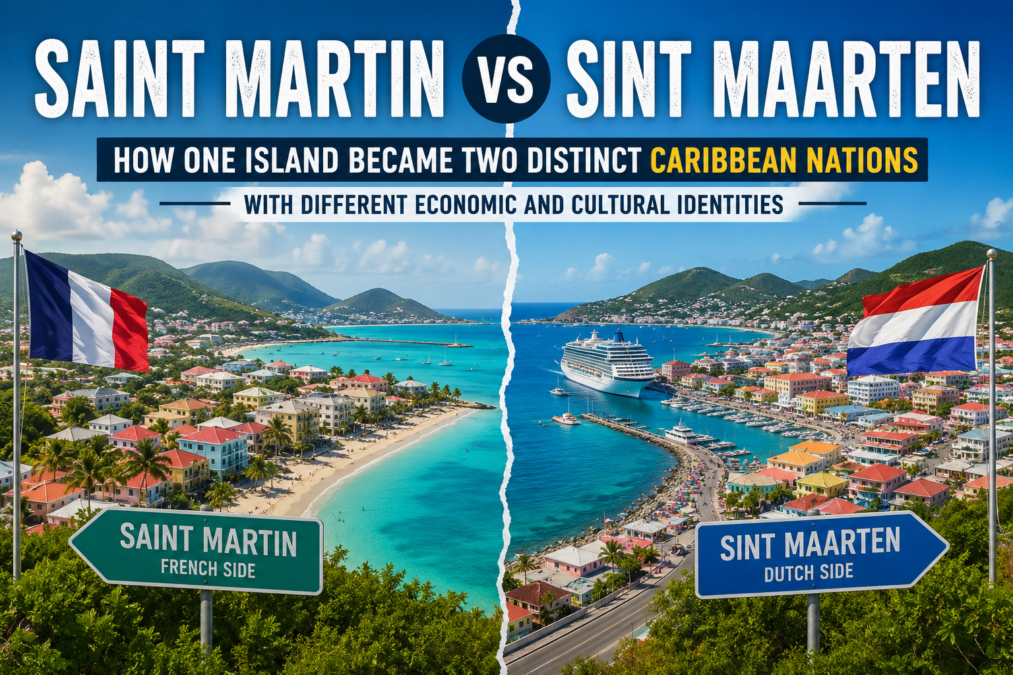

The saint martin vs sint maarten comparison is one of the most fascinating geopolitical case studies in the Caribbean. Although both territories share a single island in the northeastern Caribbean Sea, they operate under different governments, legal systems, economic models, and cultural influences. Travelers often assume they are essentially the same destination with different spellings, but the reality is considerably more complex.
A meaningful saint martin vs sint maarten analysis requires examining geography, governance, economics, demographics, tourism development, infrastructure, and social identity. Unlike many international borders defined by major physical barriers, the border between Saint Martin and Sint Maarten is largely open, allowing residents and visitors to move freely across much of the island.
The most surprising conclusion of the saint martin vs sint maarten debate is that despite sharing beaches, ecosystems, and physical infrastructure, the two territories have evolved into remarkably different societies. The French side emphasizes cultural preservation, European integration, and lower-density tourism, while the Dutch side prioritizes commercial development, cruise tourism, and international business activity.
Saint Martin is the French northern portion of the island of Saint Martin. Sint Maarten is the Dutch southern portion of the same island.
While Saint Martin operates as an overseas collectivity of France, Sint Maarten functions as a constituent country within the Kingdom of the Netherlands.
For travelers, investors, and researchers asking about saint martin vs sint maarten, the short answer is this: both occupy the same island, but Saint Martin generally offers a more European and culturally French atmosphere, while Sint Maarten delivers a more commercial, tourism-driven, and internationally oriented Caribbean experience. Their differing political affiliations have shaped everything from taxation and infrastructure to cuisine, language, and economic priorities.
Essential Comparative Metrics
| Category | Saint Martin (French Side) | Sint Maarten (Dutch Side) |
|---|---|---|
| Political Status | French Overseas Collectivity | Constituent Country of the Kingdom of the Netherlands |
| Island Location | Northern Portion | Southern Portion |
| Official Language | French | Dutch |
| Common Languages | French, English, Creole | English, Dutch, Spanish |
| Currency | Euro (€) | Netherlands Antillean Guilder (transitioning toward Caribbean Guilder) |
| Main Economic Driver | Tourism and Services | Tourism, Cruise Industry, Financial Services |
| Largest Urban Area | Marigot | Philipsburg |
| Tourism Style | Boutique and Leisure Tourism | Mass Tourism and Cruise Tourism |
| European Connection | France | Netherlands |
| Population Density | Generally Lower | Generally Higher |
| Cultural Influence | French Caribbean | Dutch Caribbean with International Blend |
Structural And Political Foundations
Any serious saint martin vs sint maarten comparison begins with political structure. The island was divided between France and the Netherlands in the seventeenth century, creating one of the world’s oldest continuously shared borders. Despite occupying a relatively small landmass, each side developed under distinct administrative traditions.
Saint Martin follows French legal and administrative frameworks. Residents benefit from connections to French institutions, European standards, and social systems. Public services, education, and regulatory structures often reflect broader French governance principles.
Sint Maarten operates as a self-governing country within the Kingdom of the Netherlands. This arrangement provides substantial autonomy while maintaining constitutional ties to the Dutch kingdom. The Dutch side enjoys greater flexibility in economic policy and tourism development, contributing to its highly entrepreneurial environment.
The key insight in the saint martin vs sint maarten discussion is that governance differences influence nearly every aspect of daily life. Taxation, healthcare administration, business regulations, and public investment priorities all emerge from these distinct political foundations.
Behavioral Patterns And Social Intelligence
The social dynamics revealed through saint martin vs sint maarten analysis demonstrate how political systems shape community behavior. Although island residents frequently cross the border and share many cultural experiences, each side has developed a recognizable social character.
Saint Martin tends to emphasize cultural continuity, culinary heritage, and a slower-paced lifestyle. French traditions remain visible in architecture, food culture, administrative practices, and educational institutions. Community identity often reflects both Caribbean roots and European influences.
Sint Maarten exhibits a more internationally oriented social environment. Its economy attracts workers, entrepreneurs, and tourists from numerous countries, creating a highly diverse demographic landscape. English functions as the practical language of everyday communication despite Dutch being the official language.
The saint martin vs sint maarten distinction is therefore not merely governmental. It reflects two different approaches to globalization. One side prioritizes cultural preservation within a French framework, while the other embraces international commercial integration to a greater extent.
Economic Development And Tourism Strategy
One of the most important dimensions of saint martin vs sint maarten involves economic development. Tourism dominates both economies, but each territory has pursued growth through different strategies.
Saint Martin has generally favored lower-density tourism. Boutique hotels, culinary tourism, marina activities, and extended-stay visitors contribute significantly to the local economy. The region’s reputation as the “gastronomic capital of the Caribbean” reflects this emphasis on experience-driven tourism rather than volume-based visitor numbers.
Sint Maarten has built a powerful tourism engine around cruise arrivals, resort development, shopping districts, and aviation infrastructure. The famous airport approach near Maho Beach has become an international attraction in its own right. Cruise ships bring large numbers of visitors annually, supporting retail and hospitality sectors.
The broader saint martin vs sint maarten economic lesson is that two neighboring territories can leverage the same natural resources in different ways. One maximizes exclusivity and lifestyle appeal, while the other focuses on scale and accessibility.
Environmental Geography And Natural Resources
Geographically, the saint martin vs sint maarten comparison begins with shared environmental assets. Both territories occupy the same volcanic island and therefore possess similar terrain, climate, coastal ecosystems, and biodiversity.
The island features tropical weather patterns, beautiful beaches, salt ponds, mangrove habitats, and hilly interiors. Hurricanes represent a major environmental challenge for both jurisdictions, as demonstrated by severe storm events in recent decades.
However, environmental management approaches can differ. Saint Martin often aligns with French and European environmental standards, influencing conservation policies and development regulations. Sint Maarten balances conservation priorities with intensive tourism and commercial activity.
An interesting aspect of the saint martin vs sint maarten relationship is that ecological systems ignore political boundaries. Watersheds, wildlife populations, and coastal ecosystems extend across both territories. This reality frequently requires cross-border cooperation despite differing administrative frameworks.
Saint Martin: Strengths And Constraints
Examining the French side independently provides greater clarity within the broader saint martin vs sint maarten debate.
Key Strengths
Saint Martin benefits from direct association with France, creating institutional stability and access to European administrative frameworks. The territory has cultivated a strong reputation for gastronomy, boutique tourism, luxury accommodations, and cultural authenticity.
The euro currency also provides familiarity for many European visitors. French educational and social systems contribute additional stability and quality-of-life advantages.
Key Constraints
The same regulatory structures that provide stability can sometimes reduce flexibility. Administrative complexity and compliance requirements may slow certain business initiatives compared with more commercially liberal jurisdictions.
Economic dependence on tourism remains another challenge. Like many Caribbean destinations, Saint Martin is vulnerable to external shocks including global recessions, natural disasters, and disruptions in international travel.
Within the overall saint martin vs sint maarten framework, Saint Martin’s greatest strength may be its ability to maintain a distinctive cultural identity despite growing globalization.
Sint Maarten: Strengths And Constraints
A balanced saint martin vs sint maarten assessment also requires examining the Dutch side independently.
Key Strengths
Sint Maarten’s economy demonstrates exceptional adaptability and entrepreneurial energy. Its tourism infrastructure is among the most developed in the Caribbean, supported by a major international airport, cruise facilities, shopping districts, and hospitality networks.
The territory’s international orientation attracts investors, businesses, and workers from around the world. English-language communication also improves accessibility for many visitors.
Key Constraints
Heavy reliance on tourism and cruise traffic creates economic vulnerability during global disruptions. Higher development intensity can place pressure on infrastructure, environmental resources, and urban planning systems.
Rapid growth may also create challenges related to housing affordability, transportation congestion, and public service demands.
The central takeaway from the saint martin vs sint maarten comparison is that Sint Maarten excels at economic dynamism but must continuously manage the side effects of rapid commercial development.
Comparative Advantages In Real-World Scenarios
The practical value of the saint martin vs sint maarten comparison becomes most apparent when evaluating real-world situations.
For Vacation Travelers
Saint Martin appeals to visitors seeking culinary experiences, boutique accommodations, and a quieter atmosphere.
Sint Maarten attracts travelers interested in nightlife, casinos, shopping, cruise tourism, and resort-based vacations.
For Entrepreneurs
Sint Maarten often offers a more commercially oriented environment with extensive tourism-related business opportunities.
Saint Martin may appeal to businesses targeting premium hospitality, luxury services, and European clientele.
For Long-Term Residents
Saint Martin provides stronger integration with French institutions and social systems.
Sint Maarten offers a more international environment with significant economic activity and multicultural interaction.
The saint martin vs sint maarten decision ultimately depends on whether an individual prioritizes lifestyle, business opportunity, cultural experience, or administrative structure.
Infrastructure, Transportation, And Connectivity
Infrastructure represents another revealing dimension of the saint martin vs sint maarten discussion.
Sint Maarten hosts the island’s primary international aviation gateway. This gives the Dutch side strategic importance in regional transportation and tourism logistics. The airport serves as a major connection point for travelers visiting numerous Caribbean destinations.
Saint Martin maintains ferry services, marinas, and transportation networks that support both tourism and local mobility. Its infrastructure development often reflects broader French planning approaches.
Perhaps the most remarkable aspect of saint martin vs sint maarten infrastructure is the practical openness of the border. Visitors frequently cross between jurisdictions multiple times in a single day without experiencing the type of barriers associated with many international frontiers.
This interconnectedness creates a unique economic ecosystem in which transportation, labor markets, and tourism activities operate across political boundaries.
Cultural Identity And Linguistic Evolution
The cultural dimension of saint martin vs sint maarten reveals how historical influences continue shaping modern identity.
Saint Martin’s French heritage remains visible through language, cuisine, architecture, education, and civic institutions. French bakeries, cafés, and culinary traditions contribute significantly to local character.
Sint Maarten reflects a broader international blend. Dutch heritage exists alongside strong Caribbean, North American, Latin American, and global influences. English dominates everyday communication, reinforcing the territory’s cosmopolitan atmosphere.
The most insightful conclusion from this saint martin vs sint maarten analysis is that culture cannot be understood solely through official political labels. Both territories have developed hybrid identities that combine European traditions with Caribbean realities.
Their differences are real, but so are their shared experiences as communities occupying the same island environment.
Scientific And Expert Consensus (2026)
Current academic, economic, and tourism research generally agrees on several conclusions regarding saint martin vs sint maarten.
First, neither territory can be accurately understood in isolation. Economic activity, labor mobility, tourism flows, and environmental systems operate across the entire island.
Second, governance differences have significantly influenced development outcomes. French administrative integration has encouraged stability and cultural preservation, while Dutch autonomy has facilitated entrepreneurial growth and tourism expansion.
Third, resilience increasingly depends on cooperation. Climate adaptation, disaster preparedness, environmental protection, and infrastructure planning require cross-border coordination.
Experts generally view the saint martin vs sint maarten relationship as an example of successful long-term coexistence between two sovereign traditions sharing a limited geographic space. Rather than competing directly, the territories often benefit from offering complementary experiences.
Final Synthesis And Verdict
The ultimate saint martin vs sint maarten verdict depends on the criteria being measured.
If the goal is cultural authenticity, culinary distinction, and a more traditionally European-Caribbean atmosphere, Saint Martin often holds the advantage.
If the priority is commercial energy, tourism infrastructure, international connectivity, and entertainment options, Sint Maarten frequently emerges ahead.
The deeper lesson from the saint martin vs sint maarten comparison is that geography alone does not determine societal outcomes. Despite sharing beaches, weather, ecosystems, and physical space, the two territories have evolved distinct identities through different political institutions and development philosophies.
Rather than asking which side is objectively better, a more useful question is which model better aligns with a visitor’s, resident’s, or investor’s priorities. The French side demonstrates the value of cultural continuity and institutional integration, while the Dutch side illustrates the benefits of economic flexibility and global engagement.
Together, they form one of the world’s most intriguing examples of how two societies can share a single island while pursuing different paths toward prosperity and identity.
Frequently Asked Questions
What is the main difference between Saint Martin and Sint Maarten?
The main difference is political status. Saint Martin is the French northern side of the island, while Sint Maarten is the Dutch southern side. These different governing systems influence laws, currencies, infrastructure, culture, and economic development.
Is Saint Martin or Sint Maarten better for tourists?
The answer depends on travel goals. In the saint martin vs sint maarten comparison, Saint Martin is often preferred for gastronomy, boutique hotels, and a quieter atmosphere, whereas Sint Maarten is popular for nightlife, resorts, casinos, shopping, and cruise tourism.
Can you freely travel between Saint Martin and Sint Maarten?
Yes. The border is generally open, allowing visitors and residents to move easily between the French and Dutch sides of the island without major restrictions under normal conditions.
Which side has the stronger economy in the Saint Martin vs Sint Maarten comparison?
Sint Maarten typically generates greater tourism volume due to cruise traffic and large-scale hospitality infrastructure. However, Saint Martin maintains a strong economy focused on higher-value tourism, services, and cultural experiences. The economies are interconnected and difficult to evaluate entirely separately.