
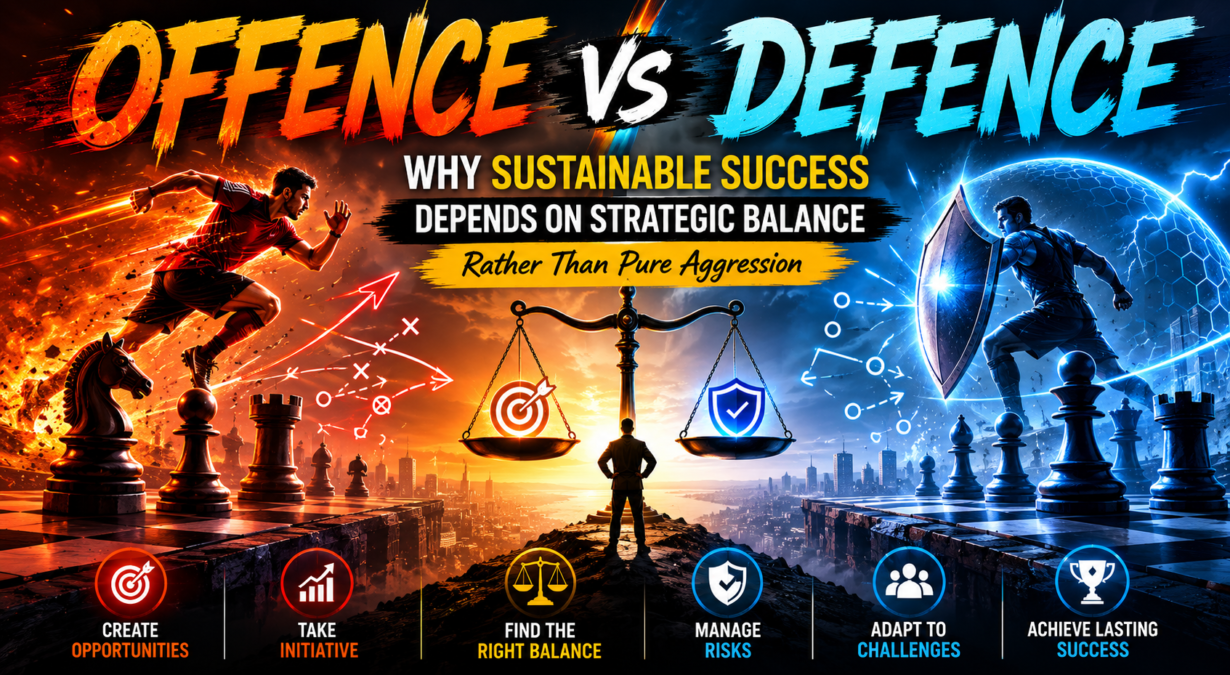

The debate surrounding offence vs defence extends far beyond sports terminology. In modern strategic thinking, offence refers to proactive actions designed to create pressure, seize opportunities, and dominate outcomes, while defence focuses on protection, resilience, risk reduction, and structural stability. From military doctrine and competitive sports to cybersecurity, business strategy, and political systems, the relationship between offence and defence shapes how organizations and individuals survive and succeed.
A meaningful offence vs defence comparison requires more than simply asking which side is stronger. The real analytical framework involves examining resource allocation, psychological pressure, adaptability, timing, sustainability, and risk exposure. Offensive systems often generate momentum and visibility, while defensive systems create durability and consistency. Both approaches operate under different strategic logics.
The surprising insight in the broader offence vs defence debate is that elite performance rarely comes from choosing one side exclusively. History repeatedly shows that dominant systems integrate offensive initiative with defensive discipline. Teams, governments, businesses, and military forces that overcommit to attack often collapse under instability, while overly defensive structures frequently stagnate and lose strategic relevance.
Essential Comparative Metrics
| Comparative Factor | Offence | Defence |
|---|---|---|
| Primary Objective | Create pressure and gain advantage | Prevent damage and preserve stability |
| Core Psychology | Aggression and initiative | Patience and resilience |
| Resource Consumption | Usually high | Often more sustainable |
| Risk Exposure | Higher vulnerability if unsuccessful | Lower immediate exposure |
| Public Visibility | Highly visible and celebrated | Frequently underestimated |
| Success Dependency | Timing and execution speed | Consistency and structural discipline |
| Adaptability | Requires rapid innovation | Requires predictive awareness |
| Failure Consequences | Can collapse quickly | Can erode gradually |
| Best Application | Expansion and disruption | Protection and endurance |
Structural And Biological Foundations
The offence vs defence relationship appears deeply rooted in biological and evolutionary systems. Predators evolved offensive tools such as speed, claws, venom, and coordinated hunting strategies. Prey species developed defensive mechanisms including camouflage, armor, toxin resistance, and group vigilance. Nature demonstrates that survival does not automatically favor aggression; instead, it rewards adaptive balance.
Human systems mirror these biological realities. Offensive behavior in organizations and societies is associated with expansion, experimentation, and competitive disruption. Defensive structures emerge through legal systems, security institutions, risk management, and infrastructure protection. The two are interconnected rather than oppositional.
In neuroscience, offensive behavior is often associated with reward anticipation and dopamine-driven action systems, while defensive behavior activates threat assessment and survival mechanisms. This biological duality explains why the offence vs defence dynamic feels psychologically intuitive across cultures. Humans are naturally drawn toward both ambition and protection because both impulses contributed to long-term survival.
A useful definition is this: offence creates change, while defence preserves continuity. Sustainable systems require both capacities operating simultaneously.
Behavioral Patterns And Social Intelligence
One of the most overlooked aspects of offence vs defence is the role of psychology and collective behavior. Offensive systems generally rely on confidence, initiative, unpredictability, and momentum. Defensive systems depend on anticipation, communication, coordination, and emotional control.
In sports, offensive teams often energize audiences because attack-oriented strategies produce visible excitement and measurable action. Defensive excellence, however, demands subtler intelligence. Reading patterns, maintaining positioning, and minimizing mistakes require cognitive discipline that spectators frequently underestimate.
The same principle exists in business competition. Aggressive expansion strategies may attract headlines and investor enthusiasm, while defensive operational efficiency quietly sustains profitability over decades. Companies that survive economic instability often possess strong defensive fundamentals even if they appear less innovative publicly.
The offence vs defence contrast also reveals different social leadership styles. Offensive leaders emphasize vision and transformation, while defensive leaders prioritize stability and institutional continuity. Neither model is universally superior. During periods of disruption, offence becomes valuable; during crises, defence often becomes essential.
While offensive strategies create opportunities rapidly, defensive systems reduce catastrophic failure risk through consistency and resilience.
Subject A: Strengths And Constraints Of Offence
The primary strength of offence lies in initiative. In nearly every competitive environment, the side dictating tempo forces opponents into reactive positions. Offensive systems create uncertainty and psychological pressure because they compel constant adaptation.
In the offence vs defence framework, offence excels in dynamic environments where speed matters more than stability. Fast-moving technology sectors, high-tempo sports systems, military blitz strategies, and disruptive political campaigns often benefit from offensive momentum. Offensive strategies also generate visibility, making them attractive in media-driven environments where perception influences outcomes.
Another major advantage is opportunity creation. Defensive systems usually wait for events to occur, whereas offensive systems actively manufacture favorable conditions. This proactive capacity explains why offensive innovation frequently drives economic and technological progress.
However, offence carries structural weaknesses. Aggressive expansion consumes resources quickly and increases vulnerability if execution fails. Offensive systems often depend heavily on morale and momentum. Once disrupted, collapse can occur rapidly.
Historical military campaigns illustrate this danger clearly. Many offensively dominant forces achieved early victories but failed because logistics, supply chains, and defensive endurance eventually determined long-term outcomes. The same phenomenon appears in business, where aggressive scaling sometimes outpaces operational stability.
The biggest limitation in the offence vs defence debate is that offence alone rarely sustains success indefinitely. Constant attack creates exhaustion, overextension, and exposure.
Subject B: Strengths And Constraints Of Defence
Defence derives power from resilience. Unlike offensive systems that prioritize expansion, defensive systems focus on preserving structural integrity under pressure. This makes defence especially effective in long-duration competition.
In the offence vs defence comparison, defensive strength often appears less dramatic because its success is measured by prevention rather than spectacle. A strong defensive cybersecurity system receives little attention when attacks fail. A disciplined sports defence may appear “boring” despite preventing defeat consistently.
One major defensive advantage is efficiency. Defensive systems frequently require fewer resources than offensive expansion campaigns. Strategic defence also provides flexibility because stable structures can absorb shocks and adapt gradually rather than reacting impulsively.
Another overlooked benefit is psychological endurance. Defensive teams and organizations tend to maintain emotional control during volatility. This stability becomes invaluable during economic downturns, political crises, or prolonged conflicts.
Yet defence has serious limitations. Excessive defensive orientation can produce stagnation, risk aversion, and missed opportunities. Organizations focused solely on preservation often fail to innovate until disruption becomes unavoidable.
The offence vs defence dilemma becomes most dangerous when defence transforms into passivity. Defensive systems that never counterattack eventually surrender initiative entirely. Historical examples show that fortified positions without adaptive strategy often fail once opponents identify structural weaknesses.
Defence preserves survival, but without selective offensive capability, it may struggle to achieve dominance or long-term influence.
Comparative Advantages In Real-World Scenarios
The practical reality of offence vs defence depends heavily on environmental context. Different situations reward different strategic balances.
In professional sports, offensive dominance may succeed during regular seasons where scoring pressure overwhelms weaker opponents. However, championship environments frequently reward defensive consistency because high-pressure games reduce offensive efficiency. Elite defensive structures become increasingly valuable when margins narrow.
In cybersecurity, the offence vs defence relationship operates differently. Offensive cyber capabilities evolve rapidly because attackers need only exploit one vulnerability, while defenders must secure entire systems continuously. This asymmetry gives offence certain tactical advantages, although advanced defensive architecture can significantly reduce risk.
Military history offers another revealing perspective. Offensive warfare can secure rapid territorial gains, but defensive positioning often determines long-term sustainability. Modern warfare increasingly emphasizes hybrid systems combining offensive precision with layered defensive intelligence.
Business competition also reflects this duality. Startups frequently rely on offensive disruption to enter markets, while established firms depend on defensive scale, infrastructure, and customer retention. Interestingly, the most successful corporations eventually integrate both models: they defend core assets while aggressively innovating at strategic edges.
The broader lesson from the offence vs defence analysis is that context matters more than ideology. No universal strategy dominates permanently because environments evolve continuously.
The Economics Of Offence vs Defence
Economic systems reveal another critical dimension of offence vs defence. Offensive expansion often drives growth, market penetration, and innovation. Defensive economic structures focus on preservation, regulation, and risk management.
High-growth economies usually prioritize offensive investment strategies such as infrastructure expansion, technological development, and international competition. However, economies lacking defensive safeguards become vulnerable to collapse during crises. Financial history repeatedly demonstrates that speculative offensive growth without defensive oversight creates instability.
The 2008 financial crisis highlighted this imbalance dramatically. Offensive profit-seeking behavior expanded rapidly, while defensive regulatory structures failed to contain systemic risk. The eventual collapse illustrated how offensive momentum without defensive discipline can destabilize entire economies.
In personal finance, the offence vs defence framework appears through investment versus savings behavior. Offensive financial strategies pursue aggressive returns, while defensive strategies prioritize asset protection and diversification. Financial advisors increasingly recommend blended approaches because neither extreme consistently performs well across all market conditions.
Economic resilience ultimately depends on integrating offensive innovation with defensive safeguards. Sustainable growth requires protection against catastrophic exposure.
Tactical Speed Versus Strategic Longevity
One of the defining themes in offence vs defence is the contrast between short-term momentum and long-term endurance. Offence often wins attention quickly because it generates visible results. Defence wins quietly over extended periods by reducing cumulative damage.
This distinction explains why offensive strategies dominate media narratives while defensive systems dominate survival statistics. Rapid success stories attract fascination, but long-term institutional stability typically emerges from disciplined defensive architecture.
Sports dynasties provide a useful example. Teams built entirely around offensive explosiveness may achieve brief peaks, but sustained championship success often depends on defensive adaptability, depth, and consistency. The same principle appears in geopolitics, where empires historically expanded through offensive conquest but survived through defensive administration and logistics.
The offence vs defence contrast therefore reflects a deeper strategic paradox: the systems most admired publicly are not always the systems most capable of enduring pressure over time.
Scientific And Expert Consensus (2026)
Current research across psychology, military science, sports analytics, and organizational theory increasingly rejects simplistic offence vs defence binaries. Experts now emphasize adaptive integration rather than ideological preference.
Sports analytics research demonstrates that elite teams usually maintain balanced efficiency metrics rather than extreme specialization. Purely offensive teams often struggle defensively during high-pressure moments, while purely defensive teams lack scoring flexibility under adverse conditions.
Military strategists similarly emphasize multi-domain integration. Modern conflicts involve cyber operations, intelligence systems, drone technologies, economic pressure, and information warfare. Offensive and defensive capacities now overlap continuously rather than existing as separate phases.
Organizational psychologists also note that resilient institutions combine offensive innovation cultures with defensive procedural safeguards. Companies able to experiment aggressively while maintaining operational stability outperform organizations committed exclusively to one approach.
The emerging expert consensus in the offence vs defence discussion is remarkably consistent: sustainable dominance depends on adaptive balance. Systems that overcommit to aggression become unstable, while systems that overcommit to protection become obsolete.
A direct answer to the central question is this: neither offence nor defence is inherently superior because effectiveness depends on timing, adaptability, and strategic integration. The strongest systems combine offensive initiative with defensive resilience, allowing them to pursue opportunities while surviving disruption.
Psychological Pressure And Momentum Dynamics
The emotional dimension of offence vs defence strongly influences outcomes. Offensive systems often generate fear and uncertainty because they force rapid decision-making. Defensive systems, meanwhile, create frustration by slowing momentum and reducing available opportunities.
Momentum psychology is particularly important in competitive environments. Offensive success can create cascading confidence effects, where early victories increase risk tolerance and creativity. However, this same momentum can encourage overconfidence and reckless decision-making.
Defensive psychology operates differently. Strong defensive structures cultivate patience and emotional regulation. Teams or organizations confident in their defensive capabilities are less likely to panic under pressure. This emotional stability often becomes decisive during prolonged competition.
Interestingly, public perception tends to reward offence more visibly than defence. Spectators remember dramatic attacks, rapid growth, and aggressive expansion more than disciplined prevention. Yet expert analysts frequently recognize that defensive competence determines whether offensive gains can actually be sustained.
The offence vs defence relationship therefore involves not only strategy but also perception management. What audiences celebrate and what systems require for survival are not always identical.
Technology And The Future Of Offence vs Defence
Technological evolution is rapidly transforming the offence vs defence balance. Artificial intelligence, predictive analytics, autonomous systems, and cyber warfare tools are changing how both offensive and defensive operations function.
In cybersecurity, offensive AI tools can automate vulnerability detection and attack execution at unprecedented scale. Simultaneously, defensive AI systems can monitor networks continuously and respond faster than human analysts. This creates an escalating technological arms race where adaptability becomes more important than static strength.
In sports, advanced analytics increasingly optimize both offensive play design and defensive positioning. Data-driven strategy reduces randomness, making balanced systems more effective than emotionally driven approaches.
Military technology presents an even more dramatic shift. Precision weapons, drone swarms, and satellite intelligence blur traditional distinctions between offence and defence. Defensive systems must now anticipate attacks occurring across digital and physical domains simultaneously.
The future of offence vs defence likely favors integrated intelligence systems capable of switching dynamically between aggressive and protective modes depending on situational requirements.
Final Synthesis And Verdict
The enduring fascination with offence vs defence comes from its universality. The same strategic tension appears in biology, sports, economics, warfare, politics, psychology, and technology. Every competitive system must decide how much energy to allocate toward expansion versus protection.
The evidence strongly suggests that neither approach independently guarantees superiority. Offence drives momentum, innovation, visibility, and disruption. Defence provides resilience, sustainability, emotional stability, and structural continuity. Systems relying exclusively on offence often burn out under pressure, while systems relying exclusively on defence frequently become stagnant and reactive.
The deeper strategic insight is that successful organizations and individuals do not treat offence and defence as opposites. Instead, they treat them as complementary functions within adaptive systems. Offensive capability without defensive stability creates fragility. Defensive capability without offensive initiative creates irrelevance.
In the final analysis of offence vs defence, long-term dominance belongs not to the most aggressive or most cautious competitor, but to the one capable of balancing initiative with resilience. Sustainable success emerges when systems know when to attack, when to protect, and when to transition intelligently between the two.
Frequently Asked Questions
What is the main difference between offence and defence?
Offence focuses on creating opportunities, pressure, and forward momentum, while defence focuses on protection, stability, and damage prevention. In the broader offence vs defence comparison, offence is proactive whereas defence is protective and reactive.
Is offence better than defence in sports?
Not universally. Offensive teams may dominate weaker opponents, but defensive consistency often becomes more important during high-pressure championship environments. The strongest teams usually balance both capabilities effectively.
Why is defence often underrated?
Defence is less visually dramatic because successful defence prevents events rather than creating visible action. Audiences often notice spectacular offensive moments more than disciplined defensive positioning, despite defence being critical for long-term success.
How does offence vs defence apply outside sports?
The offence vs defence framework applies to business strategy, military operations, cybersecurity, economics, politics, and even personal decision-making. Offensive approaches prioritize growth and initiative, while defensive approaches prioritize protection and resilience.
Can a system succeed using only offence or only defence?
Usually not over the long term. Pure offence creates instability and resource exhaustion, while pure defence risks stagnation and loss of initiative. Most sustainable systems combine offensive flexibility with defensive stability.