
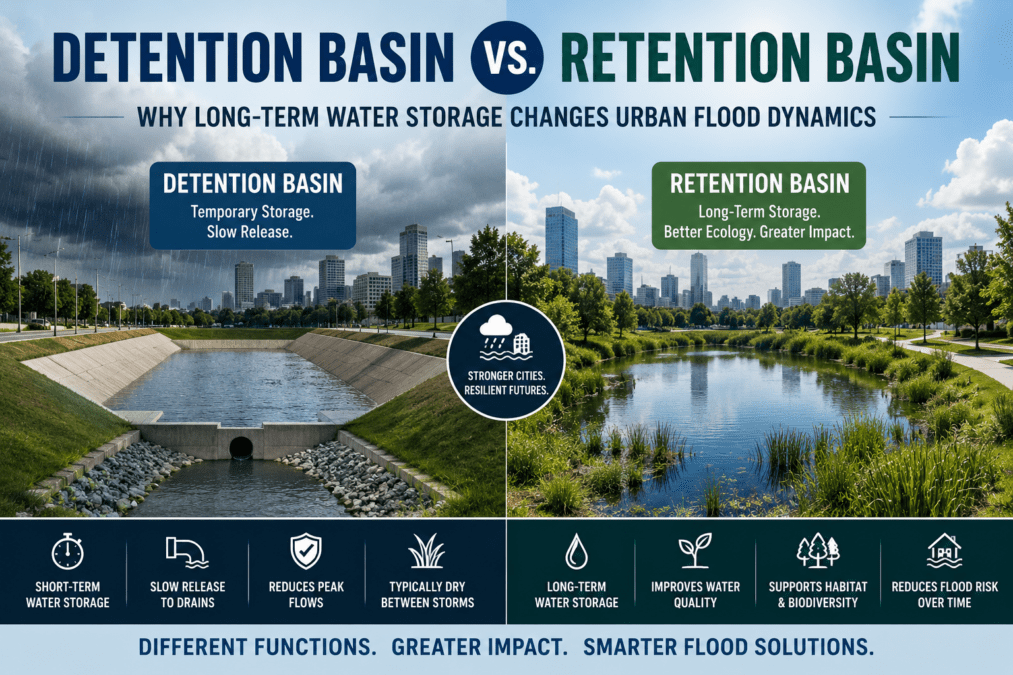

Urban stormwater systems are no longer designed only to move water away quickly. Modern infrastructure planning now focuses on reducing flood risk, improving water quality, protecting ecosystems, and adapting cities to increasingly volatile rainfall patterns. In this context, the debate around detention basin vs retention basin has become central to civil engineering, municipal planning, and sustainable land development. Although the two systems appear visually similar, their hydraulic behavior, environmental impact, and long-term performance differ significantly.
The comparison framework for detention basin vs retention basin involves far more than temporary versus permanent water storage. Engineers evaluate storage duration, infiltration capacity, pollutant removal efficiency, maintenance requirements, land-use compatibility, ecological benefits, and resilience under climate stress. A detention basin primarily delays stormwater discharge, while a retention basin is designed to permanently hold water and support gradual infiltration or evaporation. That operational difference influences everything from flood mitigation to biodiversity.
The surprising insight in the detention basin vs retention basin discussion is that the “better” option is rarely universal. Detention systems often outperform retention systems in dense urban environments with limited land and rapid runoff concerns, while retention basins provide stronger ecological and water-quality advantages in regions prioritizing environmental restoration. The real distinction lies in how each system manages time, storage, and hydrological stability under real-world stress conditions.
Understanding the Core Difference Between Detention Basin vs Retention Basin
A detention basin is a temporary stormwater storage structure designed to hold runoff for a limited period before gradually releasing it downstream. A retention basin is a permanent water storage system that maintains a standing pool and reduces runoff through infiltration, evaporation, and controlled discharge.
In practical terms, the distinction between detention basin vs retention basin comes down to whether water remains in the basin after a storm event. Detention basins typically dry out between rainfall events, while retention basins continuously contain water. This operational difference affects engineering design, environmental outcomes, maintenance strategy, and community perception.
When municipalities evaluate detention basin vs retention basin, they are essentially deciding between rapid hydrologic regulation and long-term ecological integration. One prioritizes temporary flood control efficiency, while the other combines stormwater management with habitat creation and water-quality enhancement.
A detention basin is usually preferred where rapid drainage and flood timing are primary concerns. A retention basin is more effective where water purification, groundwater recharge, and ecosystem stability are critical goals. The choice depends on rainfall intensity, soil composition, land availability, regulatory standards, and urban density.
Essential Comparative Metrics
| Attribute | Detention Basin | Retention Basin |
|---|---|---|
| Primary Function | Temporary stormwater storage | Permanent water storage and infiltration |
| Water Presence | Normally dry between storms | Maintains permanent pool |
| Flood Reduction | High short-term flow control | Moderate to high long-term regulation |
| Water Quality Improvement | Moderate | High |
| Groundwater Recharge | Limited | Strong potential |
| Maintenance Complexity | Lower | Higher |
| Mosquito Risk | Lower | Potentially higher if poorly maintained |
| Ecological Benefits | Limited vegetation support | Supports wetlands and biodiversity |
| Construction Cost | Generally lower | Generally higher |
| Urban Land Efficiency | High | Moderate |
| Climate Adaptation Capacity | Effective for peak-flow events | Effective for long-duration resilience |
Structural And Hydrological Foundations
The structural design behind detention basin vs retention basin reflects two fundamentally different philosophies of stormwater management. Detention basins are engineered primarily around hydraulic timing. Their purpose is to capture runoff during peak rainfall and release it slowly through outlet structures, reducing downstream flooding and erosion. These basins are often dry depressions integrated into parks, roadside corridors, or commercial developments.
Retention basins, by contrast, are designed around permanent hydrological balance. They maintain a standing body of water that continuously interacts with surrounding soils, vegetation, and atmospheric conditions. Their design often incorporates wetland shelves, sediment forebays, aquatic vegetation zones, and infiltration layers. Because they permanently contain water, retention systems function more like artificial lakes or ecological ponds than temporary storage chambers.
In the detention basin vs retention basin debate, storage duration changes engineering priorities. Detention systems emphasize outlet sizing and discharge control, while retention systems prioritize water-quality retention, sediment settlement, and biological stabilization. This distinction becomes especially important during prolonged storm cycles, where retention basins can reduce cumulative runoff loads more effectively over time.
Another critical structural difference involves sediment behavior. Detention basins experience rapid sediment deposition during storm events but remain dry afterward, simplifying removal. Retention basins accumulate finer suspended particles continuously, requiring more specialized dredging and ecological maintenance strategies over the long term.
Behavioral Patterns And Environmental Intelligence
Stormwater systems display behavioral characteristics much like living ecosystems. In the context of detention basin vs retention basin, those behavioral differences influence environmental performance, resilience, and sustainability outcomes.
Detention basins behave reactively. They activate during heavy rainfall, absorb peak runoff, and then return to a dormant dry state. Their effectiveness depends on timing precision and outlet calibration. Because they remain dry most of the time, vegetation is usually limited to grasses or erosion-resistant landscaping. This makes detention systems highly functional but ecologically simplified.
Retention basins behave continuously. Water circulation, sunlight exposure, sediment accumulation, and biological activity occur year-round. Aquatic vegetation and microbial ecosystems naturally develop within these systems, improving nutrient absorption and pollutant breakdown. This ongoing ecological interaction gives retention basins a type of environmental intelligence that detention systems generally lack.
The detention basin vs retention basin comparison becomes particularly relevant in climate adaptation planning. Detention systems respond effectively to sudden peak-flow events, especially in heavily paved urban areas. Retention systems, however, perform better in maintaining long-term watershed stability and reducing cumulative pollutant loads entering rivers and lakes.
Interestingly, public perception also differs. Dry detention basins are often viewed purely as infrastructure, while retention basins are frequently incorporated into community landscapes as visual amenities. That social integration can increase property value and improve urban aesthetics, though it also raises expectations for maintenance and safety management.
Subject A: Strengths And Constraints Of Detention Basins
Detention basins offer one of the most efficient forms of urban flood mitigation because they directly target peak runoff timing. In the detention basin vs retention basin comparison, detention systems excel where rapid stormwater surges threaten downstream infrastructure. Roads, parking lots, industrial zones, and dense suburban developments often rely on detention basins because they can be integrated into relatively compact land footprints.
One major strength is operational simplicity. Since detention basins typically remain dry between storms, they require less ecological management and present fewer long-term water-quality complications. Maintenance crews can inspect and repair outlet structures more easily, and sediment removal is generally less expensive than dredging permanent water bodies.
Detention systems also reduce mosquito concerns because stagnant water does not persist for extended periods. This makes them attractive in densely populated residential environments where public health perception matters significantly.
However, detention basins have limitations. Their water-quality improvement capability is lower because runoff is stored only temporarily. Pollutants such as nitrogen, phosphorus, heavy metals, and hydrocarbons may still move downstream relatively quickly. In addition, detention basins provide limited groundwater recharge because water is intentionally discharged rather than retained.
Another challenge in the detention basin vs retention basin evaluation is ecological underperformance. Detention basins rarely support stable aquatic ecosystems or meaningful biodiversity. During extreme rainfall events that exceed design capacity, they may also become overwhelmed quickly, especially if urbanization increases impervious surface coverage beyond original engineering assumptions.
Subject B: Strengths And Constraints Of Retention Basins
Retention basins are increasingly favored in sustainable urban planning because they combine stormwater control with environmental restoration. In the broader detention basin vs retention basin discussion, retention systems stand out for their ability to improve water quality and support ecological resilience over decades.
Their strongest advantage is pollutant removal efficiency. Because water remains in the basin for extended periods, suspended sediments settle naturally while biological processes break down contaminants. Aquatic plants absorb nutrients, microbial colonies metabolize organic pollutants, and sunlight-driven processes contribute to water purification. This makes retention basins highly valuable near environmentally sensitive watersheds.
Retention systems also support groundwater recharge through infiltration, especially in permeable soil regions. In drought-prone climates, that hydrological stabilization becomes increasingly important. Some municipalities now view retention basins not only as drainage infrastructure but as strategic water-resource assets.
The detention basin vs retention basin comparison also highlights the aesthetic and recreational value of retention systems. Properly designed basins can become integrated public spaces featuring walking trails, wetland habitats, and landscaped shoreline zones.
Yet retention basins come with constraints. Permanent water requires ongoing maintenance to prevent algae blooms, invasive vegetation, odor problems, and mosquito breeding. Sediment accumulation management is more technically demanding and costly than in dry detention systems.
Land consumption is another limitation. Retention basins generally require larger footprints and more careful grading. In high-density urban cores where land values are extremely high, detention systems may remain more economically feasible despite offering fewer ecological benefits.
Comparative Advantages In Real-World Scenarios
The practical reality of detention basin vs retention basin becomes clearer when examined through specific land-use and climate scenarios. Neither system universally dominates because performance depends heavily on environmental context and infrastructure priorities.
In dense urban developments dominated by asphalt and concrete, detention basins often provide superior flood-control efficiency. Their ability to rapidly intercept and slowly release runoff reduces pressure on municipal drainage systems during short-duration storms. Shopping centers, highway corridors, and industrial parks frequently adopt detention designs because available land is limited and rapid runoff management is the primary concern.
Retention basins perform better in mixed-use suburban regions, environmentally sensitive zones, and master-planned communities where long-term watershed health matters. Their ability to remove pollutants and stabilize local hydrology becomes increasingly valuable as environmental regulations tighten globally.
The detention basin vs retention basin comparison is also influenced by climate patterns. Regions experiencing sudden cloudburst events may prioritize detention capacity to prevent flash flooding. Areas dealing with prolonged seasonal rainfall or groundwater depletion may gain greater value from retention systems.
Hybrid infrastructure models are becoming more common as engineers attempt to combine the strengths of both systems. Some developments now incorporate upstream detention features feeding into downstream retention wetlands. This layered approach reduces peak-flow stress while simultaneously improving water quality and ecological performance.
Economic analysis also matters. Detention basins often have lower initial construction costs, while retention basins may generate greater long-term environmental and property-value returns. Municipalities increasingly evaluate lifecycle performance rather than focusing solely on installation expense.
Water Quality Performance And Pollutant Management
One of the most important distinctions in detention basin vs retention basin involves pollutant removal mechanisms. Stormwater runoff carries oils, fertilizers, heavy metals, sediments, pesticides, and microplastics from urban surfaces into drainage systems. How each basin type handles these contaminants significantly affects watershed health.
Detention basins mainly reduce pollutant transport indirectly by slowing runoff velocity. As water temporarily pools, heavier sediments settle before controlled discharge occurs. However, because storage duration is short, many dissolved pollutants remain suspended and eventually continue downstream.
Retention basins provide substantially stronger treatment capability because water residence time is longer. This allows physical, biological, and chemical processes to interact more effectively. Sediment settles gradually, nutrients are absorbed by plants, and microorganisms help decompose organic pollutants. In many modern urban planning models, retention basins are considered decentralized water-treatment ecosystems rather than simple drainage structures.
The detention basin vs retention basin comparison becomes particularly important near drinking water reservoirs or ecologically fragile rivers. Retention systems can dramatically reduce nutrient loading responsible for harmful algae blooms and oxygen depletion.
However, poorly maintained retention basins can also become pollutant sinks over time. Excessive sediment accumulation may reduce capacity and create ecological imbalance. Successful performance therefore depends on consistent inspection, vegetation management, and sediment control strategies.
Land Use Efficiency And Urban Planning Impact
Urban planners often evaluate detention basin vs retention basin through the lens of land economics and development flexibility. The amount of usable space consumed by stormwater infrastructure directly affects housing density, transportation planning, and commercial expansion.
Detention basins are generally more land-efficient because they can serve dual purposes. Many are designed as recreational fields, parks, or open green spaces that remain functional when dry. During storm events, these areas temporarily store runoff before returning to normal use. This adaptability makes detention systems attractive in high-density developments where every acre carries substantial economic value.
Retention basins require permanent water allocation, which limits alternative land use. Yet their integration into community design can create high-value visual landscapes. Waterfront aesthetics frequently increase adjacent property desirability, especially in residential developments emphasizing environmental quality and recreational access.
The detention basin vs retention basin decision also shapes zoning and infrastructure coordination. Retention systems often demand greater ecological buffers and vegetation planning, while detention systems emphasize hydraulic connectivity with storm sewer networks.
Interestingly, some modern cities now treat stormwater infrastructure as public amenity infrastructure rather than hidden engineering. Retention basins designed with trails, boardwalks, and native habitat zones contribute to urban cooling, biodiversity, and mental well-being. This broader planning perspective is gradually reshaping how municipalities interpret infrastructure value.
Climate Resilience And Future Infrastructure Trends
Climate volatility has fundamentally changed the relevance of the detention basin vs retention basin debate. Traditional stormwater assumptions based on historical rainfall patterns are increasingly unreliable as extreme weather events intensify globally.
Detention basins remain highly effective against short-duration flash flooding because they directly target runoff timing. Cities vulnerable to sudden high-intensity storms often rely on detention networks to protect roads, bridges, and underground drainage systems from immediate overload.
Retention basins contribute more strongly to long-term resilience. By holding water continuously, they moderate hydrological extremes, support groundwater recharge, and maintain ecosystem stability during drought cycles. In regions facing alternating flood and drought conditions, retention systems provide broader adaptive value.
The future of detention basin vs retention basin may ultimately involve integrated green infrastructure rather than strict separation. Engineers increasingly combine bioswales, permeable pavement, green roofs, detention chambers, and retention wetlands into interconnected systems capable of handling complex hydrological stress.
Smart monitoring technology is also transforming basin management. Sensors now measure water level, pollutant concentration, and discharge timing in real time. These systems improve maintenance efficiency and allow municipalities to optimize stormwater performance dynamically during severe weather events.
As urban populations expand and climate pressure grows, stormwater infrastructure is evolving from passive drainage into active environmental management. The detention-versus-retention decision increasingly reflects broader priorities about sustainability, resilience, and urban livability.
Scientific And Expert Consensus (2026)
By 2026, scientific consensus no longer frames detention basin vs retention basin as a simple either-or decision. Most hydrologists, civil engineers, and environmental planners now view the systems as complementary tools optimized for different objectives.
Research consistently shows that detention basins are highly effective at reducing peak discharge rates and minimizing flash-flood pressure on urban drainage systems. Their cost efficiency and operational simplicity make them valuable in heavily urbanized environments with constrained land availability.
At the same time, retention basins demonstrate superior long-term environmental performance. Studies repeatedly associate retention systems with improved water quality, enhanced biodiversity, reduced nutrient transport, and stronger groundwater recharge capacity. Their ecological multifunctionality aligns closely with modern sustainability goals.
Experts increasingly recommend hybrid infrastructure models that integrate both approaches within watershed-scale planning. Instead of asking which system is universally better, planners now ask where each system performs best within an interconnected hydrological network.
The evolving expert consensus around detention basin vs retention basin reflects a broader infrastructure shift. Stormwater systems are no longer evaluated solely by drainage speed. They are assessed by ecological impact, climate resilience, urban livability, and lifecycle sustainability over multiple decades.
Final Synthesis And Verdict
The comparison between detention basin vs retention basin ultimately reveals two different philosophies of water management. Detention basins prioritize hydraulic efficiency, temporary storage, and rapid urban flood mitigation. Retention basins prioritize ecological integration, long-term water stability, and environmental restoration.
Neither system universally dominates because each solves a different category of problem. Detention basins excel where space is limited, runoff surges are intense, and infrastructure protection is the primary objective. Retention basins excel where water quality, groundwater recharge, and ecosystem health carry greater long-term importance.
The most important insight from the detention basin vs retention basin analysis is that modern cities increasingly require both. Climate change, urban expansion, and environmental regulation are pushing infrastructure planning toward layered, multifunctional systems rather than single-purpose engineering solutions.
As urban hydrology becomes more complex, the future likely belongs to integrated stormwater ecosystems that combine detention efficiency with retention resilience. In that sense, the debate is evolving beyond competition. The real challenge is designing balanced infrastructure capable of protecting cities while restoring environmental stability simultaneously.
Frequently Asked Questions
What is the main difference between detention basin vs retention basin?
The primary difference between detention basin vs retention basin is water permanence. A detention basin temporarily stores stormwater and releases it slowly after rainfall, while a retention basin permanently holds water and manages runoff through infiltration, evaporation, and gradual discharge.
Which is better for flood control: detention basin or retention basin?
Detention basins are generally more effective for immediate peak-flow flood control because they are specifically engineered to delay rapid runoff surges. Retention basins also reduce flooding but focus more on long-term hydrological balance and environmental performance.
Why do retention basins improve water quality more effectively?
Retention basins keep water for longer periods, allowing sediments to settle and biological processes to remove pollutants naturally. Plants, microbes, and infiltration processes continuously filter contaminants, making retention systems stronger for watershed protection.
Are detention basins cheaper than retention basins?
In most cases, detention basins have lower construction and maintenance costs because they remain dry between storms and require less ecological management. Retention basins often involve higher long-term maintenance due to permanent water storage and vegetation management requirements.