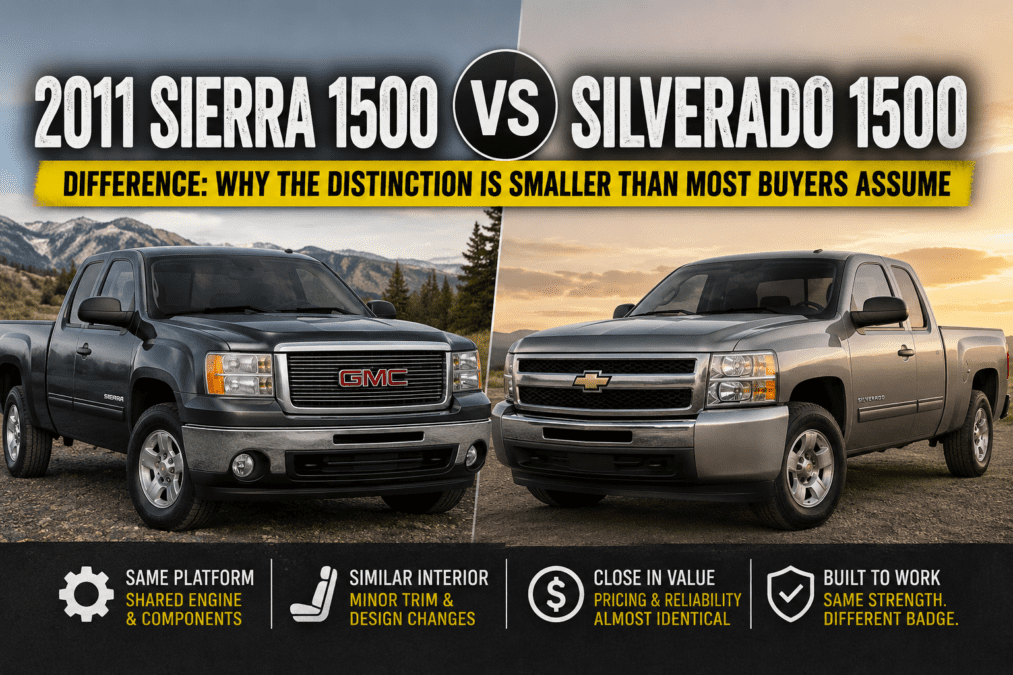

The full-size pickup market has long been dominated by vehicles that share engineering foundations while presenting different brand identities. Few examples illustrate this better than the GMC Sierra 1500 and Chevrolet Silverado 1500. For shoppers researching the 2011 sierra 1500 vs silverado 1500 difference, the challenge is understanding whether the distinctions are meaningful enough to influence purchasing decisions or whether the trucks are essentially identical beneath their badges.
A proper comparison requires looking beyond marketing language and examining platform architecture, powertrain options, towing capability, interior design philosophy, long-term ownership factors, and market positioning. While both trucks originate from the same parent company and share substantial engineering components, their intended audiences and execution differ in subtle but important ways.
The surprising conclusion emerging from most ownership data and industry analysis is that the 2011 sierra 1500 vs silverado 1500 difference is less about capability and more about presentation. Performance metrics, reliability trends, and mechanical systems overlap heavily, while styling, feature packaging, and perceived premium value create the primary separation between the two vehicles.
Defining the Two Trucks
The 2011 GMC Sierra 1500 is a full-size pickup truck positioned as the more premium offering within General Motors’ truck portfolio. It combines work-truck capability with upgraded styling cues, refined interior options, and a more upscale market image.
The 2011 Chevrolet Silverado 1500 is a full-size pickup truck designed to appeal to the broadest possible customer base through extensive trim diversity, strong utility credentials, and competitive pricing.
While both trucks share major mechanical components, the 2011 sierra 1500 vs silverado 1500 difference becomes evident in brand positioning, feature packaging, and visual identity.
Comparative Metrics Overview
| Attribute | 2011 GMC Sierra 1500 | 2011 Chevrolet Silverado 1500 |
|---|---|---|
| Manufacturer Division | GMC | Chevrolet |
| Platform | GMT900 | GMT900 |
| Engine Options | 4.3L V6, 4.8L V8, 5.3L V8, 6.2L V8 | 4.3L V6, 4.8L V8, 5.3L V8, 6.2L V8 |
| Maximum Horsepower | 403 hp (6.2L V8) | 403 hp (6.2L V8) |
| Maximum Towing Capacity | Up to 10,700 lbs | Up to 10,700 lbs |
| Transmission Options | 4-Speed or 6-Speed Automatic | 4-Speed or 6-Speed Automatic |
| Drivetrain Choices | 2WD or 4WD | 2WD or 4WD |
| Suspension Design | Independent Front, Solid Rear Axle | Independent Front, Solid Rear Axle |
| Interior Positioning | More Premium-Oriented | Broader Consumer Focus |
| Exterior Styling | Bolder Grille, Upscale Appearance | Mainstream Truck Design |
| Luxury Trim Availability | Strong Focus (SLT, Denali) | Available (LTZ) |
| Work-Truck Availability | Moderate | Extensive |
| Used Market Pricing | Typically Slightly Higher | Typically Slightly Lower |
| Parts Availability | Excellent | Excellent |
| Aftermarket Support | Very Strong | Extremely Strong |
| Best Suited For | Buyers Seeking Premium Styling and Features | Buyers Prioritizing Value and Variety |
Structural And Mechanical Foundations
When analyzing the 2011 sierra 1500 vs silverado 1500 difference, the most important starting point is their shared architecture. Both trucks are built on General Motors’ GMT900 platform, meaning the frame, suspension geometry, wheelbase options, drivetrain components, and much of the underlying engineering are nearly identical.
This common foundation delivers several practical consequences. Ride quality, towing behavior, payload performance, and overall durability tend to be remarkably similar when equivalent configurations are compared. The same engines are available across much of the lineup, including the well-known 4.8-liter, 5.3-liter, and 6.2-liter V8 powerplants.
Because so many critical systems are shared, owners frequently report nearly indistinguishable driving experiences. The structural reality is that both vehicles originate from the same engineering blueprint. Consequently, buyers searching for dramatic mechanical differences often discover that the real distinctions emerge elsewhere rather than in the trucks’ fundamental design.
Design Philosophy And Brand Identity
A major aspect of the 2011 sierra 1500 vs silverado 1500 difference lies in visual presentation. GMC historically positioned itself as the professional-grade truck brand within General Motors, while Chevrolet targeted a broader customer spectrum.
The Sierra adopted a more upright grille design, premium chrome treatments, and styling elements intended to communicate refinement and authority. Its exterior appearance often projected a more upscale image without fundamentally altering capability.
The Silverado pursued a slightly more mainstream aesthetic. Designers emphasized mass-market appeal, ensuring the truck remained attractive to contractors, families, fleet operators, and recreational users alike.
These visual distinctions may appear cosmetic, yet they influence buyer perception significantly. Vehicle purchasing decisions frequently involve emotional factors alongside objective specifications. As a result, the styling-related 2011 sierra 1500 vs silverado 1500 difference has often proven more influential than measurable performance distinctions.
Behavioral Patterns And Driver Experience
Driver experience provides another valuable lens for evaluating the 2011 sierra 1500 vs silverado 1500 difference. Despite shared engineering, ownership experiences can diverge due to trim selection and feature packaging.
Sierra buyers historically gravitated toward premium trims that emphasized comfort, technology, and upscale appointments. Consequently, many used Sierra examples on today’s market include higher-end interiors, upgraded seating surfaces, and additional convenience features.
Silverado ownership patterns have traditionally been more diverse. The truck attracted everyone from fleet managers and agricultural operators to suburban families. This broader audience created a wider range of configurations, from basic work trucks to luxury-oriented variants.
While identical mechanical setups produce nearly identical driving behavior, the average ownership experience may differ because of equipment levels. Therefore, the practical 2011 sierra 1500 vs silverado 1500 difference often depends less on engineering and more on how each truck was originally specified.
Powertrain Analysis
Powertrain selection represents one area where buyers expect major contrasts, yet the 2011 sierra 1500 vs silverado 1500 difference remains relatively small.
Both trucks offered a range of engines designed to satisfy different needs. The base V6 prioritized affordability, while multiple V8 options delivered increasing levels of towing capability and acceleration performance. The widely used 5.3-liter V8 became particularly popular because it balanced power, fuel efficiency, and reliability.
Transmission options mirrored each other as well. Depending on engine and trim combinations, buyers could choose between four-speed and six-speed automatic transmissions. Gear ratios, drivetrain calibration, and overall performance characteristics remained largely comparable.
This shared mechanical portfolio means acceleration times, towing confidence, and hauling capability are primarily determined by configuration rather than brand badge. In practical terms, the 2011 sierra 1500 vs silverado 1500 difference rarely affects real-world powertrain performance when equivalent specifications are matched.
Subject A: Strengths And Constraints Of The GMC Sierra 1500
The GMC Sierra 1500 possesses several notable strengths that help explain its enduring popularity. One advantage is perceived premium value. Buyers often associate GMC branding with refinement, professionalism, and higher-end presentation.
Interior materials frequently appeared more upscale in comparable trims. Exterior styling projected a distinctive visual presence that many truck enthusiasts preferred. Additionally, resale values sometimes remained slightly stronger due to the brand’s premium positioning.
However, constraints exist as well. Purchase prices, both new and used, often exceeded comparable Silverado models. Parts costs may occasionally be marginally higher depending on trim-specific components. The premium image can also create inflated expectations regarding capability, despite the fact that mechanical performance remains largely shared.
For buyers prioritizing image, refinement, and upscale design, the Sierra presents compelling advantages. Yet understanding the true 2011 sierra 1500 vs silverado 1500 difference requires recognizing that much of the premium stems from positioning rather than radically different engineering.
Subject B: Strengths And Constraints Of The Chevrolet Silverado 1500
The Silverado 1500’s greatest strength is versatility. Few trucks in its segment offered such a broad spectrum of configurations, allowing buyers to tailor capability, comfort, and cost according to individual needs.
The used vehicle market typically contains far more Silverado examples, simplifying the search process and increasing negotiating leverage. Replacement parts availability is generally excellent, and the truck enjoys strong aftermarket support.
Affordability represents another major advantage. Equivalent Silverados frequently sell for less than comparable Sierra models while delivering nearly identical mechanical performance.
The primary limitation involves perceived prestige. Some buyers simply prefer the more upscale image associated with GMC. Additionally, lower-trim Silverado interiors can feel more utilitarian than similarly equipped Sierra counterparts.
These factors illustrate that the 2011 sierra 1500 vs silverado 1500 difference often revolves around value perception rather than objective capability.
Interior Quality And Comfort
Interior design reveals one of the most visible examples of the 2011 sierra 1500 vs silverado 1500 difference. While dashboard architecture shares significant commonality, trim execution often diverges.
Higher-end Sierra models emphasized premium materials, enhanced trim pieces, and luxury-oriented appointments. The cabin environment frequently felt more sophisticated, particularly in SLT and Denali variants.
Silverado interiors ranged from highly functional work-truck configurations to impressively equipped luxury trims. However, entry-level models often prioritized durability over elegance.
Noise isolation, seat comfort, and ergonomics remained generally competitive in both vehicles. Yet the Sierra consistently reinforced its premium-brand identity through subtle material and design upgrades.
For drivers spending long hours behind the wheel, these seemingly minor distinctions can have a meaningful impact on ownership satisfaction.
Comparative Advantages In Real-World Scenarios
The practical 2011 sierra 1500 vs silverado 1500 difference becomes clearer when evaluated through real-world use cases.
For commercial fleets, Silverado often represents the better value proposition. Lower acquisition costs and abundant inventory make large-scale purchasing easier and more economical.
For private owners seeking a premium truck experience without entering luxury-brand territory, Sierra frequently offers greater appeal. Its styling, branding, and upscale appointments create a more refined ownership experience.
For towing and hauling applications, neither truck holds a decisive advantage. Equivalent configurations produce nearly identical performance metrics because they share engines, transmissions, and chassis components.
For long-term customization, Silverado benefits from an enormous aftermarket ecosystem. Accessories, performance upgrades, and replacement parts are widely available.
Thus, the best choice depends on ownership priorities rather than objective superiority.
Direct Answer
If someone asks about the 2011 sierra 1500 vs silverado 1500 difference, the simplest answer is that both trucks share the same core engineering, engines, transmissions, and capability, while the Sierra emphasizes premium styling and upscale branding and the Silverado emphasizes value, broader trim availability, and lower purchase costs. Capability differences are usually minimal when comparable configurations are matched.
Reliability And Ownership Costs
Reliability analysis reveals another important aspect of the 2011 sierra 1500 vs silverado 1500 difference. Since both vehicles share major mechanical systems, reliability patterns tend to mirror each other.
Common ownership concerns include fuel management system issues on certain V8 engines, electronic component wear, suspension maintenance, and age-related corrosion depending on climate exposure. These issues generally affect both trucks similarly.
Maintenance costs remain comparable because most major components are interchangeable or closely related. Routine service procedures, repair complexity, and parts sourcing are likewise similar.
The biggest ownership-cost distinction often involves initial purchase price. Sierra models typically command a modest premium on the used market. While resale values may remain slightly stronger, the higher upfront cost can offset part of that advantage.
From a reliability perspective, buyers should focus more on vehicle condition, maintenance history, and configuration than on brand badge.
Scientific And Expert Consensus (2026)
Industry analysts, automotive historians, and used-truck specialists generally agree on a consistent conclusion regarding the 2011 sierra 1500 vs silverado 1500 difference.
Experts recognize that both trucks originate from a common engineering platform and deliver remarkably similar capability. Mechanical superiority is difficult to assign because equivalent configurations perform nearly identically.
Consensus instead centers on market positioning. GMC successfully differentiated the Sierra through premium branding and upscale presentation, while Chevrolet optimized the Silverado for broad market accessibility and value.
Professional reviewers frequently note that buyers should evaluate condition, maintenance records, engine selection, and trim level before focusing heavily on brand identity. A well-maintained Silverado often represents a better purchase than a neglected Sierra, and vice versa.
This perspective reflects a mature understanding that vehicle quality depends on more than manufacturer positioning.
Market Value And Collectability
As these trucks continue aging, discussions about the 2011 sierra 1500 vs silverado 1500 difference increasingly include market value trends.
Sierra models, particularly premium trims, often maintain stronger resale values due to perceived exclusivity. Denali variants are especially sought after because they combine truck utility with luxury-oriented features.
Silverado models benefit from widespread popularity and strong demand among budget-conscious truck buyers. Their larger production numbers create more opportunities for finding well-maintained examples.
Neither truck currently occupies true collector status, yet special configurations and exceptionally preserved vehicles are attracting increased enthusiast interest. Future appreciation is likely to depend on rarity, condition, and specification rather than brand alone.
Final Synthesis And Verdict
The most important takeaway regarding the 2011 sierra 1500 vs silverado 1500 difference is that capability does not meaningfully separate these trucks. They share the same platform, similar powertrains, comparable towing ratings, and closely related reliability characteristics.
Where the distinction emerges is in philosophy. The Sierra targets buyers seeking a more premium truck identity, while the Silverado prioritizes flexibility, affordability, and mass-market appeal.
If value, inventory availability, and lower purchase costs matter most, the Silverado generally offers the stronger proposition. If premium styling, upscale branding, and enhanced cabin presentation are priorities, the Sierra justifies consideration.
Ultimately, the 2011 sierra 1500 vs silverado 1500 difference is best understood as a branding and execution distinction layered onto a shared engineering foundation. While the Sierra projects greater refinement, the Silverado often delivers comparable capability for less money. For most used-truck shoppers, vehicle condition and maintenance history should outweigh badge preference.
Frequently Asked Questions
Is there a major mechanical difference between a 2011 Sierra 1500 and a 2011 Silverado 1500?
No. The core 2011 sierra 1500 vs silverado 1500 difference is not mechanical. Both trucks share platform architecture, engine options, transmission choices, and many drivetrain components.
Which truck is more reliable: the 2011 Sierra 1500 or the 2011 Silverado 1500?
Reliability is generally comparable because both trucks use similar engineering. Maintenance history and vehicle condition are usually more important than whether the truck is a Sierra or Silverado.
Why does a Sierra often cost more than a Silverado?
The Sierra is positioned as GMC’s premium truck offering. This branding strategy, combined with upscale trim packaging and stronger perceived exclusivity, often results in higher market prices.
Which is better for towing?
Neither truck holds a universal towing advantage. While specific configurations may differ, equivalent engine and drivetrain combinations produce very similar towing capabilities, making the 2011 sierra 1500 vs silverado 1500 difference largely irrelevant for most towing applications.