
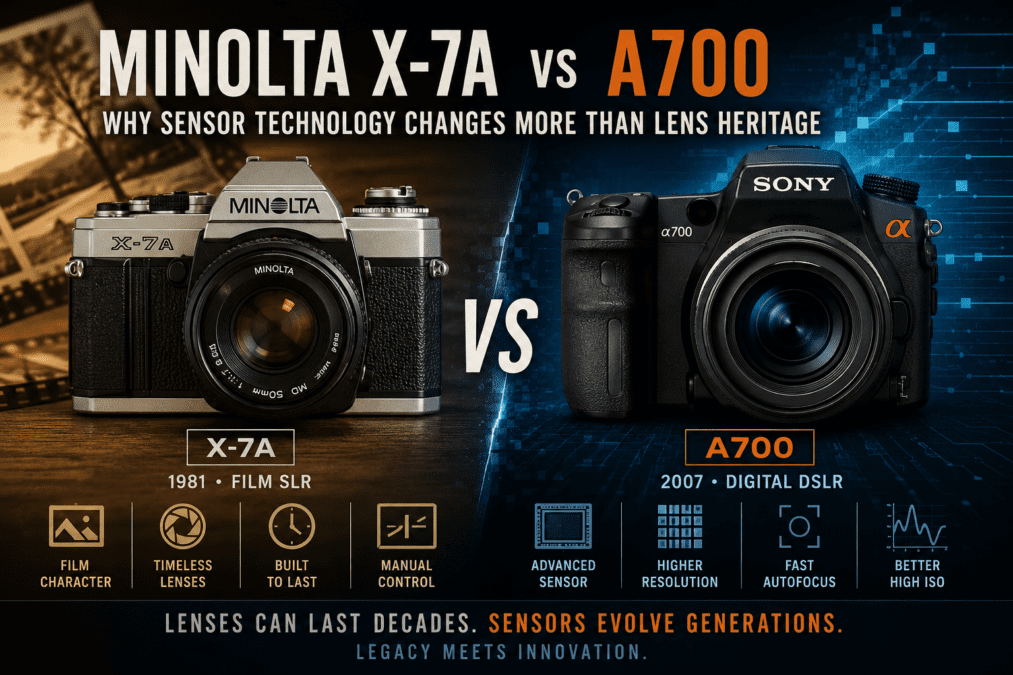

The comparison between the Minolta X-7A and the A700 represents far more than a simple choice between two camera models. It reflects a technological transition spanning decades, moving from fully mechanical film photography toward sophisticated digital imaging systems. While both cameras share roots within the broader Minolta photographic legacy, they were designed for entirely different eras, workflows, and user expectations.
A meaningful minolta x-7a vs a700 analysis requires examining not only specifications but also the philosophies behind each camera. The X-7A emerged during a period when photographers relied heavily on manual exposure control, film selection, and technical discipline. The A700, by contrast, arrived in the digital age, emphasizing speed, flexibility, image review, and advanced automation.
The most surprising insight in the minolta x-7a vs a700 debate is that superiority depends less on image quality alone and more on photographic intent. The A700 is objectively more capable in measurable performance categories, yet the X-7A often delivers a shooting experience that many enthusiasts still find uniquely rewarding. Understanding this distinction is essential before declaring a winner.
Essential Comparative Metrics
| Attribute | Minolta X-7A | Sony A700 |
|---|---|---|
| Camera Type | 35mm Film SLR | Digital DSLR |
| Launch Era | 1980s | 2007 |
| Image Medium | 35mm Film | APS-C CMOS Sensor |
| Resolution | Dependent on Film Stock | 12.24 Megapixels |
| Lens Mount | Minolta SR/MD Mount | A-Mount |
| Autofocus | No | Yes |
| Image Review | Not Available | Rear LCD Display |
| Burst Shooting | Manual Advance | Up to 5 FPS |
| ISO Adjustment | Film Dependent | Adjustable Digitally |
| Storage | Film Rolls | Memory Cards |
| Battery Dependence | Minimal | Significant |
| Learning Curve | Moderate to High | Moderate |
A Minolta X-7A is a manual-focus 35mm film SLR designed around traditional photographic techniques. An A700 is a digital DSLR that combines interchangeable lenses with advanced electronic imaging technologies.
For photographers asking which camera is better in the minolta x-7a vs a700 comparison, the answer depends on priorities. The A700 offers greater speed, flexibility, autofocus capability, and workflow efficiency, while the X-7A provides a classic film experience, tactile controls, and a slower, more deliberate approach to image creation that many enthusiasts continue to value.
Structural And Biological Foundations
Although cameras are not biological entities, their structural foundations determine how effectively they perform under different conditions. The minolta x-7a vs a700 discussion begins with understanding their core architecture.
The X-7A relies on a mechanical and optical framework centered around 35mm film. Light enters through the lens, reflects through a mirror system, and ultimately exposes film emulsion. Every photograph depends on physical chemical processes. This design encourages precision because mistakes often remain invisible until film development.
The A700 replaces film with a digital sensor capable of converting incoming light into electronic data. This transition fundamentally changes photography. Exposure errors can be identified instantly, ISO can be adjusted between shots, and image files can be processed after capture.
From a structural perspective, the A700 represents a highly integrated electronic system, while the X-7A remains closer to the traditional mechanical ideals that defined photography for much of the twentieth century. This distinction shapes every aspect of the minolta x-7a vs a700 comparison.
Behavioral Patterns And Social Intelligence
The concept of behavioral patterns in cameras refers to how they interact with photographers during practical use. The minolta x-7a vs a700 comparison reveals dramatically different operational personalities.
The X-7A encourages patience. Photographers typically spend more time evaluating light, composing scenes, and selecting exposure settings. Because every frame carries a cost, shooting tends to become more intentional. Many film photographers argue that this behavior improves discipline and visual awareness.
The A700 behaves differently. It facilitates experimentation through immediate feedback and rapid shooting capabilities. Users can test compositions, adjust settings instantly, and learn from results in real time. This accelerates skill development in many situations.
While the X-7A rewards thoughtful preparation, the A700 rewards adaptability and responsiveness. Neither approach is inherently superior. Instead, they cultivate different photographic habits. Understanding these behavioral differences is critical when evaluating minolta x-7a vs a700 from a practical perspective rather than a purely technical one.
Subject A: Strengths And Constraints
The X-7A possesses several enduring strengths that continue to attract collectors and film enthusiasts. In the minolta x-7a vs a700 discussion, these strengths are often overlooked because they are difficult to quantify.
One major advantage is simplicity. The camera focuses attention on exposure fundamentals rather than menu systems and digital customization. Its mechanical design also creates a tactile shooting experience that many photographers find engaging and educational.
Film itself offers creative possibilities through different emulsions, grain structures, and color renditions. A photographer can dramatically alter image characteristics simply by changing film stock.
However, limitations are significant. There is no autofocus, no image review, and no rapid workflow. Film and development costs accumulate over time. Low-light flexibility is restricted by the ISO characteristics of the chosen film.
Therefore, in the minolta x-7a vs a700 comparison, the X-7A excels as a learning tool and artistic instrument but struggles when efficiency and versatility become priorities.
Subject B: Strengths And Constraints
The A700 was designed to maximize photographic efficiency while maintaining enthusiast-level control. Its strengths dominate many categories within the minolta x-7a vs a700 debate.
Autofocus dramatically improves usability for sports, wildlife, events, and spontaneous photography. Continuous shooting capabilities increase the likelihood of capturing decisive moments. Digital storage allows thousands of images without changing media.
The APS-C sensor provides flexibility unavailable to film users who are locked into a single roll’s characteristics. White balance, ISO, and exposure compensation can be adjusted instantly. Post-processing further expands creative possibilities.
Yet the A700 is not without constraints. Some photographers view digital workflows as less deliberate and more prone to excessive shooting. Battery dependence introduces operational vulnerabilities absent from many mechanical cameras. Additionally, some enthusiasts prefer the tonal rendering and unpredictability associated with film.
Within the minolta x-7a vs a700 framework, the A700’s strengths overwhelmingly support practical photography, though it may not satisfy photographers seeking a purely analog experience.
Image Quality And Photographic Output
Image quality remains one of the most debated topics in the minolta x-7a vs a700 conversation. Surprisingly, the answer is not straightforward.
The A700 produces consistent, measurable results. Its sensor delivers predictable color, dynamic range, and detail levels. Modern editing software further enhances image quality, enabling corrections that would be difficult or impossible with film.
The X-7A’s output varies according to film choice, development methods, scanning quality, and shooting technique. Certain films produce distinctive color palettes and grain structures that digital simulations attempt to replicate. Many photographers appreciate this organic variability.
While the A700 generally delivers greater technical consistency, the X-7A often produces images with a unique character that some viewers perceive as more artistic. The distinction illustrates why minolta x-7a vs a700 cannot be reduced to megapixels or laboratory measurements alone.
Lens Ecosystems And Upgrade Potential
Another important aspect of the minolta x-7a vs a700 evaluation involves lens compatibility and long-term growth potential.
The X-7A uses Minolta’s manual-focus SR/MD lens system. Many of these lenses are optically impressive and remain highly respected among collectors. Their mechanical focus rings and aperture controls contribute to the classic film photography experience.
The A700 utilizes the A-Mount ecosystem. This opens access to autofocus lenses developed by both Minolta and Sony, providing a wider range of practical options for contemporary photography.
The upgrade path favors the A700 because digital workflows continue to integrate more easily with modern technology. However, collectors and enthusiasts often value MD lenses for their craftsmanship and character.
Consequently, the minolta x-7a vs a700 comparison highlights two different philosophies: preserving historical photographic traditions versus embracing technological adaptability.
Comparative Advantages In Real-World Scenarios
Real-world performance often reveals differences more clearly than specifications. The minolta x-7a vs a700 comparison becomes particularly illuminating when viewed through actual shooting scenarios.
For travel photography, the A700 holds a substantial advantage. Immediate image review helps avoid costly mistakes, while memory cards provide extensive storage capacity. Autofocus also assists in rapidly changing environments.
For sports and wildlife photography, the A700 wins decisively. Continuous shooting, autofocus tracking, and digital responsiveness are essential tools.
For educational photography, however, the X-7A offers unique benefits. Students learn exposure fundamentals more deeply because every frame requires deliberate decision-making.
For artistic projects emphasizing process and craftsmanship, many photographers prefer the film-based workflow of the X-7A. The slower pace often encourages stronger compositional discipline.
While the X-7A excels in intentional and creative environments, the A700 dominates situations requiring speed, reliability, and adaptability. This reality heavily influences the outcome of the minolta x-7a vs a700 debate.
Ownership Costs And Long-Term Value
Cost considerations introduce another layer to the minolta x-7a vs a700 discussion.
The initial purchase price of either camera may appear attractive in the used market. However, ownership economics differ significantly.
The X-7A requires continuous investment in film, processing, and scanning. These recurring costs can exceed the camera’s purchase price many times over. Nevertheless, some photographers view these expenses as part of the artistic process rather than a disadvantage.
The A700 largely eliminates ongoing media costs. Once storage cards and batteries are acquired, thousands of images can be captured at minimal additional expense.
Long-term value also depends on collector interest. Vintage film cameras sometimes appreciate because of nostalgia and limited availability. Digital cameras generally depreciate more rapidly as technology advances.
As a result, the financial aspect of minolta x-7a vs a700 depends on whether one prioritizes operational efficiency or collectible appeal.
Scientific And Expert Consensus (2026)
The expert consensus surrounding minolta x-7a vs a700 is remarkably consistent. Most photographic historians, educators, and imaging specialists agree that the cameras serve different purposes rather than directly competing.
Technical experts overwhelmingly recognize the A700 as the more capable photographic tool. Its autofocus system, digital workflow, adjustable sensitivity, and rapid operation create measurable advantages in nearly every practical category.
Film specialists, however, continue to emphasize the educational and artistic value of cameras such as the X-7A. The requirement to slow down, anticipate outcomes, and commit to settings before exposure fosters a distinct creative discipline.
Modern photography education increasingly combines both approaches. Students often learn foundational concepts through film while relying on digital systems for professional work.
Therefore, the prevailing 2026 consensus is not that one camera replaces the other. Instead, each represents a different solution to different photographic goals within the broader minolta x-7a vs a700 conversation.
Final Synthesis And Verdict
After examining technology, usability, image quality, workflow efficiency, ownership costs, and expert opinion, a clear conclusion emerges from the minolta x-7a vs a700 analysis.
The A700 is the stronger photographic tool for most users. Its digital sensor, autofocus capabilities, rapid shooting performance, and modern workflow advantages make it more versatile across a wider range of situations. Photographers seeking practicality, speed, and consistency will almost certainly prefer the A700.
The X-7A remains valuable for different reasons. It offers a distinctive shooting experience rooted in craftsmanship, patience, and photographic fundamentals. For enthusiasts who appreciate film aesthetics and the tactile nature of analog photography, it delivers rewards that cannot be measured solely through specifications.
Ultimately, the minolta x-7a vs a700 comparison is not a battle between good and bad technology. It is a choice between two philosophies of image-making. If efficiency and capability matter most, choose the A700. If process, tradition, and artistic immersion are the priority, the X-7A remains a compelling alternative decades after its introduction.
Frequently Asked Questions
Is the Minolta X-7A better than the A700 for learning photography?
The X-7A can be excellent for learning exposure fundamentals because it encourages deliberate decision-making. However, the A700 allows faster experimentation and immediate feedback. Both teach valuable skills, but they do so through different methods.
Which camera produces better image quality in the minolta x-7a vs a700 comparison?
Technically, the A700 provides more consistent image quality and greater flexibility. The X-7A can produce distinctive film-based aesthetics that some photographers prefer artistically, even if technical performance is less predictable.
Can lenses from the X-7A be used directly on the A700?
Generally, no. The cameras use different lens mount systems. Adapters may exist for certain applications, but direct compatibility is limited and often compromises functionality.
Who should choose the A700 over the X-7A?
Photographers who prioritize speed, autofocus performance, workflow efficiency, digital editing, and practical versatility should choose the A700. Those interested in traditional film photography and a more deliberate creative process may prefer the X-7A despite its limitations.