
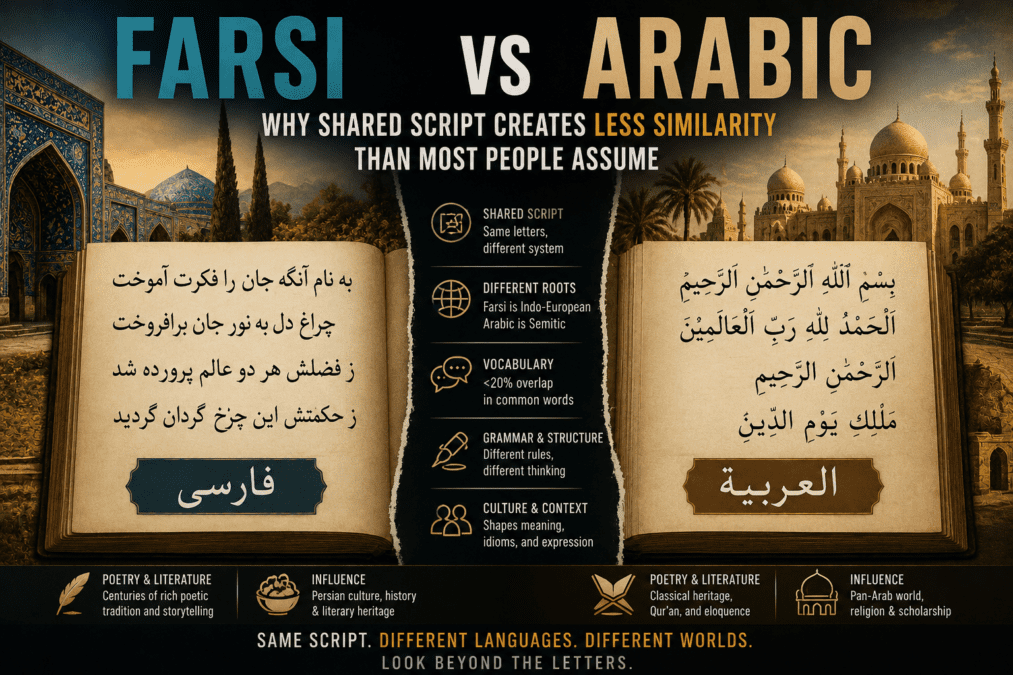

Language comparisons often become distorted by visual similarities. Few examples demonstrate this more clearly than farsi vs arabic. At first glance, both languages appear closely related because they use comparable writing systems, share centuries of cultural interaction, and contain overlapping vocabulary. Yet beneath the surface, they belong to entirely different linguistic families with distinct grammatical structures, historical origins, and patterns of thought.
A meaningful farsi vs arabic analysis requires looking beyond script and borrowed words. The comparison must examine language family, phonology, syntax, morphology, historical development, literary traditions, and practical communication. Only by evaluating these dimensions together can we understand where the languages genuinely overlap and where they fundamentally diverge.
The central insight emerging from a deep farsi vs arabic comparison is that script similarity often creates an illusion of linguistic closeness. While Arabic profoundly influenced Persian vocabulary and writing, Persian retained its Indo-European foundation. As a result, speakers of one language cannot automatically understand the other despite centuries of cultural exchange. This distinction explains why the relationship between the two languages is simultaneously intimate and remarkably distant.
Defining Farsi And Arabic
Farsi, also known as Persian, is an Indo-European language primarily spoken in Iran and closely related to Dari and Tajik.
Arabic is a Semitic language originating in the Arabian Peninsula and serving as the primary language of more than twenty countries across the Middle East and North Africa.
In a simple farsi vs arabic comparison, Persian inherited many Arabic words and adopted a modified Arabic script, while Arabic preserved its Semitic grammatical system and linguistic structure. Although they share visual characteristics in writing, they remain fundamentally different languages.
Comparative Metrics
| Attribute | Farsi (Persian) | Arabic |
|---|---|---|
| Language Family | Indo-European | Semitic (Afro-Asiatic) |
| Primary Regions | Iran, Afghanistan, Tajikistan | Middle East and North Africa |
| Writing System | Modified Arabic Script | Arabic Script |
| Native Speakers | Approximately 70–80 million | More than 300 million |
| Language Origin | Derived from Old Persian | Derived from Proto-Semitic roots |
| Grammar Style | Relatively analytic and simplified | Highly inflected and root-based |
| Word Formation | Primarily prefixes, suffixes, and compounding | Root-and-pattern morphology |
| Grammatical Gender | No grammatical gender | Masculine and feminine forms required |
| Verb Complexity | Moderate | High |
| Sentence Structure | Typically Subject-Object-Verb (SOV) | Flexible, often Verb-Subject-Object (VSO) |
| Pronunciation Style | Softer consonants and simplified sounds | Includes emphatic and throat-based consonants |
| Vocabulary Influence | Contains many Arabic loanwords | Relatively limited Persian borrowing |
| Mutual Intelligibility | Very low with Arabic speakers | Very low with Persian speakers |
| Literary Heritage | Renowned for poetry, philosophy, and mysticism | Renowned for rhetoric, theology, and classical literature |
| Religious Importance | Important in Persian Islamic scholarship | Language of the Quran and Islamic worship |
| Learning Difficulty | Generally easier for many foreign learners | Generally more challenging due to grammar complexity |
| Geographic Reach | Concentrated in a few countries | Official language across more than 20 countries |
| Cultural Influence | Strong influence through poetry and Persian civilization | Strong influence through religion, trade, and scholarship |
| Best For | Iranian studies, Persian literature, and regional culture | Regional communication, diplomacy, and Islamic studies |
Historical Origins And Linguistic Evolution
The story behind farsi vs arabic begins thousands of years before either language adopted its modern form. Persian descends from Old Persian, a language used during the Achaemenid Empire. Through Middle Persian and later New Persian, it evolved while maintaining its Indo-European roots. Its relatives are languages such as English, German, Hindi, and Russian rather than Arabic.
Arabic developed within the Semitic branch of the Afro-Asiatic language family. It shares deeper linguistic ancestry with Hebrew, Aramaic, and Amharic. Classical Arabic emerged as a highly structured literary language and later spread extensively through religion, trade, scholarship, and political expansion.
The Arab conquest of Persia in the seventh century profoundly influenced Persian culture and vocabulary. Yet despite absorbing thousands of Arabic words, Persian retained its core grammatical identity. This historical outcome remains one of the most important observations in any serious farsi vs arabic study.
Structural And Biological Foundations
From a linguistic perspective, farsi vs arabic represents a comparison between two fundamentally different language architectures. Persian follows many patterns familiar to speakers of other Indo-European languages. Sentence construction tends to be predictable, and grammatical relationships often rely on word order rather than extensive inflection.
Arabic operates through a root-and-pattern system. Most words originate from consonantal roots, usually consisting of three consonants. Different vowel patterns and affixes generate related meanings from the same root. This system allows Arabic to create vast semantic networks while preserving connections between concepts.
Another major distinction involves grammatical gender. Persian does not assign masculine or feminine gender to nouns. Arabic, by contrast, requires gender agreement across nouns, adjectives, pronouns, and many verb forms. This difference significantly shapes how speakers process and construct language.
The structural contrast found in farsi vs arabic reveals that linguistic similarity cannot be determined merely by script or vocabulary borrowing.
Writing Systems And Orthographic Similarities
One reason people often misunderstand farsi vs arabic is that both languages use visually related writing systems. Persian adopted the Arabic script after the Islamic expansion into Persia but modified it to accommodate sounds not present in Arabic.
Persian added letters such as پ, چ, ژ, and گ. These characters represent sounds that Arabic lacks. Consequently, although Arabic readers may recognize Persian text visually, accurate pronunciation and comprehension remain difficult.
The writing direction is also identical, moving from right to left. Many letter forms appear nearly the same, creating an impression of mutual readability. Yet script familiarity should not be confused with linguistic understanding.
A useful analogy is the relationship between English and French using the Latin alphabet. Shared writing systems facilitate reading mechanics but do not guarantee comprehension. The same principle applies throughout the farsi vs arabic comparison.
Pronunciation And Sound Systems
Pronunciation offers another revealing perspective on farsi vs arabic. Arabic contains several consonants that have no direct equivalent in Persian. These include emphatic consonants and deep throat sounds that are characteristic of Semitic phonology.
Persian pronunciation generally evolved toward a softer sound profile. Many Arabic loanwords entered Persian but gradually lost distinctions that remain important in Arabic speech. Multiple Arabic letters representing different sounds may be pronounced identically in modern Persian.
Vowel systems also differ significantly. Arabic often preserves vowel distinctions that carry grammatical importance. Persian pronunciation relies on a different balance between vowels and consonants, producing a rhythm distinct from Arabic speech.
As a result, even when Persian speakers encounter familiar Arabic vocabulary, pronunciation differences can hinder understanding. The phonological dimension of farsi vs arabic highlights how language identity extends far beyond shared written forms.
Grammar And Sentence Construction
Grammar is arguably where the deepest divide in farsi vs arabic becomes visible. Persian grammar is often considered comparatively accessible because it lacks many of the inflectional layers found in Arabic.
Persian nouns do not change according to grammatical gender. Verb systems, while sophisticated, remain more streamlined than Arabic’s extensive conjugation structures. Sentence order generally follows a subject-object-verb pattern.
Arabic employs a far richer inflectional framework. Verbs change according to person, number, gender, tense, mood, and voice. Nouns may carry markers indicating grammatical roles. Adjective agreement introduces additional complexity.
While Persian tends to express relationships through syntax and auxiliary structures, Arabic frequently encodes these relationships directly within word forms. Therefore, learners comparing farsi vs arabic often find that grammar—not vocabulary—creates the largest challenge.
Offence vs Defence: Why Sustainable Success Depends on Strategic Balance Rather Than Pure Aggression
Vocabulary Exchange And Cultural Borrowing
An intriguing aspect of farsi vs arabic is the asymmetrical nature of vocabulary influence. Persian absorbed a substantial number of Arabic words, particularly in religion, administration, philosophy, law, and scholarship.
However, borrowed vocabulary does not erase linguistic identity. Persian integrated Arabic terms into Persian grammatical structures. The borrowed words became Persianized through pronunciation, usage, and context.
Arabic, meanwhile, absorbed far fewer Persian terms overall, though Persian influence can still be observed in certain historical and cultural domains. This exchange reflects historical power dynamics, trade routes, intellectual movements, and centuries of interaction.
The result is a linguistic relationship in which Persian speakers may recognize many Arabic-derived terms, yet still struggle to understand Arabic conversation. This phenomenon frequently surprises people examining farsi vs arabic for the first time.
Behavioral Patterns And Social Intelligence
Languages influence social interaction in subtle ways. In the context of farsi vs arabic, cultural communication patterns provide important insights.
Persian discourse often emphasizes indirectness, politeness strategies, and elaborate forms of social courtesy. Concepts such as ritual politeness and nuanced interpersonal negotiation play important roles in communication.
Arabic communication styles vary significantly across regions, but many Arabic-speaking societies place strong value on rhetorical expression, eloquence, and linguistic precision. Classical Arabic traditions contributed to highly developed forms of public speaking, poetry, and oral performance.
Neither approach is inherently superior. Instead, each reflects historical social structures, literary traditions, and cultural priorities. Comparing communication styles helps explain why language learning involves more than memorizing vocabulary and grammar.
The social dimension of farsi vs arabic demonstrates how language functions as both a communication system and a cultural framework.
Literary Traditions And Intellectual Influence
Literature provides one of the richest lenses through which to examine farsi vs arabic. Persian literature became renowned for philosophical poetry, mysticism, and symbolic storytelling. Persian poets shaped intellectual traditions far beyond Iran’s borders.
Arabic literature developed an equally influential legacy centered on eloquence, rhetoric, theology, history, science, and poetry. Classical Arabic texts helped preserve and transmit knowledge throughout large portions of the medieval world.
The literary traditions frequently interacted with one another. Scholars translated works across linguistic boundaries, creating intellectual exchanges that enriched both cultures. Yet the stylistic characteristics remained distinct.
Persian literature often pursued metaphorical and mystical expression, while Arabic literary traditions frequently emphasized linguistic mastery and rhetorical sophistication. Understanding these differences provides a deeper appreciation of the broader farsi vs arabic relationship.
Subject A: Strengths And Constraints
Persian possesses several notable strengths. Its relatively straightforward grammar and absence of grammatical gender can reduce learning barriers for many students. The language also offers access to a rich literary tradition spanning poetry, philosophy, and cultural history.
Another strength lies in adaptability. Persian has incorporated vocabulary from numerous sources while preserving a coherent linguistic identity. This flexibility contributed to its longevity and regional influence.
However, Persian’s geographic reach is more limited than Arabic’s. Opportunities for use are concentrated primarily within Iran, Afghanistan, Tajikistan, and diaspora communities. Some learners may therefore encounter fewer practical situations for daily use.
Within the broader farsi vs arabic discussion, Persian stands out for accessibility and literary richness while facing limitations in global demographic reach.
Subject B: Strengths And Constraints
Arabic’s greatest strength is its geographic and demographic scale. Hundreds of millions of speakers use Arabic across a vast region spanning multiple continents. The language also holds exceptional religious significance for Muslims worldwide.
Its root-based morphology creates remarkable expressive power and semantic precision. Arabic literature, philosophy, theology, and scholarship have influenced civilizations for centuries.
The primary challenge involves complexity. Learners often encounter substantial grammatical demands, extensive verb systems, and differences between Modern Standard Arabic and regional dialects. Mastering formal Arabic does not automatically guarantee conversational fluency in every Arabic-speaking country.
The farsi vs arabic comparison therefore reveals a trade-off. Arabic offers immense reach and historical influence but often requires greater linguistic investment from learners.
Comparative Advantages In Real-World Scenarios
A practical farsi vs arabic evaluation depends heavily on individual goals.
For students interested in Iranian culture, Persian poetry, regional history, or contemporary Iran, Persian provides direct access to unique intellectual and cultural resources. Its grammar may also feel more approachable for speakers of many European and South Asian languages.
Arabic becomes advantageous when communication across multiple Middle Eastern and North African countries is a priority. Its importance in diplomacy, international relations, religious studies, journalism, and regional business significantly expands its practical value.
While Persian often offers a smoother learning curve, Arabic generally provides broader geographic utility. The better choice depends less on linguistic superiority and more on intended application.
This reality illustrates why comparisons should focus on suitability rather than declaring a universal winner.
Scientific And Expert Consensus (2026)
Current linguistic scholarship consistently emphasizes that farsi vs arabic should not be viewed as a comparison between closely related languages. Experts classify them within entirely separate language families.
Researchers generally agree on several key conclusions. First, script similarity creates a misleading impression of linguistic proximity. Second, centuries of vocabulary exchange do not erase underlying structural differences. Third, mutual intelligibility remains extremely limited despite shared historical interactions.
Modern linguists frequently cite Persian as a notable example of cultural influence without linguistic assimilation. Arabic shaped Persian vocabulary and writing conventions, yet Persian preserved its Indo-European framework.
The consensus emerging in 2026 is clear: the relationship between the languages is best understood as one of profound historical interaction rather than direct linguistic kinship.
Is Farsi Harder Or Easier Than Arabic?
For most learners, Persian is generally considered easier than Arabic.
Persian grammar is comparatively streamlined, lacks grammatical gender, and relies less on complex inflection. Arabic requires learners to master extensive conjugation systems, agreement rules, and root-based word formation patterns.
However, difficulty depends on linguistic background. A speaker already familiar with Semitic languages may find Arabic more intuitive than someone approaching it from an Indo-European perspective.
The answer to the farsi vs arabic difficulty question therefore varies by learner, but Persian is commonly regarded as the more accessible entry point.
Which Language Has Greater Global Influence?
Arabic currently possesses broader global influence due to its larger speaker population, official status in numerous countries, and central role in Islamic religious practice.
Persian nevertheless maintains substantial cultural influence through literature, historical scholarship, and regional significance. Its impact exceeds what speaker numbers alone might suggest.
A meaningful farsi vs arabic comparison recognizes that influence can be measured in different ways: demographics, religion, culture, diplomacy, literature, or economics.
Final Synthesis And Verdict
The most important conclusion from this farsi vs arabic analysis is that visual similarity conceals profound linguistic differences. Shared script and centuries of cultural interaction create an appearance of closeness, yet the languages originate from separate language families and operate according to different structural principles.
Persian represents an Indo-European tradition characterized by comparatively accessible grammar, literary elegance, and cultural continuity. Arabic embodies a Semitic tradition distinguished by morphological sophistication, global reach, and extraordinary historical influence.
When evaluating farsi vs arabic, the question is not which language is objectively better. The more meaningful question is which language aligns with a learner’s goals, interests, and practical needs. Persian offers accessibility and literary depth. Arabic offers scale, influence, and geographic breadth.
Ultimately, the surprising insight is that the strongest connection between the two languages is historical rather than structural. Their relationship demonstrates how cultures can profoundly influence one another while preserving distinct linguistic identities.
Frequently Asked Questions
Are Farsi and Arabic mutually intelligible?
No. Despite sharing a similar script and many loanwords, Persian and Arabic are not mutually intelligible. Most native speakers cannot understand the other language without formal study.
Why do Farsi and Arabic look similar in writing?
Persian adopted and modified the Arabic script after the Islamic expansion into Persia. The shared script creates visual similarity, but the languages themselves belong to different language families.
Is Farsi older than Arabic?
Both languages evolved from much older ancestral forms. Old Persian and early forms of Arabic have ancient histories, making direct age comparisons difficult. Linguists generally focus on historical development rather than declaring one language older.
Should I learn Farsi or Arabic first?
The answer depends on your goals. If you are interested in Iran, Persian literature, or a somewhat easier learning path, Persian may be preferable. If you seek broader regional communication and greater geographic reach, Arabic is often the stronger choice.