
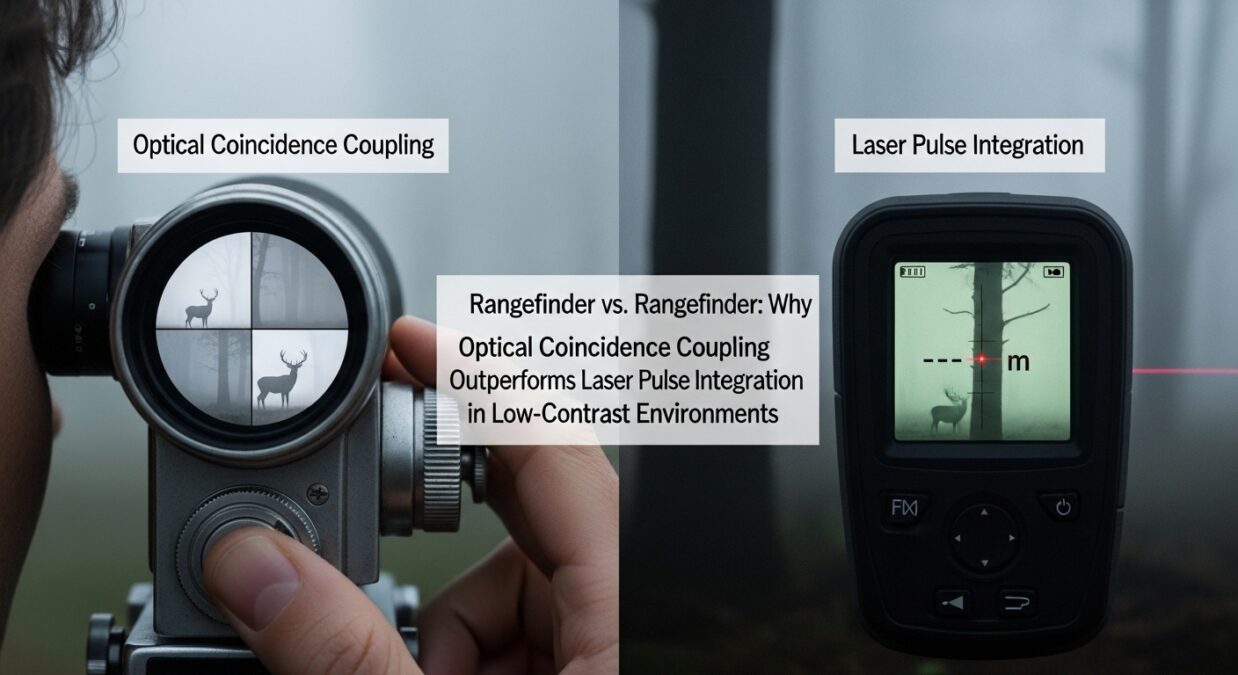

In the lexicon of precision optics and modern metrology, the term “rangefinder” occupies a dual throne. On one side resides the coincidence rangefinder—a purely optical-mechanical marvel that dominated artillery, surveying, and naval warfare for nearly a century without a single battery or circuit board. On the other side resides the modern laser rangefinder, a device so ubiquitous in golf bags, hunting vests, and construction sites that its technological underpinnings are often taken for granted. While both devices answer the same fundamental question—”How far is that object?”—the physics by which they arrive at the answer represent a stark divergence in the philosophy of measurement. To engage in a genuine rangefinder vs rangefinder analysis is not merely to compare old versus new; it is to dissect the relationship between analog triangulation and digital time-of-flight computation.
The framework for this rangefinder vs rangefinder comparison is not built upon a linear timeline of obsolescence. Instead, we must adopt a comparative lens rooted in environmental resilience and signal integrity. A laser rangefinder, regardless of its civilian or military grade, is fundamentally a transceiver. It emits a pulse, waits for a photon echo, and calculates distance based on the speed of light. This is an active system. The optical coincidence rangefinder, conversely, is a passive stereo-optical computer. It relies solely on ambient light and the geometry of human vision (or photographic plates). The metrics for success in this rangefinder vs rangefinder evaluation therefore shift away from raw maximum distance and toward operational security, atmospheric interference negation, and target edge detection.
The core thesis of this rangefinder vs rangefinder study is a counterintuitive insight: In specific high-stakes scenarios defined by thermal scintillation, heavy precipitation, or the presence of advanced laser warning receivers, the 19th-century coincidence rangefinder achieves a level of effective reliability that modern Class 1 laser devices cannot match. While the laser variant dominates the rangefinder vs rangefinder debate in terms of speed and single-operator convenience, the optical variant remains unparalleled in the rangefinder vs rangefinder metric of “stealth and atmospheric immunity.” This examination will not argue for the return of brass and glass to the golf course, but it will illuminate why the engineering principles of the stereoscopic rangefinder vs rangefinder struggle are still taught in advanced optical physics curricula and why certain military periscopes retain manual ranging stadia.
📊 Essential Comparative Metrics: Coincidence vs. Laser Emission
To ground this rangefinder vs rangefinder analysis in quantifiable reality, the following table delineates the operational parameters that distinguish the passive optical baseline from the active electronic baseline. Note that these metrics are not merely specifications; they are physical constraints dictated by the atmosphere and the uncertainty principle of light.
| Metric | Optical Coincidence Rangefinder (Stereoscopic) | Laser Rangefinder (Pulsed Time-of-Flight) |
|---|---|---|
| Operational Principle | Triangulation via dual optical paths and manual coincidence adjustment. | Emission of collimated light pulse; measurement of return interval (Δt). |
| Energy Signature | Zero Emission. Completely passive. Undetectable by electronic warfare (EW) suites. | Active Emission. Detectable by Laser Warning Receivers (LWR) and NVG bloom. |
| Atmospheric Interference | High tolerance. Heat haze degrades image sharpness but parallax geometry remains constant. | Severe degradation. Beam wander and pulse stretching in fog, dust, or thermal bloom. |
| Operator Cognitive Load | High. Requires binocular vision acuity and fine motor adjustment (Stadiametric skill). | Low. Point-and-click interface with instant digital readout. |
| Measurement Latency | 3–8 seconds (manual adjustment to null point). | < 0.5 seconds. |
| Effective Range Ceiling | Limited by baseline length (tube separation). Max practical: 20km (Barr & Stroud). | Limited by beam divergence and target reflectivity. Max: 40km+ (Mil-spec). |
| Target Discrimination | Excellent. Human brain resolves overlapping silhouettes via stereo acuity. | Moderate. Prone to “range gate pull-off” and false returns from dust/smoke. |
Structural And Biological Foundations
The structural divergence in this rangefinder vs rangefinder equation begins with the physical baseline. A coincidence rangefinder relies on a fixed, rigid tube—often exceeding one meter in length for naval applications—housing two objective lenses at opposing ends. The distance between these lenses (the baseline) is the instrument’s absolute source of angular resolution. A longer baseline directly equates to greater accuracy at distance; it is a linear mechanical advantage. In contrast, the laser rangefinder vs rangefinder comparison shows the modern device’s structure is dictated by the collimation of a diode. Here, the “baseline” is not physical separation but the temporal resolution of a stopwatch counting picoseconds. The former is constrained by ship deck space and metallurgy; the latter is constrained by semiconductor clock speeds and eye-safety regulations. The biological foundation of the optical rangefinder vs rangefinder experience is equally distinct: the human visual cortex is the final processor in the analog chain, performing a Fourier transform of edge contrast that no LIDAR algorithm has yet fully replicated for cluttered backgrounds.
Behavioral Patterns And Social Intelligence
When we speak of “behavior” in a rangefinder vs rangefinder context, we refer to the device’s interaction with the environment, not its user manual. A laser rangefinder behaves like an interrogator—it shouts a question into the void and listens for an echo. This behavior is inherently social within the electromagnetic spectrum; it announces presence. A sniper using a laser rangefinder in a contested rangefinder vs rangefinder theater immediately triggers enemy counter-sensors. The optical rangefinder, by contrast, behaves as a voyeur. It listens to light that is already there. This passive social intelligence makes the coincidence rangefinder vs rangefinder distinction critical in naval operations. A submarine periscope using a stadiametric rangefinder vs rangefinder approach (a form of optical ranging) does not break the stealth of the boat. The behavioral pattern is one of silent observation, a trait that ensures the optical rangefinder vs rangefinder discussion remains relevant for Special Operations Forces (SOF) who prioritize emissions control (EMCON) above all else.
Skeet vs Trap: Why Olympic Shotgun Disciplines Demand Opposite Neural and Biomechanical Profiles
Subject A: Strengths And Constraints (Optical Coincidence)
The primary strength of the optical rangefinder in any rangefinder vs rangefinder analysis is its immunity to counter-detection and its unparalleled performance in beam-disrupting atmospherics. When a laser pulse encounters fog, water droplets act as Mie scattering centers, returning a “cloud echo” that confuses the receiver. The optical rangefinder vs rangefinder test shows the coincidence device suffers no such fate; as long as the human eye can discern the mast of a ship through the mist, the rangefinder can measure it. Its constraints, however, are severe and undeniable. The device demands a target with a distinct vertical edge or high contrast. A perfectly camouflaged tank in a treeline is a poor target for optical coincidence. Furthermore, the rangefinder vs rangefinder comparison reveals a biological bottleneck: operator fatigue and interpupillary misalignment. Two different operators may get slightly different readings due to the subjective nature of “perfect coincidence.” This lack of objective repeatability is the chink in the optical rangefinder vs rangefinder armor.
Subject B: Strengths And Constraints (Laser Emission)
The laser rangefinder’s dominance in the commercial rangefinder vs rangefinder market is a function of its three primary strengths: speed, digitization, and single-operator viability. A golfer does not need to triangulate; they need a number in 0.3 seconds. The laser rangefinder vs rangefinder edge is its ability to integrate with ballistic computers and GPS mapping. It is a node in a digital network, not a standalone analog calculator. However, the constraints of the laser rangefinder vs rangefinder equation are more insidious than most users realize. Beyond the obvious issue of rain and fog, there is speckle noise and range walk. On a hot day, thermal lensing can bend the laser beam away from the target, a phenomenon that does not affect the straight-line geometry of the optical rangefinder vs rangefinder design. Additionally, the laser rangefinder is legally and practically constrained by eye-safety classifications. A high-power, long-range rangefinder vs rangefinder advantage for the laser only exists if the device is allowed to emit energy levels that are hazardous to human vision.
Comparative Advantages In Real-World Scenarios
The true test of any rangefinder vs rangefinder argument is not the laboratory but the battlefield and the fairway. Consider a scenario of maritime interdiction in heavy sea spray. A laser rangefinder will struggle to lock onto a small, fast-moving rigid-hull inflatable boat (RHIB) due to wave clutter and salt spray attenuation. The laser rangefinder vs rangefinder shortcoming here is a “no return” or “multiple return” error. The optical coincidence rangefinder vs rangefinder solution—specifically a stabilized director with optical ranging—allows the operator to visually track the bow spray and adjust the split-image prism until the two halves of the RHIB align perfectly. The measurement is made on the visual geometry, not on a fragile photon return. Conversely, in the realm of surveying or forestry, the rangefinder vs rangefinder debate is decisively won by the laser. The ability to range a specific tree trunk at 800 meters through a thicket of branches—using “last target” logic—is a feat impossible for the broad-stroke stereopsis of the optical rangefinder vs rangefinder device. The laser’s narrow beam divergence provides a specificity that the human eye’s parallel processing cannot match.
Scientific And Expert Consensus (2026)
By 2026, the scientific consensus on the rangefinder vs rangefinder dichotomy has matured beyond simple replacement theory. Photonics engineers at institutions like SPIE (Society of Photo-Optical Instrumentation Engineers) and defense analysts at RUSI (Royal United Services Institute) now classify the rangefinder vs rangefinder debate as an application-specific continuum rather than a generational hierarchy. Research into “Quantum Illumination LIDAR” aims to solve the atmospheric backscatter problem that plagues the laser rangefinder vs rangefinder comparison, but these systems remain lab-bound due to cryogenic cooling requirements. Meanwhile, the operational manuals for next-generation armored fighting vehicles, such as the M10 Booker, explicitly include manual backup optical ranging stadia in their fire control systems. This is a tacit acknowledgment from the defense industry that the rangefinder vs rangefinder equation has a significant “joker”—the threat of GPS denial and laser dazzler countermeasures. The expert view in 2026 is clear: electronic warfare (EW) has resurrected the tactical viability of the passive optical rangefinder vs rangefinder technique as a survival tool.
Final Synthesis And Verdict
To render a verdict in this rangefinder vs rangefinder examination is to acknowledge that the two instruments serve different gods of measurement. The laser rangefinder serves the god of Efficiency. It removes human error, speeds up workflow, and digitizes the world. It is the undisputed champion of the rangefinder vs rangefinder arena for 99% of civilian and industrial tasks. The optical coincidence rangefinder serves the god of Resilience. It is the device you want when batteries are dead, when electronic emissions are suicide, or when the air itself is too turbulent for a laser to maintain coherence. The rangefinder vs rangefinder insight derived from this study is that the optical method, despite its age, maintains an unassailable lead in the rangefinder vs rangefinder metric of Signal-to-Noise Ratio in a Denied Environment. The laser gives you a number faster; the coincidence prism gives you a number when a laser cannot give you any number at all. As such, the rangefinder vs rangefinder dialogue is not a story of the past versus the future, but of the fragile pulse versus the immutable angle.
Featured Snippet Optimization
Definition Sentences: A rangefinder vs rangefinder comparison delineates between a device measuring distance via the geometric principle of stereoscopic triangulation (optical coincidence) and a device measuring distance via the emission and timed return of collimated light (laser time-of-flight). The rangefinder vs rangefinder distinction fundamentally separates passive angular measurement from active photonic interrogation.
While Comparison: While a laser rangefinder provides instantaneous digital readouts and dominates the consumer rangefinder vs rangefinder market through speed and ease of use, the optical coincidence rangefinder offers a zero-emission, jam-proof alternative that remains functionally superior in heavy fog and electronic warfare environments where laser pulses are either scattered or detected by enemy sensors.
Direct Answer (58 words): In a rangefinder vs rangefinder evaluation focused on stealth and atmospheric interference, the optical coincidence rangefinder achieves higher effective reliability despite slower operation. This is because passive stereo optics are immune to laser warning receivers and beam scatter caused by fog or thermal haze. While the laser rangefinder vs rangefinder speed is unbeatable for golf and surveying, optical methods dominate in contested maritime and tactical EMCON scenarios.
FAQ: Rangefinder vs Rangefinder In Practice
Q: Why would anyone use an optical rangefinder today when lasers are so cheap and accurate?
A: The primary driver for the continued use of optical rangefinding in military and specialized maritime contexts is Emissions Control (EMCON) . A laser rangefinder is an active sensor; it emits a beam that can be seen by night vision devices and triggers Laser Warning Receivers (LWRs) on modern tanks and ships. In a rangefinder vs rangefinder scenario where staying hidden is paramount—such as a submarine periscope observation or a forward reconnaissance patrol—the optical rangefinder provides a passive, undetectable method of gathering distance data. It is the equivalent of listening with binoculars versus shouting with a flashlight.
Q: Does a laser rangefinder work better in the rain than an optical one?
A: No. This is a common misconception in the rangefinder vs rangefinder comparison. Rain, fog, and dust are catastrophic for laser rangefinders because the water droplets reflect and scatter the emitted pulse. The device often reads the distance to the rain (a false return) rather than the target. An optical rangefinder, relying on ambient light and the operator’s eye, can see through the rain gaps. While the image is dimmer, the angular geometry required for the rangefinder vs rangefinder measurement remains consistent, making the optical method more reliable in inclement weather.
Q: Can you train your eye to be a natural “rangefinder vs rangefinder” tool without any device?
A: Yes, to a degree of practical accuracy. This skill is known as Stadiametric Ranging, which is a form of manual rangefinder vs rangefinder methodology using only the reticle in a riflescope or binoculars. By knowing the approximate height of a known object (e.g., a human is ~1.8m tall, a door is ~2m), you measure how many angular “mils” or hash marks it occupies in your vision. This is the mathematical cousin of the coincidence rangefinder vs rangefinder principle. It’s slower and less precise than a laser, but it requires no battery and emits no signal.
Q: Is the term “rangefinder” in photography the same as this rangefinder vs rangefinder comparison?
A: Structurally, yes, but functionally, it’s a different goal. A photographic rangefinder vs rangefinder discussion usually involves the Leica M-series focusing mechanism. It uses a mechanical coupling to align a secondary image patch for focus distance, not target distance. The engineering principle is the same optical triangulation used in the military rangefinder vs rangefinder context, but the output is a calibrated movement of a camera lens helicoid rather than a yardage reading on a drum. The underlying physics of the rangefinder vs rangefinder comparison holds true across both domains.