
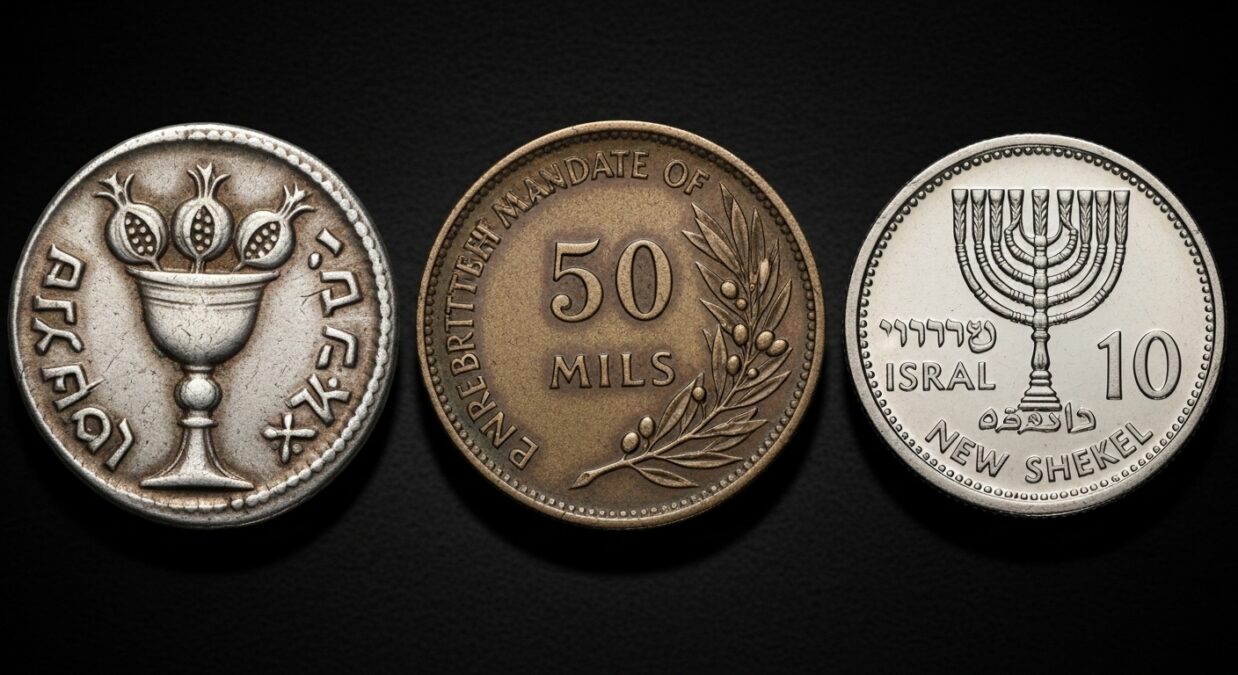

Opening Analysis: Defining the Numismatic Continuum
The term “Israeli coin” occupies a unique and complex position in the lexicon of global numismatics. Unlike the coinage of nations with unbroken linear histories, the concept of an israeli coin ancient vs modern forces us to navigate a landscape fractured by exile, imperial occupation, and a dramatic 20th-century revival. The ancient manifestation refers primarily to the coinage minted by the Hasmonean dynasty, the Herodian client kings, and the Jewish rebels during the First Jewish-Roman War and the Bar Kokhba Revolt—a period spanning roughly 135 BCE to 135 CE. The modern manifestation, by contrast, begins in 1948 with the establishment of the State of Israel and the subsequent issuance of the Israeli Pruta, Lira, Shekel, and ultimately the New Israeli Shekel (NIS) used today. Any serious study of israeli coin ancient vs modern is therefore not merely a comparison of metal composition or weight standards, but an archaeological excavation of sovereignty itself.
The framework for this comparative study must account for a profound disparity in technological context and geopolitical reality. The ancient israeli coin was produced under the watchful eye—and often the direct prohibition—of superpowers like the Seleucid Empire and Imperial Rome. Minting coins in the ancient Levant was a political act of defiance or a delegated privilege of vassalage. The modern israeli coin, however, is the product of a sovereign central bank equipped with state-of-the-art anti-counterfeiting technology and informed by global monetary policy. To bridge these two worlds, we must evaluate them across three axes: the material (what the coin is made of), the iconographic (what the coin says about identity), and the economic (what the coin could actually purchase). The comparison of israeli coin ancient vs modern reveals less about the metal in one’s palm and more about the shifting psychology of a nation.
The core thesis of this analysis is that the trajectory from the ancient israeli coin to its modern counterpart represents a pivot from apocalyptic particularism to universal economic integration. Ancient Judean coinage is unique in the classical world for its near-total rejection of the human image—specifically the ruler’s portrait—in favor of agricultural symbols and sacred script. This was a theological and cultural red line drawn in bronze and silver. The modern israeli coin, while deeply rooted in those same ancient symbols, functions within a globalized economy where the image of the state is standard and the coin’s primary purpose is frictionless exchange rather than religious proclamation. By examining the israeli coin ancient vs modern dichotomy, we uncover a civilization that once used currency to seclude itself from the world and now uses it to engage with the world on its own terms.
Essential Comparative Metrics
The table below delineates the empirical and contextual differences between the two eras of the israeli coin. This data underscores the vast technological and political chasm that defines the israeli coin ancient vs modern comparison.
| Metric | Ancient Israeli Coinage (135 BCE – 135 CE) | Modern Israeli Coinage (1948 – Present) |
|---|---|---|
| Primary Authority | Hasmonean Priest-Kings; Herodian Dynasty; Jewish Revolt Authorities | Bank of Israel (Sovereign Central Bank) |
| Typical Composition | Bronze (Prutah), Silver (Shekel/Zuz) | Aluminum-Bronze, Cupronickel, Nickel-Bonded Steel |
| Dominant Iconography | Agricultural (Pomegranate, Vine Leaf, Palm Tree, Amphora); Paleo-Hebrew Script | Lyre, Menorah, Lily, State Emblem; Modern & Classical Hebrew |
| Portraiture Policy | Strictly Aniconic (No human or animal likeness) | Portraits of Cultural Figures (e.g., Agnon, Ben-Gurion on Banknotes only) |
| Script | Paleo-Hebrew (Revival of archaic script for national identity) | Modern Hebrew, Arabic, English |
| Production Method | Struck (Hammer and Anvil Die) | Precision Milled (Computer-Aided Design, Edge Lettering) |
| Purchasing Power (Unit) | 1 Silver Shekel: Approx. 4 days unskilled labor (Temple Tax) | 1 NIS: Approx. 5-7 minutes minimum wage labor (2026) |
Structural And Biological Foundations
The physicality of the israeli coin ancient vs modern tells a story of technological capability and resource scarcity. Ancient coin production was a literal exercise in brute force. A blank flan of bronze or silver was placed between two engraved iron dies. A slave or artisan then delivered a heavy hammer blow to the upper die, forcing the metal to flow into the cavities of the design. This “striking” process resulted in coins that were off-center, cracked, or irregular—a far cry from the clinical perfection expected today. The silver for the israeli coin of the First Revolt (66-70 CE) was likely sourced from melting down Tyrian Shekels or from the Temple treasury itself, imbuing the currency with a visceral, sacred weight.
Modern israeli coin production is governed by micron-level tolerances. The blanks are punched from precision-rolled alloy strips, annealed in controlled-atmosphere furnaces, and struck by hydraulic presses exerting dozens of tons of pressure. The introduction of nickel-bonded steel for the 10 Agorot coin reflects a modern economic reality: the face value of the israeli coin must far exceed the commodity value of the metal, a concept entirely alien to the ancient world where a silver shekel was valued by its bullion content. The structural integrity of the modern israeli coin ensures it can survive decades in circulation or vending machines, whereas ancient bronze prutot often suffer from aggressive patination and brittleness due to metallurgical impurities.
Behavioral Patterns And Social Intelligence
How a population interacts with its currency reveals the fabric of daily life. In antiquity, the israeli coin was a tool of Temple piety and political signaling. The famous silver Shekel of Year 1 (66 CE) bore the legend “Jerusalem the Holy” and a chalice. To hold that israeli coin was to participate in a rebellion against the might of Nero’s Rome. Transactions in the marketplaces of Sepphoris or the alleys of the Lower City of Jerusalem using these bronze prutot were slow, deliberate acts involving scales and frequent debates over authenticity (as counterfeiting by plating base metal with silver was rampant). The israeli coin ancient vs modern behavioral shift is stark: ancient use was communal and ritualistic; modern use is individualistic and frictionless.
Today, the israeli coin is often bypassed entirely. Israel is a global leader in contactless payments and fintech. The physical israeli coin (specifically the Agorot and small Shekel denominations) is increasingly relegated to charity boxes, tips, and the pockets of children. The social intelligence of the modern israeli coin is its quiet ubiquity; it requires no literacy in Paleo-Hebrew or knowledge of the harvest calendar. It is a neutral token of exchange accepted by Jew, Arab, Druze, and tourist alike. This represents a fundamental change from the ancient israeli coin, which was explicitly designed to exclude Hellenistic and Roman cultural norms and reinforce a specific, often insurgent, ethno-religious identity.
Ancient Israeli Coin: Strengths And Constraints
The paramount strength of the ancient israeli coin lies in its power as a primary historical source and a vehicle of soft power resistance. When the Hasmonean King Alexander Jannaeus minted a israeli coin with his name in Greek on one side and Paleo-Hebrew on the other, he was navigating a tightrope between globalism and nationalism. The decision of the First Revolt leaders to issue thick silver shekels was a logistical nightmare—Roman blockades made silver scarce—but it was an ideological masterstroke. Each israeli coin acted as a miniature propaganda poster declaring independence. The strength was in the symbol, not the metallurgy. The iconic “Year Four” shekel, minted mere months before the destruction of the Temple, remains a testament to the human spirit under siege.
However, the constraints were crippling. The ancient israeli coin was a localized, brittle economy. Its acceptance was limited primarily to Judea and Galilee. A merchant trying to use a Bar Kokhba israeli coin in Alexandria or Antioch would find it worthless—worse, it could mark him as a rebel sympathizer. Furthermore, the minting technology was crude, leading to widespread counterfeiting and a lack of standardization in weight. The bronze Prutah of the procurators, while technically an israeli coin by geography, was a constant reminder of Roman subjugation. The inability to maintain a continuous minting tradition after 135 CE meant that for nearly 1,800 years, there was no living memory of striking a Jewish israeli coin, only the static, buried memory in the soil.
Modern Israeli Coin: Strengths And Constraints
The modern israeli coin benefits from the full apparatus of statehood: a robust economy, advanced minting technology (utilizing the KOMSCO mint in South Korea or the Royal Dutch Mint), and a central bank (Bank of Israel) capable of managing inflation and monetary supply. The strength of the israeli coin is its reliability and homogeneity. The Agora series, featuring the ancient ship, lyre, and menorah, draws a direct visual lineage to the ancient israeli coin, but it does so with the precision of modern engraving. The 5 Shekel coin, with its dodecagonal shape and advanced bi-metallic construction, is a secure token that confidently sits in the global currency basket. The israeli coin ancient vs modern comparison highlights that the modern version is far more effective as a medium of exchange.
Yet, the modern israeli coin is constrained by its own success and inflation. The purchasing power of the Agora has evaporated; the 10 Agorot israeli coin is worth approximately $0.03 USD (2026), making it functionally useless in many retail contexts. There are perennial discussions within the Bank of Israel about demonetizing the smallest denominations. Moreover, the modern israeli coin lacks the tactile, rugged individuality of its ancient forebear. A hoard of ancient prutot varies in patina, strike, and wear; a roll of modern 10 Shekel coins is sterile and uniform. The constraint is a loss of numismatic soul—the israeli coin is no longer a personal artifact but an industrial widget.
Comparative Advantages In Real-World Scenarios
To illustrate the israeli coin ancient vs modern utility, consider three distinct scenarios: wartime, pilgrimage, and daily bread.
Scenario 1: Wartime Economy (67 CE vs. 2026)
In 67 CE, a Jewish farmer fleeing Galilee could not rely on the israeli coin to buy safe passage in Samaria. The ancient israeli coin was a liability outside the rebel-held enclaves. However, it was essential for paying the Temple tax or purchasing supplies from a fellow rebel. In 2026, during a period of heightened security, the modern israeli coin is a resilience asset. If digital networks fail or cyberattacks disrupt credit card processing, the physical israeli coin in one’s pocket remains an unconditional, anonymous, and immediate method of payment for water, bread, or transport. The modern israeli coin serves as a fallback for the state; the ancient israeli coin served as a banner for the cause.
Scenario 2: The Pilgrimage Economy
The ancient israeli coin was indispensable in the Temple precincts. The Tyrian Shekel was the only accepted currency for the annual half-shekel tax, necessitating the famous money-changers. When the rebels minted their own israeli coin Shekel, they were reclaiming this religious economic act. Today, a pilgrim visiting the Western Wall or the Church of the Holy Sepulchre uses the israeli coin for parking meters, falafel, and tzedakah (charity) boxes. The modern israeli coin facilitates the logistics of spirituality, whereas the ancient israeli coin was the substance of that spirituality.
Scenario 3: Daily Commerce (Bread and Oil)
In antiquity, a loaf of bread might cost two bronze Prutot. These tiny israeli coin issues were often so poorly struck that one side was blank. A day’s wages for a laborer in the parable of the workers in the vineyard was a denarius (a Roman coin), but local israeli coin prutot were the small change of the poor. In modern Israel, a pita and za’atar might cost 5-10 NIS, paid with a combination of a 5 Shekel israeli coin and a few 10 Agorot pieces. The transaction is seamless, standardized, and takes seconds. The israeli coin ancient vs modern comparison here shows a move from a barter-adjacent, trust-based bronze token to a frictionless fiat instrument.
Scientific And Expert Consensus (2026)
Contemporary numismatic scholarship, led by the Israel Numismatic Society and the analytical work of the Bank of Israel Currency Department, treats the israeli coin ancient vs modern relationship as a continuous narrative rather than a broken one. Advanced metallurgical analysis using X-Ray Fluorescence (XRF) has recently confirmed that the silver used in the Year 4 First Revolt israeli coin shekels has a distinct trace element signature matching silver hoards known to have been stored in Jerusalem before 70 CE. This scientific data provides a tangible link between the israeli coin of the Second Temple period and the physical wealth of the city.
From an economic history perspective, experts emphasize the “impossible trinity” faced by ancient minters of the israeli coin: they sought monetary sovereignty (setting their own standard), free capital flows (using silver that had to come from outside), and a fixed exchange rate (tying the shekel to the Tyrian weight standard). They failed. The modern Bank of Israel, conversely, successfully navigates this trinity with a floating israeli coin currency and sophisticated monetary tools. The consensus is clear: while the ancient israeli coin was a powerful expression of identity, it was a failure of economics. The modern israeli coin is a triumph of economics that deliberately echoes the identity of its ancient predecessor.
Final Synthesis And Verdict
The comparative analysis of israeli coin ancient vs modern culminates not in a winner, but in a profound observation of purpose. The ancient israeli coin—whether the delicate lily of the Hasmoneans or the defiant chalice of the Zealots—was a separation machine. It was designed to carve out a sacred, economic, and cultural space separate from the empires that surrounded it. It was a coin that said “no” to the image of Caesar. The modern israeli coin—whether the 10 Agorot replica of a Bar Kokhba denarius or the New Shekel with its vertical state emblem—is an integration engine. It is a coin that says “yes” to the global market, to Visa, and to the digital age.
Yet, the modern israeli coin carries the DNA of that ancient “no” in its script and symbols. This is the unique verdict of the israeli coin ancient vs modern study: Modern Israeli currency has achieved what ancient Judean currency could not. It has preserved the distinct iconographic vocabulary of the past (the vine leaf, the lyre, the seven-branched candelabra) while establishing the full, undisputed sovereignty and economic credibility that the ancient minters bled and died for. The israeli coin in your pocket is the quiet, successful conclusion of a war fought with hammers and bronze two thousand years ago. The israeli coin ancient vs modern journey is the transformation of a revolutionary cry into a routine, everyday sound of change jingling in a pocket.
FAQ: Israeli Coin Ancient vs Modern
Q: Why do ancient Israeli coins never show the face of a king or emperor, but modern Israeli coins show people (on the notes)?
A: The ancient israeli coin adhered to a strict interpretation of the Second Commandment prohibition against “graven images.” This aniconism was a deliberate rejection of Hellenistic and Roman ruler cults. Modern Israel, while a Jewish state, separates numismatic imagery from theological restriction. Portraits of cultural figures like S.Y. Agnon or Golda Meir appear only on banknotes—not on the actual israeli coin—as a mark of national pride rather than divine kingship. The israeli coin itself remains largely symbolic (menorah, flora).
Q: Are ancient Israeli coins valuable?
A: Value varies dramatically by type and condition in the israeli coin ancient vs modern market. A common bronze Prutah of the procurators can be purchased for under $50 USD. However, a silver Shekel of Year 1 from the First Revolt, or a silver Sela from the Bar Kokhba revolt (which were often overstruck on Roman coins), can fetch between $5,000 and $1,000,000+ at auction, depending on condition and pedigree. These are not just coins; they are archaeological artifacts of Jewish sovereignty.
Q: Does the modern Israeli Shekel use the same weight standard as the ancient Shekel?
A: No. The ancient israeli coin shekel was a weight of silver (approx. 14 grams). The modern israeli coin Shekel is a fiat currency unit with no link to silver or gold. When the Bank of Israel introduced the “New Shekel” in 1985, they consciously revived the ancient name israeli coin for national symbolism, but the monetary policy behind it is entirely modern and floating against foreign exchange markets.
Q: Where can I see the best collection of ancient Israeli coins?
A: The definitive collection of the ancient israeli coin is housed at the Israel Museum in Jerusalem, specifically in the Archaeology Wing and the Shrine of the Book complex. Their numismatic collection includes the largest hoard of First Revolt silver shekels ever discovered, providing an unparalleled visual reference for the israeli coin ancient vs modern study.