
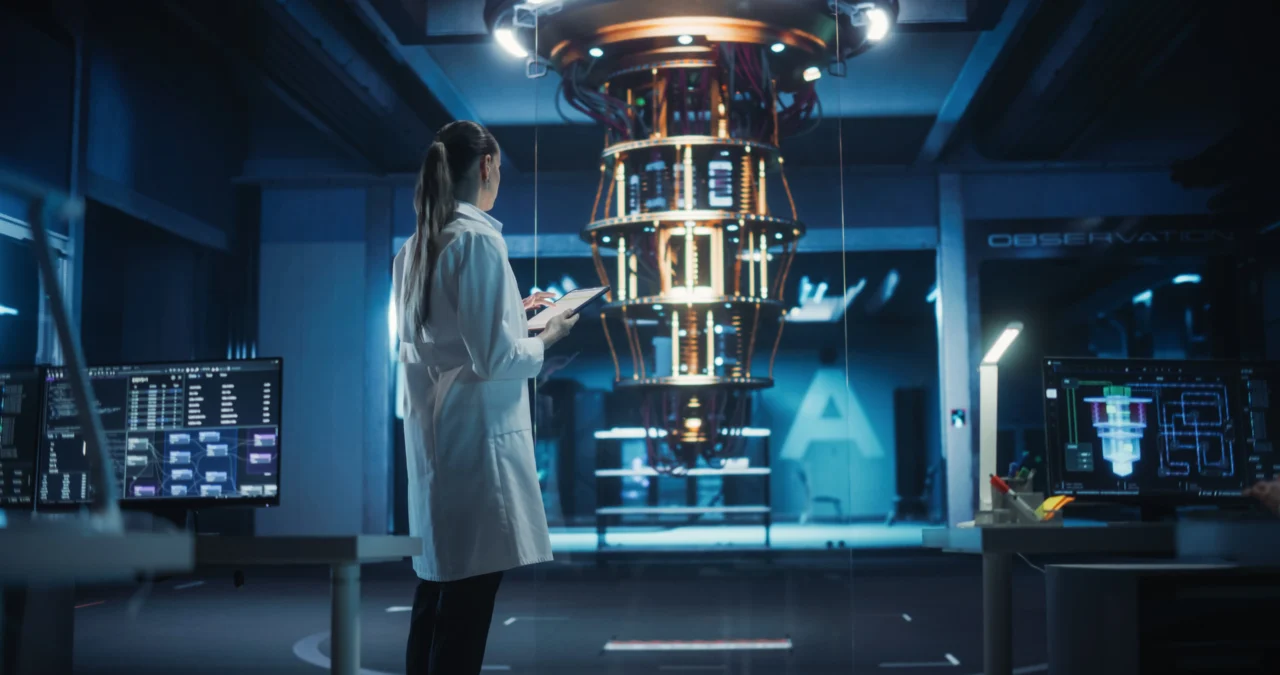

The technological landscape experienced a definitive and revolutionary shift when examining the latest breakthroughs in quantum computing 2024, marking a critical transition from theoretical physics to tangible practical execution. For decades, researchers struggled with the profound fragility of qubits and environment-induced noise, which severely limited computational systems to short, specialized experiments. However, fundamental engineering milestones achieved during this landmark period permanently altered how modern scientists view computational scalability, architectural reliability, and processing power.
Entering this brand-new era required moving far beyond raw physical qubit counts to focus heavily on error mitigation, hardware stability, and real-world applicability. Industry leaders realized that exponential scaling was entirely impossible without first addressing the core vulnerability of individual quantum bits. Consequently, the latest breakthroughs in quantum computing 2024 established a solid, dependable foundation for fault-tolerant architectures, proving that advanced systems could finally overcome historical limitations and deliver unprecedented computational speed.
The Hardware Leap: Unpacking Google’s Willow Chip
A monumental milestone arrived when Google Quantum AI officially unveiled Willow, its groundbreaking 105-qubit superconducting processor, in late 2024. This advanced system completely crushed industry expectations by successfully completing a complex Random Circuit Sampling benchmark in under five minutes—a staggering task that would allegedly require traditional classical supercomputers roughly 10 septillion years to calculate. This phenomenal performance leap highlighted the raw processing capability hidden within modern, highly optimized processor designs.
Beyond raw speed, the processor showcased significantly improved coherence lifetimes and participation ratio engineering that drastically reduced physical noise across the grid. By closely examining the latest breakthroughs in quantum computing 2024, industry analysts quickly recognized that Willow represented far more than just a simple speed test or marketing gimmick. It served as a concrete, undeniable proof-of-concept that next-generation hardware could successfully execute complex operations without degrading into chaotic operational noise.
Conquering the Noise: Quantum Error Correction Breakthroughs
For many years, cumulative error rates remained the single greatest barrier preventing quantum computers from reaching true commercial viability and mass adoption. The major turning point occurred when experimental systems successfully crossed the crucial below-threshold boundary, meaning that errors actually decreased as the physical qubit arrays scaled larger. This exponential reduction successfully solved a decades-long dilemma that had plagued leading physics laboratories and technology enterprises across the globe.
Collaborative research efforts from elite academic institutions like Harvard University and prominent industry pioneers introduced advanced fault-tolerant configurations and real-time decoding techniques. Tracking the latest breakthroughs in quantum computing 2024 clearly reveals that these innovative error-correction strategies successfully transformed abstract mathematical models into manageable, engineering-level challenges. Stabilizing logical qubits means that long-term processing routines and complex algorithms can finally run safely without crashing.
Software Stability and Industry Integration
Hardware advancements alone could not drive the entire quantum computing industry forward without robust, user-friendly software ecosystems designed to support developers. The rollout of stable software development kits, such as IBM’s Qiskit SDK 1.x, empowered hundreds of thousands of programmers worldwide to test algorithms seamlessly. Cloud-based platforms democratized access, allowing external researchers, students, and corporate partners to run experiments remotely without owning physical hardware.
Simultaneously, major financial institutions, logistics providers, and healthcare entities accelerated early pilot programs leveraging cutting-edge quantum-secured communication frameworks. Analyzing the latest breakthroughs in quantum computing 2024 demonstrates how hybrid workflows—combining classical artificial intelligence with quantum backend tools—began solving specialized optimization tasks in real-world business environments, proving the technology’s immediate commercial value.
Real-World Implications and Future Horizons
The seamless transition from academic theory to commercial utility opened up massive, unprecedented potential across the pharmaceutical sector, materials science, and complex molecular modeling. Researchers began utilizing early quantum simulation tools to evaluate intricate chemical reactions and optimize global energy grid allocations efficiently. These early enterprise applications signal a profound paradigm shift in how corporate sectors approach complex mathematical optimization and data analysis problems.
At the same time, forward-thinking organizations accelerated their strategic adoption of quantum-resistant cryptography to safeguard sensitive government and financial data against future processing threats. Reviewing the latest breakthroughs in quantum computing 2024 highlights a maturing industry preparing systematically and aggressively for a fully fault-tolerant digital future. The collective industry momentum ensures that commercial scalability will remain a dominant technological focus for decades to come.
Conclusion
The monumental milestones achieved throughout the year solidified an irreversible turning point for information processing technology and global digital infrastructure. By successfully conquering critical error-correction thresholds and introducing exceptionally powerful processors like Google Willow, the global scientific community effectively bridged the long-standing gap between theoretical physics and practical utility. As hardware reliability continues to improve and software ecosystems expand rapidly, the horizon for fault-tolerant computing grows brighter than ever before.
Frequently Asked Questions
What was the most significant milestone in quantum computing in 2024?
The introduction of Google’s 105-qubit Willow chip stands out as the defining achievement of the year. It successfully demonstrated below-threshold error correction while completing a complex benchmark calculation in under five minutes that would take traditional classical supercomputers septillions of years to process.
How do logical qubits differ from physical qubits?
Physical qubits are the actual hardware components on a processor, which are inherently extremely sensitive to environmental noise and interference. Logical qubits group multiple physical qubits together using advanced error-correction codes to create stable, reliable units capable of running longer, uninterrupted calculations.
Can current quantum systems break standard internet encryption?
No, current systems cannot break modern security yet. Despite massive processing leaps, tech leaders emphasize that commercial systems remain years away from posing a direct, practical threat to standard RSA encryption and modern cryptographic protocols used across the global internet.
You may also read: Passenger Support, Rebooking, and Airline Protocols