
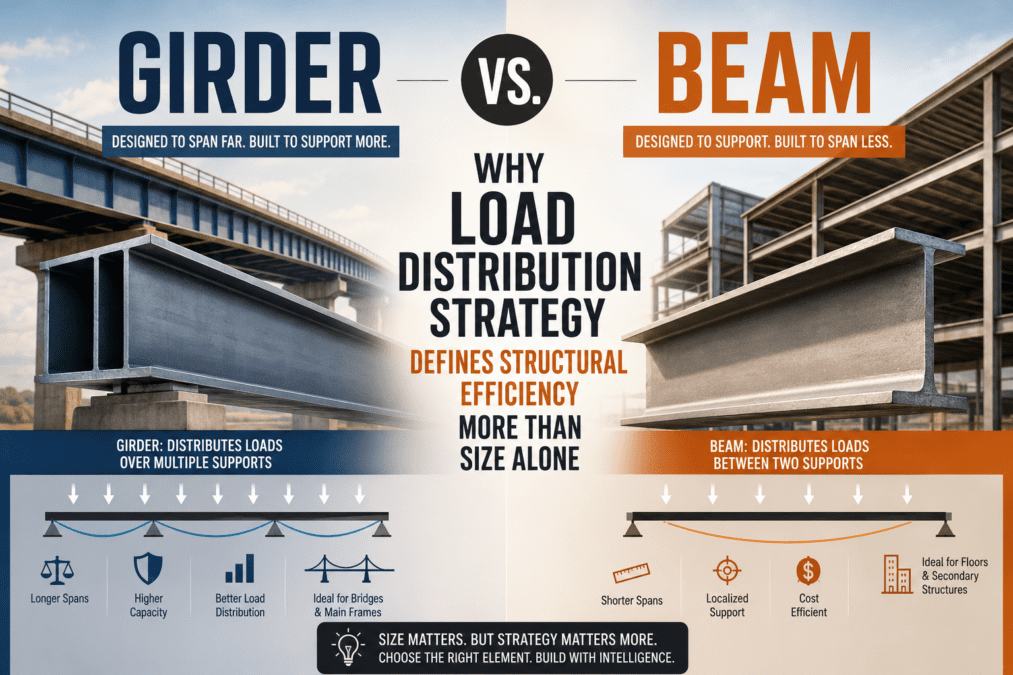

The debate surrounding girder vs beam is often simplified into a question of size, with girders described as “large beams” and beams treated as secondary framing members. In practical structural engineering, however, the distinction is far more important than scale alone. Both components are fundamental load-bearing elements used in buildings, bridges, industrial frameworks, and transportation infrastructure, yet they serve different structural purposes within a load-transfer hierarchy.
A beam is typically a horizontal structural member designed to resist bending loads transferred from slabs, roofs, floors, or walls. A girder, by contrast, is usually the primary support member that carries multiple beams or concentrated structural loads. While a beam distributes local forces, a girder organizes the structural load path across a larger framework. This distinction explains why the girder vs beam comparison matters in modern architecture and civil engineering.
The core insight is that the difference between girder vs beam is not simply dimensional but systemic. Girders are often engineered as strategic load collectors within a structure, while beams act as distributed support members. In advanced construction, the choice between them influences material efficiency, vibration control, span capability, seismic resilience, maintenance economics, and long-term structural behavior.
Essential Comparative Metrics
| Category | Girder | Beam |
|---|---|---|
| Primary Structural Role | Main load-carrying support | Secondary load-transfer element |
| Load Source | Supports multiple beams or columns | Supports slabs, decks, roofs, or walls |
| Typical Span Length | Long-span applications | Short-to-medium spans |
| Structural Hierarchy | Higher-level framing member | Intermediate support member |
| Common Materials | Steel, reinforced concrete, prestressed concrete | Steel, timber, aluminum, reinforced concrete |
| Moment Resistance | Very high bending resistance | Moderate-to-high bending resistance |
| Construction Cost | Higher fabrication and installation cost | Lower relative cost |
| Bridge Applications | Main bridge support systems | Deck support framing |
| Typical Shape | Deep I-sections or box sections | I-beam, T-beam, rectangular, channel |
| Failure Impact | Potentially catastrophic structural consequences | Localized structural effects |
Structural And Mechanical Foundations
The engineering distinction in girder vs beam begins with structural hierarchy. A beam is generally intended to transfer loads from a surface element into columns, walls, or girders. A girder, however, often serves as the central structural pathway that gathers forces from multiple beams and redistributes them into foundational supports.
From a mechanics perspective, both resist bending moments, shear forces, and deflection. Yet girders are typically engineered for substantially higher load intensity and longer unsupported spans. This often requires deeper cross-sections, advanced reinforcement strategies, and more rigorous stability calculations. In steel construction, girders commonly use built-up plate assemblies or box configurations because ordinary rolled sections may not provide sufficient stiffness.
The girder vs beam distinction also affects dynamic performance. Girders frequently experience compounded loading patterns due to multiple tributary load sources. As a result, engineers must consider torsion, lateral buckling, fatigue stress, and vibration amplification more carefully. Beams, while still critical, usually operate under more localized structural conditions.
A beam is a structural member primarily designed to resist transverse loads through bending. A girder is a primary support element engineered to carry beams and redistribute major structural forces across a framework.
Load Distribution And Force Transfer Behavior
The most revealing aspect of girder vs beam lies in how each member participates in load distribution. Beams typically collect loads from immediate structural surfaces such as floor slabs or roof systems. Girders, meanwhile, consolidate the cumulative loads from several beams into columns or bearing walls.
This difference changes the entire engineering strategy. A beam may be optimized for localized bending efficiency, whereas a girder must account for cumulative stress concentrations, load path continuity, and redundancy planning. In bridge engineering, girders often define the primary skeleton of the structure itself. Without girders, the structural system cannot effectively channel forces toward supports.
While beams usually distribute direct surface loads across shorter spans, girders coordinate large-scale structural load transfer across major support systems.
In real-world construction, this hierarchy creates major economic implications. Increasing beam quantity may reduce girder loading but increases connection complexity and fabrication labor. Reducing beam frequency often requires heavier girders capable of supporting larger tributary areas. Engineers therefore balance beam spacing and girder capacity simultaneously to achieve optimal efficiency.
The girder vs beam relationship also changes depending on material selection. Steel structures tend to emphasize girder dominance in long-span systems, while reinforced concrete buildings may integrate beam and girder behavior more continuously within monolithic frames.
Material Science And Section Design
Material selection strongly influences the outcome of any girder vs beam analysis. Because girders handle larger forces, they are frequently manufactured using high-strength structural steel or prestressed concrete systems. Beams, by comparison, can be produced economically from a wider range of materials including timber, laminated wood, cold-formed steel, and conventional reinforced concrete.
Cross-sectional geometry is equally important. Girders commonly use deep I-sections, plate girders, or box girders to maximize moment of inertia while minimizing unnecessary weight. The goal is to resist bending efficiently over long spans without excessive deflection. Beams may use shallower profiles because their tributary load demands are smaller.
The girder vs beam distinction becomes particularly significant in modern skyscraper construction. High-rise structures require girders capable of redistributing vertical and lateral loads around elevators, mechanical floors, and transfer levels. These transfer girders often support entire column lines above them, making them among the most critical components in a building.
Fatigue behavior also differs considerably. Since girders experience larger cumulative stress cycles, especially in bridges and industrial facilities, they demand more stringent inspection protocols. Beam fatigue still matters, but failure progression is often slower and more localized compared to girder deterioration.
Subject A: Strengths And Constraints Of Girders
Girders provide exceptional structural efficiency in long-span applications. Their greatest advantage is the ability to consolidate and redistribute heavy loads across large distances without excessive intermediate supports. This makes girders indispensable in bridges, stadiums, airports, warehouses, and high-rise transfer systems.
Another advantage in the girder vs beam comparison is spatial flexibility. Because girders can span farther, architects gain more open floor space with fewer columns interrupting occupancy zones. This flexibility is economically valuable in commercial buildings, parking structures, and transportation terminals.
Girders also enhance structural hierarchy clarity. By concentrating primary load transfer into designated members, engineers can design more predictable force pathways and improve overall system coordination.
However, girders introduce major constraints. Fabrication costs are significantly higher due to material volume, welding complexity, transportation requirements, and erection logistics. Large steel girders often require special transport permits and crane operations during installation.
Another limitation is sensitivity to failure. Because girders frequently support multiple beams simultaneously, girder damage can trigger progressive structural collapse if redundancy is insufficient. This risk explains why girder inspection standards are especially rigorous in bridge engineering and seismic regions.
The girder vs beam comparison therefore reveals that girders offer unmatched load capacity but at increased cost, engineering complexity, and structural consequence.
Subject B: Strengths And Constraints Of Beams
Beams remain the most versatile structural members in construction because they balance strength, simplicity, and adaptability. In the girder vs beam discussion, beams excel in localized load management and economical framing layouts.
One major advantage is installation efficiency. Standardized beam sizes simplify fabrication, transportation, and field assembly. In residential and mid-rise construction, beams often provide the most cost-effective structural solution because they can be repeated modularly throughout a project.
Beams also offer design flexibility across materials. Timber beams dominate residential framing, reinforced concrete beams are common in institutional buildings, and steel beams remain prevalent in industrial facilities. This versatility makes beams adaptable to a wide range of structural environments.
Another important benefit is redundancy. Because structures often contain many beams distributed throughout the framing system, localized beam failure may not immediately compromise the entire structure. Load redistribution can sometimes prevent catastrophic collapse long enough for repairs or evacuation.
Yet beams have limitations. Their shorter span capability means more columns or supports are typically required. This can reduce usable space and complicate architectural planning. Excessive beam spacing also increases floor deflection and vibration concerns.
The girder vs beam comparison ultimately shows that beams prioritize modular efficiency and economical construction, whereas girders prioritize large-scale load organization and span performance.
ISBN 10 vs 13: Why Publishing Systems Transitioned From Simplicity to Global Scalability
Comparative Advantages In Real-World Scenarios
The practical outcome of girder vs beam depends heavily on project type, loading conditions, architectural goals, and economic priorities. In residential housing, beams dominate because spans are moderate and cost efficiency is essential. Using girders excessively in small-scale structures would increase construction expenses unnecessarily.
In bridge systems, however, girders become indispensable. Box girders, plate girders, and concrete girders allow bridges to span rivers, highways, and rail corridors efficiently. Beams alone cannot economically achieve these large unsupported distances without excessive intermediate supports.
Industrial facilities provide another revealing example. Manufacturing plants often use girders to create open operational spaces for cranes, conveyors, and machinery. Secondary beams then distribute roof and floor loads into these primary girders. This layered hierarchy demonstrates the complementary relationship embedded within the girder vs beam framework.
Seismic engineering introduces additional complexity. Girders may require enhanced ductility and connection detailing because they accumulate larger force concentrations during earthquakes. Beams, meanwhile, are often intentionally designed as sacrificial yielding components within moment-resisting frames to dissipate seismic energy safely.
A direct answer to the girder vs beam question is this: a beam primarily supports localized structural loads, while a girder functions as a major load-distribution member that supports multiple beams or large structural forces. The distinction is based more on structural role and load hierarchy than on physical size alone.
Structural Efficiency And Economic Trade-Offs
One of the most misunderstood aspects of girder vs beam is economic efficiency. Larger structural members are not automatically more efficient. In many cases, increasing girder capacity may reduce the number of columns but significantly increase fabrication and installation costs.
Engineers therefore optimize entire framing systems rather than isolated members. A dense beam network with smaller girders may reduce steel tonnage overall. Conversely, fewer but stronger girders may accelerate construction timelines and create more usable interior space.
Modern computational modeling has transformed the girder vs beam optimization process. Finite element analysis allows engineers to simulate stress distribution, vibration behavior, and load-path redundancy with extraordinary precision. This enables hybrid strategies that balance beam repetition against girder dominance.
Environmental considerations now influence design decisions as well. Steel girders possess high recyclability but substantial embodied carbon during production. Timber beam systems may reduce carbon footprints in mid-rise projects but lack the long-span performance required for major infrastructure.
Lifecycle maintenance also matters. Girders generally require more intensive inspection regimes due to their critical structural role. Beams, while numerous, are often easier and cheaper to replace individually.
The result is that the girder vs beam decision reflects not only structural mechanics but also economics, sustainability, operational flexibility, and long-term asset management.
Scientific And Expert Consensus (2026)
Current engineering consensus emphasizes that the girder vs beam distinction should be understood functionally rather than purely geometrically. Modern design codes increasingly define girders according to load-transfer responsibility within structural systems instead of simply member depth or weight.
Research in structural optimization highlights how advanced materials are reshaping traditional definitions. High-performance steel alloys, fiber-reinforced polymers, and prestressed concrete systems allow some beams to achieve capacities once associated exclusively with girders. Nevertheless, the hierarchical distinction remains essential in engineering analysis.
Bridge engineering research also demonstrates that girder fatigue performance is among the most critical predictors of infrastructure longevity. Transportation agencies worldwide prioritize girder inspection because failure consequences are system-wide rather than localized.
In earthquake-resistant design, experts increasingly favor distributed energy dissipation strategies where beams absorb controlled deformation while girders maintain overall structural continuity. This philosophy reflects evolving understanding of resilience-based engineering.
The consensus emerging in 2026 is that girder vs beam should not be interpreted as competing structural elements. Instead, they represent interconnected roles within a coordinated force-transfer network. Structural performance depends less on which member is “stronger” and more on how effectively the system distributes loads across both.
Final Synthesis And Verdict
The comparison between girder vs beam ultimately reveals a deeper engineering principle: structural success depends on intelligent force organization rather than isolated component strength. Beams and girders are not interchangeable terms but distinct functional members operating within different levels of a structural hierarchy.
Beams excel in modularity, localized support, cost efficiency, and adaptable framing systems. They form the repetitive structural backbone of most buildings and efficiently transfer loads from occupied surfaces into larger supports. Their versatility explains why they remain fundamental across residential, commercial, and industrial construction.
Girders, however, define large-scale structural coordination. They consolidate forces from multiple beams, enable long spans, reduce column dependency, and stabilize major infrastructure systems. Their importance becomes most visible in bridges, transfer floors, stadiums, and high-capacity industrial structures where load concentration and span demands exceed ordinary beam capability.
The real insight in girder vs beam is that the distinction is strategic rather than merely physical. A girder is not simply a bigger beam. It is a structural organizer within the load-transfer ecosystem of a building or bridge.
As engineering continues evolving toward lighter materials, smarter modeling, and more resilient infrastructure, the relationship between girders and beams will remain central to structural design. Their combined interaction—not their opposition—creates the efficiency, safety, and adaptability of modern construction systems.
Frequently Asked Questions
Is a girder simply a larger beam?
Not necessarily. In the girder vs beam comparison, the main distinction is structural function rather than size. A girder typically supports other beams and acts as a primary load-transfer member, while a beam generally supports slabs, roofs, or localized structural loads.
Why are girders used in bridges more often than beams?
Bridges require long spans and high load capacity. Girders provide superior bending resistance and load distribution over large distances, making them ideal as primary structural supports in transportation infrastructure.
Can a beam become a girder in certain designs?
Yes. Structural terminology depends on role within the framing system. A member functioning as the primary support for multiple beams may be classified as a girder even if its physical shape resembles a standard beam.
Which is more expensive in the girder vs beam comparison?
Girders are usually more expensive because they require larger sections, higher material volume, specialized fabrication, and more complex installation procedures. However, they can reduce the number of columns and supports needed in a structure, which may offset overall project costs.