
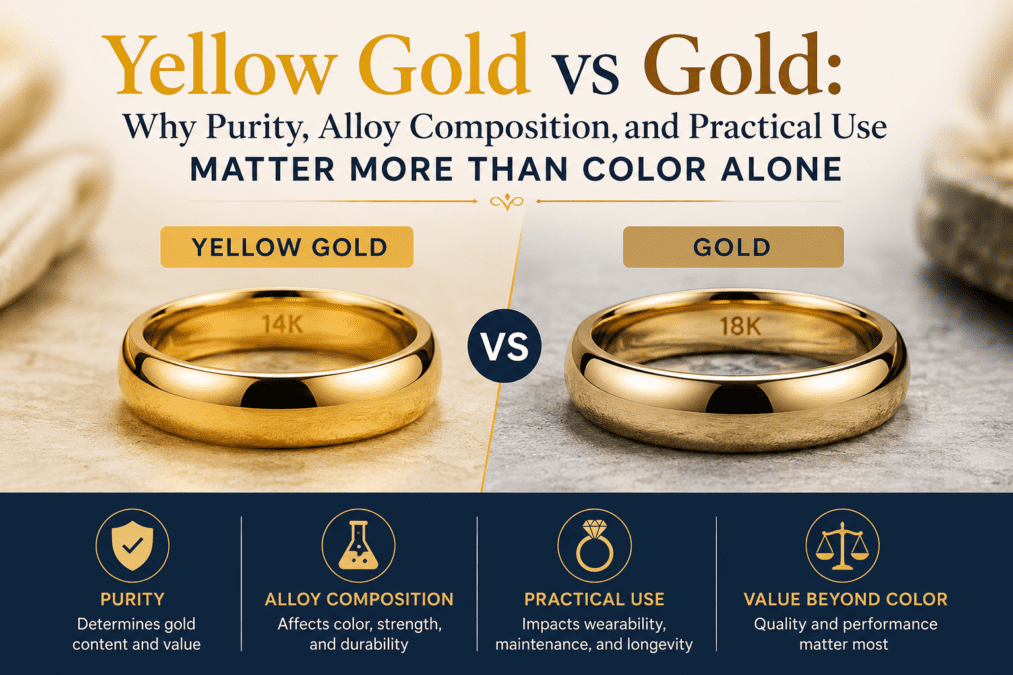

When consumers compare yellow gold vs gold, they often assume the two terms describe entirely different precious metals. In reality, the comparison is more nuanced. Gold is a naturally occurring chemical element valued for its rarity, durability, conductivity, and cultural significance. Yellow gold, by contrast, is a jewelry-specific form of gold created by combining pure gold with carefully selected alloy metals that preserve a warm golden appearance.
A meaningful yellow gold vs gold comparison requires examining chemistry, metallurgy, jewelry manufacturing, durability, aesthetics, investment value, and consumer behavior. The distinction is not merely visual. It reflects how pure gold is transformed into practical products that can withstand daily wear while retaining the prestige associated with precious metals.
The most surprising insight in the yellow gold vs gold debate is that pure gold is often too soft for many real-world applications. While consumers frequently associate higher purity with greater quality, jewelry experts recognize that durability, scratch resistance, and long-term wearability often depend on alloy composition rather than purity alone. Understanding this relationship reveals why yellow gold remains one of the most popular jewelry materials worldwide despite the existence of higher-purity gold options.
Essential Comparative Metrics
| Attribute | Yellow Gold | Gold (Pure Gold/24K) |
|---|---|---|
| Definition | An alloy of gold mixed with metals such as copper, silver, or zinc to improve durability. | A naturally occurring precious metal in its purest commercial form, typically 24K. |
| Purity Range | Usually 10K, 14K, 18K, or 22K. | 24K (99.9% or higher gold content). |
| Gold Content | Varies by karat rating. | Nearly 100% gold. |
| Color | Warm, traditional yellow tone. | Rich, deep yellow metallic appearance. |
| Hardness | Higher due to alloy metals. | Relatively soft. |
| Scratch Resistance | Moderate to high. | Low. |
| Resistance to Bending | Strong and durable for daily wear. | More prone to bending and deformation. |
| Jewelry Suitability | Excellent for rings, bracelets, necklaces, and watches. | Best for ceremonial jewelry, investment pieces, and collectibles. |
| Investment Value | Depends on purity level and craftsmanship. | Highest intrinsic precious-metal value. |
| Market Price | Usually lower than pure gold because of lower gold content. | Directly tied to the global gold price. |
| Maintenance Requirements | Requires occasional polishing. | Requires careful handling to avoid dents and scratches. |
| Tarnish Resistance | Very good, though alloy metals can slightly affect performance. | Excellent; does not tarnish under normal conditions. |
| Manufacturing Flexibility | Highly adaptable for complex jewelry designs. | Limited by softness. |
| Popularity in Jewelry | One of the most widely used jewelry materials worldwide. | Less common for everyday jewelry. |
| Best Use Case | Everyday luxury jewelry and long-term wear. | Bullion, wealth preservation, and cultural investment. |
| Main Advantage | Balance of beauty, durability, and value. | Maximum purity and intrinsic worth. |
| Main Limitation | Lower gold purity than 24K gold. | Too soft for many daily-wear applications. |
A simple definition helps clarify the discussion. Gold is a naturally occurring precious metal with atomic number 79. Yellow gold is an alloy containing gold and additional metals that preserve a yellow appearance while improving durability.
In practical terms, the answer to yellow gold vs gold is that pure gold offers maximum purity and intrinsic value, while yellow gold provides a balance between purity, durability, appearance, and everyday usability. For most jewelry applications, yellow gold is the more practical material, whereas pure gold remains preferred for bullion, investment holdings, and certain cultural traditions.
FXAA vs TAA: Why Temporal Data Often Beats Spatial Filtering—Until Motion Exposes the Trade-Off
Structural And Metallurgical Foundations
Understanding yellow gold vs gold begins with metallurgy. Pure gold consists almost entirely of gold atoms arranged in a crystalline metallic structure. This structure contributes to gold’s famous resistance to corrosion and oxidation but also explains its softness.
Yellow gold is engineered by mixing pure gold with metals such as silver, copper, and occasionally zinc. These additions alter the metal’s mechanical properties without eliminating its characteristic golden color. The resulting alloy becomes harder and more resistant to scratches and bending.
The percentage of gold determines the karat rating. Twenty-four karat gold represents nearly pure gold, while 18K gold contains 75% gold and 25% alloy metals. Fourteen-karat yellow gold contains approximately 58.5% gold. As alloy content increases, durability generally improves while purity decreases.
This balance between purity and performance lies at the heart of the yellow gold vs gold discussion. Jewelry designers must continuously navigate the tradeoff between maintaining gold content and achieving sufficient structural strength.
Physical Properties And Material Performance
One of the most important aspects of yellow gold vs gold is physical behavior under stress. Pure gold possesses exceptional malleability and ductility. A single ounce can be stretched into remarkably thin sheets or long wires without breaking.
These characteristics make gold valuable in electronics, aerospace engineering, and specialized industrial applications. However, softness becomes a disadvantage for jewelry subjected to everyday impacts.
Yellow gold benefits from alloy reinforcement. Copper contributes hardness, while silver can enhance strength and maintain color balance. The resulting material withstands normal wear more effectively than pure gold.
A useful comparison sentence illustrates the difference clearly: While pure gold offers maximum precious-metal content, yellow gold delivers superior resistance to deformation during daily use.
Consumers often discover this distinction when comparing rings, bracelets, or watches. Pure gold pieces may develop dents and scratches more readily, whereas yellow gold alloys typically maintain their shape for longer periods.
Historical Evolution And Cultural Importance
The history of yellow gold vs gold reflects thousands of years of human innovation. Ancient civilizations initially worked with naturally occurring gold because of its beauty and resistance to corrosion. Egyptians, Mesopotamians, Greeks, and Romans all prized gold for ceremonial, religious, and economic purposes.
As metalworking techniques evolved, artisans recognized the limitations of pure gold for practical objects. They began mixing gold with other metals to improve durability and expand design possibilities.
Yellow gold became particularly important because it preserved the traditional appearance associated with wealth and prestige. Across many cultures, the warm yellow tone symbolized prosperity, divine favor, authority, and permanence.
Today, this historical preference continues to influence consumer choices. Even with the availability of white gold, rose gold, platinum, and titanium, yellow gold remains deeply connected to cultural traditions, wedding jewelry, heirloom pieces, and luxury goods worldwide.
The enduring popularity of yellow gold demonstrates that aesthetics and symbolism often matter as much as technical specifications.
Behavioral Patterns And Consumer Preferences
Consumer behavior provides another perspective on yellow gold vs gold. Purchasing decisions rarely depend solely on purity. Instead, buyers evaluate appearance, durability, maintenance requirements, emotional significance, and budget.
Research consistently shows that jewelry buyers prioritize wearability alongside prestige. Many consumers appreciate the status associated with gold ownership but prefer materials capable of enduring everyday activities.
Yellow gold appeals to a broad audience because it delivers familiarity and practicality simultaneously. Its warm tone complements diverse skin tones and aligns with traditional expectations of what gold jewelry should look like.
Pure gold attracts a different category of buyer. These consumers often prioritize metal content, investment value, cultural customs, or collectible significance over durability concerns.
The result is a marketplace where both materials thrive. Rather than replacing one another, pure gold and yellow gold serve distinct consumer needs and purchasing motivations.
Subject A: Strengths And Constraints Of Yellow Gold
Within the yellow gold vs gold comparison, yellow gold offers several compelling advantages. Its greatest strength is versatility. By adjusting alloy composition, manufacturers can create jewelry suited for rings, necklaces, earrings, bracelets, and luxury watches.
Durability is another major benefit. Yellow gold alloys resist bending and scratching more effectively than pure gold. This characteristic makes them ideal for daily wear and long-term use.
Yellow gold also maintains strong consumer appeal because its appearance aligns with traditional perceptions of luxury. The warm color remains timeless and recognizable across generations.
However, yellow gold is not without limitations. Alloy metals reduce overall purity, which may concern buyers focused on intrinsic precious-metal content. Some alloys can also influence skin sensitivity in certain individuals, depending on their composition.
Additionally, resale calculations may be more complex because value depends on both craftsmanship and gold content. Despite these constraints, yellow gold remains one of the most balanced choices available in modern jewelry.
Subject B: Strengths And Constraints Of Pure Gold
Examining pure gold reveals why it remains essential despite challenges highlighted in yellow gold vs gold comparisons. Its greatest advantage is purity. Pure gold contains nearly the maximum possible concentration of gold, making it highly desirable for investment purposes.
Gold also exhibits extraordinary chemical stability. It resists corrosion, oxidation, and tarnishing better than most metals. This property contributes to its long-term preservation and enduring value.
From a financial perspective, pure gold serves as a globally recognized store of wealth. Bullion bars, coins, and reserves rely on high-purity gold because investors prioritize metal content above all else.
Yet softness remains a significant limitation. Pure gold scratches easily and can deform under repeated mechanical stress. Complex jewelry designs may also require additional structural support.
Consequently, pure gold excels where purity and intrinsic value matter most, while yellow gold often proves more practical for everyday wear.
Comparative Advantages In Real-World Scenarios
The practical outcome of yellow gold vs gold depends heavily on intended use. Different scenarios produce different winners.
For engagement rings, wedding bands, and daily jewelry, yellow gold typically offers the better balance of appearance and durability. Frequent contact with hard surfaces makes alloy strength particularly valuable.
For investment portfolios, pure gold generally holds the advantage. Investors seek maximum gold content and direct exposure to precious-metal prices rather than jewelry craftsmanship.
In luxury watchmaking, yellow gold often provides superior performance because manufacturers require both visual appeal and structural reliability.
For cultural ceremonies and traditional gifting, preferences vary. Some societies place exceptional value on high-purity gold due to symbolic associations with wealth and authenticity.
These examples demonstrate why the yellow gold vs gold discussion cannot be resolved through a single universal answer. Context determines which material delivers greater overall value.
Economic Value And Market Dynamics
Economic considerations add another layer to yellow gold vs gold analysis. Gold prices are typically quoted based on pure gold content. As a result, purity directly influences intrinsic metal value.
Pure gold closely tracks commodity market movements because its value is almost entirely tied to gold itself. Investors often use it as a hedge against inflation, currency instability, and economic uncertainty.
Yellow gold incorporates additional factors. Craftsmanship, design complexity, brand reputation, and alloy composition all contribute to final pricing.
Interestingly, premium jewelry can command prices significantly above raw material costs. Consumers frequently pay for artistry, heritage, exclusivity, and design innovation in addition to metal value.
This distinction means that investment-oriented buyers and jewelry-focused consumers often evaluate value differently. Understanding this divergence is essential when assessing long-term ownership costs and benefits.
Durability, Maintenance, And Longevity
Durability remains one of the most decisive factors in yellow gold vs gold comparisons. Jewelry experiences constant exposure to friction, impact, environmental contaminants, and routine handling.
Yellow gold’s alloy structure improves hardness and reduces susceptibility to visible wear. Rings made from 14K or 18K yellow gold often maintain their shape and appearance for decades with proper care.
Pure gold requires greater caution. Although it will not tarnish, its softness makes scratches, dents, and deformation more likely.
Maintenance routines differ accordingly. Yellow gold may occasionally require polishing to restore luster. Pure gold may need reshaping or professional restoration if significant deformation occurs.
Both materials possess exceptional longevity relative to many alternatives. However, yellow gold generally offers a more practical balance between preservation and daily usability.
Scientific And Expert Consensus (2026)
The current expert consensus surrounding yellow gold vs gold is remarkably consistent. Materials scientists, jewelers, metallurgists, and luxury market analysts largely agree that neither material is universally superior.
Instead, suitability depends on intended application. Pure gold remains unmatched when maximum precious-metal content is the primary objective. Its chemical stability, rarity, and investment characteristics continue to justify its global importance.
Experts simultaneously recognize that alloying solves critical engineering challenges. Yellow gold demonstrates how controlled metallurgical modifications can improve durability without sacrificing aesthetic appeal.
Jewelry professionals commonly recommend 14K or 18K yellow gold for items worn regularly. Investment specialists typically favor higher-purity gold products when maximizing bullion exposure.
This consensus reflects a broader principle in materials science: optimal performance often emerges from balancing competing characteristics rather than maximizing a single attribute.
Environmental And Sustainability Considerations
Modern discussions of yellow gold vs gold increasingly include sustainability. Environmental impacts originate primarily from mining, refining, transportation, and manufacturing processes.
Recycled gold has become an important industry trend. Both pure gold and yellow gold can be produced using recycled material, reducing demand for newly mined resources.
Because gold is highly recyclable, it can circulate through the economy repeatedly without significant degradation of quality. This characteristic distinguishes it from many other industrial materials.
Manufacturers are also adopting more transparent sourcing practices. Responsible mining certifications and traceability programs help consumers make informed purchasing decisions.
From a sustainability perspective, the distinction between yellow gold and pure gold is often less significant than the sourcing and processing methods used to create the final product.
Final Synthesis And Verdict
The central lesson of yellow gold vs gold is that purity alone does not determine superiority. Pure gold represents the highest concentration of precious metal and remains unmatched for investment, wealth preservation, and certain cultural traditions.
Yellow gold, however, demonstrates the practical advantages of intelligent alloy design. By combining gold with complementary metals, manufacturers create a material capable of withstanding everyday wear while preserving the classic appearance consumers expect.
For jewelry worn frequently, yellow gold often provides the better overall experience. For bullion ownership and maximum intrinsic value, pure gold remains the benchmark.
Ultimately, the most informed conclusion in the yellow gold vs gold debate is that each material excels in different contexts. The better choice depends not on abstract rankings but on how the metal will actually be used.
Frequently Asked Questions
Is yellow gold real gold?
Yes. Yellow gold contains genuine gold combined with alloy metals such as copper and silver. The amount of gold present depends on the karat rating. Eighteen-karat yellow gold contains 75% gold, while fourteen-karat yellow gold contains approximately 58.5% gold.
Which is more valuable in the yellow gold vs gold comparison?
Pure gold generally possesses higher intrinsic metal value because it contains a greater percentage of gold. However, yellow gold jewelry may sell for higher retail prices due to craftsmanship, design, branding, and manufacturing complexity.
Why isn’t most jewelry made from pure gold?
Pure gold is relatively soft and can scratch, bend, or deform more easily than alloyed alternatives. Yellow gold improves durability while maintaining the traditional golden appearance that consumers prefer.
Is yellow gold better for everyday wear?
In many cases, yes. Yellow gold alloys provide improved hardness and structural stability, making them well suited for rings, bracelets, watches, and other items exposed to daily use.
Does yellow gold last as long as pure gold?
Both can last for generations when properly maintained. Yellow gold typically withstands everyday wear better, while pure gold retains exceptional resistance to corrosion and tarnishing.