
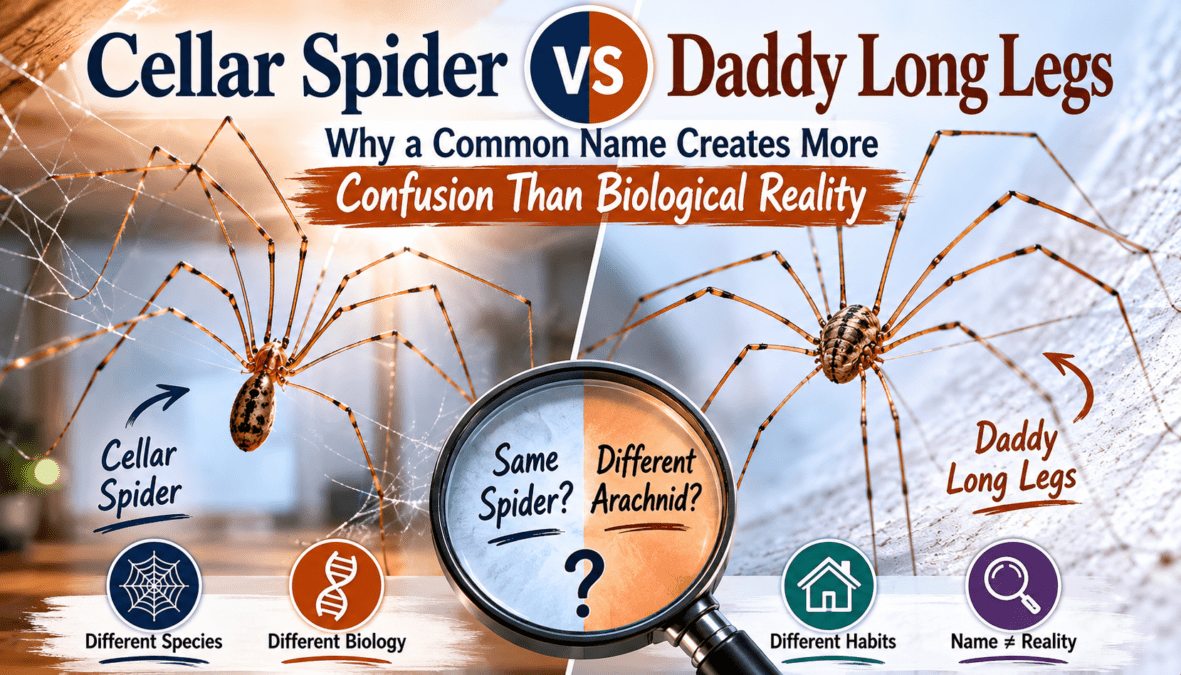

The phrase cellar spider vs daddy long legs represents one of the most misunderstood comparisons in zoology. In everyday conversation, many people use the term “daddy long legs” to describe several different creatures, including cellar spiders, harvestmen, and even crane flies. This linguistic overlap has created decades of confusion about anatomy, behavior, venom, and ecological roles.
A meaningful cellar spider vs daddy long legs comparison requires a clear biological framework. Rather than relying on popular labels, scientists classify organisms according to anatomical structure, evolutionary lineage, feeding behavior, and ecological function. When these factors are examined closely, the comparison becomes far more interesting than the myths commonly repeated online.
The central insight is surprisingly simple: many discussions about cellar spider vs daddy long legs are actually comparing different animals that are not even in the same biological group. Understanding this distinction reveals why common names can sometimes obscure scientific reality and why accurate classification matters when studying biodiversity.
A cellar spider is a true spider belonging primarily to the family Pholcidae. A daddy long legs, depending on regional usage, often refers to a harvestman, which belongs to the order Opiliones and is not a true spider.
While both creatures possess long, slender legs and are frequently found near human structures, they differ significantly in anatomy, venom systems, web construction, feeding behavior, and evolutionary history.
For readers seeking a direct answer: in the cellar spider vs daddy long legs debate, cellar spiders are true spiders that produce silk, build webs, possess separate body segments, and use venom to subdue prey. Harvestmen—the organisms most commonly identified scientifically as daddy long legs—lack silk glands, do not build webs, have fused body structures, and employ entirely different feeding strategies. Their similarities are largely superficial rather than evolutionary.
Essential Comparative Metrics
| Attribute | Cellar Spider | Daddy Long Legs (Harvestman) |
|---|---|---|
| Scientific Classification | Family Pholcidae | Order Opiliones |
| Common Identification | True spider | Arachnid, but not a true spider |
| Body Structure | Two distinct body segments | Body appears as one fused segment |
| Silk Production | Produces silk | Does not produce silk |
| Web Building | Builds irregular webs | Does not build webs |
| Venom Glands | Present | Absent |
| Primary Feeding Method | Captures prey using webs and venom | Forages and scavenges actively |
| Diet | Insects, flies, mosquitoes, and other spiders | Small insects, fungi, plant matter, and carrion |
| Leg Length | Very long relative to body size | Very long relative to body size |
| Eyes | Usually eight eyes | Typically one central eye cluster |
| Mobility | Moderate; often remains near web | High; actively roams for food |
| Preferred Habitat | Basements, garages, sheds, and buildings | Forests, gardens, fields, and leaf litter |
| Ecological Role | Predatory pest controller | Generalist scavenger and predator |
| Threat To Humans | Generally harmless | Harmless |
| Key Strength | Efficient web-based hunting | Exceptional adaptability and varied diet |
| Main Limitation | Dependent on web-building locations | Lacks venom and silk-based hunting tools |
Structural And Biological Foundations
The most important factor in understanding cellar spider vs daddy long legs is anatomy. At first glance, both animals appear nearly identical because each possesses a small body attached to extraordinarily long legs. However, closer examination reveals fundamental biological differences.
Cellar spiders belong to the same broad group as orb-weavers, wolf spiders, and jumping spiders. Their bodies consist of two clearly defined segments: the cephalothorax and abdomen. These spiders also possess spinnerets used for silk production and specialized mouthparts adapted for predatory feeding.
Harvestmen, by contrast, belong to a distinct order of arachnids. Their bodies appear as a single fused structure rather than two separate segments. They lack spinnerets, cannot produce silk, and do not possess venom glands. These distinctions are not minor anatomical details; they reflect millions of years of separate evolutionary development.
Consequently, the cellar spider vs daddy long legs comparison is less like comparing two breeds of dogs and more like comparing related yet fundamentally different branches of the arachnid family tree.
Behavioral Patterns And Social Intelligence
Behavior often reveals biological identity more clearly than physical appearance. In a cellar spider vs daddy long legs analysis, behavioral differences are among the strongest indicators of evolutionary separation.
Cellar spiders are specialized predators. They spend much of their lives suspended upside down in irregular webs, waiting for prey to become trapped. Many species demonstrate remarkable hunting efficiency and can even invade the webs of larger spiders. Their ability to manipulate silk vibrations allows them to detect prey, rivals, and potential mates with surprising precision.
Harvestmen follow a completely different strategy. Rather than constructing traps, they actively roam through vegetation, leaf litter, rocks, and forest floors in search of food. Their diets are remarkably flexible, including insects, fungi, decaying organic matter, and plant materials.
Some harvestman species display collective behavior by forming large aggregations containing dozens or even hundreds of individuals. These gatherings may help regulate moisture, reduce predation risk, or improve survival during environmental stress.
The contrast highlights how the cellar spider vs daddy long legs discussion extends beyond appearance into fundamentally different ecological lifestyles.
Cellar Spider: Strengths And Constraints
Within the cellar spider vs daddy long legs comparison, cellar spiders possess several highly effective adaptations that contribute to their success.
One major strength is silk production. Web construction allows these spiders to capture prey while minimizing energy expenditure. Instead of actively chasing food, they create structures that perform much of the hunting process automatically. This strategy increases efficiency and reduces exposure to predators.
Another advantage is their ability to prey on other spiders. Certain cellar spider species can invade foreign webs, exploit resident spiders, and gain access to prey resources that competitors cannot utilize effectively.
Their elongated legs also provide significant sensory benefits. Vibrations traveling through web strands can be detected rapidly, allowing quick responses to threats and opportunities.
However, cellar spiders also face limitations. Dependence on webs can restrict mobility and habitat flexibility. Environmental disturbances may destroy web structures, requiring substantial rebuilding effort. Additionally, web-based hunting can become less effective when prey density declines.
These strengths and constraints illustrate why cellar spiders excel in stable environments but may struggle in situations requiring broader ecological adaptability.
Daddy Long Legs: Strengths And Constraints
Evaluating the other side of the cellar spider vs daddy long legs debate reveals a distinctly different set of advantages.
Harvestmen benefit from extraordinary ecological flexibility. Because they do not rely on webs, they can exploit a wide variety of habitats and food sources. Their omnivorous tendencies allow them to survive in conditions where specialized predators might struggle.
Mobility is another key advantage. Long legs enable efficient movement across uneven terrain, forest litter, rocks, and vegetation. Rather than waiting passively for prey, harvestmen can actively search for resources.
Some species possess defensive chemical secretions that discourage predators. Although these chemicals vary among species, they provide an alternative protective mechanism compared with venom or silk-based defenses.
Yet harvestmen also face challenges. The absence of webs eliminates an efficient prey-capture system. Without venom glands, they cannot immobilize prey using toxins. Their feeding methods therefore tend to focus on smaller, weaker, or already vulnerable food sources.
In the broader cellar spider vs daddy long legs discussion, harvestmen succeed not through specialization but through versatility and adaptability.
Comparative Advantages In Real-World Scenarios
When examining cellar spider vs daddy long legs under practical ecological conditions, the winner depends entirely on context.
In indoor environments, basements, garages, barns, and crawl spaces, cellar spiders often hold the advantage. Their web-building capabilities allow them to exploit stable structures where flying and crawling insects are abundant. Human-made architecture effectively creates ideal hunting grounds.
In forests, fields, and natural ecosystems, harvestmen frequently demonstrate superior flexibility. Their ability to consume diverse food sources means they are less dependent on any single ecological niche.
If the comparison focuses on predatory efficiency, cellar spiders generally outperform harvestmen. Their combination of silk, venom, and ambush tactics creates a highly specialized hunting system.
If resilience across changing environmental conditions is prioritized, harvestmen often emerge stronger. Generalist feeding behavior provides a buffer against fluctuations in prey populations.
Thus, the most accurate conclusion in a cellar spider vs daddy long legs comparison is that each organism dominates under different ecological circumstances rather than one being universally superior.
The Venom Myth And Public Misconceptions
No discussion of cellar spider vs daddy long legs is complete without addressing one of the most persistent biological myths.
A widely circulated claim states that daddy long legs possess the most powerful venom in the world but cannot bite humans because their fangs are too small. This statement is scientifically inaccurate.
The confusion largely stems from mixing multiple organisms under the same common name. Harvestmen do not possess venom glands at all. Therefore, they cannot be secretly harboring extraordinarily potent venom.
Cellar spiders do possess venom, but their venom is designed primarily for small arthropod prey. Scientific investigations have repeatedly found no evidence supporting the claim that they possess the world’s most dangerous venom.
The myth persists because common names encourage people to combine unrelated animals into a single category. The cellar spider vs daddy long legs discussion demonstrates why scientific terminology remains essential for accurate biological understanding.
Evolutionary History And Taxonomic Divergence
Evolutionary history provides deeper insight into the cellar spider vs daddy long legs relationship.
Both animals belong to the class Arachnida, meaning they share distant ancestry with spiders, scorpions, mites, and ticks. However, their evolutionary pathways diverged hundreds of millions of years ago.
Cellar spiders evolved within the spider lineage, acquiring specialized silk-producing structures and venom systems that became defining features of spider evolution. Their modern adaptations reflect a long history of predatory specialization.
Harvestmen followed a different trajectory. Instead of investing heavily in silk and venom, they evolved toward mobility, dietary flexibility, and generalized resource exploitation.
This divergence demonstrates a fundamental principle of evolution: successful organisms can emerge through dramatically different strategies. The cellar spider vs daddy long legs comparison illustrates how separate evolutionary solutions can produce superficially similar appearances while maintaining profound biological differences.
Habitat Preferences And Geographic Distribution
Habitat selection further clarifies the distinctions in the cellar spider vs daddy long legs comparison.
Cellar spiders thrive in sheltered environments with relatively stable humidity and temperature. Human structures have greatly expanded their opportunities. Basements, attics, warehouses, sheds, and bridges often provide ideal conditions for web construction.
Harvestmen are more commonly associated with outdoor ecosystems. They inhabit forests, grasslands, gardens, caves, wetlands, and mountainous regions. Their mobility allows them to exploit microhabitats that would be unsuitable for permanent web construction.
Geographically, both groups have achieved impressive global distributions. Species occur across multiple continents and occupy a broad range of climates.
Despite overlapping ranges, their preferred ecological strategies remain distinct. Cellar spiders typically establish fixed hunting locations, whereas harvestmen maintain more active lifestyles centered on movement and exploration.
Ecological Importance And Pest Regulation
The ecological significance of cellar spider vs daddy long legs extends beyond academic curiosity.
Cellar spiders contribute to natural pest control by consuming flies, mosquitoes, moths, ants, and other arthropods. Their willingness to prey on other spiders can also influence local arachnid communities.
Harvestmen perform a different but equally valuable role. As scavengers and opportunistic feeders, they help recycle organic matter and participate in nutrient cycling processes. Their broad diet supports ecosystem stability by connecting multiple food-web pathways.
Neither organism deserves the negative reputation often associated with household arachnids. Instead, both provide ecological services that benefit natural and human-modified environments.
Understanding these contributions transforms the cellar spider vs daddy long legs discussion from a simple identification exercise into a broader appreciation of biodiversity and ecosystem function.
Scientific And Expert Consensus (2026)
Current scientific consensus leaves little ambiguity regarding cellar spider vs daddy long legs classification.
Arachnologists agree that cellar spiders are true spiders belonging to the family Pholcidae. They possess silk glands, venom systems, two-part body structures, and the defining characteristics associated with spiders.
Scientists also agree that harvestmen belong to the order Opiliones. Although they are arachnids, they are not spiders. Their fused body form, lack of silk production, and absence of venom glands distinguish them clearly from true spiders.
Modern research increasingly emphasizes public education because common-name confusion continues to generate misconceptions about venom, danger, and ecological roles.
The expert consensus can therefore be summarized simply: similarities between the two groups are largely external, while the biological differences are substantial and evolutionarily significant.
Final Synthesis And Verdict
The most important conclusion from the cellar spider vs daddy long legs comparison is that the debate often begins with a mistaken assumption. These animals may look similar, but they represent distinct evolutionary solutions to survival.
Cellar spiders are specialized predators equipped with silk, venom, and web-building capabilities. Their success stems from efficient prey capture and adaptation to stable environments.
Harvestmen are versatile generalists that rely on mobility, flexible feeding habits, and ecological adaptability. Their success arises from broad resource utilization rather than specialized hunting tools.
If the goal is predatory efficiency, cellar spiders possess the stronger toolkit. If the goal is environmental flexibility and dietary diversity, harvestmen hold significant advantages.
Ultimately, the cellar spider vs daddy long legs comparison reveals less about competition and more about evolutionary diversity. Two arachnids with similar appearances have achieved ecological success through remarkably different biological strategies, demonstrating that nature often produces multiple pathways to survival.
Frequently Asked Questions
Are cellar spiders and daddy long legs the same thing?
Not necessarily. In many regions, people call cellar spiders “daddy long legs.” Scientifically, however, daddy long legs often refers to harvestmen, which are not true spiders. This naming overlap creates significant confusion.
Which is more dangerous: cellar spider or daddy long legs?
Neither is considered dangerous to humans. Cellar spiders possess venom used for small prey, while harvestmen lack venom glands entirely. Both are generally harmless and avoid human interaction.
Can daddy long legs build webs?
Harvestmen cannot build webs because they lack silk-producing spinnerets. Cellar spiders, on the other hand, are known for constructing irregular cobweb-like structures.
Why do cellar spiders and daddy long legs look so similar?
The resemblance results largely from long-legged body designs that evolved for movement, sensory awareness, and environmental interaction. Similar appearance does not indicate close biological identity, which is why the cellar spider vs daddy long legs comparison remains such a fascinating example of superficial similarity masking deep evolutionary differences.