
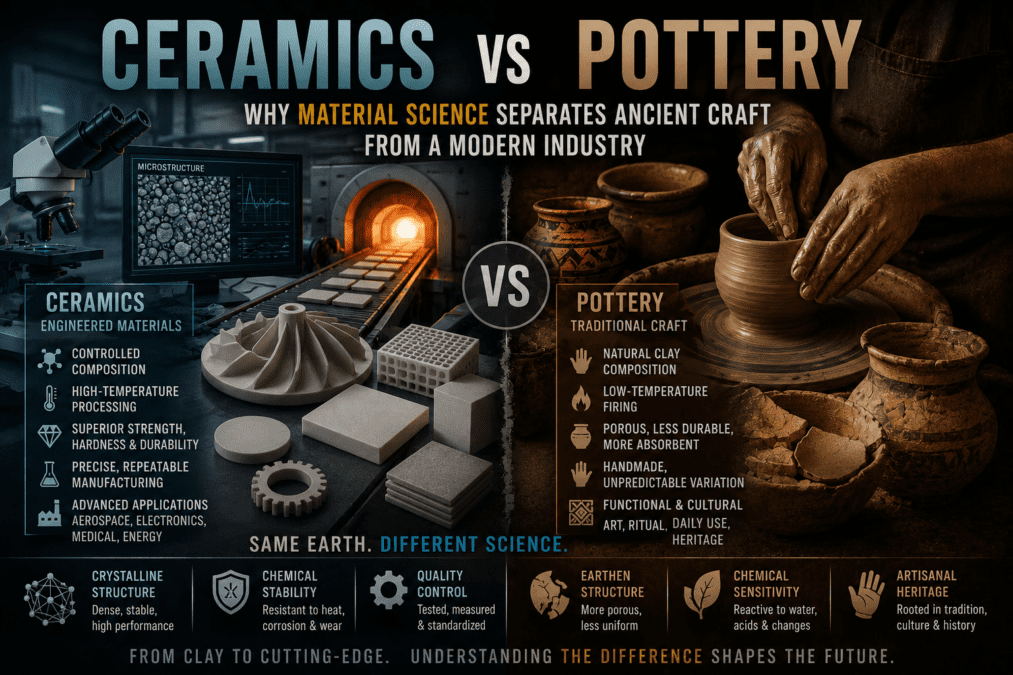

The discussion of ceramics vs pottery is often treated as a simple comparison between two forms of clay-based creation. In reality, the distinction is much deeper. Pottery represents one of humanity’s oldest artistic and functional crafts, while ceramics encompasses a far broader category that extends into engineering, medicine, aerospace technology, and advanced manufacturing. Understanding the difference requires looking beyond appearance and examining material composition, firing processes, intended functions, and technological applications.
A meaningful ceramics vs pottery analysis must evaluate both historical and modern perspectives. While the two terms overlap significantly, they are not interchangeable. Pottery is a subset of ceramics, but not all ceramics are pottery. This relationship creates confusion among consumers, artists, students, and even hobbyists entering the field.
The most important insight is that the divide between ceramics vs pottery is not primarily artistic—it is structural. Pottery is defined largely by purpose and tradition, whereas ceramics are defined by material transformation through heat. This distinction explains why a handcrafted vase, a dental implant, and a spacecraft heat shield can all belong to the ceramic family despite serving entirely different functions.
Understanding the Core Difference
Ceramics are inorganic, non-metallic materials that become permanently hardened through high-temperature firing. Pottery refers specifically to vessels, containers, decorative objects, and functional wares traditionally made from clay and fired in a kiln.
In simple terms, pottery is a category within ceramics.
A useful way to understand ceramics vs pottery is to imagine a family tree. Ceramics represent the entire tree, while pottery is one branch. Every piece of pottery is ceramic, but many ceramics have nothing to do with pottery.
While pottery focuses on functional or decorative clay objects, ceramics include technical materials used in electronics, medical devices, industrial machinery, construction, and advanced engineering systems.
Direct Answer: The difference between ceramics vs pottery is that pottery refers specifically to clay-based vessels and decorative objects shaped and fired for practical or artistic use, while ceramics encompass all heat-hardened inorganic materials, including pottery as well as advanced products such as tiles, insulators, dental crowns, laboratory equipment, and aerospace components.
Comparative Metrics
| Attribute | Ceramics | Pottery |
|---|---|---|
| Definition | Broad category of fired inorganic materials | Clay-based vessels and artistic wares |
| Scope | Industrial, artistic, scientific, and medical applications | Primarily artistic and functional applications |
| Materials Used | Clay, alumina, zirconia, silicon carbide, and other engineered compounds | Mainly clay bodies |
| Historical Origins | Ancient origins with significant expansion through modern science and engineering | One of humanity’s oldest crafts |
| Primary Purpose | Multiple applications across industries and daily life | Containers, tableware, decorative objects, and artistic expression |
| Manufacturing Complexity | Ranges from simple handcrafted products to highly engineered components | Generally artisan-focused and craft-oriented |
| Industrial Usage | Extensive use in manufacturing, electronics, construction, and aerospace | Limited industrial use |
| Medical Applications | Common in dental implants, joint replacements, and medical devices | Rare |
| Artistic Expression | Moderate to high, depending on the application | Very high, with strong emphasis on creativity and craftsmanship |
| Technological Importance | Critical in modern engineering and advanced technology sectors | Generally indirect and culturally focused |
| Heat Resistance | Often extremely high, especially in technical ceramics | Moderate to high depending on clay type and firing temperature |
| Durability | Can be engineered for exceptional durability and wear resistance | Durable for everyday use but often more susceptible to impact damage |
| Common Products | Tiles, insulators, dental crowns, engine components, laboratory equipment | Bowls, mugs, vases, plates, planters, sculptures |
| Production Scale | Small-scale artisan work to mass industrial manufacturing | Primarily small-scale or studio production, though some mass production exists |
| Scientific Relevance | High, with applications in materials sc |
Structural And Material Foundations
The foundation of the ceramics vs pottery comparison lies in material science. Ceramics are created when inorganic materials undergo irreversible chemical and structural changes under high temperatures. This process produces hardness, heat resistance, corrosion resistance, and durability.
Pottery relies primarily on naturally occurring clay. Potters manipulate plastic clay, shape it into desired forms, dry it carefully, and fire it in a kiln. The resulting object becomes stronger and more stable than raw clay.
Modern ceramics, however, extend far beyond traditional clay. Engineers develop ceramic compounds using highly refined materials such as alumina, zirconia, silicon nitride, and silicon carbide. These materials possess characteristics that make them valuable in environments where metals or polymers may fail.
This distinction reveals a key truth about ceramics vs pottery: pottery is rooted in craft traditions, while ceramics increasingly intersect with advanced scientific innovation.
Historical Evolution And Cultural Significance
The history of ceramics vs pottery begins thousands of years ago. Archaeological evidence suggests pottery emerged long before written language. Early civilizations relied on clay vessels for cooking, food storage, transportation, and ceremonial purposes.
Pottery became a cultural signature of societies across Asia, Africa, Europe, and the Americas. Decorative styles, firing techniques, and glazing methods often reflected religious beliefs, trade networks, and social structures.
Ceramics evolved alongside pottery but experienced a dramatic transformation during the industrial era. Scientific understanding of materials enabled researchers to manipulate ceramic compositions with increasing precision. What began as clay containers gradually expanded into architectural materials, electrical insulators, and eventually highly specialized engineering components.
Examining ceramics vs pottery through a historical lens reveals how one ancient craft became the foundation for an entire technological discipline.
Manufacturing Processes And Production Methods
Another major difference in ceramics vs pottery involves manufacturing techniques. Traditional pottery often emphasizes individual craftsmanship. Potters throw forms on wheels, hand-build sculptures, or use molds to create unique pieces.
The pottery process generally includes:
- Clay preparation
- Forming
- Drying
- Bisque firing
- Glazing
- Final firing
Ceramic manufacturing can follow similar steps but often incorporates industrial precision. Advanced ceramics may require powder engineering, controlled atmospheres, computer-guided sintering, and microscopic quality testing.
While pottery production values artistic variation, industrial ceramics prioritize consistency, performance, and predictable material behavior. This difference illustrates why a handcrafted bowl and a jet-engine ceramic component belong to the same broad family yet emerge from vastly different production philosophies.
Minolta x-7a vs a700: Why Sensor Technology Changes More Than Lens Heritage
Functional Performance Characteristics
Performance is where the distinction between ceramics vs pottery becomes especially clear. Pottery is typically designed for domestic, decorative, or artistic functions. Durability matters, but aesthetics often remain equally important.
Ceramics can be engineered for extreme environments. Depending on composition, ceramics may resist:
- High temperatures
- Chemical corrosion
- Electrical conductivity
- Mechanical wear
- Thermal shock
Many advanced ceramics maintain structural integrity under conditions that would damage metals or plastics.
Pottery, by contrast, generally serves human-scale functions such as serving food, storing liquids, displaying flowers, or expressing artistic creativity.
This does not diminish pottery’s value. Rather, it highlights how ceramics encompass a much wider performance spectrum than pottery alone.
Behavioral Patterns And Human Relationship With The Material
Unlike comparisons involving living organisms, the behavioral dimension of ceramics vs pottery concerns how humans interact with the materials and traditions.
Pottery encourages direct engagement. Artists often describe the process as tactile, intuitive, and deeply personal. The softness of clay allows immediate feedback during shaping, making pottery an accessible medium for creativity and craftsmanship.
Ceramics often involve a more analytical relationship. Engineers and material scientists approach ceramic materials through measurable performance properties such as fracture toughness, thermal conductivity, and hardness.
While pottery emphasizes artistic dialogue between creator and material, ceramics increasingly involve collaboration between scientific design and manufacturing precision.
The difference reflects not only material usage but also distinct human approaches to creation and innovation.
Pottery: Strengths And Constraints
Pottery possesses several strengths that explain its enduring popularity across cultures and centuries.
Its greatest advantage is accessibility. Clay is abundant, relatively inexpensive, and easy to shape using simple tools. Pottery also supports extraordinary artistic expression through texture, form, carving, glazing, and surface decoration.
Functional pottery combines beauty with utility. A well-crafted mug, bowl, or vase can serve practical purposes while simultaneously functioning as art.
However, pottery faces limitations. Many pottery forms remain vulnerable to impact damage. Production speed may be slower than industrial manufacturing methods. Pottery also lacks the specialized performance capabilities found in advanced ceramic materials.
Within the broader ceramics vs pottery discussion, pottery excels where craftsmanship, individuality, and cultural expression are prioritized.
Ceramics: Strengths And Constraints
Ceramics offer remarkable versatility. Their applications extend far beyond artistic production into medicine, construction, electronics, transportation, and aerospace engineering.
Key strengths include:
- Exceptional heat resistance
- High hardness
- Chemical stability
- Corrosion resistance
- Long-term durability
Advanced ceramics have enabled innovations ranging from artificial joints to semiconductor manufacturing equipment.
Yet ceramics also possess limitations. Many ceramic materials exhibit brittleness compared with metals. Manufacturing can be expensive, especially when precision engineering is required. Quality control often demands sophisticated equipment and expertise.
The ceramics vs pottery comparison demonstrates that ceramics achieve broader functionality but often sacrifice the simplicity and accessibility that characterize traditional pottery.
Comparative Advantages In Real-World Scenarios
The practical value of ceramics vs pottery depends entirely on context.
For artistic expression, pottery frequently holds the advantage. Artists can create unique forms that reflect personal style, cultural heritage, and aesthetic experimentation.
For household use, pottery remains highly effective. Tableware, serving dishes, planters, and decorative pieces continue to represent major applications.
For industrial environments, ceramics dominate. Manufacturing facilities rely on ceramic components capable of withstanding temperatures and chemical conditions that exceed the limits of many conventional materials.
In healthcare, advanced ceramics support dental restorations, orthopedic implants, and specialized surgical tools.
In aerospace engineering, ceramic composites help protect vehicles from extreme thermal environments.
Thus, the winner in ceramics vs pottery depends entirely on the objective being considered.
Economic Impact And Market Dynamics
Economically, the ceramics vs pottery landscape reveals two interconnected but distinct industries.
Pottery often exists within artisan markets, cultural tourism, educational institutions, and small-scale manufacturing. Value frequently derives from craftsmanship, originality, and artistic reputation.
The ceramic industry operates on a much larger economic scale. Global ceramic production supports construction, electronics, transportation, energy infrastructure, and healthcare systems.
Ceramic tiles, sanitary ware, technical ceramics, and industrial components represent multi-billion-dollar market segments worldwide.
The economic distinction underscores a central theme: pottery contributes cultural and artistic value, while ceramics contribute both cultural and industrial value across numerous sectors.
Sustainability And Environmental Considerations
Environmental discussions increasingly influence the ceramics vs pottery debate.
Pottery often benefits from natural raw materials and long product lifespans. Handmade pottery may also involve lower transportation impacts when produced locally.
However, firing kilns consume significant energy. Fuel source selection strongly affects environmental performance.
Industrial ceramics face similar energy challenges but may offset environmental costs through durability and efficiency. Ceramic insulation, for example, can reduce energy consumption throughout a building’s operational life.
Advanced ceramic components can also improve efficiency in transportation and industrial systems.
Neither category is inherently superior from a sustainability perspective. Environmental outcomes depend on manufacturing methods, energy sources, product lifespan, and end-use applications.
Scientific And Expert Consensus (2026)
The scientific consensus surrounding ceramics vs pottery is straightforward. Researchers, archaeologists, artists, and materials engineers generally agree that pottery represents a subset within the broader ceramic category.
Modern materials science classifies ceramics according to composition, processing methods, and performance characteristics rather than artistic traditions alone.
Experts typically divide ceramics into categories such as:
- Traditional ceramics
- Structural ceramics
- Advanced ceramics
- Technical ceramics
- Bioceramics
Pottery falls primarily within traditional ceramics.
Current academic literature increasingly emphasizes functional classification because ceramic technology now plays a critical role in fields ranging from renewable energy to biomedical engineering.
The consensus therefore supports a hierarchical relationship rather than a direct opposition: pottery exists within ceramics rather than standing separate from it.
Common Misconceptions About Ceramics Vs Pottery
Several misconceptions persist in discussions about ceramics vs pottery.
The first misconception is that the terms are synonyms. They are not. Pottery belongs to the ceramic family but does not represent the entire category.
The second misconception is that ceramics are exclusively industrial products. In reality, many artistic works are ceramics.
A third misconception assumes pottery is technologically primitive. Modern potters frequently employ sophisticated glazing chemistry, kiln programming, and material testing techniques.
Another misunderstanding suggests ceramics lack artistic value. Contemporary ceramic artists regularly produce museum-quality works that blur boundaries between art, design, and engineering.
Recognizing these distinctions leads to a more accurate understanding of how the two concepts relate.
Future Outlook: Where The Fields Are Heading
Looking ahead, the future of ceramics vs pottery appears increasingly interconnected.
Pottery continues to benefit from renewed interest in handmade products, sustainability, and artisanal craftsmanship. Consumers often seek objects with visible human involvement rather than mass-produced uniformity.
Ceramics are advancing rapidly through developments in additive manufacturing, nanotechnology, and biomedical engineering. Researchers are exploring ceramic applications in energy storage, electronics, and next-generation medical treatments.
Interestingly, innovations frequently flow in both directions. Artists adopt scientific advances in materials and firing technologies, while engineers sometimes draw inspiration from traditional ceramic practices.
The future is therefore unlikely to create greater separation. Instead, pottery and ceramics may become even more closely linked through shared innovation and experimentation.
Final Synthesis And Verdict
The debate over ceramics vs pottery ultimately reflects a relationship of inclusion rather than competition. Pottery represents a specialized branch of the broader ceramic world. It preserves humanity’s oldest traditions of shaping clay into useful and meaningful forms.
Ceramics extend those foundations into modern science, medicine, architecture, manufacturing, and aerospace engineering. The category encompasses both handcrafted beauty and technological sophistication.
If the objective is artistic expression, cultural continuity, and functional craftsmanship, pottery stands as an extraordinary medium. If the objective is understanding the full range of heat-transformed inorganic materials, ceramics provide a much broader framework.
The most accurate conclusion is simple: pottery explains where ceramics began, while modern ceramics demonstrate how far that ancient innovation has evolved. Understanding ceramics vs pottery therefore requires recognizing that one is not an alternative to the other. Pottery is one of the most important and enduring forms of ceramic creation, while ceramics represent the expansive universe that grew from that original craft.
Frequently Asked Questions
Is pottery considered a ceramic?
Yes. Pottery is a type of ceramic. Any clay object that has been fired and permanently hardened in a kiln falls within the broader ceramic category.
What is the simplest way to understand ceramics vs pottery?
Think of ceramics as the larger category and pottery as one specific subset. All pottery is ceramic, but many ceramics are not pottery.
Why are advanced ceramics important in modern technology?
Advanced ceramics provide exceptional heat resistance, hardness, corrosion resistance, and durability. These properties make them valuable in aerospace, electronics, medicine, energy production, and industrial manufacturing.
Can pottery be used for practical purposes today?
Absolutely. Pottery remains widely used for tableware, cooking vessels, storage containers, decorative pieces, and architectural applications. Many handmade pottery products combine utility with artistic value.