
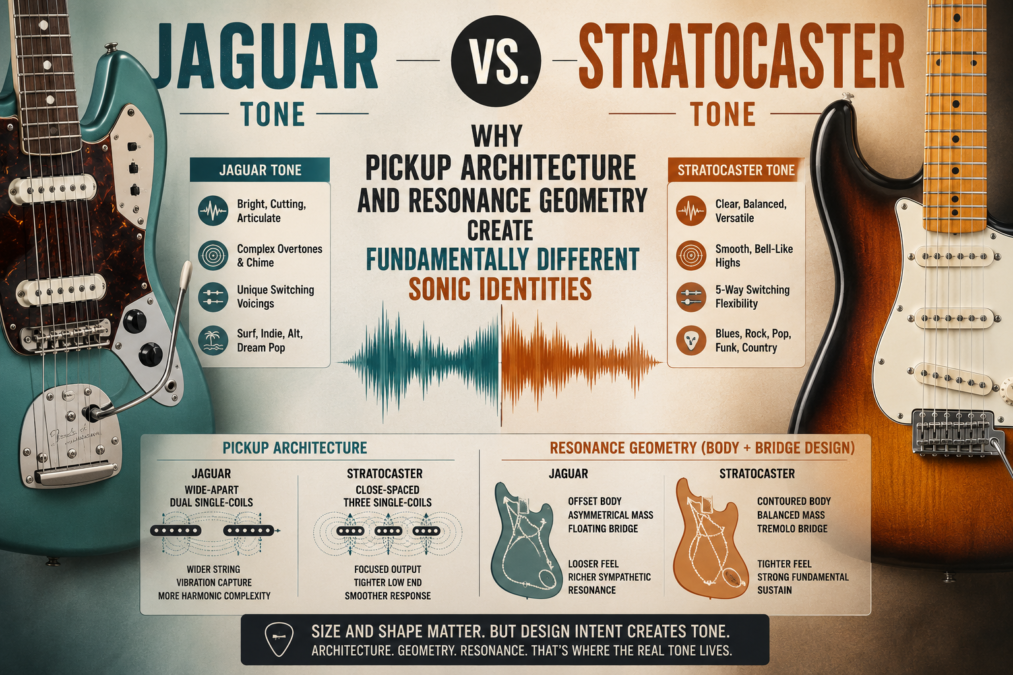

The debate surrounding jaguar vs stratocaster tone has persisted for decades because these two electric guitar designs approach sound production from entirely different engineering philosophies. Although both instruments emerged from the same manufacturer and share offset-era design DNA, the tonal outcomes diverge dramatically once amplification, scale length, pickup construction, bridge geometry, and harmonic behavior are analyzed in practical playing environments. The Jaguar emphasizes sharp transient articulation and upper-mid precision, while the Stratocaster favors broader harmonic spread, dynamic elasticity, and smoother frequency transition across registers.
A serious comparison of jaguar vs stratocaster tone requires more than subjective descriptions like “bright,” “warm,” or “thin.” The analysis must examine physical structure, electromagnetic pickup behavior, sustain characteristics, resonance decay patterns, string tension response, and how these variables interact with amplifiers, pedals, and performance techniques. Guitar tone is not produced by pickups alone; it emerges from the interaction between the entire instrument and the player’s attack dynamics.
The surprising conclusion is that the Jaguar is not merely a brighter Stratocaster, nor is the Stratocaster simply a fuller Jaguar. Instead, each instrument occupies a distinct acoustic and psychoacoustic niche. The Jaguar was engineered for clarity and definition under dense rhythmic conditions, whereas the Stratocaster evolved into a dynamically adaptive platform capable of translating nuanced human touch into expressive tonal variation across multiple genres.
Essential Comparative Metrics
| Category | Jaguar | Stratocaster |
|---|---|---|
| Scale Length | 24 inches | 25.5 inches |
| Pickup Character | Sharp, focused, high-definition attack | Rounded, balanced, harmonically open |
| String Tension Feel | Softer and more elastic | Tighter and more responsive |
| Primary Frequency Emphasis | Upper mids and treble articulation | Broad midrange with balanced highs |
| Sustain Profile | Shorter and more percussive | Longer and smoother |
| Bridge Design | Floating vibrato system | Synchronized tremolo system |
| Clean Tone Personality | Chimey, cutting, glass-like | Fluid, bell-like, dimensional |
| Distortion Response | Tight and aggressive | Smooth and expressive |
| Chord Separation | Exceptional note definition | Balanced harmonic blending |
| Genre Association | Surf, indie, post-punk, shoegaze | Blues, rock, funk, pop, fusion |
Structural And Acoustic Foundations
The most important factor in understanding jaguar vs stratocaster tone is scale length. The Jaguar’s 24-inch scale reduces string tension significantly compared to the Stratocaster’s 25.5-inch scale. Lower tension changes how strings vibrate, producing softer attack compression and slightly faster note decay. This shorter scale also alters overtone spacing, contributing to the Jaguar’s signature tightness and metallic shimmer.
The Stratocaster’s longer scale increases tension, resulting in stronger fundamental projection and more stable harmonic sustain. Notes retain clarity during bends and aggressive picking because the strings resist excessive lateral movement. This creates the familiar Stratocaster “snap” associated with blues and funk rhythm playing.
Pickup construction further separates the instruments. Jaguar pickups are physically narrower and surrounded by metal claws that concentrate magnetic flux. This increases perceived brightness and attack precision. Stratocaster pickups, by contrast, produce a broader magnetic field that captures a wider harmonic spectrum, creating smoother tonal diffusion.
A Jaguar guitar is an offset electric instrument designed for sharp articulation, rapid transient response, and high-definition chord separation. A Stratocaster is a long-scale electric guitar optimized for dynamic expression, sustain continuity, and balanced harmonic projection.
Pickup Architecture And Electromagnetic Response
Jaguar pickups sense a narrower section of string vibration because of their compact coil design. Narrow sensing windows emphasize upper harmonics and suppress excessive low-mid bloom. This produces the famously cutting Jaguar tone that remains articulate even through heavy reverb or fuzz saturation. Complex chords preserve individual note identity rather than collapsing into harmonic congestion.
The Stratocaster pickup system operates differently. Its wider magnetic aperture captures more of the string’s movement envelope, producing broader harmonic content and smoother transient decay. The result is a more elastic and “breathing” tone that reacts dramatically to picking intensity.
While Jaguar pickups prioritize precision and attack clarity, Stratocaster pickups emphasize dynamic range and harmonic fluidity.
This distinction becomes especially apparent under gain. Jaguar tones stay focused and angular, making them ideal for layered alternative textures. Stratocaster tones compress more organically and respond to touch with greater expressive variation, particularly in lead phrasing.
The classic “quack” in Stratocaster positions two and four also has no true Jaguar equivalent because the Jaguar’s switching architecture and pickup spacing generate different phase interactions.
Resonance Geometry And Body Interaction
Body resonance plays a surprisingly large role in jaguar vs stratocaster tone. Although solid-body guitars rely heavily on electronic amplification, the physical vibration profile of the wood still affects sustain, overtone emphasis, and attack behavior.
The Jaguar’s offset body and floating vibrato create a looser resonance ecosystem. Vibrational energy disperses rapidly through the bridge assembly, contributing to shorter sustain and stronger percussive definition. Many players interpret this as “immediacy.” The guitar responds quickly but does not linger excessively after attack.
The Stratocaster distributes resonance differently. Its tremolo block anchors more string energy into the body, allowing notes to bloom and sustain with smoother decay curves. This gives the instrument a more vocal quality during expressive lead work.
In practical terms, Jaguar chords often sound more separated and rhythmically aggressive, while Stratocaster chords sound fuller and more blended. Neither approach is objectively superior. The choice depends on whether the player values precision or expansiveness.
A direct answer to the jaguar vs stratocaster tone question is this: the Jaguar delivers sharper articulation and tighter harmonic focus, whereas the Stratocaster produces broader dynamic expression and smoother sustain behavior. The tonal difference comes primarily from scale length, pickup geometry, and bridge resonance rather than cosmetic design variations.
Behavioral Patterns In Playing Dynamics
One overlooked dimension of jaguar vs stratocaster tone involves player interaction mechanics. Different guitars encourage different playing behaviors because they physically resist or reward certain techniques.
The Jaguar’s shorter scale invites looser fretting pressure and softer vibrato movements. Fast chord transitions feel effortless, and rhythm work becomes highly responsive. However, aggressive bends can sometimes feel unstable because lower string tension reduces resistance.
This responsiveness is why Jaguar guitars became closely associated with surf, post-punk, shoegaze, and indie genres. These styles benefit from rapid articulation, atmospheric layering, and rhythmic precision rather than sustained blues phrasing.
The Stratocaster encourages a different behavioral relationship. Its tighter scale rewards expressive bends, articulate string attack, and nuanced touch control. The instrument reacts proportionally to picking intensity, enabling performers to manipulate tone dynamically without relying heavily on pedals.
This dynamic responsiveness explains why Stratocasters dominate blues and fusion contexts. The guitar behaves almost like a pressure-sensitive instrument, translating subtle human variations into audible tonal shifts.
The contrast in jaguar vs stratocaster tone therefore extends beyond sound itself. It fundamentally shapes how musicians phrase notes, construct chords, and interact with amplification systems.
Ford vs Chevy: Why Brand Identity Matters Less Than Platform Engineering in 2026
Jaguar Tone Strengths And Constraints
The Jaguar’s greatest tonal strength lies in articulation density. Few electric guitars preserve note separation under heavy effects processing as effectively. Dense reverb, modulation, and fuzz chains often blur lower-mid frequencies on other guitars, but the Jaguar’s focused high-end structure maintains clarity.
This characteristic made the Jaguar essential to shoegaze and atmospheric indie recordings. Layers remain intelligible instead of collapsing into indistinct noise. Rhythmic attack also stays sharp during rapid alternate picking.
Another strength in jaguar vs stratocaster tone comparisons is transient immediacy. Jaguar notes emerge quickly and decay cleanly, creating exceptional rhythmic precision for syncopated playing styles.
However, these advantages also introduce limitations. Some players perceive Jaguar tones as thin or overly bright in clean settings. The reduced sustain can make long melodic phrasing feel less fluid compared to a Stratocaster.
The floating bridge system additionally requires careful setup stability. Improper string gauge selection can reduce resonance consistency and create unwanted buzzing.
Despite these constraints, the Jaguar excels in contexts where tonal separation, atmospheric layering, and sharp articulation matter more than sustain-heavy expressiveness.
Stratocaster Tone Strengths And Constraints
The Stratocaster’s tonal dominance across modern music stems from versatility. In the jaguar vs stratocaster tone debate, the Stratocaster consistently demonstrates broader adaptability across genres, amplifiers, and playing styles.
Its clean tones possess remarkable dimensionality. Notes bloom gradually instead of appearing abruptly, producing a vocal-like quality especially noticeable in neck pickup settings. This smooth expansion creates emotional depth during melodic passages.
The Stratocaster also responds exceptionally well to touch dynamics. Soft picking produces delicate transparency, while aggressive attack introduces natural compression and harmonic saturation. Few guitars translate human microdynamics as effectively.
Another major advantage is frequency balance. Stratocasters rarely overpower mixes with excessive low mids or piercing highs. Their EQ profile sits naturally within band arrangements.
Yet the Stratocaster is not without weaknesses. Under extreme distortion or dense ambient effects, note separation can become less precise than on a Jaguar. The broader harmonic spread that makes Stratocasters expressive can also create sonic congestion in heavily layered recordings.
Some players additionally find Stratocasters less aggressive for cutting rhythmic applications. Compared directly in jaguar vs stratocaster tone evaluations, the Strat can sound smoother but less urgent.
Comparative Advantages In Real-World Recording Scenarios
Studio environments reveal the practical implications of jaguar vs stratocaster tone more clearly than isolated bedroom playing. Recording engineers often choose instruments based not on solo tone, but on how guitars occupy frequency space within full arrangements.
The Jaguar performs exceptionally well in layered productions. Its focused upper-mid articulation prevents masking conflicts with bass guitar and lower-register keyboards. Double-tracked Jaguar rhythms maintain stereo definition without overwhelming vocal frequencies.
The Stratocaster, meanwhile, excels in expressive centerpiece roles. Lead lines remain emotionally detailed because sustain and harmonic spread create perceived depth. Stratocaster clean tones also interact beautifully with compression and analog delay processing.
For funk rhythm, the Stratocaster’s percussive snap and dynamic elasticity usually outperform the Jaguar. For atmospheric post-rock textures, the Jaguar’s controlled attack often provides superior clarity.
Session musicians frequently choose between the two based on arrangement density. Sparse arrangements benefit from Stratocaster fullness, while dense productions often benefit from Jaguar precision.
Thus, jaguar vs stratocaster tone is ultimately context dependent. One instrument optimizes spatial clarity; the other optimizes expressive dimensionality.
Scientific And Expert Consensus (2026)
Modern luthiery analysis increasingly supports the idea that the tonal differences in jaguar vs stratocaster tone originate from interacting systems rather than isolated features. Scale length, pickup geometry, bridge resonance, nut friction, and neck stiffness collectively influence vibrational behavior.
Acoustic measurement studies consistently show that shorter-scale guitars emphasize different overtone relationships than long-scale instruments. The Jaguar’s faster transient decay contributes to perceived brightness because high-frequency attack dominates the listener’s psychoacoustic impression.
Engineers analyzing waveform response also observe that Stratocaster signals display smoother sustain curves and broader harmonic distribution. This explains why listeners frequently describe Stratocaster tones as “rounder” or “more vocal.”
Professional producers increasingly reject simplistic claims that wood type alone determines electric guitar sound. Current consensus instead emphasizes mechanical coupling and electromagnetic sensing behavior.
Experts generally agree on several points:
- Jaguar guitars provide superior articulation under dense effects processing
- Stratocasters offer greater dynamic versatility across genres
- Scale length dramatically affects player interaction and tonal perception
- Pickup geometry shapes harmonic emphasis more than pickup output ratings
- Sustain behavior influences emotional interpretation of tone
The contemporary understanding of jaguar vs stratocaster tone therefore centers on systems engineering rather than mythology.
Cultural Identity And Genre Evolution
The cultural history behind jaguar vs stratocaster tone also explains why players perceive the instruments differently. Tone is partially psychological; listeners associate specific frequency behaviors with genre expectations.
The Jaguar became culturally tied to surf music before later being adopted by alternative and shoegaze artists. Its sharp attack complemented spring reverb and atmospheric pedal experimentation. Over time, listeners began associating Jaguar tones with introspection, tension, and sonic experimentation.
The Stratocaster evolved differently. Blues players, rock virtuosos, funk rhythm specialists, and fusion musicians collectively shaped its identity as an expressive and emotionally flexible instrument. Audiences now associate Stratocaster tones with human nuance and performance sensitivity.
This historical layering affects perception. Players hearing a Jaguar may subconsciously anticipate angular textures and atmospheric layering. Hearing a Stratocaster often primes expectations of expressive phrasing and dynamic touch response.
Consequently, the jaguar vs stratocaster tone debate involves both measurable acoustics and deeply embedded cultural listening habits.
Final Synthesis And Verdict
The most important insight from the jaguar vs stratocaster tone comparison is that these guitars solve different musical problems rather than competing for identical roles.
The Jaguar is engineered around articulation efficiency. Its shorter scale, focused pickups, and floating bridge system create a tone optimized for precision, rhythmic separation, and clarity under dense sonic layering. It excels where attack definition matters more than sustain continuity.
The Stratocaster is engineered around expressive adaptability. Its longer scale, broader pickup response, and smoother resonance behavior create a tone capable of translating subtle performance dynamics into emotionally rich musical phrasing.
Players seeking atmospheric precision, post-punk aggression, or shoegaze layering often prefer the Jaguar. Players prioritizing touch sensitivity, blues phrasing, funk articulation, or broad genre versatility usually gravitate toward the Stratocaster.
Neither guitar is inherently superior because the tonal objectives differ fundamentally. The Jaguar compresses sonic information into focused clarity, while the Stratocaster expands sonic information into expressive dimensionality.
That distinction is the real answer behind the enduring fascination with jaguar vs stratocaster tone.
Frequently Asked Questions
Is Jaguar tone brighter than Stratocaster tone?
Yes, most players perceive Jaguar tone as brighter because the pickup design and shorter scale emphasize upper-mid attack frequencies. However, the brightness is more about transient focus and note definition than extreme treble output alone.
Why does a Jaguar sound thinner than a Stratocaster?
The Jaguar’s shorter sustain, tighter pickup focus, and reduced low-mid bloom create a leaner tonal profile. In isolation this can sound thinner, but within dense mixes it often improves clarity and separation.
Which guitar is better for shoegaze and ambient music?
The Jaguar is often preferred for shoegaze because its articulation survives heavy reverb and fuzz processing more effectively. The Stratocaster can still perform well in ambient music, but it generally produces smoother and less aggressive layering textures.
Which is more versatile in modern recording environments?
The Stratocaster is usually considered more versatile because it adapts effectively to blues, funk, pop, rock, fusion, and studio session work. The Jaguar is more specialized but exceptionally strong in alternative, indie, surf, and atmospheric genres.
Does scale length really affect guitar tone?
Yes. Scale length changes string tension, harmonic spacing, sustain behavior, and attack response. In the jaguar vs stratocaster tone comparison, scale length is one of the most important reasons the instruments feel and sound fundamentally different.