
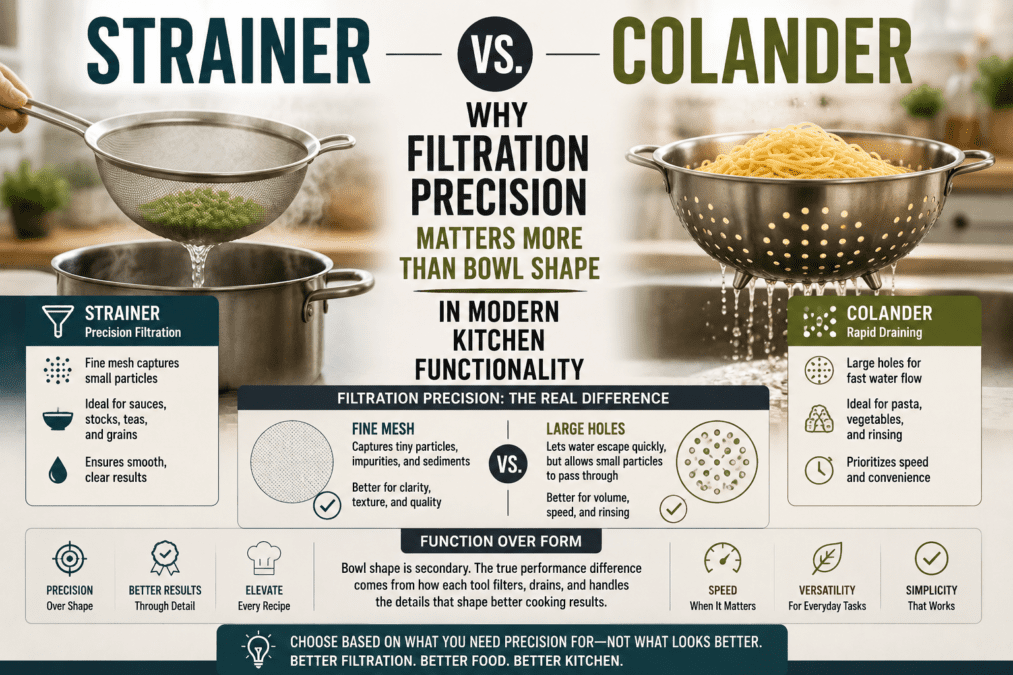

The debate surrounding strainer vs colander is often treated as a simple kitchen terminology issue, yet the distinction reflects two fundamentally different approaches to food filtration, liquid separation, and culinary workflow design. Both tools are used to separate solids from liquids, but their engineering principles, mesh density, drainage speed, and intended culinary applications differ substantially. In modern kitchens, understanding the functional divide between a strainer and a colander influences everything from pasta texture to sauce clarity and food safety efficiency.
A meaningful strainer vs colander comparison requires more than visual observation. The analysis must consider fluid dynamics, pore geometry, thermal resistance, ergonomics, material science, and food preparation context. While casual users may assume the tools are interchangeable, chefs, food scientists, and commercial kitchen designers recognize that each serves highly specialized purposes shaped by centuries of culinary evolution.
The central insight of the strainer vs colander discussion is that filtration precision usually matters more than container size or appearance. A colander prioritizes rapid water evacuation and high-volume drainage, whereas a strainer prioritizes particle retention and filtration control. This distinction explains why professional kitchens rarely substitute one for the other despite superficial similarities.
Defining The Core Difference
A strainer is a filtration tool designed to separate fine particles from liquids using mesh or perforated surfaces with relatively small openings. A colander is a larger drainage vessel designed primarily for rapid removal of water from bulk foods such as pasta, vegetables, or boiled grains.
While a strainer emphasizes precision and filtration quality, a colander emphasizes speed, capacity, and structural stability during high-volume draining tasks.
In practical culinary terms, the strainer vs colander distinction becomes most visible when preparing foods with different particle sizes. A strainer can remove seeds from puree, clarify broth, or sift fine ingredients. A colander, by contrast, excels at draining spaghetti, washing produce, or cooling boiled potatoes. Attempting to replace one with the other often reduces efficiency, texture quality, or preparation accuracy.
Essential Comparative Metrics
| Category | Strainer | Colander |
|---|---|---|
| Primary Function | Fine filtration and separation | Bulk draining and rinsing |
| Hole or Mesh Size | Very small mesh openings | Larger perforations |
| Drainage Speed | Moderate to slow | Fast |
| Precision Level | High | Moderate |
| Typical Materials | Fine steel mesh, nylon, silicone | Metal, plastic, ceramic, silicone |
| Best For | Sauces, tea, flour, purees | Pasta, vegetables, rice, fruit washing |
| Capacity Range | Usually smaller | Usually larger |
| Food Retention Ability | Excellent for tiny particles | Poor for small particles |
| Cleaning Complexity | Higher due to mesh density | Lower |
| Commercial Kitchen Usage | Precision preparation tasks | High-volume draining operations |
| Structural Design | Handle-focused or bowl mesh | Bowl-shaped support structure |
Structural And Mechanical Foundations
The engineering behind strainer vs colander functionality begins with aperture geometry. Strainers use tightly woven mesh or micro-perforated surfaces that create resistance against small solids while allowing liquids to pass through gradually. This structure produces controlled filtration capable of separating particles at highly specific scales. The smaller the aperture, the greater the filtration precision but the slower the drainage speed.
Colanders operate under an entirely different principle. Their larger perforations reduce fluid resistance and maximize water evacuation speed. The bowl-shaped design distributes food weight evenly while preventing collapse during heavy draining tasks. In commercial food preparation, this matters significantly because rapid drainage reduces heat retention and prevents overcooking after boiling.
Material science also shapes the strainer vs colander comparison. Fine mesh strainers often require corrosion-resistant stainless steel to maintain structural integrity under repeated thermal expansion. Colanders prioritize rigidity and impact resistance because they routinely handle heavier loads. This explains why colanders are commonly manufactured with thicker structural walls and reinforced base supports.
Historical Evolution Of Kitchen Filtration Tools
The strainer vs colander distinction emerged from separate culinary needs rather than stylistic variation. Ancient civilizations used woven reeds, cloth filters, and perforated clay vessels for food separation long before industrial metalworking enabled modern kitchen tools.
Early strainers evolved alongside sauce-making, brewing, and flour refinement. Precision mattered because cuisines increasingly relied on texture uniformity and sediment removal. French culinary traditions especially elevated strainers into indispensable professional tools for consommés, veloutés, and reductions.
Colanders evolved more directly from agricultural washing baskets and grain-draining vessels. Their purpose centered on volume handling rather than filtration accuracy. As pasta production expanded across Europe, colanders became associated with high-capacity boiling and draining systems.
Modern manufacturing blurred visual distinctions between the two, creating confusion in contemporary households. However, the underlying physics behind strainer vs colander functionality remains unchanged. One optimizes filtration precision; the other optimizes liquid evacuation efficiency.
Fluid Dynamics And Drainage Efficiency
One of the most overlooked aspects of the strainer vs colander comparison involves fluid mechanics. Liquids behave differently depending on aperture size, surface tension, and gravitational flow resistance.
A strainer deliberately slows fluid movement. This controlled flow allows suspended solids to remain trapped while filtered liquid passes through. In culinary science, this becomes essential when clarifying stocks, removing pulp from citrus juice, or producing smooth custards. Rapid flow would compromise separation quality.
A colander minimizes resistance to maximize throughput. Larger openings allow turbulent water release, reducing pooling and accelerating cooling. This matters for starch-heavy foods like pasta because prolonged exposure to residual boiling water continues cooking after draining.
The strainer vs colander debate therefore reflects competing priorities: precision versus throughput. Professional kitchens select between them based on whether filtration accuracy or drainage speed matters more to the final dish quality.
Heat Retention And Thermal Performance
Thermal management creates another important dimension in the strainer vs colander analysis. Different food preparation methods require different heat retention behaviors.
Strainers often retain more heat because dense mesh slows airflow and liquid release. This characteristic can be beneficial when filtering hot broths or steeping ingredients gradually. However, it may become disadvantageous when rapid cooling is required.
Colanders encourage ventilation and heat dissipation. Their open perforation patterns allow steam escape from multiple directions, helping foods cool more evenly. This is especially valuable when blanching vegetables or draining pasta intended for cold dishes.
Material composition further influences thermal performance. Stainless steel colanders dissipate heat faster than plastic versions, while silicone strainers may retain warmth longer due to lower thermal conductivity. In professional settings, these differences affect workflow timing and food texture preservation.
Consequently, the strainer vs colander distinction is partially a thermal engineering decision rather than merely a filtration choice.
Subject A: Strengths And Constraints Of Strainers
The greatest strength of a strainer lies in precision control. Fine mesh construction enables removal of seeds, sediment, foam, flour clumps, tea leaves, and microscopic food particles that would pass directly through a colander. This makes strainers indispensable in pastry work, sauce refinement, beverage preparation, and high-end culinary presentation.
Another major advantage in the strainer vs colander comparison is texture management. Strainers create smoother soups, silkier sauces, and cleaner liquids. Fine filtration directly influences mouthfeel, which is a critical factor in professional gastronomy.
However, strainers possess limitations. Dense mesh clogs more easily, especially when filtering starch-heavy or fibrous materials. Cleaning requires greater attention because trapped particles accumulate within microscopic openings. Strainers also generally support lower food volume capacity, making them inefficient for bulk draining tasks.
Durability can become another issue. Fine mesh surfaces deform more easily under heavy pressure compared with rigid colander structures. In commercial kitchens, overloading strainers frequently shortens operational lifespan.
Thus, in the broader strainer vs colander evaluation, strainers excel in finesse but sacrifice throughput and structural robustness.
Subject B: Strengths And Constraints Of Colanders
Colanders dominate situations involving speed, volume, and convenience. Their large perforations rapidly expel water while accommodating heavy food quantities. This makes them ideal for pasta preparation, vegetable washing, shellfish cleaning, and industrial food processing.
One major advantage in the strainer vs colander discussion is ergonomic efficiency. Colanders are usually self-supporting, enabling hands-free drainage over sinks. Their rigid structures tolerate significant weight without deformation, making them suitable for commercial kitchens and high-volume cooking environments.
Cleaning is generally easier because larger openings resist clogging. Food residue washes away quickly, reducing sanitation complexity.
Yet colanders have major limitations in precision applications. Rice grains, quinoa, seeds, and fine particles often escape through perforations. Liquids drained through colanders may retain sediment or foam that strainers would remove effectively.
The strainer vs colander contrast therefore highlights a classic engineering tradeoff. Colanders maximize operational efficiency and structural strength but sacrifice filtration accuracy and fine-particle control.
Comparative Advantages In Real-World Culinary Scenarios
The practical relevance of strainer vs colander becomes clearer when examined across specific kitchen tasks.
For pasta preparation, colanders are overwhelmingly superior because they evacuate large quantities of boiling water quickly without trapping steam excessively. Using a fine strainer for pasta often causes water pooling and prolonged cooking exposure.
For soup clarification, strainers dominate because they preserve liquid smoothness while removing solids. A colander cannot capture microscopic particles effectively enough for refined culinary applications.
For rinsing berries or leafy vegetables, the ideal choice depends on food size. Colanders handle larger produce efficiently, while strainers prevent delicate berries or grains from escaping.
For baking preparation, strainers outperform colanders because flour aeration and powdered ingredient refinement require microscopic filtration capability.
In beverage preparation, the strainer vs colander distinction becomes even more pronounced. Tea, coffee concentrates, cocktails, and fruit extractions demand filtration precision that only strainers can provide consistently.
Real-world kitchen efficiency therefore depends less on owning one tool and more on understanding the functional specialization of each.
Hygienic And Food Safety Considerations
Food safety experts increasingly analyze kitchen tools through the lens of sanitation efficiency and microbial retention. Within the strainer vs colander comparison, hygiene outcomes vary considerably depending on material type and cleaning practices.
Strainers present greater sanitation challenges because fine mesh traps organic residue more easily. Moisture retention within microscopic crevices can encourage bacterial accumulation if drying is incomplete. Commercial kitchens therefore often require immediate washing and air-drying protocols for fine mesh equipment.
Colanders generally dry faster and allow easier visual inspection during cleaning. Their broader openings reduce the likelihood of hidden food accumulation. However, plastic colanders may develop scratches over time that harbor bacteria, especially under repeated dishwasher exposure.
Material choice matters significantly. Stainless steel remains the preferred professional standard because it resists corrosion, staining, and microbial adhesion better than many plastics.
The strainer vs colander debate thus extends beyond convenience into public health considerations, particularly in large-scale food service operations.
Power vs Energy: Why Rate and Capacity Are Fundamentally Different Scientific Quantities
Ergonomics And User Experience
Kitchen ergonomics strongly influence the practical usability of both tools. The strainer vs colander comparison reveals different design priorities aimed at different workflow patterns.
Strainers often emphasize precision handling. Many feature elongated handles, stabilizing hooks, or compact bowl structures designed for controlled pouring and targeted filtration. These characteristics improve maneuverability during delicate culinary tasks.
Colanders prioritize stability and capacity management. Wide bases, side handles, and self-standing geometry reduce physical strain during large-volume drainage. In households preparing family meals, this efficiency becomes especially valuable.
Weight distribution also differs substantially. Colanders are designed to support heavier loads evenly, while strainers function best under moderate quantities. Overloading a strainer can compromise mesh integrity and increase spill risk.
Modern kitchen manufacturers increasingly hybridize the two designs, but most hybrid products fail to match the specialized efficiency of dedicated tools. This reinforces the enduring relevance of the traditional strainer vs colander distinction.
Material Science And Manufacturing Trends
The evolution of kitchen manufacturing has transformed the strainer vs colander landscape over the past two decades. Traditional stainless steel remains dominant, yet silicone, reinforced polymers, and composite materials are increasingly common.
Fine mesh strainers require precise manufacturing tolerances because even minor inconsistencies alter filtration performance. High-end models often use micro-welded stainless mesh for improved durability and corrosion resistance.
Colanders increasingly incorporate collapsible silicone designs aimed at storage efficiency. While convenient for small kitchens, these designs sometimes compromise rigidity under high-temperature loads.
Environmental considerations also influence manufacturing trends. Recyclable metals generally outperform disposable plastics in lifecycle sustainability analyses. Professional culinary institutions increasingly favor durable metal equipment because replacement frequency affects long-term environmental impact.
The strainer vs colander discussion therefore intersects with sustainability, industrial engineering, and consumer design psychology as much as culinary functionality.
Scientific And Expert Consensus (2026)
Current culinary science and professional kitchen consensus strongly reject the idea that strainers and colanders are interchangeable tools. Expert analysis consistently emphasizes functional specialization based on particle control, drainage rate, and food handling efficiency.
Professional chefs generally classify strainers as precision filtration instruments and colanders as volume-drainage systems. Food engineering studies further support this distinction by demonstrating measurable differences in fluid evacuation rates, residual moisture retention, and particle separation efficiency.
Culinary schools in 2026 increasingly teach kitchen tool selection as part of process optimization rather than simple utensil familiarity. Students learn that incorrect filtration tools can alter texture, cooking continuity, and presentation quality.
The broader consensus within the strainer vs colander debate is therefore clear: choosing the correct tool improves consistency, efficiency, and food quality more than many casual cooks realize.
Psychological And Cultural Perceptions
An overlooked dimension of the strainer vs colander comparison involves cultural kitchen habits. Many households inherit cooking routines without analyzing the underlying tool logic. As a result, people often use whichever tool is available rather than whichever tool is optimal.
Cultural cuisines also influence preferences. Pasta-heavy culinary traditions rely heavily on colanders, whereas sauce-centric or tea-oriented cuisines depend more extensively on strainers.
Marketing language further blurs distinctions. Retailers sometimes label products ambiguously, encouraging consumers to view them as interchangeable. However, professional kitchens rarely make this mistake because operational efficiency exposes functional shortcomings immediately.
This explains why the strainer vs colander confusion persists among home cooks despite clear technical differences recognized by culinary professionals.
Final Synthesis And Verdict
The modern strainer vs colander comparison ultimately reveals two tools designed around entirely different engineering priorities. A strainer specializes in filtration precision, texture refinement, and microscopic particle separation. A colander specializes in rapid drainage, volume handling, and ergonomic efficiency during bulk food preparation.
Neither tool is universally superior because each addresses distinct culinary problems. However, the misconception that they are interchangeable overlooks important principles of fluid mechanics, thermal control, hygiene, and food texture management.
For precision cooking, beverage preparation, sauce refinement, baking, and fine filtration, strainers remain unmatched. For pasta draining, vegetable washing, and large-scale liquid evacuation, colanders consistently outperform strainers.
The most important insight from the strainer vs colander debate is that kitchen efficiency depends less on owning more tools and more on understanding why specific tools exist in the first place. Filtration precision and drainage throughput are separate culinary requirements, and modern cooking performs best when each is treated accordingly.
Frequently Asked Questions
Is a strainer better than a colander?
A strainer is better for precision filtration tasks such as removing seeds, pulp, or fine particles from liquids. A colander is better for rapidly draining large quantities of water from foods like pasta or vegetables. The better tool depends entirely on the cooking objective.
Can a colander replace a strainer?
A colander can replace a strainer only for coarse drainage tasks. It cannot effectively filter small particles, flour, sediment, or delicate ingredients because its perforations are much larger than strainer mesh openings.
Why do professional chefs use both?
Professional kitchens use both because each tool solves different culinary problems. Strainers provide filtration precision and texture control, while colanders improve speed and efficiency during high-volume draining operations.
Which is easier to clean: strainer or colander?
Colanders are usually easier to clean because their larger openings prevent food buildup. Strainers require more careful cleaning since fine mesh traps particles and residue more easily.
What foods require a strainer instead of a colander?
Foods and preparations requiring a strainer include sauces, custards, purees, tea, cocktails, citrus juice, powdered baking ingredients, and clarified broths. These applications depend on fine filtration that a colander cannot provide effectively.