
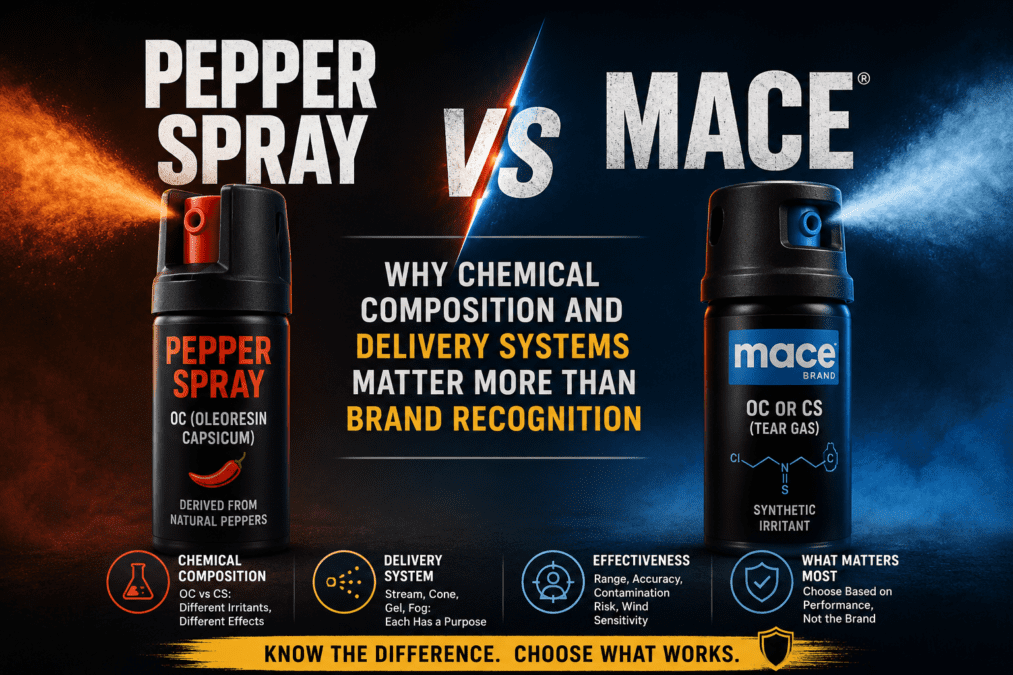

The debate around pepper spray vs mace has evolved far beyond simple brand confusion. In modern self-defense discussions, the distinction now involves chemistry, physiological response, legal interpretation, environmental performance, and incapacitation reliability. Many consumers still use the terms interchangeably, yet the two substances operate through fundamentally different biological mechanisms.
A meaningful pepper spray vs mace comparison requires examining active ingredients, aerosol delivery systems, effects on the nervous and respiratory systems, environmental reliability, and civilian defensive applications. Rather than asking which product is “stronger,” the more relevant question is which technology performs more consistently under real-world stress conditions.
The surprising insight emerging from modern defensive research is that pepper spray vs mace is no longer primarily a contest between two equivalent irritants. Instead, it represents a transition from older tear-gas-based incapacitation methods toward inflammatory capsaicin-based systems designed for rapid physiological overload. In practical defensive scenarios, modern pepper spray formulations have largely displaced traditional mace products because biological pain compliance tends to outperform irritation alone.
Understanding The Difference Between Pepper Spray And Mace
Pepper spray is a self-defense aerosol containing oleoresin capsicum, an inflammatory compound derived from chili peppers that causes intense burning, eye closure, respiratory distress, and temporary incapacitation.
Mace originally referred to a tear gas formulation using chemicals such as CN or CS gas, while modern commercial Mace-branded products often contain pepper spray blends instead of traditional tear agents.
While both are designed for civilian self-defense, pepper spray vs mace differs primarily in physiological action. Pepper spray inflames tissue and overwhelms pain receptors, while traditional mace products relied more heavily on chemical irritation of the eyes and respiratory tract.
In direct defensive effectiveness, modern evidence suggests that pepper spray generally produces more reliable incapacitation across varied populations, especially against individuals under the influence of alcohol or stimulants.
Essential Comparative Metrics
| Category | Pepper Spray | Traditional Mace |
|---|---|---|
| Primary Active Ingredient | Oleoresin Capsicum (OC) | CN or CS Tear Gas |
| Mechanism Of Action | Inflammatory pain response | Chemical irritation |
| Effect On Eyes | Immediate involuntary closure | Tearing and irritation |
| Respiratory Impact | Strong inflammatory restriction | Moderate irritation |
| Pain Intensity | Extremely high | Moderate to high |
| Effectiveness Against Intoxicated Individuals | Generally high | Less reliable |
| Environmental Sensitivity | Wind-sensitive but adaptable | Highly wind-sensitive |
| Civilian Usage Trend | Dominant modern standard | Declining standalone use |
| Recovery Time | 20–60 minutes typical | 15–45 minutes typical |
| Modern Law Enforcement Preference | Widely adopted | La |
Structural And Chemical Foundations
The core difference in pepper spray vs mace originates at the molecular level. Pepper spray relies on capsaicinoids extracted from hot peppers, especially capsaicin, which activates TRPV1 pain receptors throughout mucous membranes. This creates immediate inflammatory distress that affects the eyes, skin, nose, throat, and lungs simultaneously.
Traditional mace formulations historically depended on chloroacetophenone (CN) or chlorobenzylidene malononitrile (CS), both categorized as tear gases. These compounds primarily irritate tissues rather than generating the deep inflammatory overload associated with pepper-based sprays. Although effective in crowd-control environments, tear agents often produce less predictable results during close civilian encounters.
This distinction matters because inflammatory responses are biologically difficult to suppress voluntarily. An individual may psychologically resist irritation, but overwhelming involuntary eye closure and airway inflammation are harder to overcome. Modern pepper spray vs mace evaluations increasingly favor inflammatory systems because human physiology responds more uniformly to pain receptor activation than to irritation alone.
Another major factor involves solvent engineering. Contemporary pepper sprays frequently incorporate UV dyes, gel carriers, stream delivery systems, or foam technologies that improve targeting and reduce environmental contamination.
Physiological Effects On The Human Body
Understanding pepper spray vs mace requires examining how each affects the body under stress. Pepper spray triggers immediate inflammation of exposed tissue. Within seconds, the eyes clamp shut involuntarily, breathing becomes difficult, and exposed skin develops intense burning sensations. These reactions are not merely uncomfortable; they directly impair mobility and coordination.
Traditional mace products historically caused tearing, coughing, and disorientation through irritation mechanisms. Although unpleasant, these effects sometimes allowed determined individuals to continue functioning, especially if adrenaline levels were elevated. This became a significant operational concern in both policing and civilian defense.
Modern self-defense experts frequently emphasize that pepper spray’s effectiveness comes from systemic overload rather than localized irritation. The body effectively prioritizes emergency pain management, disrupting aggression and motor planning simultaneously.
Another overlooked aspect in pepper spray vs mace discussions involves psychological panic. Pepper spray often creates immediate fear responses because victims experience temporary blindness combined with airway distress. Tear-gas-based products may cause discomfort without producing the same degree of physiological panic.
Environmental exposure also differs. Traditional tear gas compounds can linger in enclosed spaces, potentially affecting bystanders more broadly. Pepper spray contamination remains serious but often disperses more predictably depending on delivery format.
Behavioral Patterns And Defensive Reliability
Behavioral science plays a critical role in the pepper spray vs mace debate. Self-defense tools succeed not merely through chemistry but through their ability to interrupt aggressive intent. A defensive aerosol must create enough disruption to break forward momentum and provide escape time.
Pepper spray has demonstrated stronger behavioral interruption in high-adrenaline situations because it produces immediate sensory overload. Vision impairment, respiratory distress, and burning pain combine into a multi-system defensive effect. This layered incapacitation is particularly important when facing determined attackers.
Traditional mace products performed adequately in many historical law-enforcement contexts, but behavioral reliability varied more widely across populations. Individuals under the influence of narcotics, alcohol, or extreme emotional states sometimes displayed reduced sensitivity to irritants.
The pepper spray vs mace comparison also intersects with reaction timing. Pepper spray generally reaches full effect faster, especially modern high-concentration OC formulas. Rapid incapacitation matters because most civilian defensive encounters occur at close range and unfold within seconds.
Another behavioral consideration involves compliance psychology. Subjects exposed to pepper spray frequently disengage instinctively because their bodies experience overwhelming physical distress. Tear agents may irritate sufficiently to deter some individuals, but determined aggressors occasionally continue advancing despite exposure.
Pepper Spray: Strengths And Constraints
The primary strength of pepper spray is reliability across varied defensive conditions. Contemporary studies and field reports consistently show that pepper spray remains effective against most individuals regardless of pain tolerance, emotional intensity, or intoxication level. This has made it the dominant civilian self-defense aerosol in many countries.
One reason the pepper spray vs mace discussion increasingly favors pepper spray is its immediate functional impairment. Vision disruption occurs rapidly, breathing becomes strained, and coordination deteriorates. These combined effects create critical escape opportunities for civilians.
Pepper spray also benefits from modern engineering diversity. Consumers can choose foggers, cone sprays, stream systems, gel projectors, and foam-based variants. Gel technologies reduce blowback risk outdoors, while stream designs improve precision in confined areas.
However, pepper spray is not flawless. Wind remains a major operational concern. Improper deployment can contaminate the user, especially with aerosol-heavy patterns. Indoor use may affect everyone in the environment if ventilation is limited.
Another limitation in the pepper spray vs mace comparison involves legal restrictions. Some jurisdictions regulate spray concentration, container size, or civilian possession. Users must understand local defensive weapon laws before carrying any chemical deterrent.
Pepper spray also requires training. Panic deployment, poor aim, or failure to maintain distance can compromise effectiveness dramatically.
Traditional Mace: Strengths And Constraints
Traditional mace products emerged during an earlier era of chemical defensive technology. Their original advantage involved temporary incapacitation without requiring lethal force. In crowd-control or compliance settings, tear agents created disorientation and irritation sufficient for many enforcement applications.
One strength in the pepper spray vs mace comparison is that tear-gas-based compounds can affect larger areas more diffusely. In some enclosed settings, this broad irritation field may discourage aggression from multiple individuals simultaneously.
Traditional mace formulations also tend to produce slightly less intense inflammatory pain than pepper spray. Some users historically viewed this as a benefit because recovery periods could feel less traumatic after exposure.
Nevertheless, the weaknesses of older mace systems became increasingly apparent over time. Tear agents frequently showed inconsistent stopping power against highly aggressive subjects. Individuals experiencing adrenaline surges or chemical intoxication often retained substantial physical capability after exposure.
Environmental instability also limits effectiveness. Wind dispersion, outdoor dilution, and delayed reaction times reduce operational reliability. In real-world self-defense, milliseconds matter, and slower incapacitation creates greater danger for civilians.
The most important modern reality is that many products marketed under the “Mace” name today actually contain OC pepper formulations. This reflects broader market recognition that inflammatory capsaicin systems generally outperform traditional tear gas in civilian defensive use.
Delivery Systems And Aerosol Engineering
Modern pepper spray vs mace analysis increasingly focuses on delivery mechanics rather than chemical ingredients alone. Aerosol engineering significantly affects accuracy, contamination risk, range, and stopping reliability.
Stream systems project concentrated liquid in narrow trajectories, improving precision and reducing airborne contamination. Gel systems extend this concept further by minimizing drift and increasing adherence to facial surfaces. Foam variants reduce inhalation spread while maintaining close-contact effectiveness.
Traditional tear-gas systems historically relied more heavily on aerosolized cloud dispersion. While this increased area coverage, it also elevated blowback risk and environmental contamination. In confined spaces, everyone nearby could become exposed.
The pepper spray vs mace distinction therefore extends beyond chemistry into tactical usability. Civilian defensive tools must function under panic conditions, low visibility, and unpredictable movement. Highly targeted delivery systems improve survivability because they reduce collateral exposure.
Range also matters. Most consumer sprays operate effectively between 6 and 15 feet, though advanced stream systems can exceed this. Greater distance improves defensive safety margins, particularly against armed or physically stronger attackers.
Temperature stability represents another engineering factor. Some aerosol systems lose pressure in cold weather, reducing deployment consistency. High-quality defensive sprays now use propellant technologies designed for broader environmental reliability.
PTFE vs Teflon: Why a Trademarked Coating Is Often Mistaken for an Entire Material Class
Comparative Advantages In Real-World Scenarios
Real-world encounters reveal why the pepper spray vs mace discussion shifted so dramatically over the last two decades. Defensive situations are chaotic, brief, and physiologically intense. The ideal deterrent must create immediate disruption without requiring precision combat skills.
In outdoor assaults, pepper spray generally offers superior stopping power because inflammatory pain overwhelms aggressive behavior rapidly. Stream or gel systems reduce wind interference and allow targeted deployment at safer distances.
During attempted robberies or harassment incidents, pepper spray’s fast sensory shutdown often creates enough hesitation for escape. Temporary blindness combined with respiratory distress reduces pursuit capability substantially.
Traditional mace historically performed better in broader-area crowd disruption scenarios rather than individual civilian defense. Its diffuse irritation effect could inconvenience multiple people simultaneously, but this same property increased bystander contamination.
The pepper spray vs mace comparison becomes especially important against intoxicated attackers. Alcohol and stimulants frequently diminish responsiveness to irritants but do not eliminate inflammatory pain receptor activation. This distinction explains why many law-enforcement agencies transitioned toward OC-based systems.
Indoor scenarios present additional complications. Pepper spray contamination can affect everyone nearby, particularly with fogger designs. Gel systems reduce this problem significantly and have become increasingly popular for home-defense applications.
Legal And Ethical Considerations
Legal frameworks surrounding pepper spray vs mace vary significantly by jurisdiction. Some regions classify chemical sprays as defensive tools, while others regulate them similarly to controlled weapons. Restrictions may include age limits, licensing requirements, concentration caps, or bans on concealed carry.
One critical legal distinction involves intended use. Defensive sprays are generally lawful when carried for personal protection, but misuse can result in assault charges. Deploying chemical agents during verbal disputes or non-threatening confrontations may constitute criminal conduct.
Ethically, pepper spray occupies a complex middle ground between verbal deterrence and lethal force. Many security professionals consider it one of the most proportionate civilian defensive tools because it temporarily incapacitates without causing permanent injury in most cases.
The pepper spray vs mace conversation also includes concerns about misuse against vulnerable populations. Individuals with respiratory disorders, cardiovascular conditions, or severe allergies may experience elevated medical risks after exposure.
Training and accountability therefore matter enormously. Responsible ownership includes understanding deployment distance, environmental conditions, decontamination procedures, and escape strategy planning.
Another emerging issue involves false marketing. Some products labeled “mace” imply historical tear-gas chemistry despite actually containing pepper-based formulations. Consumers should verify active ingredients rather than relying solely on branding language.
Scientific And Expert Consensus (2026)
The scientific consensus surrounding pepper spray vs mace increasingly favors pepper-based inflammatory systems for civilian self-defense applications. Research across policing, corrections, and personal-defense studies indicates that oleoresin capsicum formulations produce more reliable incapacitation under varied physiological conditions.
Experts generally attribute this superiority to the body’s involuntary response mechanisms. Pain receptor overload, airway inflammation, and forced eye closure create multi-system disruption that is difficult to resist intentionally.
Another major factor involves population variability. Tear agents historically showed inconsistent effectiveness among highly motivated individuals, intoxicated subjects, or people with elevated pain tolerance. Pepper spray demonstrates stronger consistency across these categories.
The pepper spray vs mace debate has also evolved due to product modernization. Many contemporary “Mace” brand products now include OC compounds or hybrid formulations because consumer demand shifted toward more dependable stopping performance.
Medical researchers continue studying long-term exposure safety, especially regarding respiratory complications in confined environments. Although most healthy individuals recover fully, improper use can create serious temporary distress.
Law-enforcement training organizations increasingly recommend targeted stream or gel pepper systems rather than wide-dispersion irritant clouds. This reflects broader recognition that precision and rapid incapacitation outperform generalized irritation in close defensive encounters.
Psychological Deterrence And Human Decision-Making
One underappreciated aspect of pepper spray vs mace involves psychological deterrence before deployment even occurs. Defensive tools influence behavior not only chemically but cognitively. Visible sprays often signal preparedness, potentially discouraging escalation before physical confrontation begins.
Pepper spray carries particularly strong psychological associations because it is widely recognized as painful and incapacitating. Media representation, law-enforcement usage, and public awareness have reinforced its reputation as an effective deterrent.
Traditional mace once held similar cultural recognition, but generational shifts changed public understanding. Today, many people use “mace” as a generic term without realizing the underlying chemical distinctions.
The pepper spray vs mace comparison therefore includes branding psychology. Pepper spray benefits from stronger contemporary perceptions of effectiveness, while traditional tear agents increasingly appear outdated in public discourse.
Decision-making under stress also matters. Civilians facing danger often experience tunnel vision, trembling, and reduced fine motor control. Simpler deployment systems improve defensive success rates dramatically. Modern pepper spray designs increasingly prioritize intuitive operation, ergonomic grips, and safety mechanisms that function under panic conditions.
Confidence influences survivability as well. People carrying tools they trust are more likely to respond decisively during emergencies.
Decontamination And Recovery
Recovery characteristics represent another important dimension in pepper spray vs mace analysis. Pepper spray exposure typically causes intense burning, involuntary eye closure, coughing, and breathing difficulty lasting between 20 and 60 minutes. Residual skin sensitivity may persist longer depending on concentration and exposure duration.
Decontamination generally involves fresh air, blinking, cool water flushing, and avoiding oil-based products that trap capsaicin compounds against the skin. Milk remedies remain popular culturally, though evidence supporting them is mixed.
Traditional mace products often caused tearing, coughing, and irritation with slightly shorter average recovery windows. However, tear-gas compounds could linger environmentally, creating prolonged contamination in enclosed spaces.
The pepper spray vs mace difference becomes especially important indoors. Pepper spray residues usually settle more predictably, particularly with gel systems. Tear agents may disperse more widely and affect ventilation systems or nearby rooms.
Medical intervention is rarely necessary for healthy individuals but may become important for those experiencing severe respiratory distress or allergic reactions. Training programs increasingly emphasize post-incident decontamination because panic and improper cleaning techniques can intensify discomfort.
Another consideration involves cross-contamination. Clothing, hands, and contaminated surfaces can reactivate exposure hours later if not cleaned carefully.
Final Synthesis And Verdict
The modern pepper spray vs mace comparison ultimately reflects a broader evolution in self-defense philosophy. Traditional tear-gas-based systems focused primarily on irritation and temporary discomfort, while contemporary pepper spray technologies prioritize rapid physiological overload and behavioral interruption.
Pepper spray consistently demonstrates stronger real-world reliability because inflammatory pain responses are harder to resist voluntarily than irritation alone. Immediate eye closure, breathing difficulty, and intense burning create multi-layered incapacitation that improves escape opportunities during civilian defensive encounters.
Traditional mace products retain historical significance and limited tactical value, particularly in area-denial or diffuse crowd-control contexts. However, their standalone effectiveness against aggressive individuals has become increasingly questioned in modern defensive research.
The most revealing outcome of the pepper spray vs mace debate is that the market itself has largely chosen a winner. Many products sold under legacy “Mace” branding now incorporate pepper-based OC formulations because consumers, trainers, and law-enforcement agencies increasingly prioritize inflammatory incapacitation over simple irritation.
For most civilian defensive purposes, modern pepper spray systems — especially targeted stream or gel variants — provide the strongest balance of stopping power, portability, accessibility, and practical reliability. The critical factor, however, remains responsible ownership. Even the most effective defensive tool depends on legal awareness, situational judgment, and proper training.
Frequently Asked Questions
Is pepper spray stronger than mace?
In most modern defensive evaluations, pepper spray is considered more effective than traditional mace because it creates inflammatory pain, involuntary eye closure, and respiratory distress rather than irritation alone. This generally produces faster and more reliable incapacitation.
Why do people still say “mace” when talking about pepper spray?
Many people use “mace” as a generic term for defensive sprays because the Mace brand became culturally dominant decades ago. However, traditional mace originally referred to tear-gas-based formulas, while many modern Mace-branded products now contain pepper spray ingredients.
Which works better against an aggressive attacker?
In the pepper spray vs mace comparison, pepper spray typically performs better against aggressive or intoxicated individuals because inflammatory pain responses are harder to ignore than tear-gas irritation.
Can pepper spray or mace cause permanent injury?
Most exposures result in temporary effects that resolve within an hour, but improper use, high concentrations, enclosed environments, or preexisting medical conditions can increase risks. Responsible use and prompt decontamination are essential.