
Fantasy literature has evolved into one of the most structurally diverse storytelling categories in modern fiction, yet the distinction between low fantasy vs high fantasy remains one of the most misunderstood comparisons in literary analysis. Both subgenres rely on speculative imagination, supernatural systems, and alternative perceptions of reality, but they fundamentally differ in how they position magic, society, morality, and human limitation. High fantasy typically constructs entirely separate worlds governed by expansive mythologies, while low fantasy embeds supernatural disruption into environments that remain psychologically or socially recognizable.
The comparison between low fantasy vs high fantasy is not merely about “less magic” versus “more magic.” The deeper distinction involves narrative architecture, philosophical scope, and emotional framing. High fantasy tends to externalize conflict through wars, kingdoms, prophecies, and civilization-scale struggles. Low fantasy, by contrast, often internalizes conflict, focusing on moral ambiguity, political realism, survival pressures, or the psychological consequences of power. The same dragon, sword, or magical system can produce entirely different narrative outcomes depending on which framework governs the story.
The most surprising insight emerging from modern literary criticism is that low fantasy vs high fantasy reflects two competing theories of escapism itself. High fantasy offers transcendence through mythic expansion, while low fantasy achieves immersion through recognizable imperfection. One asks readers to believe in heroic destiny; the other asks readers to confront flawed humanity within extraordinary conditions. This structural difference explains why audiences often respond emotionally to each subgenre in radically different ways despite their shared fantasy roots.
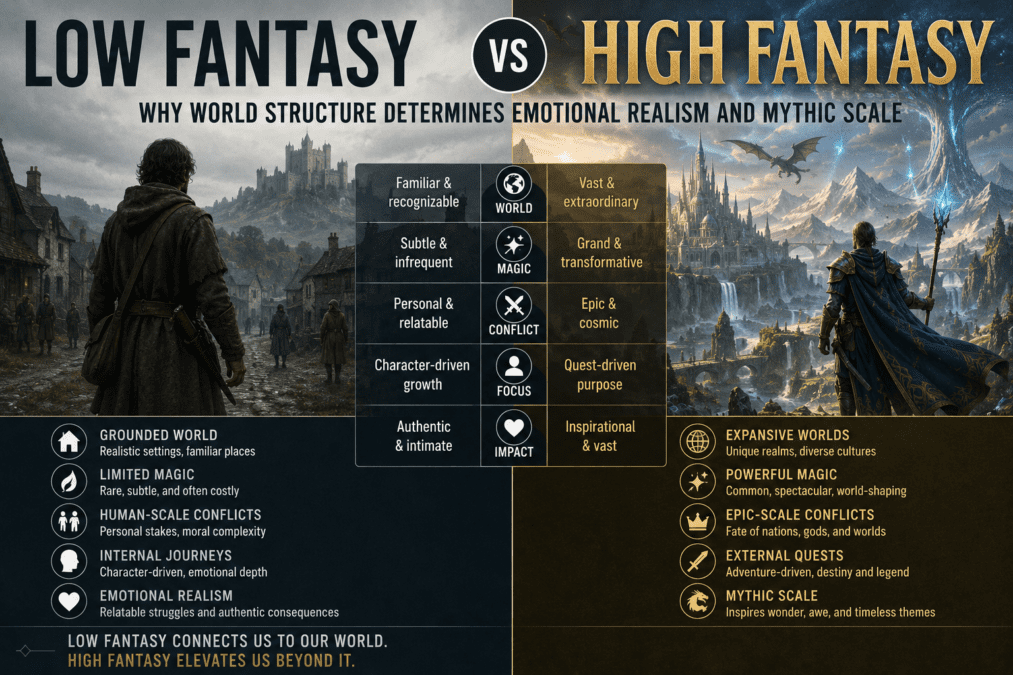
Essential Comparative Metrics
Structural And Biological Foundations
The structural divide in low fantasy vs high fantasy begins with world construction. High fantasy creates entirely autonomous realities with distinct geographies, histories, religions, and metaphysical systems. These worlds function independently from modern Earth and frequently possess internally consistent cosmologies spanning thousands of years. The narrative depends on readers accepting the fictional world as complete and sovereign.
Low fantasy operates differently. Rather than maximizing mythic distance, it reduces separation between the fictional and recognizable worlds. Even when secondary worlds exist, they tend to mirror historical social dynamics such as feudal violence, economic instability, corruption, or class struggle. Magic often behaves as an unpredictable force rather than a normalized social technology.
Low fantasy is a fantasy subgenre where supernatural elements intrude upon realistic or historically grounded societies. High fantasy is a fantasy subgenre set primarily in fully invented worlds with expansive mythologies and large-scale heroic conflicts.
This distinction changes narrative mechanics entirely. In high fantasy, the world itself becomes part of the spectacle. In low fantasy, the world becomes a pressure system exposing human weakness and institutional fragility.
Behavioral Patterns And Social Intelligence
One of the most revealing aspects of low fantasy vs high fantasy is how each genre portrays social behavior and human decision-making. High fantasy often elevates idealized virtues such as courage, sacrifice, loyalty, and destiny. Characters may struggle internally, but their journeys typically reinforce broader moral frameworks tied to order, justice, or cosmic balance.
Low fantasy is generally more skeptical about collective morality. Institutions are flawed, rulers are compromised, and survival frequently outweighs heroism. Characters succeed not because they embody purity, but because they adapt strategically to unstable environments. Alliances shift, ethics become situational, and political intelligence often matters more than physical strength.
While high fantasy emphasizes mythic purpose and transcendent ideals, low fantasy focuses on survival, compromise, and the consequences of power within morally unstable systems.
This difference strongly affects reader psychology. High fantasy encourages aspirational identification. Readers imagine becoming heroic participants within a larger cosmic struggle. Low fantasy instead encourages analytical engagement. Readers evaluate motives, power structures, and emotional realism in ways closer to political drama or historical fiction.
The distinction explains why some audiences perceive high fantasy as emotionally uplifting while others prefer the intellectual tension and realism associated with low fantasy narratives.
Subject A: Strengths And Constraints
The strengths of low fantasy emerge from its realism, emotional density, and narrative unpredictability. Because the supernatural is restrained or destabilizing, consequences feel immediate and personal. Violence has social cost. Political decisions reshape lives directly. Characters are rarely protected by destiny or moral certainty.
This framework produces unusually strong psychological immersion. Readers often experience low fantasy as believable despite its speculative elements because the social logic resembles recognizable human history. Fear, greed, ambition, tribalism, and institutional decay operate according to patterns audiences understand intuitively.
Another advantage in low fantasy vs high fantasy is tonal flexibility. Low fantasy can absorb noir fiction, military fiction, political thrillers, and survival narratives without losing genre cohesion. The reduced emphasis on absolute morality allows stories to explore trauma, compromise, and ideological collapse with greater subtlety.
However, low fantasy also has limitations. Excessive realism can erode wonder, making the fantasy feel emotionally narrow or oppressive. Some narratives become so cynical that mythic resonance disappears entirely. Readers seeking escapism, enchantment, or visionary imagination may perceive low fantasy as emotionally exhausting rather than immersive.
The genre also risks thematic repetition. Grim political betrayal and moral ambiguity can lose impact when overused, especially if stories substitute brutality for philosophical depth.
Subject B: Strengths And Constraints
High fantasy excels through scale, symbolic clarity, and mythic resonance. Its greatest strength lies in its ability to create immersive civilizations that feel culturally complete. Languages, religions, magical systems, ancient prophecies, and intergenerational conflicts combine to create narrative ecosystems far larger than individual protagonists.
This scale enables emotional experiences that low fantasy rarely attempts. Awe, transcendence, and mythic destiny are central components of the high fantasy experience. Readers engage not only with characters but with entire historical arcs. Battles are not merely territorial disputes; they symbolize existential struggles between chaos and order, corruption and hope, mortality and transcendence.
In low fantasy vs high fantasy comparisons, high fantasy consistently demonstrates greater imaginative elasticity. The genre can incorporate dragons, immortal races, cosmic deities, metaphysical planes, and complex magical systems without destabilizing audience expectations because grandeur is structurally expected.
Yet high fantasy also faces constraints. Extensive worldbuilding can overwhelm narrative momentum. Exposition-heavy storytelling sometimes prioritizes lore over emotional immediacy. Archetypal morality may also feel simplistic to readers who prefer sociopolitical realism or psychological ambiguity.
Another recurring issue involves emotional distance. Because high fantasy operates on enormous scales, personal suffering occasionally becomes abstract. Readers may admire the mythology intellectually while feeling less emotionally connected to individual human consequences.
Comparative Advantages In Real-World Scenarios
The practical storytelling advantages in low fantasy vs high fantasy become clearer when examining how each subgenre functions across media and audience demographics.
Low fantasy performs especially well in television adaptation because grounded politics, interpersonal tension, and morally layered conflict translate effectively to serialized drama. Audiences accustomed to crime thrillers or historical epics often transition naturally into low fantasy because the genre emphasizes familiar emotional structures despite supernatural elements.
High fantasy, meanwhile, dominates in transmedia franchise building. Its elaborate worlds encourage encyclopedic engagement, fandom communities, merchandise ecosystems, role-playing adaptations, and long-term mythological investment. Readers often return repeatedly to high fantasy settings because the world itself functions as a narrative attraction.
From a literary perspective, low fantasy tends to produce stronger sociological commentary. Themes such as authoritarianism, corruption, class conflict, religious extremism, and wartime trauma integrate naturally into grounded settings. High fantasy more frequently explores metaphysical or existential themes including destiny, sacrifice, immortality, cosmic balance, and the preservation of civilization.
A direct answer to the question of low fantasy vs high fantasy depends on reader priorities. Low fantasy offers emotional realism, political complexity, and psychological tension within restrained supernatural systems. High fantasy provides mythic immersion, expansive worldbuilding, and large-scale heroic narratives designed to evoke wonder, transcendence, and epic emotional stakes.
Neither framework is inherently superior. Their strengths emerge from entirely different narrative philosophies.
Scientific And Expert Consensus (2026)
Contemporary literary scholarship increasingly treats low fantasy vs high fantasy as a distinction rooted in cognitive immersion theory rather than simple setting classification. Researchers examining reader engagement have found that audiences respond differently to realism-based immersion and mythic-scale immersion.
Low fantasy activates recognition-based engagement. Readers emotionally invest because the social systems resemble historical or modern reality. Political manipulation, scarcity, institutional failure, and ambiguous morality mirror recognizable human behavior patterns. This resemblance strengthens psychological credibility.
High fantasy activates imaginative transcendence. Instead of anchoring immersion through realism, it expands cognitive possibility through symbolic structures and mythic escalation. The reader experiences emotional enlargement rather than social familiarity.
Modern critics also note that the distinction between low fantasy vs high fantasy has become increasingly hybridized. Many contemporary works combine grounded political realism with epic cosmology. Others begin as low fantasy before evolving into high fantasy as mythological dimensions expand.
Streaming media has accelerated this blending process. Audiences now expect sophisticated political systems alongside large-scale magical mythology. As a result, pure archetypal fantasy has become less dominant than structurally hybrid narratives balancing realism and wonder simultaneously.
Expert consensus in 2026 therefore emphasizes spectrum rather than binary classification. Most major fantasy works occupy shifting positions between low and high fantasy rather than fitting perfectly into rigid categories.
Influence On Character Psychology And Identity Formation
Character construction changes dramatically depending on whether a narrative operates within low fantasy vs high fantasy structures. In high fantasy, identity frequently emerges through destiny, lineage, prophecy, or cosmic role. Characters discover who they are by understanding how they fit into a larger metaphysical order.
This produces psychologically expansive storytelling. Heroes often evolve from ordinary individuals into symbolic figures representing hope, restoration, or resistance against existential threats. Their emotional growth parallels the fate of kingdoms or civilizations.
Psionics vs Mind Magic: A Cognitive Mechanics Analysis of Internal Power vs Arcane Mediation
Low fantasy rejects many of these assumptions. Identity forms through adaptation rather than destiny. Characters are shaped by scarcity, trauma, institutional failure, and survival pressures. Instead of discovering heroic purpose, protagonists frequently confront uncomfortable truths about themselves and the societies they inhabit.
The psychological effect on readers differs substantially. High fantasy can inspire aspiration and emotional elevation because its characters transcend limitation. Low fantasy creates intimacy because its characters remain constrained by recognizable flaws and consequences.
This is one reason debates about low fantasy vs high fantasy often become emotionally charged among readers. Preferences frequently reflect differing psychological needs. Some audiences seek mythic hope and symbolic clarity. Others prefer realism, skepticism, and moral complexity.
The Role Of Magic In Narrative Logic
Magic systems reveal perhaps the clearest structural distinction in low fantasy vs high fantasy analysis. In high fantasy, magic often functions as infrastructure. It shapes warfare, economics, religion, transportation, governance, and cosmology. Entire civilizations adapt around magical existence.
Because magic is integrated into society, readers experience it as normalized reality. Wizards, enchanted artifacts, mythical races, and supernatural laws become components of everyday world logic. This normalization allows high fantasy to escalate into extraordinary spectacle without destabilizing internal coherence.
Low fantasy typically treats magic differently. Supernatural forces are disruptive, feared, hidden, or poorly understood. Magic destabilizes rather than organizes society. Its rarity increases narrative tension because each appearance carries uncertainty and emotional weight.
This difference changes suspense mechanics profoundly. In high fantasy, conflict often revolves around strategic magical application or mythological revelation. In low fantasy, conflict frequently emerges from unpredictability itself. Characters may not fully understand the supernatural forces shaping their world.
The distinction explains why low fantasy vs high fantasy generates contrasting emotional textures. High fantasy encourages fascination with possibility. Low fantasy emphasizes anxiety surrounding uncontrollable power.
Cultural Influence And Modern Popularity
The cultural evolution of low fantasy vs high fantasy reflects broader changes in audience expectations over the past century. Earlier fantasy traditions heavily favored high fantasy structures influenced by mythology, medieval romance, and heroic epics. Readers sought worlds detached from industrial modernity and grounded instead in symbolic grandeur.
In the twenty-first century, low fantasy gained substantial popularity due to increasing audience interest in realism, political ambiguity, and institutional critique. Contemporary viewers often prefer narratives acknowledging corruption, moral uncertainty, and the psychological costs of violence.
However, high fantasy has remained culturally dominant in franchise influence because its expansive worlds support long-term engagement. Massive fan communities emerge more easily around settings rich in lore, languages, maps, religions, and dynastic histories.
The modern entertainment industry therefore treats low fantasy vs high fantasy less as competing genres and more as complementary emotional frameworks. Some audiences alternate between them depending on psychological mood. During periods of social instability, grounded fantasy may feel intellectually relevant, while mythic fantasy may provide emotional restoration and imaginative escape.
This flexibility helps explain why hybrid fantasy continues to dominate bestselling fiction and streaming adaptations globally.
Narrative Pacing And Emotional Density
Narrative pacing differs substantially between low fantasy vs high fantasy due to the scale of storytelling priorities. High fantasy often develops gradually because worldbuilding itself becomes part of the reader experience. Histories, cultures, magical systems, and geopolitical dynamics require significant narrative space before major conflicts fully emerge.
This slower pacing can produce immense emotional payoff when mythological threads converge. Readers experience a sense of historical momentum rarely achievable in more grounded fiction. Climactic moments feel civilization-defining because the narrative has carefully constructed large-scale stakes.
Low fantasy generally operates with greater immediacy. Political conspiracies, betrayals, warfare, and survival conflicts create rapid tension early in the story. Emotional density arises from interpersonal risk rather than mythological revelation.
As a result, low fantasy often feels sharper and more volatile. Character deaths, betrayals, or institutional collapse produce immediate psychological impact because narratives remain tightly connected to human vulnerability.
The pacing distinction in low fantasy vs high fantasy also influences adaptation success. Fast-moving low fantasy tends to perform well in episodic television, while high fantasy often excels in long-form literary series where readers can absorb extensive worldbuilding over time.
Final Synthesis And Verdict
The enduring debate surrounding low fantasy vs high fantasy persists because the comparison is ultimately philosophical rather than superficial. These subgenres do not merely differ in setting or magical quantity. They embody opposing interpretations of human struggle, morality, power, and transcendence.
High fantasy transforms conflict into mythic symbolism. It enlarges reality, elevates heroism, and frames civilization itself as part of a cosmic narrative. Its greatest strength lies in wonder — the ability to make readers feel emotionally connected to something larger than ordinary existence.
Low fantasy narrows the lens intentionally. It strips away heroic certainty and examines how flawed individuals navigate unstable systems shaped by violence, ambition, and compromise. Its power comes from credibility, tension, and psychological intimacy.
In practical terms, low fantasy vs high fantasy should not be viewed as a hierarchy. The stronger framework depends entirely on narrative intention. Stories exploring institutional decay, political realism, or moral ambiguity often thrive in low fantasy structures. Stories seeking transcendence, mythic resonance, or civilization-scale emotional stakes generally flourish in high fantasy environments.
The most influential modern fantasy works increasingly merge both traditions. They combine the emotional realism of low fantasy with the imaginative ambition of high fantasy, producing narratives capable of delivering both psychological depth and mythic scale simultaneously.
That hybrid evolution may ultimately define the future of fantasy storytelling itself.
FAQ
What is the main difference between low fantasy vs high fantasy?
The main difference between low fantasy vs high fantasy is world structure and narrative scope. High fantasy usually takes place in entirely invented worlds with expansive mythologies, while low fantasy focuses on grounded societies where supernatural elements are limited, disruptive, or psychologically realistic.
Is low fantasy darker than high fantasy?
Low fantasy is often darker because it emphasizes political realism, moral ambiguity, and survival pressures. However, darkness is not mandatory. High fantasy can also become emotionally intense, especially when dealing with war, corruption, or civilizational collapse.
Can a story be both low fantasy and high fantasy?
Yes. Many modern fantasy works combine elements of both. A story may feature realistic political systems and morally complex characters while also including epic mythology, ancient prophecies, or large-scale magical conflict. This blending has become increasingly common in contemporary fantasy fiction.
Why do some readers prefer low fantasy vs high fantasy?
Reader preference usually depends on emotional expectations. People who enjoy realism, political complexity, and psychological tension often prefer low fantasy. Readers seeking mythic escapism, heroic narratives, and immersive worldbuilding are generally more drawn to high fantasy.