

Opening Perspective
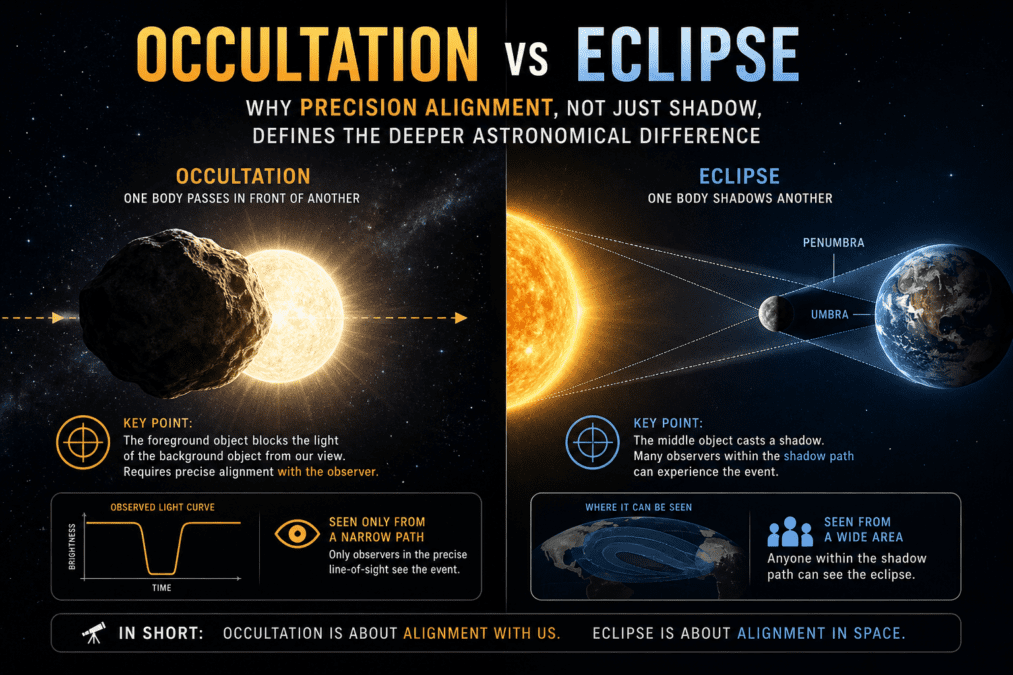
In observational astronomy, the terms occultation and eclipse are often used interchangeably in casual conversation, yet they represent distinct geometric phenomena with different scientific implications. An occultation occurs when one celestial body completely hides another from view, typically involving a smaller foreground object blocking a more distant one. In contrast, an eclipse involves the alignment of three bodies where one enters the shadow of another, most commonly seen in events like a Solar Eclipse.
This occultation vs ecclipse comparison is best understood through a framework of alignment geometry, observer dependence, and shadow dynamics. While both phenomena rely on precise positioning in space, their observational signatures and scientific utility differ significantly.
The key insight is this: occultations are about line-of-sight obstruction, while eclipses are about shadow projection across space. This distinction makes occultations more precise tools for measurement, while eclipses offer broader insights into celestial mechanics and atmospheric physics.
Essential Comparative Metrics
| Comparison Factor | Occultation | Eclipse |
|---|---|---|
| Definition | Occurs when one celestial body completely blocks another from the observer’s view | Occurs when one celestial body moves into the shadow of another |
| Core Mechanism | Line-of-sight obstruction | Shadow projection (umbra and penumbra) |
| Number of Bodies Involved | Usually 2 (foreground and background object) | Always 3 (light source, blocker, and target) |
| Role of Light | Light is directly blocked | Light is partially or fully shadowed |
| Alignment Precision | Extremely precise alignment required | High but less strict than occultation |
| Visibility Range | Very narrow, location-specific | Wide geographic visibility (especially partial eclipses) |
| Duration | Usually very short (seconds to minutes) | Can last from minutes to several hours |
| Common Examples | Moon occulting a distant star or planet | Solar eclipse, lunar eclipse |
| Scientific Applications | Measuring आकार, atmospheres, rings, and الدقيقة orbital data | Studying solar corona, Earth’s shadow, and orbital dynamics |
| Observation Difficulty | Harder; requires precise timing and instruments | Easier; often visible to the naked eye (with protection) |
| Frequency | More frequent but less noticeable | Less frequent but widely observed |
| Visual Impact | Subtle or invisible without उपकरण | Highly dramatic and visually striking |
| Dependence on Observer Position | Critical; small shifts change visibility | Important but covers larger regions |
Structural And Biological Foundations
From a structural standpoint, the occultation vs ecclipse distinction lies in spatial geometry rather than physical composition. Occultations occur when a foreground object—like the Moon—passes directly in front of a distant star, completely obscuring it. This is a pure line-of-sight event, requiring extremely precise angular alignment.
Eclipses, however, are fundamentally shadow-based phenomena. In a Lunar Eclipse, the Earth casts its shadow onto the Moon, while in a solar eclipse, the Moon’s shadow falls on Earth. This introduces the concept of umbra and penumbra—regions of total and partial shadow—which do not exist in occultations.
While occultations demand near-perfect alignment from the observer’s perspective, eclipses allow for broader visibility due to the spatial spread of shadows. This structural difference explains why eclipses are widely visible events, whereas occultations are often highly localized and fleeting.
Behavioral Patterns And Social Intelligence
Although celestial objects lack behavior in a biological sense, their observable patterns reveal predictable orbital dynamics. In the occultation vs ecclipse comparison, occultations are more frequent but less noticeable, often involving distant stars or planets being briefly obscured by the Moon.
Eclipses, on the other hand, follow longer cycles and are deeply embedded in human cultural and scientific observation. Events like total solar eclipses have been recorded for millennia, influencing calendars, mythology, and early astronomy.
While occultations provide high-frequency data points for astronomers, eclipses serve as rare but impactful events that allow for large-scale observation. This difference reflects a trade-off between data precision (occultation) and visual impact (eclipse).
Occultation vs Ecclipse: Strengths And Constraints (Occultation)
In the occultation vs ecclipse framework, occultations offer unmatched precision for scientific measurement. When a star is occulted by a ग्रह like the Moon, the exact timing of disappearance and reappearance allows astronomers to calculate angular diameters, detect atmospheres, and even discover rings around ग्रह like Uranus.
However, this precision comes with constraints. Occultations are highly location-dependent; a slight shift in observer position can mean the difference between visibility and complete absence. Additionally, they often involve faint objects, requiring advanced उपकरण for observation.
Another limitation is duration—occultations are typically brief, sometimes lasting only seconds. This makes them less accessible for public observation but invaluable for targeted scientific studies.
Occultation vs Ecclipse: Strengths And Constraints (Eclipse)
Eclipses, in contrast, are more accessible and visually dramatic. In the occultation vs ecclipse comparison, eclipses provide opportunities to study large-scale phenomena such as the solar corona during a Total Solar Eclipse.
magna carta psp vs ps2: A Platform Divide That Reshaped Tactical RPG Experience
Their broader visibility makes them ideal for public engagement and educational outreach. वैज्ञानिक communities often mobilize global observation campaigns during eclipses to gather diverse datasets.
However, eclipses are less precise for certain measurements. The presence of atmospheric distortion and shadow gradients introduces variability. Additionally, their rarity—especially total solar eclipses in a given location—limits their frequency as data sources.
Comparative Advantages In Real-World Scenarios
In practical astronomy, the occultation vs ecclipse distinction determines observational strategy. Occultations are preferred for high-resolution measurements, such as detecting thin atmospheres or refining orbital parameters of distant objects.
Eclipses, meanwhile, excel in macro-scale observation. For instance, studying the الشمس’s outer layers during an eclipse has led to discoveries about solar wind and magnetic fields.
While occultations are used in precision astrophysics, eclipses are often leveraged in both research and public science communication. This duality highlights their complementary roles rather than direct competition.
Scientific And Expert Consensus (2026)
Current consensus in astronomy emphasizes that the occultation vs ecclipse distinction is not merely semantic but foundational. Occultations are considered tools of precision, often used in cutting-edge research involving exoplanets and distant stars.
Eclipses, by contrast, are phenomenological events that provide insights into large-scale interactions between celestial bodies. المؤسسات like NASA and European Space Agency continue to use both phenomena in complementary ways.
The modern view is that occultations and eclipses represent two ends of an observational spectrum—one optimized for accuracy, the other for scope.
Final Synthesis And Verdict
The occultation vs ecclipse comparison ultimately reveals a deeper truth about astronomical observation: alignment alone is not enough—how light interacts with that alignment defines the phenomenon.
Occultations are defined by direct obstruction, offering unmatched precision but limited visibility. Eclipses, driven by shadow dynamics, provide broader observational opportunities at the cost of exactness.
Direct Answer (Featured Snippet Style):
An occultation occurs when one celestial object completely blocks another from view, while an eclipse happens when one object moves into the shadow of another. The key difference is that occultations involve direct line-of-sight obstruction, whereas eclipses depend on shadow projection and involve three bodies.
In scientific practice, both are indispensable. The choice between them depends not on superiority, but on the question being asked.
FAQ Section
1. Is every eclipse also an occultation?
Not exactly. While a solar eclipse involves the Moon blocking the Sun (which resembles an occultation), it is classified as an eclipse because shadow dynamics are central to the event.
2. Why are occultations harder to observe than eclipses?
Occultations require extremely precise alignment and are often visible only from narrow مناطق on Earth, whereas eclipses can be seen across large regions.
3. Can planets cause occultations?
Yes. Planets like Jupiter or Saturn can occult distant stars, and these events are used to study their atmospheres and ring systems.
4. Which is more useful for scientific research?
It depends on the الهدف. Occultations are better for precise measurements, while eclipses are ideal for studying large-scale interactions like solar activity.