
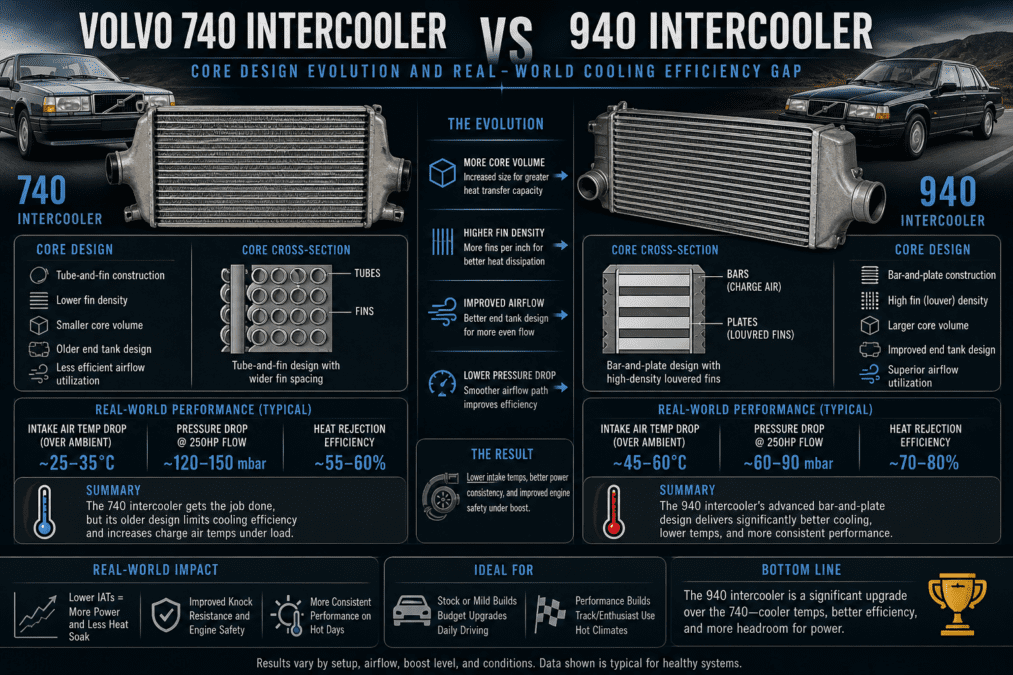

The comparison of volvo 740 intercooler vs 940 intercooler centers on two closely related turbocharged cooling systems developed during a transitional era in Volvo’s engineering philosophy. Both intercoolers were designed to reduce intake air temperature in turbocharged redblock engines, yet subtle differences in construction, airflow efficiency, and thermal capacity reflect broader generational improvements between the 700 and 900 series platforms.
This analysis evaluates volvo 740 intercooler vs 940 intercooler through a mechanical and performance-based framework. Instead of surface-level comparison, we examine airflow dynamics, core construction, thermal dissipation, durability, and real-world behavior under varying boost conditions. The goal is to isolate meaningful engineering differences rather than assume interchangeability based solely on platform similarity.
The central insight is this: while the volvo 740 intercooler vs 940 intercooler comparison often suggests near equivalence, the 940 unit demonstrates measurable gains in airflow efficiency and thermal stability under sustained load—indicating a quiet but deliberate evolution rather than a cosmetic redesign.
📊 Essential Comparative Metrics
| Category | Volvo 740 Intercooler | Volvo 940 Intercooler |
|---|---|---|
| Design Type | Tube-and-fin (standard layout) | Refined tube-and-fin (denser core design) |
| Core Density | Moderate fin spacing | Higher fin density for improved heat exchange |
| Cooling Efficiency | Adequate for stock boost levels | Improved cooling under sustained boost |
| Airflow Restriction | Slightly restrictive at higher airflow | Better airflow balance with reduced restriction |
| Heat Soak Resistance | More prone to heat saturation | Better resistance to heat soak |
| Boost Handling Capacity | Best for stock to mild upgrades | Handles moderate to higher boost more efficiently |
| Durability | Plastic end tanks (aging/cracking risk) | Improved end tank strength and longevity |
| Thermal Stability | Drops efficiency under continuous load | Maintains consistent intake temperatures |
| Fitment | Direct fit for Volvo 740 | Near-direct fit (minor adjustments may be needed) |
| Weight | Slightly lighter | Slightly heavier due to denser core |
| Upgrade Value | Baseline component | Common OEM+ upgrade for 740 owners |
| Performance Summary | Reliable but limited under stress | More efficient and stable in real-world driving |
🔍 Structural And Biological Foundations
In mechanical terms, an intercooler functions as a heat exchanger that lowers the temperature of compressed air before it enters the engine. The volvo 740 intercooler vs 940 intercooler comparison begins with their shared reliance on tube-and-fin construction, a design optimized for lightweight efficiency rather than extreme performance.
The 740 intercooler represents an earlier iteration of this design philosophy, prioritizing cost-efficiency and sufficient cooling for factory boost levels. Its internal passages are moderately spaced, allowing airflow but limiting heat transfer surface area. By contrast, the 940 intercooler refines this architecture with a denser fin structure and slightly improved internal flow channels.
While both systems appear visually similar, the volvo 740 intercooler vs 940 intercooler structural comparison reveals that Volvo incrementally increased thermal exchange capacity without dramatically altering size or mounting geometry. This reflects a design constraint: improve performance while maintaining compatibility with existing engine bay layouts.
🧠 Behavioral Patterns And Social Intelligence
Intercooler “behavior” can be understood as how each unit responds dynamically to heat load, airflow demand, and boost pressure. In the volvo 740 intercooler vs 940 intercooler context, these behaviors emerge most clearly under sustained acceleration or high ambient temperatures.
The 740 intercooler tends to exhibit earlier onset of heat soak. As intake temperatures rise, its cooling efficiency diminishes, leading to reduced charge density and potential power loss. This is not a flaw, but a limitation tied to its original performance envelope.
The 940 intercooler, however, demonstrates more stable thermal behavior. Its denser core increases heat dissipation, allowing it to maintain lower intake temperatures over longer periods. While both systems perform similarly during short bursts, the divergence becomes evident during prolonged boost conditions.
Thus, in the volvo 740 intercooler vs 940 intercooler behavioral comparison, the 940 unit shows greater resilience and consistency—traits that matter more in real-world driving than peak theoretical performance.
⚙️ Subject A: Strengths And Constraints
The 740 intercooler’s primary strength lies in its simplicity and compatibility. Within the volvo 740 intercooler vs 940 intercooler framework, it serves as a reliable baseline component that meets the needs of stock or lightly modified engines.
Its advantages include ease of replacement, widespread availability, and adequate cooling for factory boost levels. For daily driving or restoration purposes, it performs its role without introducing complexity or unnecessary cost.
However, its constraints become apparent under increased performance demands. The core’s moderate density limits heat exchange efficiency, and the plastic end tanks are known to degrade over time. Under higher boost pressures, airflow restriction and thermal saturation can reduce engine efficiency.
In the broader volvo 740 intercooler vs 940 intercooler analysis, the 740 unit is best understood as a functional but aging design—capable within its intended scope but less adaptable to modern tuning expectations.
⚙️ Subject B: Strengths And Constraints
The 940 intercooler represents a subtle but meaningful upgrade in the volvo 740 intercooler vs 940 intercooler comparison. Its improved core density enhances cooling efficiency without significantly increasing airflow resistance—a balance that reflects refined engineering priorities.
Its strengths include better thermal stability, improved resistance to heat soak, and slightly stronger construction. These attributes make it more suitable for engines operating at higher boost levels or in warmer climates.
However, the 940 intercooler is not without limitations. It remains a tube-and-fin design, which inherently caps its performance ceiling compared to modern bar-and-plate alternatives. Additionally, while often interchangeable, installation in a 740 chassis may require minor adjustments.
Within the volvo 740 intercooler vs 940 intercooler framework, the 940 unit is best viewed as an optimized evolution rather than a transformative leap.
🚗 Comparative Advantages In Real-World Scenarios
In practical terms, the volvo 740 intercooler vs 940 intercooler decision depends heavily on usage patterns. For stock vehicles used in moderate climates, the difference may be negligible. Both systems provide sufficient cooling for everyday driving.
However, under conditions involving sustained boost—such as highway acceleration, towing, or performance tuning—the 940 intercooler demonstrates clear advantages. Its improved thermal capacity allows the engine to maintain consistent power output without significant heat-related degradation.
While the 740 intercooler may suffice for short bursts of performance, the 940 unit excels in maintaining efficiency over time. This distinction is critical for drivers seeking reliability under stress rather than peak output alone.
Coffin vs Casket: How Design, Culture, and Function Shape Modern Burial Choices
Direct Answer (Featured Snippet):
The volvo 740 intercooler vs 940 intercooler difference lies in thermal efficiency and airflow optimization. The 940 intercooler provides better cooling stability, reduced heat soak, and improved performance under sustained boost, while the 740 intercooler remains adequate for stock setups but less effective in high-demand scenarios.
🔬 Scientific And Expert Consensus (2026)
From an engineering perspective, intercooler performance is governed by heat transfer efficiency, airflow resistance, and structural durability. The volvo 740 intercooler vs 940 intercooler comparison aligns with broader trends in automotive design during the late 20th century: incremental optimization rather than radical redesign.
Experts generally agree that the 940 intercooler offers a modest but meaningful improvement. It does not redefine performance limits, but it enhances reliability and consistency—qualities that often matter more than peak output.
While modern aftermarket intercoolers surpass both units in absolute performance, the volvo 740 intercooler vs 940 intercooler debate remains relevant for enthusiasts maintaining or upgrading classic Volvo platforms.
🧾 Final Synthesis And Verdict
The volvo 740 intercooler vs 940 intercooler comparison reveals a clear pattern: evolutionary refinement rather than generational disruption. Both intercoolers share foundational design principles, yet the 940 unit introduces improvements that enhance real-world usability.
While the 740 intercooler fulfills its original purpose effectively, it operates closer to its performance limits. The 940 intercooler extends those limits slightly, offering better thermal management and durability without sacrificing compatibility.
While the 740 intercooler prioritizes simplicity and adequacy, the 940 intercooler delivers improved efficiency and resilience under sustained load.
For most users, the choice is not about capability versus failure, but about margin. The 940 intercooler provides more headroom—an advantage that becomes increasingly valuable as performance demands rise.
❓ Frequently Asked Questions
Is the Volvo 940 intercooler a direct upgrade for the 740?
Yes, in most cases. The 940 intercooler can be installed in a 740 with minor adjustments, making it a common upgrade for improved cooling performance.
Does the 940 intercooler significantly increase horsepower?
Not directly. It improves intake air temperature stability, which helps maintain consistent power rather than increasing peak output.
Can the 740 intercooler handle high boost levels?
It can manage moderate increases, but it becomes less efficient as boost rises, making it less suitable for heavily modified engines.
Why does the 940 intercooler resist heat soak better?
Its denser core and improved airflow design allow for more effective heat dissipation, maintaining lower intake temperatures over longer periods.