
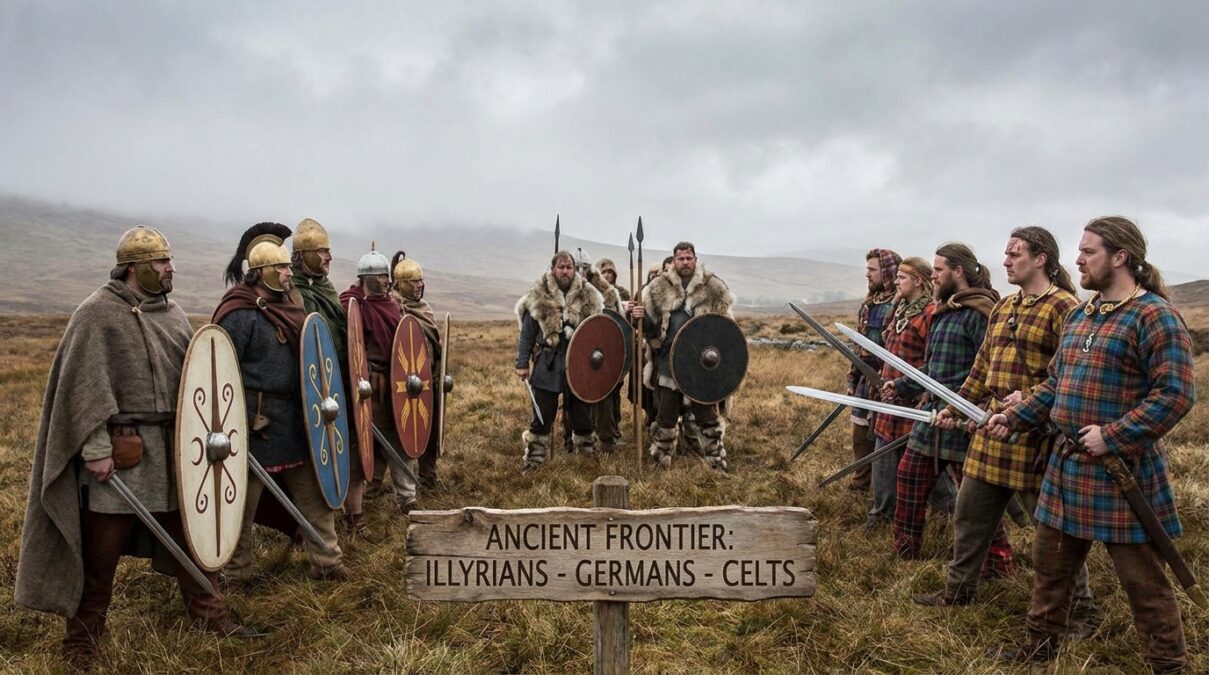

The comparison of ancient Illyrians vs Germans vs Celts brings together three influential Indo-European cultural spheres that shaped large portions of prehistoric and early historic Europe. Though often grouped loosely as “barbarian” societies in classical sources, these populations developed distinct identities, political systems, and adaptive strategies that continue to influence European cultural memory.
This analysis approaches ancient Illyrians vs Germans vs Celts through a multidisciplinary framework—combining archaeology, linguistics, classical historiography, and modern anthropological insights. Instead of relying on outdated stereotypes, the comparison emphasizes structural organization, environmental adaptation, and behavioral intelligence as key variables.
The central thesis is that while the ancient Illyrians vs Germans vs Celts shared broad Indo-European roots, their divergence in geography and social evolution produced fundamentally different survival strategies: Illyrians as fragmented maritime-tribal networks, Celts as expansive cultural integrators, and Germans as decentralized but highly adaptive frontier societies.
Essential Comparative Metrics
| Category | Ancient Illyrians | Ancient Germans | Ancient Celts |
|---|---|---|---|
| Geographic Region | Balkans (Adriatic & mountainous zones) | Central & Northern Europe (forests, rivers) | Western & Central Europe (plains & river valleys) |
| Social Structure | Fragmented tribal clans | Loose tribal confederations | Hierarchical chiefdoms with elites |
| Political Organization | Decentralized, local leadership | Temporary war-leader systems | Regional kingdoms & proto-states |
| Economy | Pastoralism, raiding, coastal trade | Agriculture, hunting, livestock | Agriculture, mining, metallurgy trade |
| Military Style | Guerrilla warfare, ambush tactics | Infantry-based, mobile warfare | Elite warrior class, chariots (early) |
| Expansion Pattern | Localized survival, limited expansion | Migratory expansion over time | Large-scale cultural diffusion |
| Cultural Strength | Terrain adaptation & resilience | Flexibility & survival mobility | Art, metallurgy, and cultural spread |
| Weakness | Lack of unity | Weak long-term institutions | Internal rivalries, political fragmentation |
Structural And Biological Foundations
The ancient Illyrians vs Germans vs Celts comparison begins with their shared Indo-European ancestry but diverging environmental pressures. Biologically, these populations were not radically distinct; skeletal and genetic evidence suggests overlapping European ancestry with regional variations rather than clear racial divides.
However, structure—not biology—defined their trajectories. Illyrians occupied mountainous Balkan terrain, encouraging fragmentation into smaller tribes. This geography limited large-scale political unity but fostered resilience and defensive adaptability. Germans, by contrast, lived in forested plains and river systems, which encouraged mobility and periodic migration patterns. Their environment rewarded flexibility rather than centralized control.
Celts emerged in resource-rich regions of Central Europe, particularly around the Hallstatt and La Tène cultural zones. This allowed for early metallurgical specialization, surplus production, and eventually cultural expansion. Unlike Illyrians or Germans, Celts developed proto-urban centers and long-distance trade networks.
In the context of ancient Illyrians vs Germans vs Celts, structural conditions—not inherent capability—determined how each group evolved politically and economically.
Behavioral Patterns And Social Intelligence
A defining distinction in ancient Illyrians vs Germans vs Celts lies in their social organization and behavioral strategies. Social intelligence here refers to how effectively a society coordinates internally and interacts externally.
Illyrian societies were highly localized and kinship-based. Loyalty to tribe outweighed broader identity, limiting large-scale coordination but strengthening internal cohesion. This made them difficult to conquer fully, as resistance persisted even after nominal defeat.
Germanic tribes exhibited a balance between autonomy and temporary unity. Leadership was often situational—war leaders emerged during conflict but did not necessarily hold permanent authority. This flexible hierarchy enabled rapid adaptation, especially during migration periods.
Celtic societies demonstrated a higher degree of social stratification, including warrior elites, druids, and artisans. Their use of symbolic systems, oral traditions, and religious structures allowed for cultural continuity across vast territories.
While Illyrians prioritized survival within terrain, Germans optimized adaptability, and Celts excelled at cultural transmission. This contrast is central to understanding ancient Illyrians vs Germans vs Celts as a spectrum of social intelligence models.
Valedictorian vs Salutatorian: Why Academic Rank Alone Fails to Predict Long-Term Achievement
Ancient Illyrians: Strengths And Constraints
Within the ancient Illyrians vs Germans vs Celts framework, Illyrians stand out for their environmental resilience and decentralized defense strategies. Their mountainous homeland fostered a form of warfare that relied heavily on ambush, mobility, and knowledge of terrain.
One of their key strengths was adaptability to harsh conditions. Illyrian tribes could survive with limited resources and maintain independence longer than more centralized societies. Their maritime activity, often labeled piracy by Greek and Roman writers, was in fact a strategic extension of their economic system.
However, fragmentation was a critical constraint. The absence of a unified political structure meant that Illyrians struggled to mount coordinated resistance against large empires like Rome. Individual tribes could be subdued or co-opted without collapsing the entire cultural system, but this also prevented large-scale political evolution.
In the ancient Illyrians vs Germans vs Celts comparison, Illyrians represent a model of defensive endurance rather than expansive growth.
Ancient Germans: Strengths And Constraints
Germanic societies occupy a middle ground in the ancient Illyrians vs Germans vs Celts comparison, combining adaptability with a capacity for expansion. Their strength lay in their ability to reorganize under pressure, particularly during periods of migration.
Germanic warfare emphasized infantry cohesion, shield formations, and psychological warfare. Leaders gained authority through merit rather than hereditary status alone, which encouraged competence but limited long-term political stability.
A major strength was demographic mobility. Germanic tribes could relocate, merge, or split depending on environmental and political pressures. This adaptability later contributed to the transformation of the Roman world during the Migration Period.
The primary constraint, however, was the lack of institutional continuity. Without strong centralized governance, long-term planning and infrastructure development remained limited.
In the context of ancient Illyrians vs Germans vs Celts, Germans demonstrate how decentralized systems can still achieve large-scale historical impact through flexibility and persistence.
Ancient Celts: Strengths And Constraints
The Celts, in the ancient Illyrians vs Germans vs Celts comparison, were the most culturally expansive and structurally complex. Their societies supported specialized roles, including religious leaders (druids), craftsmen, and warrior elites.
One of their greatest strengths was cultural integration. Celtic identity spread across vast regions not through centralized empire but through shared language, art, and social practices. This created a flexible but recognizable cultural network.
Their metallurgical expertise also gave them a technological edge in weaponry and trade. Celtic goods were widely distributed, indicating sophisticated economic systems.
However, this same decentralization limited political unity. Like the Germans and Illyrians, Celts struggled to form lasting centralized states capable of resisting Roman expansion. Internal rivalries further weakened their position.
In ancient Illyrians vs Germans vs Celts, the Celts exemplify cultural influence without sustained political consolidation.
Comparative Advantages In Real-World Scenarios
When analyzing ancient Illyrians vs Germans vs Celts, it becomes clear that each group excelled under different conditions.
In mountainous defensive warfare, Illyrians held a clear advantage due to terrain familiarity and guerrilla tactics. Against conventional armies, their resistance could be prolonged and costly.
In migratory or expansion scenarios, Germanic tribes were more effective. Their flexible leadership and social structures allowed them to adapt quickly to new environments and pressures.
In trade, cultural diffusion, and technological development, Celts were dominant. Their ability to integrate diverse communities under shared cultural frameworks gave them a broader influence across Europe.
While Illyrians prioritized survival, Germans optimized movement, and Celts maximized cultural spread, the ancient Illyrians vs Germans vs Celts comparison reveals no single “superior” model—only different evolutionary strategies.
Direct answer (featured snippet style):
The key difference in ancient Illyrians vs Germans vs Celts lies in their adaptive strategies: Illyrians specialized in localized resistance, Germans in flexible migration and warfare, and Celts in cultural expansion and technological development, making each dominant in different historical and environmental contexts.
Scientific And Expert Consensus (2026)
Modern scholarship has significantly revised earlier interpretations of ancient Illyrians vs Germans vs Celts. Classical sources often portrayed these groups through a Roman or Greek lens, emphasizing “barbarism” over complexity.
Current research highlights that these societies were not primitive but differently organized. Archaeological findings show advanced craftsmanship, trade networks, and social structures across all three groups.
Genetic studies indicate overlapping ancestries, challenging older racial categorizations. Linguistic research further supports the idea of shared Indo-European roots with regional divergence.
Experts now agree that the ancient Illyrians vs Germans vs Celts comparison should focus on adaptation rather than hierarchy. Each group represents a successful response to specific environmental and historical pressures.
Final Synthesis And Verdict
The comparison of ancient Illyrians vs Germans vs Celts ultimately reveals three distinct pathways of human organization. Illyrians mastered survival in fragmented, rugged landscapes. Germans developed systems of mobility and adaptation that would later reshape Europe. Celts created expansive cultural networks that influenced art, language, and identity across regions.
While Illyrians remained localized, Germans transformed through migration, and Celts spread through cultural integration. These differences underscore a broader truth: human success is not defined by uniformity but by the ability to adapt to context.
In the final analysis, the ancient Illyrians vs Germans vs Celts are not competitors in a linear hierarchy but complementary examples of how societies evolve under different pressures. Their legacies persist not because one dominated the others, but because each contributed uniquely to the formation of European civilization.
FAQ
What is the main difference between ancient Illyrians vs Germans vs Celts?
The main difference lies in their adaptation strategies. Illyrians focused on localized survival, Germans on mobility and flexibility, while Celts emphasized cultural expansion and technological development.
Were Celts more advanced than Germans or Illyrians?
Not necessarily. While Celts had more visible technological and cultural outputs, Germans and Illyrians were equally sophisticated in areas like warfare and environmental adaptation.
Did these groups interact with each other?
Yes, especially in Central Europe where Celtic and Germanic territories overlapped. Interactions included trade, conflict, and cultural exchange.
Why did none of them form lasting empires like Rome?
Their decentralized structures, while advantageous for flexibility, limited their ability to sustain large-scale political systems. This is a key insight in the ancient Illyrians vs Germans vs Celts comparison.