

Opening
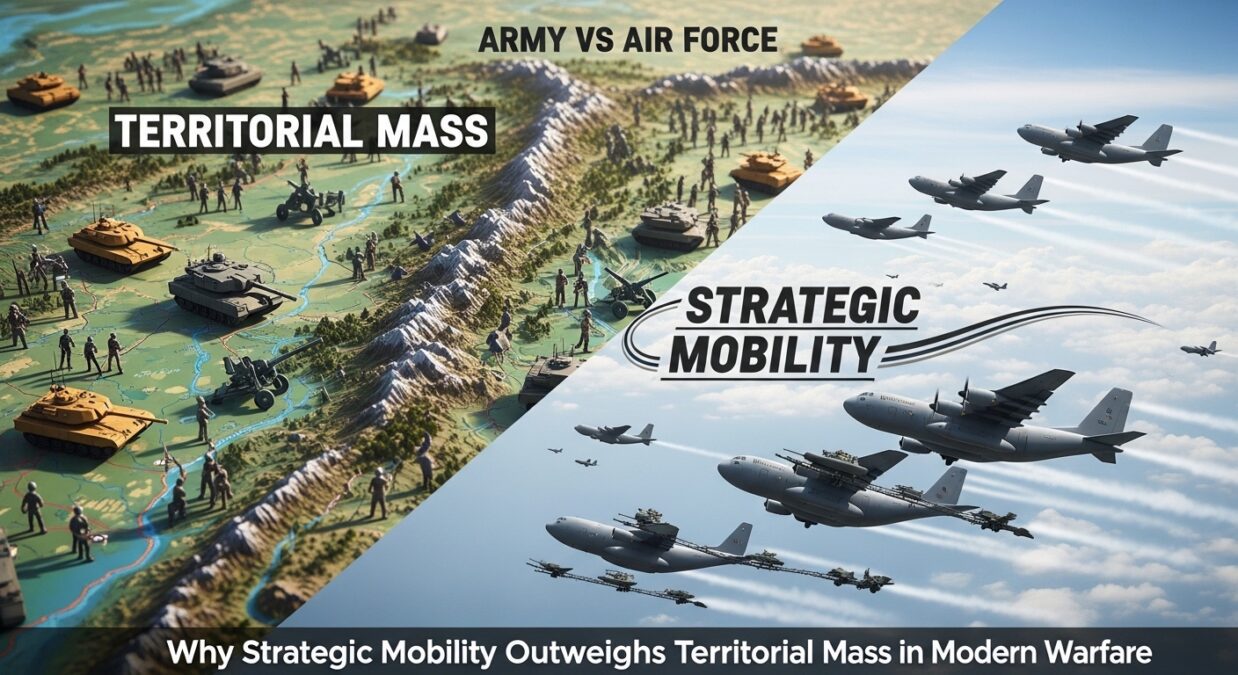
The army vs air force dynamic represents one of the most consequential institutional relationships in national defense. Armies have historically served as the primary instrument of territorial control, relying on massed ground forces, artillery, and infantry maneuvering to seize and hold physical space. Air forces, by contrast, emerged in the twentieth century as a fundamentally different expression of military power—one that prioritizes speed, vertical reach, and the ability to strike anywhere within a theater within hours. Understanding the army vs air force competition requires moving beyond service branch rivalries to examine how each domain translates physical assets into strategic outcomes.
The comparison framework used here evaluates both branches across seven discrete dimensions: structural biology (force composition and logistics), behavioral patterns (doctrine and operational culture), intelligence architectures, sustainability timelines, strategic flexibility, technological adaptability, and political utility in crisis scenarios. Unlike traditional army vs air force assessments that default to budget comparisons or personnel counts, this analysis emphasizes functional trade-offs—specifically, the inverse relationship between territorial staying power and response velocity. Each service excels at fundamentally different tasks, and modern joint warfare increasingly demands hybridization of both capabilities.
The central insight driving this army vs air force comparison is that air power has become the decisive arm for force projection in the 2020s, but armies retain irreplaceable utility for conflict termination. Precision strike capabilities have eroded the historical advantage of massed ground formations, yet no air force has ever independently achieved strategic victory against a peer adversary without ground forces to consolidate gains. This army vs air force paradox—that air power dominates the high-intensity fight but cannot finish it—explains why nations continue investing heavily in both domains despite apparent redundancy. The most effective militaries no longer ask army vs air force as an either-or proposition but rather as a question of optimal integration.
Comparative Metrics Overview
| Metric | Army | Air Force |
|---|---|---|
| Global response time (hours) | 72–120 (heavy forces) | 12–24 (fighter/ bomber wings) |
| Sustained operational tempo | 6–18 months | 30–90 days (high-intensity) |
| Territorial control capacity | High (permanent occupation) | Low (transient air superiority) |
| Personnel cost per combat effect | Moderate ($200k–$400k per soldier-year) | High ($1M–$3M per pilot-year) |
| Weather operational impact | Low (ground maneuvering resilient) | High (visibility/icing constraints) |
| Technological refresh cycle | 15–20 years (ground vehicles) | 5–10 years (airframes/sensors) |
| Vulnerability to asymmetric tactics | High (IEDs, ambushes, drones) | Moderate (MANPADS, ground fire near fields) |
| Humanitarian utility | High (occupation, stabilization, disaster response) | Low (limited to airlift/medical evacuation) |
Structural And Biological Foundations
The material differences between army and air force structures begin with what each service must physically overcome. Armies fight against terrain, fortified positions, and enemy ground forces while simultaneously protecting supply lines spanning hundreds of kilometers. This reality forces armies into hierarchical, redundantly supplied formations where mass provides resilience. A typical army division requires approximately 300–500 tons of supplies daily—fuel, ammunition, food, water, and replacement equipment. The logistical tail of a mechanized army vs air force comparison reveals that ground forces dedicate roughly 60% of their personnel to sustainment rather than direct combat roles. This structural weight enables indefinite territorial occupation but severely constrains strategic mobility.
Air forces operate against a different constraint set: gravity and time. Every kilogram lifted into combat requires fuel, and every hour of flight generates maintenance cycles measured in technician-hours per flight hour. A single F-35 combat sortie demands approximately 10–15 maintenance hours and consumes 8,000–12,000 pounds of fuel. The army vs air force structural comparison shows air power achieving unmatched speed at the cost of extreme operational fragility. Forward air bases require runway length, fuel storage, munitions bunkers, and air traffic control—infrastructure that can be neutralized by a half-dozen ballistic missiles. Armies can disperse into forests and urban areas; air forces cannot.
The personnel systems reflect these structural differences. Army career progression emphasizes command of progressively larger units, with senior leaders having managed thousands of soldiers in complex ground operations. Air force careers prioritize technical specialization, with senior leaders typically having flown 2,000–3,000 hours in specific aircraft types. This army vs air force cultural divide—generalists versus specialists—profoundly affects how each service approaches problem-solving. Armies favor decentralized initiative and adaptability to local conditions; air forces prefer centralized planning and standardized execution to minimize midair collisions and maximize bombing accuracy.
Behavioral Patterns And Social Intelligence
Doctrinal evolution in the army vs air force context reveals divergent approaches to risk and uncertainty. Army doctrine, shaped by centuries of ground combat, emphasizes mission command—the principle of communicating intent and leaving subordinates discretion to execute. This emerged from the reality that ground combat degrades communications, obscures visibility, and requires instant local decisions. An army platoon leader facing an ambush cannot request permission to maneuver; they must act immediately based on commander’s intent learned hours earlier. The army vs air force behavioral comparison shows armies training extensively for decentralized violence, trusting junior leaders with lethal authority.
Air force doctrine developed differently. Early aerial combat demonstrated that disorganized dogfights produced friendly fire and wasted ammunition, leading to highly centralized control systems. Modern air operations rely on AWACS (airborne warning and control system) directing every fighter intercept, tanker rendezvous, and bombing run. An army vs air force examination of operational command reveals air forces maintaining tight control because the margin for error is measured in seconds rather than meters. Two fighters merging at 1,200 miles per hour cannot negotiate engagement rules; they require unambiguous pre-briefed guidance. This produces air force cultures valuing procedural compliance and technical precision over the decentralized adaptability prized by armies.
Social intelligence patterns diverge significantly. Army units operating in counterinsurgency environments develop sophisticated cultural intelligence—reading local power structures, distinguishing combatants from civilians, and negotiating with village elders. The army vs air force comparison in irregular warfare shows ground forces spending months embedded in local populations, learning language patterns and social hierarchies. Air forces, by contrast, interact with populations only through ordnance delivery or humanitarian airdrops, limiting their ability to distinguish threat nuance. This has driven air force investments in intelligence-surveillance-reconnaissance (ISR) platforms to compensate, but overhead observation cannot replicate ground-level social awareness.
Polo Assn vs Polo Ralph Lauren: Why Two Polo-Shaped Logos Created a $2 Billion Brand Identity Divide
Army: Strengths And Constraints
The army’s fundamental strength in any army vs air force analysis is staying power. Ground forces occupy terrain, protect populations, and impose political outcomes through physical presence. An army battalion stationed in a contested city prevents insurgent infiltration in ways that air strikes cannot achieve—the deterrent effect of visible, persistent force. Armies also excel at absorbing punishment while maintaining combat effectiveness. Historical data shows army units retain 70-80% fighting capacity after sustaining 10-15% casualties, whereas air force squadrons become operationally ineffective after losing 20% of aircraft due to degraded mission planning and maintenance capacity. This resilience makes armies uniquely suited for protracted conflicts.
The constraints are equally significant. Strategic mobility remains the army’s persistent weakness—moving a heavy brigade combat team from continental United States to Europe requires 30–45 days and dozens of cargo ships or strategic airlift sorties. The army vs air force comparison of deployment timelines shows air forces achieving global presence in days rather than weeks. Additionally, armies face catastrophic vulnerability to precision standoff weapons. A single ballistic missile carrying submunitions can destroy an army battalion in assembly areas, whereas air force assets disperse across hardened shelters and multiple airfields. The rise of loitering munitions and attack drones has further degraded the army’s traditional advantage in close combat, as Ukrainian and Nagorno-Karabakh conflicts demonstrate—armored formations now require extensive air defense coverage even in rear areas.
Personnel costs present another constraint. The army must maintain large standing forces because training infantry, armor crews, and artillerymen to combat readiness requires 12–18 months. The army vs air force personnel calculus favors air forces in peacetime, where smaller numbers of pilots can maintain proficiency through regular sorties. Armies cannot easily surge capability—they either maintain forces or accept months of reconstitution time. This has driven many nations toward smaller professional armies rather than mass conscription forces, but even professional armies face irreducible minimum sizes for territorial defense.
Air Force: Strengths And Constraints
The air force’s preeminent advantage in any army vs air force comparison is speed and reach. Within 24 hours of order issuance, air force fighter wings can conduct strike operations anywhere within 2,000 nautical miles of their bases. This velocity creates strategic options unavailable to ground forces: preemptive strikes against emerging threats, suppression of enemy air defenses to enable follow-on operations, and rapid reinforcement of allied airspace. The army vs air force time-to-target gap—hours versus days—explains why nations facing sudden crises request air power before ground troops. Air forces also dominate the high-altitude battlespace, controlling satellite navigation and communications, ballistic missile defense, and strategic reconnaissance.
Precision strike technology has transformed air force capabilities. Modern air-delivered munitions achieve circular error probable (CEP) of 3–5 meters, enabling one aircraft to destroy targets that previously required hundreds of artillery shells or a battalion-level ground assault. The army vs air force exchange ratio increasingly favors air forces for point targets: a single F-35 sortie costing $70,000 can destroy a command bunker that would require a $3 million ground operation with potential casualties. This efficiency has driven doctrinal shifts toward air-centric campaign designs that minimize ground force exposure.
However, constraints remain severe. Air forces cannot hold territory—a limitation that becomes decisive in the army vs air force comparison for conflict termination. After air power destroys enemy conventional forces, someone must walk through the rubble, verify compliance, and prevent re-emergence. Air forces also suffer from poor attrition tolerance. A single surface-to-air missile kill costs $100 million and a pilot with 1,000 hours of training. Armies losing a $4 million tank can replace the crew in months; air forces losing a pilot requires a decade to recover equivalent experience. Weather vulnerability further limits air power utility—extended low cloud ceilings or crosswinds exceeding 25 knots can ground entire air wings, while armies maneuver regardless.
Comparative Advantages In Real-World Scenarios
Examining army vs air force performance across actual operational contexts clarifies their respective domains of dominance. In permissive environments (no air defenses, minimal anti-access threats), air forces provide overwhelming advantage for interdiction and close air support. The Kosovo War (1999) demonstrated air-only campaigns degrading enemy forces to the point of withdrawal—though critics note Serbian forces withdrew with equipment largely intact. For punitive strikes against state sponsors of terrorism, the army vs air force calculus favors air power exclusively: nations can launch cruise missile strikes or bomber raids without risking ground force casualties or triggering escalation to land invasion.
In denied environments (integrated air defenses, electronic warfare, peer competitors), the army vs air force balance shifts significantly toward armies. Air forces cannot operate effectively without suppression of enemy air defenses (SEAD), a mission requiring days or weeks of preparatory strikes against radar sites and surface-to-air missile batteries. During this suppression phase, ground forces can advance under air defense cover, seizing territory while air forces degrade defensive networks. The Ukraine conflict illustrates this interdependence: neither air force achieved lasting superiority, but both armies fought across hundreds of kilometers without decisive air support. The army vs air force lesson from peer conflict is that air superiority cannot be assumed—armies must fight under contested skies.
Counterinsurgency operations reveal the army vs air force civilian protection paradox. Air strikes inflict fewer friendly casualties than ground patrols but generate greater civilian harm ratios due to target identification challenges. Studies from Afghanistan (2008–2014) found air strikes were 3–5 times more likely than ground operations to produce non-combatant casualties per engagement. Armies conducting cordon-and-search operations kill fewer civilians but lose soldiers to ambushes and IEDs. The ethical army vs air force comparison shows no clean solution—each approach externalizes harm differently. Humanitarian disasters present the clearest army advantage: only ground forces can distribute aid, restore order, and prevent looting at scale. Air drops provide emergency relief but cannot secure distribution points against armed groups.
Scientific And Expert Consensus (2026)
Current defense analysis literature has reached several evidence-based conclusions about the army vs air force relationship. First, the threshold for air power achieving strategic effects without army follow-on forces is limited to adversaries with weak governance structures—Serbia in 1999, Libya in 2011—but fails against organized states capable of decentralizing command. RAND Corporation studies (2024–2025) analyzing 67 air campaigns since 1990 found only 22% achieved political objectives without significant ground force deployment, and those successes required permissive environments with nearby basing access. The army vs air force effectiveness gap widens when targets are mobile, concealed, or integrated with civilian infrastructure.
Second, unmanned systems are altering the army vs air force cost calculus but not replacing either domain. Drone swarms provide army units with organic precision strike, while long-endurance drones extend air force persistence. However, expert consensus rejects “drone-only” force structures because drone communication links remain vulnerable to electronic warfare, and autonomous targeting raises escalation risks. The Center for Strategic and Budgetary Assessments (2025) found that peer adversaries can degrade 60-70% of drone effectiveness through GPS jamming, spoofing, and cyber intrusion—reliability levels insufficient for decisive operations.
Third, the army vs air force budget debate has resolved toward balanced investment with regional variation. The United States maintains rough parity ($186 billion army vs $218 billion air force in FY2026), while China prioritizes air force growth ($97 billion vs $124 billion army) to challenge Western Pacific access, and European NATO members emphasize army modernization for territorial defense against Russian ground forces. Academic literature increasingly frames army vs air force not as a competition but as a joint optimization problem—asking how to allocate resources to achieve specific campaign effects rather than defending service budgets.
Final Synthesis And Verdict
The army vs air force comparison reveals complementary rather than competing instruments of national power. Air forces provide strategic mobility, precision strike, and battlespace awareness—capabilities that shape initial conflict phases and enable rapid response. Armies provide persistence, population security, and territorial control—capabilities that consolidate victory and prevent re-emergence of enemy forces. The most effective military organizations have abandoned army vs air force rivalry in favor of integrated planning, joint training rotations, and cross-domain command structures.
For defense planners, the army vs air force resource allocation question depends on strategic context. Nations facing immediate existential threats from neighboring ground forces require robust armies capable of territorial defense regardless of air superiority status. Nations with expeditionary ambitions and geographic distance from likely adversaries require air force dominance to project power across oceans. Small nations with limited budgets face the most difficult army vs air force trade-off: armies are cheaper to maintain but less useful for deterrence against distant threats; air forces provide flexible response but hollow out quickly without sustained investment.
The verdict across seven comparison metrics is contextual but clear: air forces have gained relative importance since 1990 due to precision weapons and reduced tolerance for ground force casualties, but armies remain indispensable for all conflicts requiring political resolution beyond simple punishment. A nation with only an air force can bomb an adversary into compliance only if the adversary’s population forces regime change—an uncertain causal chain. A nation with only an army cannot defeat an adversary with modern precision strike capabilities before suffering prohibitive losses approaching the battlefield. The optimal army vs air force balance appears to be roughly 40:60 army-to-air force spending for expeditionary powers and 60:40 for territorial defense forces, acknowledging that no single ratio fits all circumstances.
Frequently Asked Questions
Why does the army vs air force debate persist despite joint doctrine requiring both services?
The army vs air force debate persists primarily due to budget competition and cultural identity. Defense budgets are zero-sum at the margin—funding allocated to one service cannot be spent on the other. Service leaders naturally advocate for their branch’s primacy, and institutions develop origin stories emphasizing their unique value. Additionally, the army vs air force competition reflects genuine uncertainty about future warfare character: no analyst knows whether the next major conflict will resemble Ukraine (ground-intensive) or Kosovo (air-intensive). Until strategic clarity emerges, the debate continues.
Which branch offers better career stability and transferable civilian skills?
Air force careers typically produce more transferable technical skills (aviation maintenance, air traffic control, cyber operations, intelligence analysis) directly applicable to civilian aerospace and defense industries. Army careers produce leadership and logistics expertise valued in corporate operations, manufacturing, and government service. The army vs air force career comparison shows air force personnel having higher average civilian earnings post-service, but army veterans report higher job satisfaction from mission clarity and team cohesion. Both branches offer excellent stability, but the army vs air force retention gap (air force retains trained personnel at 8-10% higher rates) suggests service members perceive better conditions in air force roles.
How has drone technology changed the army vs air force balance?
Drone proliferation has paradoxically strengthened both services’ relevance while changing their operational roles. Small tactical drones give army units organic reconnaissance and precision strike previously requiring air force support, reducing army reliance on close air support. Long-endurance drones give air forces persistent surveillance that partially substitutes for ground patrols in permissive environments. The army vs air force drone dynamic has not replaced either service but has shifted their comparative advantages—armies now require counter-drone systems for survivability, while air forces require drone integration to maintain operational tempo against integrated air defenses.
What does the army vs air force comparison look like for smaller countries with limited budgets?
For countries with defense budgets under $5 billion annually, the army vs air force trade-off strongly favors armies with supplementary air defense systems rather than conventional air forces. Maintaining a single fighter squadron costs approximately $150–200 million annually (aircraft maintenance, pilot training, fuel, munitions, airfield infrastructure), which could instead field three mechanized brigades. The army vs air force analysis for small nations recommends investing in mobile surface-to-air missile systems (which provide territorial air defense without air force vulnerability) and army aviation (helicopters) rather than fixed-wing combat aircraft. Singapore and Finland exemplify this hybrid army vs air force model—capable ground forces with integrated air defense, supported by small, high-quality air components for specialized missions.