
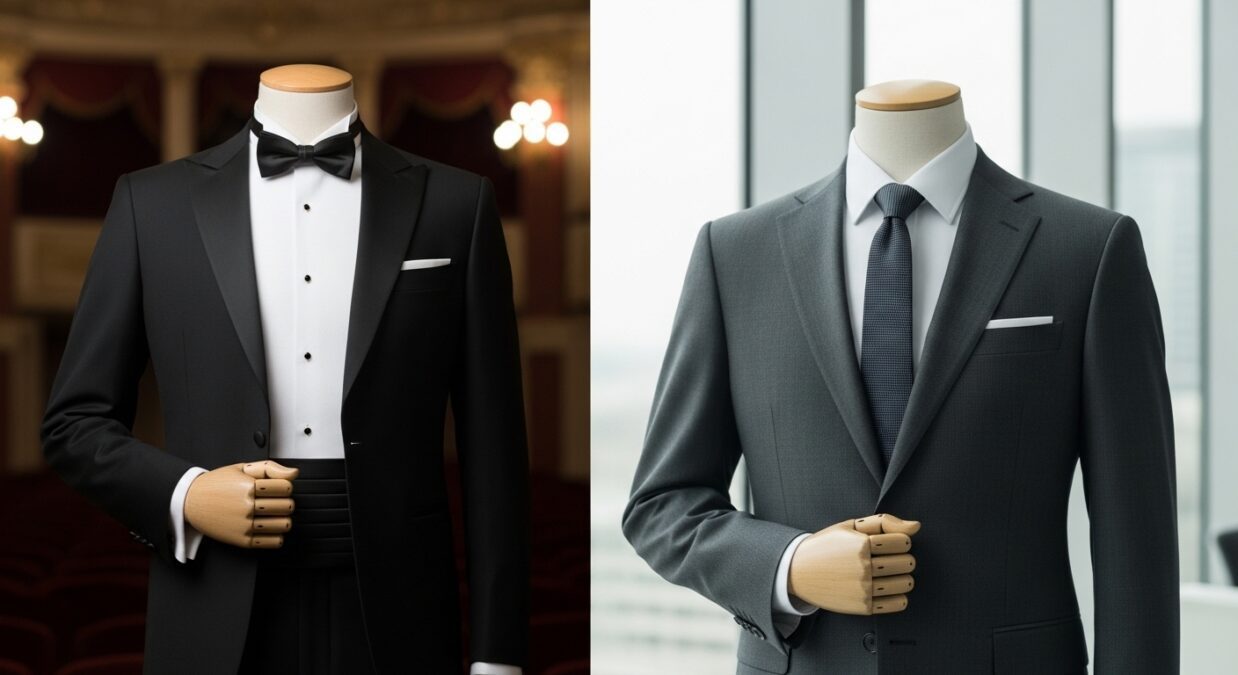

Dinner Suit vs Business Suit: In the taxonomy of modern menswear, the dinner suit and the business suit occupy adjacent yet fundamentally distinct ecological niches. A dinner suit—known interchangeably across the Atlantic as a tuxedo or black tie—is not merely a black version of a business suit. It is a specialized, rigidly codified uniform engineered specifically for artificial light, social elevation, and the suspension of ordinary commercial hierarchy. Conversely, the business suit remains the global standard uniform for professional negotiation, a garment designed to project competence and continuity under the harsh scrutiny of fluorescent office lighting and daylight.
This comparative analysis applies a dual-axis framework: Material Anthropology (how the physical composition of the garment interacts with its environment) and Semiotic Function (how the garment signals status within a specific temporal window). By examining the structural divergence—specifically the introduction of silk facings, the elimination of the daytime shirt, and the inversion of footwear logic—we can move beyond subjective taste into objective, evidence-based distinction. This is not a discussion of “which is better,” but rather a study in environmental specificity and historical inertia.
The core thesis of this examination rests on a singular, often overlooked insight: The dinner suit’s superiority in evening environments is a function of its light absorption properties, while the business suit’s dominance in the boardroom is a function of its textural friction and daylight resilience. The former is designed to recede into a flattering silhouette under dim chandeliers, ceding visual primacy to the wearer’s face and the white of the dress shirt. The latter is designed to maintain structural integrity and color fidelity across 14 hours of wear, travel, and abrasion. To conflate the two is to commit a fundamental error in optical physics and social calibration.
📊 Essential Comparative Metrics
The following table distills the objective, measurable differences that govern the application and performance of each garment category. These metrics are based on textile analysis, historical tailoring canon, and contemporary wearability standards observed through 2026.
| Metric | Dinner Suit (Tuxedo) | Business Suit (Lounge Suit) | Analytical Note |
|---|---|---|---|
| Primary Textile Finish | Matte Worsted Wool (Barathea) or Mohair Blend; Silk/Satin Facing | Worsted Wool (Twill, Herringbone, Sharkskin), Cotton, Linen | Dinner suit relies on contrasting Facings for light reflection; Business suit relies on Weave Pattern for texture. |
| Lapel Typology | Peak Lapel or Shawl Collar (Faced in Silk/Satin) | Notch Lapel (Standard) or Peak Lapel (Unfaced/Self-Faced) | The presence of Grosgrain or Satin facing is the universal, non-negotiable delimiter of evening formality. |
| Optimal Chromatic Range | Midnight Blue (Preferred) or Black | Charcoal Grey, Navy Blue, Mid-Grey | Midnight Blue appears blacker than black under tungsten/artificial light due to blue wavelength absorption. |
| Trouser Waist Treatment | Silk Braid or Satin Stripe covering outer seam; No Belt Loops | Belt Loops or Side Adjusters; Plain Seam Finish | The absence of a belt on a dinner suit is a structural mandate to preserve the unbroken vertical line of the waistcoat/cummerbund. |
| Shirt Interface | Marcella (Piqué) Bib Front; Wing or Turndown Collar; Double (French) Cuff | Poplin, Twill, Oxford Cloth; Button or French Cuff | The dinner shirt bib is an evolutionary vestige of the starched, armored chest plate of 19th-century formal wear. |
| Footwear Doctrine | Patent Leather Oxfords or Opera Pumps (High Shine, No Broguing) | Calfskin Oxfords, Derbys, Loafers (Burnished or Polished) | Light reflection under the trouser hem is paramount in evening wear; texture is paramount in day wear. |
| Temporal Jurisdiction | Strictly Post-6:00 PM (or Post-Sunset) | Sunrise to Sunset (and Evening Casual) | This is a non-negotiable rule derived from the history of indoor gaslight and candle illumination. |
| Closure System | Single Button (Covered in Facing Material) or Double-Breasted (Peak Lapel) | Two-Button, Three-Roll-Two, or Double-Breasted | The single-button stance is lower and more dramatic, designed to showcase the dress shirt bib and studs. |
Structural and Biological Foundations
The divergence between these two garments originates in the 19th-century Great Male Renunciation and the subsequent Victorian obsession with hygiene and lighting technology. The business suit, or “lounge suit,” emerged as a practical, looser-fitting alternative to the frock coat for men engaged in commerce and country leisure. It was a garment of action and movement. The dinner suit, popularized in the 1880s by the Prince of Wales (later Edward VII), was a direct rebellion against the stiff, restrictive, and physically exhausting white tie tailcoat. It was an act of sartorial relaxation for the upper classes dining en famille at Sandringham House, yet it retained the visual language of exclusivity through the use of silk—a fabric too delicate and expensive for the grime of industrial city streets.
From a materials science perspective, the silk facing on the dinner jacket lapel serves a specific biometric function absent in the business suit. Under low, directional light (candlelight or a dimmer switch), the smooth, reflective surface of silk grosgrain catches and refracts light anisotropically. This creates a subtle halo effect around the wearer’s chest and shoulders, guiding the viewer’s eye upward toward the face. In contrast, the matte or textured wool of a business suit absorbs and diffuses light. This absorption is critical for daytime wear; a reflective, shiny suit in a boardroom at 10:00 AM creates glare, distorts the perception of body shape, and reads optically as “cheap” or “sweaty” rather than “elevated.” The biological comfort of the wearer is also distinct: the dinner suit jacket is traditionally unvented or has side vents, assuming minimal physical exertion beyond dining and dancing. The business suit almost universally requires a center or double vent to accommodate the biomechanics of sitting at a desk, reaching for a phone, or navigating a revolving door.
Behavioral Patterns and Social Intelligence
The behavioral expectations encoded within each suit are so pronounced that wearing one in the wrong context constitutes a social faux pas akin to mispronouncing a name repeatedly. The business suit is a Power Projection Tool; its behavioral pattern is one of utility and negotiation. It invites approach, conversation about quarterly earnings, and the exchange of business cards. The dinner suit, conversely, is a Ceremonial Shroud. Its behavioral pattern is one of ritual and disengagement from commerce. To discuss balance sheets or ask for a job while wearing or addressing someone in black tie is a violation of the evening’s implicit contract. The dinner suit signals that the wearer has temporarily stepped off the economic ladder to engage in pure social or cultural capital exchange.
The social intelligence required to navigate these garments involves understanding their Accessory Ecosystems. The business suit tolerates, even encourages, the presence of a smartphone bulge in the breast pocket or a laptop bag slung over the shoulder. It is a system designed to accommodate the detritus of modern life. The dinner suit, however, demands a suspension of utility. The trousers have no belt loops because you are not expected to carry keys, phones, or wallets (these are relegated to an overcoat check or the inner breast pocket of a formal cape). The shirt studs and cufflinks—relics of a time before buttons were deemed too pedestrian for evening—demand a slower, more deliberate dressing ritual. This enforced slowness is a behavioral cue; it is the sartorial equivalent of a deep breath, signaling a transition from the aggressive tempo of the workday to the contemplative pace of the evening.
Dinner Suit: Strengths and Constraints
The primary strength of the dinner suit is its Optical Flattery and Uniformity of Elegance. Within its narrow constraints, it is the most democratizing garment a man can wear. A well-fitted, midnight-blue tuxedo with a properly starched Marcella shirt elevates the wearer to a standardized, almost Platonic ideal of masculine evening presentation. There is very little room for disastrous error provided the rules are followed precisely. Furthermore, the dinner suit creates a Psychological Protective Barrier. At a black-tie gala, the uniform eliminates the anxiety of “what should I wear?” and the subsequent social comparison that plagues cocktail attire events. It frees cognitive bandwidth for conversation because the hierarchy of dress is flattened—everyone is playing by the same strict codebook.
However, the constraints are severe and non-negotiable. The dinner suit suffers from Chronological and Environmental Brittleness. It cannot function effectively before sunset without looking like a member of the wait staff or a confused magician. Its delicate facings are vulnerable to ash, champagne spills, and perspiration. Most critically, it has a Limited Narrative Range. A man in a dinner suit can only tell one story: “I am participating in a formal ceremony.” He cannot signal creative industry savvy (the role of a textured sport coat) or aggressive financial ambition (the role of a pinstripe suit). Attempting to “dress down” a dinner suit with a long tie or a pre-tied bow tie shatters its structural integrity and results in a semiotic failure worse than wearing no jacket at all. The dinner suit is a binary system; it is either correctly executed or fundamentally broken.
Business Suit: Strengths and Constraints
The business suit’s overwhelming strength lies in its Morphological Adaptability and Semantic Breadth. It is a platform, not a singular expression. By altering the cloth weight (tropical wool for summer, heavy flannel for winter), the pattern (from subtle birdseye to bold chalk stripe), or the silhouette (drape cut versus Neapolitan soft shoulder), the wearer can broadcast a wide array of professional and personal signals. A navy hopsack suit with patch pockets says “approachable consultant”; a charcoal worsted suit with roped shoulders says “litigator.” This chameleonic capacity makes it the most enduring garment in the male wardrobe, capable of surviving the casualization of the office precisely because it can be deconstructed and recombined as separates. Moreover, the business suit is Physically Resilient. It is engineered to withstand the friction of an office chair, the compression of a subway commute, and the thermal shock of moving between climate-controlled lobbies and humid streets.
The constraints of the business suit are less about rules and more about Performance Anxiety and Dilution. Because the range of acceptable variation is so wide, the potential for looking mediocre or outdated is high. A poorly chosen tie width or an ill-advised square-toed shoe can undermine the entire composition. Furthermore, the business suit’s ubiquity has led to Semantic Erosion. In 2026, as hybrid work blurs the lines of formality, the suit can sometimes read as either “over-dressed and out of touch” or “a valiant but dated attempt at authority.” It lacks the immediate, unambiguous gravitas of the dinner suit because its meaning is contextual and fluid. It requires constant, active curation by the wearer to maintain its power, whereas the dinner suit’s power is inherent in its rigid structure.
Comparative Advantages in Real-World Scenarios
When placed in direct operational comparison, the advantages become starkly contextual. In a Low-Light, High-Density Social Environment (a wedding reception, an opera gala, an awards ceremony), the dinner suit is objectively superior. Its reflective facings create definition against the dark blur of the crowd. A business suit in the same environment appears flat, visually uninteresting, and, due to the lack of silk contrast, often indistinguishable from the catering staff unless the fabric is a very distinct light grey. The dinner suit’s higher armhole and softer shoulder construction (typical in traditional tailoring) also provide a marginally greater Range of Motion for Dancing than a heavily structured boardroom suit with thick shoulder padding.
Conversely, in a High-Light, Transactional Environment (a courtroom, a sales pitch, a negotiation table), the business suit is the only viable option. The dinner suit’s sheen and stark black/white contrast convey a sense of leisure, which is antithetical to the ethos of work. A client or judge seeing a dinner suit at 2:00 PM instinctively questions the wearer’s judgment, sobriety, or respect for the proceedings. The business suit’s matte finish and subtle textural variation (herringbone, nailhead) communicate Trustworthiness Through Understatement. The pocket square and tie provide just enough room for personal expression without deviating from the core message of competence. In the courtroom of public opinion and professional advancement, the business suit wins every battle fought under the sun; the dinner suit reigns only after dark.
Scientific and Expert Consensus (2026)
By 2026, textile conservation and fashion scholarship have moved beyond prescriptive “fashion rules” toward a more empirical understanding of visual perception. Recent studies in colorimetry conducted by textile institutes emphasize that Midnight Blue (Color Code: Hex #191970) remains the superior choice for evening wear fabrics, as it absorbs more ambient yellow-orange light from modern LED “warm dimming” bulbs than true black, rendering a deeper, richer silhouette in photographs. This validates the century-old sartorial preference of the Duke of Windsor and confirms the dinner suit’s primary function is Luminance Management.
The consensus among tailors on Savile Row and in Milan focuses increasingly on Weight and Drape as the key differentiator. A 2025 industry white paper on “The Future of Formal Dressing” notes that the modern dinner suit is trending toward lighter weights (8-9oz wool/mohair blends) to accommodate climate change and indoor heating, while the business suit is bifurcating: heavier, “armor-like” flannel for power roles in law and finance, and ultra-light, high-twist “travel” wools for the tech and consulting sectors. Experts agree that the Hybrid Groomswear trend (business suits with satin lapels) represents a semantic corruption of both categories. It is widely regarded by tailors as a garment that fails at both functions: it is too shiny for the office and too informal for the gala. The professional advice for 2026 is clear and binary: own a great charcoal business suit for the world of things, and a proper midnight dinner suit for the world of rituals. Attempting to serve two masters with one garment results in sartorial ambiguity and diminished authority in both spheres.
Final Synthesis and Verdict
This analysis confirms that the dinner suit and business suit are not competitors on a single axis of “formality.” They are specialized instruments designed for fundamentally different Spectrums of Light and Labor. The business suit is a tool of Diurnal Engagement—a second skin for the friction of commerce, calibrated for visibility, durability, and the subtle language of wool weaves. The dinner suit is a vessel for Nocturnal Transcendence—a uniform designed to dissolve the ego of the individual into the grace of the collective ceremony, engineered for the physics of candlelight and chandeliers.
The verdict is not one of superiority, but of Appropriate Application. To wear a dinner suit to a breakfast meeting is an error in environmental awareness; it is like wearing ski goggles to read a book. To wear a plain business suit to a black-tie gala is an error in social resonance; it is akin to mumbling while others sing. The man who understands the distinction does not see them as alternatives. He sees them as non-fungible assets in a complete sartorial portfolio. He invests in the Armor of the Boardroom (the business suit) to build his fortune, and he invests in the Attire of Leisure (the dinner suit) to signify that, at least for one evening, the work is done and the lights have dimmed.
❓ Frequently Examined Distinctions
Why can’t I just wear a black suit and tie to a black tie event?
A black business suit is constructed from a matte wool with no silk facings. Under evening lighting, it photographs as a flat, undefined void, often appearing grey or dusty due to light scatter. A proper dinner jacket uses satin or grosgrain lapels to frame the face. More importantly, the black business suit is the uniform of service staff and undertakers in many Western cultures. Wearing one to a black-tie event creates a visual misidentification and signals a lack of fluency in the specific dialect of evening dress. While the color is similar, the textural and finish differences constitute a categorical exclusion.
Can I wear brown shoes with a navy business suit to a wedding in 2026?
Yes, unequivocally. The pairing of a mid-to-dark brown calf oxford or derby with a navy business suit is now the standard for daytime and early evening events, including weddings where the dress code is “Cocktail Attire” or “Suit and Tie.” The historical prohibition against “brown in town” has dissolved completely in the 21st century. However, this rule applies only to the business suit. Brown shoes are strictly forbidden with a dinner suit. The dinner suit requires the high-contrast, mirror-like reflection of black patent leather or highly polished black calf to complete the vertical line of the black trouser and prevent visual “bleeding” into the floor.
What is the actual functional difference between a peak lapel and a notch lapel?
The notch lapel (a small triangle cut out of the seam where collar meets lapel) originates from the leisure jacket and hunting coat; it is inherently informal and tied to the history of the lounge (business) suit. The peak lapel (which points upward toward the shoulder) originates from military and naval dress uniforms and the formal tailcoat. It creates a V-shaped silhouette that broadens the shoulder and narrows the waist. In the context of a dinner suit, a peak lapel is universally preferred by tailors because the upward thrust of the lapel counterbalances the horizontal band of the bow tie. A notch lapel on a dinner jacket is a modern, cost-cutting aberration that deviates from the garment’s formal lineage.
Is a velvet dinner jacket considered a “dinner suit”?
Yes, but it occupies a specific sub-category: Creative Black Tie. A velvet dinner jacket (typically in midnight blue, burgundy, or forest green) paired with formal black trousers (with the requisite silk braid) is a historically valid and highly sophisticated evening ensemble. It maintains the core semiotic elements of the dinner suit (silk facings, bow tie, formal shirt) but substitutes the matte wool body for a plush, light-absorbing pile. It signals a more artistic or festive intention than the standard wool barathea tuxedo. Crucially, it is not a business suit, and its use is confined strictly to the same after-dark, non-commercial contexts as any other dinner jacket. It is an evolution within the species, not a hybrid with another genus.