
Most take-out robots are drawn as if every factory had a tall, clear roof. Real press halls rarely cooperate. Older buildings have low trusses, cranes, ducting and mezzanines, and sometimes the space above a mold is simply occupied by something else. When the usual overhead beam does not fit, plants end up looking at side entry robots, a geometry that works beside the press instead of above it. This guide walks through how to decide whether that geometry suits your cell, using published specifications from several robot makers and a few practical tests you can run before anyone signs a purchase order.
What a side entry robot actually does
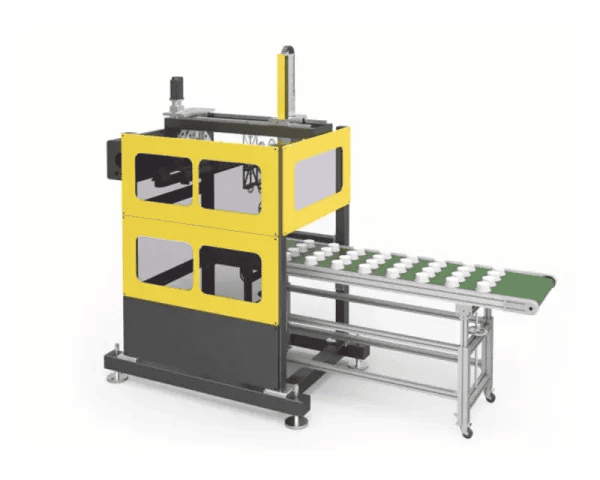
A top entry (traverse) robot mounts above the fixed platen and drops a vertical arm into the open mold. A side entry unit sits beside the machine and moves its pick-up plate into the mold area horizontally, through the gap between the tie bars. Because the working motion is mostly horizontal, the overall height stays low. Several established suppliers describe the same logic. Yushin states that its high speed SX-41 side entry model can be installed in low ceiling areas, or where auxiliary equipment blocks a top entry solution, and cites a measured dry take-out time of 0.32 seconds at its factory. Italian maker Tecnomatic groups its side entry range into three situations: very fast cycles under 5 seconds in packaging, cleanroom or low ceiling work, and in-mold labeling.
The four checks that decide fit
Press tonnage. Published side entry ranges cluster in the small to mid-size band. Chen Hsong's servo models cover 128 to 268 tons, Yushin's SXA-800III was shown for 450 to 850 ton thin-wall presses, and the manufacturer page for one current line quotes 100 to 500 tons.
Part weight and size. A U.S. patent filing on side entry trolley robots observes that these designs have mostly been used for numerous small, light parts, and that cantilevered versions struggle with large, heavy articles. Treat that as a boundary.
Cycle target. If the whole cycle is under about 6 seconds, the take-out motion is a significant share of it, and a robot with a fast, short travel path pays off.
Space around the press. Side entry units need floor space beside the machine, and the conveyor or chute has to be planned with them.
Side entry versus top entry at a glance
| Factor | Side entry | Top entry (traverse) |
|---|---|---|
| Height needed | Low | Needs clearance above the press |
| Typical tonnage in published ranges | Roughly 100 to 850 tons | Small presses to very large ones |
| Typical strength | Fast, short horizontal motion | Long strokes, heavy parts |
| Typical weakness | Limited payload and reach | Needs headroom |
| Common use | Thin-wall packaging, small precision parts | General purpose |
Where the design earns its place
The manufacturer page for one 100 to 500 ton line lists its fastest overall cycle as 2.8 seconds with a 0.5 second fetch time. Those are the supplier's own figures and depend on part and mold, so ask for a dry cycle demonstration on your press. The same page lists typical applications in four areas:
- Precision plastic parts such as gears and gearbox components, where consistent orientation reduces assembly errors.
- Toys and children's products, where parts must come out without deformation and stacking problems.
- Tool housings and industrial parts, where positioning consistency across a batch matters.
- Electrical components such as socket panels, switch housings and connector shells.
The pattern is clear: small to mid-size parts, high volumes and tight space.
A site survey beats a spec sheet
Plastics Machinery & Manufacturing quoted a systems integrator saying every application goes through a size survey that takes overhead ceiling height into account, and that low ceilings are common in older manufacturing buildings. Do the same. Measure clear height to the lowest obstruction, floor space beside the press, mold opening stroke and the position of the take-out conveyor. Then confirm the robot's range of motion against the mold height, because at least one supplier's wrist unit allows the vertical center height to be adjusted to match the mold.
How tight is the accuracy?
Chen Hsong lists position accuracy of plus or minus 0.3 mm on its servo side entry series. Accuracy matters when the robot places parts into a stacking device, downstream trimming, or in-mold labeling equipment, so ask suppliers for repeatability figures measured under load, not just under dry cycling.
Questions people ask
Can side entry robots handle heavy parts? Generally not at the top of the tonnage range. If your part weighs several kilograms or the press is large, check payload including the gripper, or use a top entry or vertical design.
Do they work with in-mold labeling? Yes, several suppliers offer dedicated versions for it, usually with a different arm and gripper design than the general purpose model.
Is a low ceiling the only reason to choose one? No. Speed on thin-wall products is the other common reason, along with keeping the area above the press free for other equipment.
The short version
If your press is under roughly 500 tons, your parts are light, your cycle is short and your roof is low, side entry robots deserve a serious look. If any of those conditions fail, run the numbers on a vertical or top entry design before committing.