
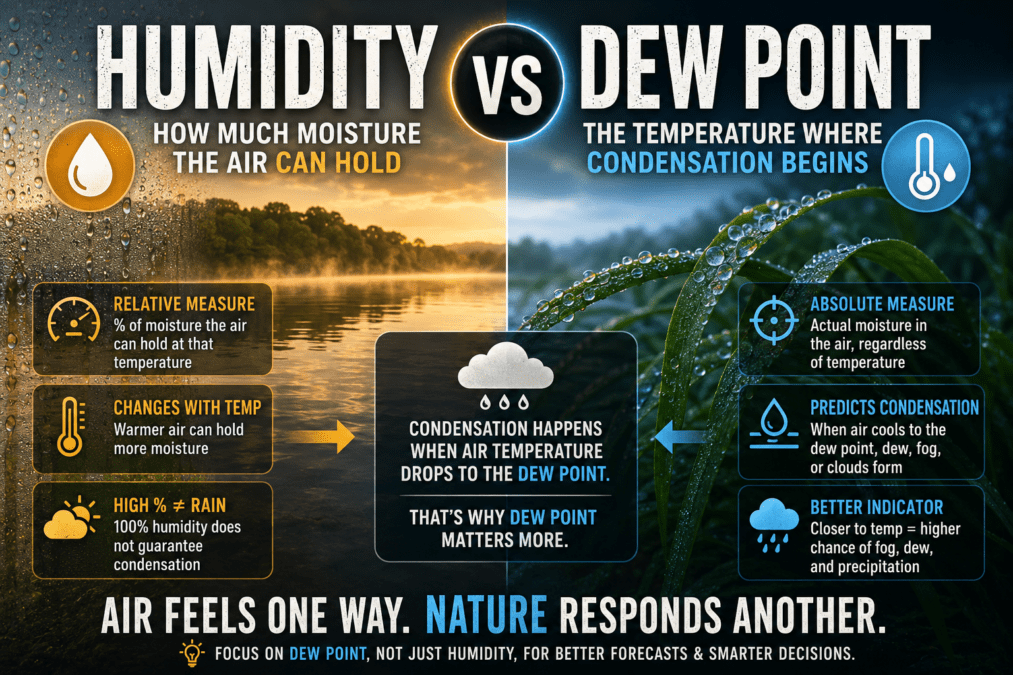

Humidity and dew point are two of the most frequently cited atmospheric measurements, yet they are often misunderstood or used interchangeably. Both describe moisture in the air, but they measure fundamentally different aspects of atmospheric water vapor. Understanding humidity vs dew point is essential for weather forecasting, climate analysis, aviation, agriculture, construction, and everyday comfort.
The comparison framework for humidity vs dew point centers on measurement philosophy. Humidity typically expresses moisture as a relative percentage influenced by temperature, whereas dew point represents the actual temperature at which air becomes saturated and condensation begins. Although both metrics originate from the same moisture content, they communicate different information.
The most important insight in the humidity vs dew point debate is that dew point often provides a more stable and realistic picture of atmospheric moisture. Relative humidity can change dramatically throughout the day even when the actual amount of water vapor remains constant, while dew point directly reflects the true moisture content of the air. This distinction explains why meteorologists increasingly emphasize dew point when evaluating comfort, fog potential, precipitation development, and environmental conditions.
Definition: Humidity is the amount of water vapor present in the air, often expressed as a percentage of the maximum moisture the air can hold at a given temperature.
Definition: Dew point is the temperature at which air becomes fully saturated and water vapor begins condensing into liquid water.
While relative humidity changes whenever temperature changes, dew point remains closely tied to the actual quantity of moisture in the atmosphere.
Direct Answer: In the comparison of humidity vs dew point, humidity measures moisture relative to temperature-dependent capacity, while dew point measures the actual temperature at which condensation occurs. Because dew point directly reflects atmospheric moisture content and is less affected by temperature fluctuations, it is generally considered the more accurate indicator of how humid the air truly feels.
Essential Comparative Metrics
| Attribute | Humidity | Dew Point |
|---|---|---|
| Primary Measurement | Relative moisture percentage | Condensation temperature |
| Unit | Percent (%) | Degrees (°C or °F) |
| Temperature Dependence | Highly dependent | Less dependent |
| Reflects Actual Moisture Content | Indirectly | Directly |
| Daily Variability | Often large | Usually moderate |
| Comfort Assessment | Moderately useful | Highly useful |
| Fog Prediction | Limited accuracy | Strong predictor |
| Condensation Forecasting | Indirect | Direct |
| Meteorological Preference | Supplementary metric | Core moisture metric |
| Agricultural Applications | Useful | Highly valuable |
| Building Moisture Analysis | Secondary indicator | Primary indicator |
Structural And Biological Foundations
Understanding humidity vs dew point begins with understanding atmospheric physics. Air contains varying amounts of water vapor, and its capacity to hold moisture changes with temperature. Warm air can contain significantly more water vapor than cold air. Relative humidity therefore compares existing moisture to maximum possible moisture at a specific temperature.
Seltzer vs Sparkling Water: Why the Difference Matters More Than Most Consumers Realize
Dew point approaches the same moisture system differently. Rather than expressing moisture as a percentage, it identifies the temperature at which saturation occurs. If air cools to its dew point, excess water vapor condenses into liquid droplets. This process creates dew, fog, frost, clouds, and condensation on surfaces.
The scientific distinction in humidity vs dew point is that humidity is a ratio while dew point is a physical threshold. Ratios fluctuate as temperature changes, but thresholds are tied directly to moisture content. This makes dew point a more robust indicator of atmospheric moisture because it avoids many of the distortions introduced by temperature swings.
Meteorologists often rely on both measurements, but dew point generally provides a clearer picture of actual atmospheric water vapor concentration.
Behavioral Patterns And Environmental Dynamics
The relationship between humidity vs dew point becomes especially visible during daily weather cycles. Relative humidity commonly rises overnight and falls during the afternoon. Many people assume this means moisture is increasing and decreasing dramatically, but the reality is often different.
Consider a summer morning with 90% relative humidity. As temperatures rise during the day, relative humidity may drop to 50% even though the actual amount of water vapor remains nearly unchanged. The percentage changes because warmer air can hold more moisture.
Dew point behaves differently. If atmospheric moisture remains stable, dew point changes little throughout the day. A dew point of 22°C indicates substantial moisture whether measured at sunrise or mid-afternoon.
This behavioral distinction explains why humidity vs dew point discussions often favor dew point for forecasting. Dew point tracks moisture itself, whereas humidity tracks moisture relative to changing atmospheric capacity. Consequently, dew point provides greater consistency for evaluating weather development, storm potential, and human comfort.
The stability of dew point also makes it valuable for long-term environmental monitoring and climate assessment.
Humidity: Strengths And Constraints
Relative humidity remains one of the most widely reported weather measurements because it is intuitive and easy to communicate. Most people understand percentages and can interpret 80% humidity as “humid” conditions.
One strength in the humidity vs dew point comparison is accessibility. Humidity is widely used in weather reports, industrial controls, greenhouses, museums, data centers, and residential HVAC systems. Many devices measure and display relative humidity directly.
Humidity also provides useful information about evaporation rates. High relative humidity slows evaporation from skin and surfaces, while low humidity accelerates drying processes. This characteristic influences comfort, agriculture, manufacturing, and building management.
However, humidity has important limitations. Its dependence on temperature can create misleading impressions. A relative humidity reading of 90% on a cool morning may feel much more comfortable than a 50% reading on a hot afternoon. The percentage alone does not accurately represent moisture burden.
Therefore, while humidity remains valuable, the humidity vs dew point analysis reveals that humidity often requires additional context before meaningful conclusions can be drawn.
Dew Point: Strengths And Constraints
Dew point is increasingly viewed as the superior indicator of atmospheric moisture because it directly reflects water vapor content. In the humidity vs dew point debate, this directness represents its greatest advantage.
Human comfort correlates strongly with dew point values. When dew points remain below approximately 10°C, conditions generally feel dry and comfortable. Between 15°C and 18°C, many people notice moderate humidity. Above 20°C, air often feels sticky and oppressive. Once dew points exceed 24°C, outdoor conditions can become significantly uncomfortable.
Dew point also excels in forecasting fog, cloud formation, precipitation potential, and condensation risk. Engineers, meteorologists, pilots, and agricultural specialists frequently rely on dew point because it predicts saturation events more accurately than relative humidity alone.
The main limitation of dew point is public familiarity. Many people understand humidity percentages but are less comfortable interpreting dew point temperatures. A dew point reading requires contextual knowledge to appreciate its implications.
Despite this educational barrier, the humidity vs dew point comparison consistently demonstrates that dew point offers greater scientific precision and practical forecasting value.
Comparative Advantages In Real-World Scenarios
The practical implications of humidity vs dew point become apparent when examining real-world applications.
Weather Forecasting
Meteorologists often prioritize dew point because it better represents atmospheric moisture reservoirs. Rising dew points frequently signal incoming moisture transport, storm development, or changing air masses.
Human Comfort
Dew point generally outperforms humidity in predicting perceived discomfort. Two days may show identical relative humidity values yet feel dramatically different due to differing dew points.
Aviation
Pilots monitor dew point closely because fog formation often occurs when air temperature approaches dew point temperature. Small differences can significantly affect visibility.
Agriculture
Crop disease, irrigation planning, and frost prediction benefit from dew point analysis. Farmers often use dew point data to anticipate moisture-related risks.
Construction And Building Science
Condensation inside walls, windows, and ventilation systems depends heavily on dew point. Building engineers rely on dew point calculations to prevent mold growth and structural damage.
Industrial Processes
Manufacturing sectors involving electronics, pharmaceuticals, food production, and precision equipment often require dew point monitoring because moisture thresholds directly affect product quality.
These examples show that in many operational settings, humidity vs dew point comparisons consistently favor dew point as the more actionable measurement.
Scientific And Expert Consensus (2026)
Scientific understanding of humidity vs dew point has evolved significantly over recent decades. Modern atmospheric science recognizes that both metrics provide useful information, but they serve different purposes.
Relative humidity remains valuable for describing saturation status and evaporation potential. It is especially useful when evaluating drying conditions, indoor air management, and certain environmental processes. Because it incorporates temperature effects, it reflects how close air is to saturation under current conditions.
However, most meteorological experts consider dew point the more reliable measure of actual atmospheric moisture. National weather agencies, aviation services, agricultural forecasting systems, and climate researchers increasingly emphasize dew point in operational analysis.
Research consistently demonstrates that dew point correlates more closely with human comfort, cloud formation, precipitation potential, and atmospheric moisture transport. These relationships make it a preferred diagnostic tool for understanding weather systems.
The consensus emerging in 2026 is not that humidity is obsolete, but rather that humidity vs dew point should be viewed as complementary measurements. Humidity explains saturation relative to temperature, while dew point explains actual moisture content.
When interpreted together, they provide the most complete understanding of atmospheric conditions.
Understanding Comfort Through Humidity vs Dew Point
Many weather consumers focus exclusively on humidity percentages, yet comfort perception reveals why humidity vs dew point is such an important distinction.
Imagine two cities reporting 60% relative humidity. One city has a temperature of 18°C while the other sits at 34°C. Despite identical humidity percentages, the hotter city feels far more uncomfortable because warm air contains substantially more water vapor.
Dew point exposes this difference immediately. The cooler city may have a dew point near 10°C, indicating relatively dry air. The hotter city may have a dew point above 23°C, indicating heavy atmospheric moisture.
Human cooling depends largely on sweat evaporation. High dew points reduce evaporation efficiency, making it harder for the body to release heat. This creates the sticky sensation commonly associated with humid weather.
Therefore, many meteorologists encourage the public to pay greater attention to dew point than relative humidity. In the broader humidity vs dew point discussion, comfort perception strongly supports the practical value of dew point measurements.
Humidity vs Dew Point In Climate And Environmental Research
Climate scientists use both metrics, but the humidity vs dew point comparison becomes increasingly important as global temperatures rise.
Warmer atmospheres can hold more water vapor. This means relative humidity may remain relatively stable while actual atmospheric moisture increases significantly. Dew point captures these changes more effectively because it responds directly to water vapor concentration.
Higher dew points contribute to heat stress, extreme rainfall events, and changing ecosystem dynamics. Researchers studying climate impacts frequently analyze dew point trends alongside temperature records to assess future environmental risks.
Environmental monitoring networks also use dew point data to evaluate drought conditions, moisture transport, and ecosystem health. Because dew point directly reflects atmospheric moisture availability, it provides insights that relative humidity alone cannot offer.
As climate research advances, the importance of understanding humidity vs dew point continues to grow across scientific disciplines.
Final Synthesis And Verdict
The comparison of humidity vs dew point ultimately reveals two measurements that describe the same atmospheric system from different perspectives.
Humidity expresses moisture as a percentage relative to temperature-dependent capacity. It is useful, familiar, and widely reported. However, its sensitivity to temperature changes can sometimes create misleading impressions about actual atmospheric moisture.
Dew point measures the temperature at which saturation occurs. Because it directly reflects water vapor content, it provides a more stable and accurate representation of atmospheric moisture conditions. It is particularly effective for assessing comfort, forecasting weather, predicting condensation, and understanding environmental processes.
The verdict in the humidity vs dew point analysis is clear: dew point is generally the superior indicator of true atmospheric moisture, while humidity remains a valuable complementary measurement that helps explain saturation behavior. For anyone seeking the most accurate understanding of how moist the air really is, dew point deserves greater attention than relative humidity.
Frequently Asked Questions
Which is more important, humidity or dew point?
In most practical situations, dew point is more informative because it directly measures atmospheric moisture content. The humidity vs dew point comparison generally favors dew point for weather forecasting, comfort assessment, and condensation prediction.
Why can humidity be high when the air does not feel humid?
Cool air reaches high relative humidity with relatively little water vapor. As a result, humidity percentages can be high while actual moisture content remains modest. This is one of the key reasons dew point often provides better insight than humidity alone.
What dew point feels uncomfortable to most people?
Many people begin noticing humidity-related discomfort when dew points exceed approximately 18°C. Conditions often feel oppressive above 22–24°C, especially when temperatures are also elevated.
Can dew point predict rain?
Dew point alone cannot predict rainfall, but higher dew points often indicate greater atmospheric moisture availability. Meteorologists frequently use dew point trends alongside temperature, pressure, and wind patterns to evaluate precipitation potential.