
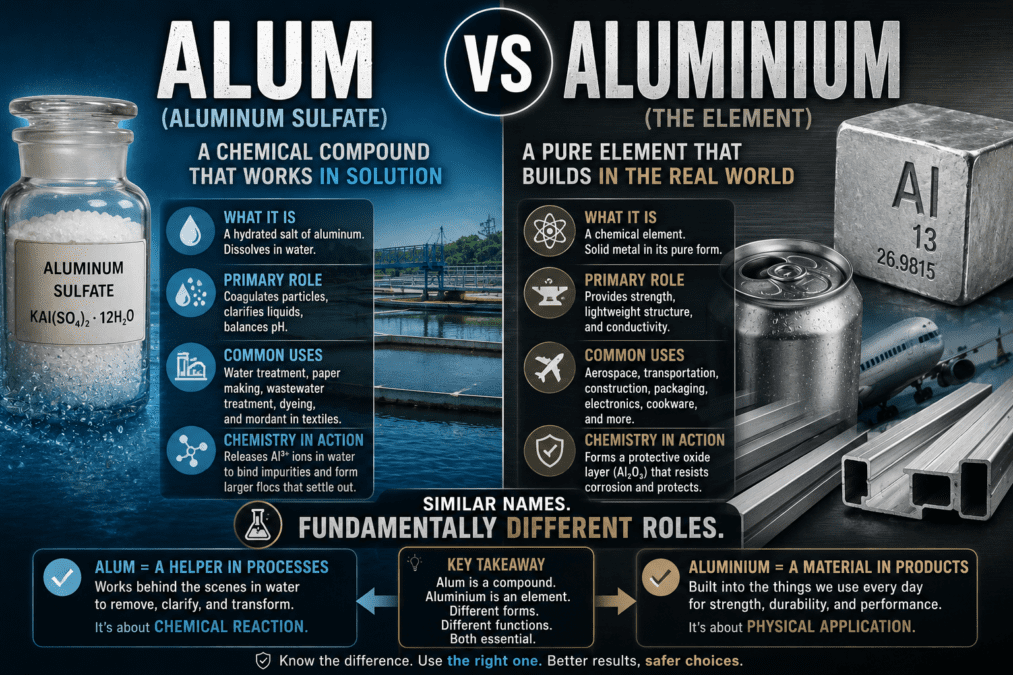

The alum vs aluminium comparison is often misunderstood because the two terms sound closely related, yet they refer to entirely different chemical substances. Aluminium is a metallic element found on the periodic table, while alum is a class of chemical compounds commonly used in water purification, food processing, medicine, textiles, and industrial applications. Despite sharing linguistic roots, their physical properties, chemical behavior, and practical functions differ dramatically.
A meaningful alum vs aluminium analysis requires more than comparing names. The comparison must examine chemical composition, atomic structure, industrial importance, manufacturing processes, environmental impact, commercial applications, and scientific relevance. Many people incorrectly assume that alum is simply another name for aluminium, but chemistry tells a far more nuanced story.
The central insight emerging from a modern alum vs aluminium evaluation is that aluminium serves primarily as a structural material and engineering metal, whereas alum functions as a specialized chemical compound designed to alter reactions, purify substances, or support manufacturing processes. Their relationship exists through chemistry, but their real-world roles occupy entirely different domains.
Aluminium is a metallic chemical element with the symbol Al and atomic number 13.
Alum is a crystalline sulfate compound typically containing aluminum ions combined with potassium, ammonium, or other elements.
While aluminium is valued for strength, conductivity, and corrosion resistance, alum is primarily valued for its chemical reactivity, coagulation properties, and industrial usefulness.
Direct Answer: In the alum vs aluminium comparison, aluminium is a lightweight metal used in transportation, construction, electronics, and packaging, whereas alum is a chemical compound used in water treatment, food preservation, dyeing, medicine, and laboratory processes. Alum often contains aluminum ions, but it is not metallic aluminium and serves entirely different functions.
Essential Comparative Metrics
| Attribute | Alum | Aluminium |
|---|---|---|
| Chemical Classification | Chemical Compound | Metallic Element |
| Formula | Typically KAl(SO₄)₂·12H₂O | Al |
| Periodic Table Status | Not an Element | Element #13 |
| Physical Form | Crystalline Solid | Metallic Solid |
| Primary Function | Chemical Processing | Structural Material |
| Electrical Conductivity | Low | High |
| Thermal Conductivity | Low | Excellent |
| Industrial Usage | Water Treatment, Food, Textiles | Aerospace, Construction, Electronics |
| Natural Occurrence | Manufactured Compound | Derived from Bauxite Ore |
| Corrosion Resistance | Not a Structural Material | Excellent Oxide Protection |
| Medical Applications | Antiseptic and Styptic Uses | Limited Direct Medical Use |
| Density | Varies by Compound | 2.7 g/cm³ |
| Recyclability | Limited | Highly Recyclable |
| Global Economic Role | Chemical Industry Input | Major Industrial Metal |
Structural And Chemical Foundations
The most important distinction in the alum vs aluminium debate lies in basic chemistry. Aluminium is a pure chemical element. Every aluminum atom contains 13 protons in its nucleus, giving it a unique identity on the periodic table. This elemental status allows aluminium to form countless alloys and compounds while retaining its fundamental atomic structure.
Alum, in contrast, is not an element at all. It belongs to a family of hydrated double sulfate salts. The most common variety, potassium alum, contains potassium, aluminum, sulfur, oxygen, and water molecules arranged into a crystalline structure. Rather than existing as a pure metallic substance, alum derives its properties from the interaction of multiple ions.
This distinction creates radically different behavior. Aluminium exhibits metallic bonding, electrical conductivity, malleability, and ductility. Alum displays ionic bonding, crystal formation, water solubility, and chemical reactivity. Therefore, any serious alum vs aluminium comparison begins with recognizing that one is a fundamental building block of matter while the other is a manufactured chemical compound built from multiple elements.
Historical Development And Discovery
Understanding history provides additional clarity to the alum vs aluminium discussion. Alum has a significantly longer documented history. Ancient civilizations used alum thousands of years ago for dyeing textiles, preserving materials, tanning leather, and treating water. Historical records from Egypt, Greece, Rome, India, and China describe widespread alum applications long before modern chemistry emerged.
Aluminium followed a very different path. Although aluminum compounds existed naturally throughout history, pure aluminium metal remained unknown because extracting it from ores proved extraordinarily difficult. During the nineteenth century, advances in electrochemistry finally enabled industrial production. Initially, aluminium was so rare that it was considered more valuable than silver.
This historical contrast reveals an interesting pattern. Humanity first encountered aluminium indirectly through compounds such as alum. Only later did technological innovation isolate metallic aluminium itself. In this sense, the alum vs aluminium relationship reflects the broader evolution of chemistry—from practical use of compounds to scientific understanding of elemental composition.
Physical Properties And Material Behavior
Physical characteristics further emphasize the differences in the alum vs aluminium comparison. Aluminium appears as a lightweight silver-white metal capable of being rolled, stretched, machined, welded, and shaped into complex forms. It possesses an exceptional strength-to-weight ratio that makes it valuable across countless industries.
Alum behaves entirely differently. It typically forms transparent or white crystals that dissolve in water and break under mechanical stress. Unlike aluminium, alum cannot be used to build structures, vehicles, machines, or consumer products requiring mechanical strength.
Another major distinction involves conductivity. Aluminium efficiently transports both heat and electricity, making it indispensable for power transmission and thermal management systems. Alum lacks these metallic properties and instead functions primarily through chemical interactions.
The alum vs aluminium comparison therefore demonstrates how chemical structure directly influences physical behavior. Metallic bonding gives aluminium engineering utility, while ionic crystalline structure gives alum chemical utility.
Production And Manufacturing Processes
The manufacturing pathways for these substances differ significantly. In the alum vs aluminium comparison, production methods illustrate how distinct their industrial identities truly are.
Aluminium production begins with bauxite ore extraction. The ore undergoes refining to produce alumina, followed by electrolytic reduction that separates metallic aluminium from oxygen. This process requires substantial energy but yields a versatile industrial metal.
Alum production generally involves controlled chemical reactions among sulfate salts and aluminum-containing compounds. Manufacturers create specific alum formulations depending on intended applications, including potassium alum, ammonium alum, sodium alum, and chromium alum.
Interestingly, aluminium often serves as a precursor ingredient in alum manufacturing. This creates a hierarchical relationship. Aluminium exists as a fundamental element, while alum represents one of many compounds that can be produced using aluminum chemistry.
When evaluating alum vs aluminium, it becomes evident that aluminium occupies a foundational position within industrial chemistry, whereas alum represents a specialized end-product designed for targeted applications.
Environmental Presence And Natural Occurrence
Natural occurrence offers another revealing perspective on the alum vs aluminium debate. Aluminium ranks among Earth’s most abundant elements and constitutes approximately 8% of the planet’s crust by weight. It occurs in minerals, rocks, clays, and soils worldwide.
Pure metallic aluminium, however, rarely exists naturally because it readily bonds with oxygen and other elements. Human industry must separate it from compounds through energy-intensive processes.
Alum differs substantially. Naturally occurring alum minerals exist but are far less common than aluminum-bearing minerals. Most commercial alum products result from industrial synthesis rather than direct extraction.
This contrast highlights an important scientific reality. The alum vs aluminium comparison is not merely a difference between two substances; it also reflects the distinction between a naturally abundant elemental resource and a purpose-built industrial compound created to achieve specific chemical outcomes.
Subject A: Alum Strengths And Constraints
Alum possesses several advantages that explain its continued relevance across industries. In water treatment, alum functions as a highly effective coagulant. It causes suspended particles to clump together, enabling easier removal during purification. This property makes alum indispensable for municipal water systems worldwide.
Food industries use certain alum formulations for texture modification and preservation. Textile manufacturers rely on alum during dyeing processes because it improves color fixation. Medical applications include styptic pencils and topical preparations that help control minor bleeding.
Despite these strengths, alum has clear limitations. It lacks structural utility, mechanical strength, conductivity, and versatility as an engineering material. Its usefulness depends primarily on chemical rather than physical properties.
In the broader alum vs aluminium assessment, alum excels when chemical intervention is required. However, it cannot compete with aluminium in transportation, construction, electronics, packaging, or infrastructure applications. Its effectiveness remains specialized rather than universal.
Subject B: Aluminium Strengths And Constraints
Aluminium’s strengths explain its status as one of the world’s most important industrial metals. It combines low density with impressive strength, creating exceptional efficiency in transportation systems. Aircraft, automobiles, trains, and ships benefit from reduced weight and improved fuel economy.
Corrosion resistance represents another major advantage. A naturally forming oxide layer protects aluminium from environmental degradation. This characteristic contributes to long service life in construction, packaging, and outdoor applications.
Electrical conductivity further enhances aluminium’s value. Power transmission networks depend heavily on aluminum conductors because they offer a favorable balance between performance and cost.
Nevertheless, aluminium is not without limitations. Primary production requires significant energy input. Certain applications require stronger metals such as steel or titanium. Aluminium can also experience fatigue and deformation under specific conditions.
Within the alum vs aluminium framework, aluminium demonstrates remarkable versatility. Unlike alum’s specialized chemical role, aluminium functions across engineering, manufacturing, transportation, and consumer-product sectors.
Industrial Applications Across Modern Economies
A detailed examination of industrial applications reveals perhaps the most practical distinction in the alum vs aluminium comparison.
Alum dominates sectors requiring controlled chemical reactions. Water treatment plants use alum to remove impurities. Paper manufacturers employ it during processing. Textile industries depend on alum for dye fixation. Cosmetic and pharmaceutical products also utilize specific alum formulations.
Aluminium dominates sectors requiring physical performance. Buildings use aluminum framing, roofing, and facades. Aircraft rely on aluminum alloys for weight reduction. Beverage packaging depends heavily on aluminum cans. Electronics manufacturers use aluminum for heat dissipation and structural components.
The economic implications are profound. Aluminium supports trillion-dollar manufacturing ecosystems, while alum serves as a critical but comparatively specialized industrial chemical.
This difference demonstrates that the alum vs aluminium discussion is not about determining superiority. Instead, it is about understanding distinct functions within modern industrial systems.
Safety, Health, And Human Exposure
Health considerations add another layer to the alum vs aluminium analysis. Humans encounter both substances regularly, though through different pathways.
Alum appears in water treatment systems, food-related applications, deodorants, and certain medical products. When used according to regulatory standards, alum has a long history of practical use. Safety evaluations focus on dosage, exposure duration, and application-specific guidelines.
Aluminium exposure occurs through cookware, packaging, transportation materials, consumer goods, and environmental sources. Regulatory agencies worldwide continuously evaluate aluminum exposure levels and associated health considerations.
An important distinction involves bioavailability. The body interacts differently with aluminum ions in compounds than with metallic aluminium. Consequently, discussions surrounding exposure require careful attention to chemical form rather than simply the presence of aluminum itself.
The alum vs aluminium comparison therefore highlights a broader scientific principle: chemical composition often matters more than elemental identity when evaluating biological interactions.
Comparative Advantages In Real-World Scenarios
Real-world performance offers perhaps the clearest framework for evaluating alum vs aluminium.
If a city requires cleaner drinking water, alum becomes the preferred solution because its coagulation properties directly address purification challenges. Aluminium metal would be ineffective for this purpose.
If an aerospace manufacturer seeks lightweight structural materials, aluminium becomes the obvious choice. Alum crystals cannot provide the necessary mechanical performance.
If a textile producer wants improved dye retention, alum offers significant advantages. If an electrical utility needs transmission cables, aluminium provides superior functionality.
These examples reveal a key insight. The alum vs aluminium debate should not be viewed as a competition with a single winner. Each substance excels in entirely different operational environments. Their value emerges from specialization rather than direct substitution.
Industries select between alum and aluminium based on desired outcomes, not on generalized measures of quality or importance.
Economic Significance And Global Market Influence
The economic dimension of the alum vs aluminium comparison illustrates substantial differences in scale and market impact.
Aluminium ranks among the world’s most economically significant metals. Global industries depend on it for transportation, infrastructure, packaging, renewable energy systems, and consumer products. Millions of jobs and substantial portions of international trade relate directly or indirectly to aluminum production and utilization.
Alum occupies a smaller but strategically important niche. Municipal water systems, paper manufacturing, textiles, pharmaceuticals, and specialty chemicals rely on stable alum supplies. Although its market size is considerably smaller than aluminium’s, its functional importance remains substantial.
An interesting observation emerges from this comparison. Aluminium generates value primarily through physical transformation into products and structures. Alum generates value through chemical performance during industrial processes.
This distinction reinforces the broader conclusion that alum vs aluminium represents a comparison of fundamentally different economic roles rather than competing materials.
Scientific And Expert Consensus (2026)
Current scientific consensus leaves little ambiguity regarding the alum vs aluminium distinction. Chemists universally classify aluminium as an elemental metal and alum as a family of hydrated sulfate compounds containing aluminum ions.
Researchers emphasize that confusion often arises from language rather than chemistry. The shared root derives from historical relationships between aluminum-containing minerals and compounds. However, modern chemical classification clearly separates the two categories.
Materials scientists focus on aluminium’s structural and conductive properties. Environmental engineers often focus on alum’s coagulation capabilities. Industrial chemists recognize both substances as important but functionally distinct tools.
The consensus position in 2026 can be summarized simply: alum and aluminium are chemically related through aluminum content, but they are neither interchangeable nor equivalent. Their properties, applications, and scientific classifications differ fundamentally.
Final Synthesis And Verdict
The most important conclusion from the alum vs aluminium comparison is that similarity in naming does not imply similarity in function. Aluminium is a metallic element that underpins modern engineering, transportation, electronics, packaging, and infrastructure. Alum is a family of chemical compounds valued for purification, processing, preservation, and reaction control.
Throughout this analysis, the evidence consistently shows that aluminium derives its importance from physical performance, whereas alum derives its importance from chemical performance. One builds airplanes, power grids, and skyscrapers. The other helps purify water, process textiles, manufacture paper, and support specialized industrial reactions.
For scientists, engineers, students, and consumers, understanding the alum vs aluminium distinction prevents a common misconception. Alum is not merely another form of aluminium. Rather, it is a separate category of compound that happens to contain aluminum ions within a much more complex chemical structure.
The verdict is straightforward: in the alum vs aluminium debate, neither is inherently superior. Their value depends entirely on context. Aluminium dominates where structural and conductive properties matter, while alum excels wherever controlled chemical action is required. Their differences illustrate how chemistry transforms the same elemental foundation into substances with dramatically different capabilities.
Frequently Asked Questions
Is alum the same thing as aluminium?
No. In the alum vs aluminium comparison, aluminium is a metallic element, while alum is a sulfate-based chemical compound that often contains aluminum ions along with other components such as potassium and water molecules.
Why does alum contain aluminum if it is not aluminium?
Alum contains aluminum as one ingredient within a larger chemical structure. Aluminium refers to the pure element itself, whereas alum refers to a compound formed when aluminum combines with other elements and molecules.
Which is more important industrially, alum or aluminium?
Aluminium has a much larger global economic footprint because it supports transportation, construction, electronics, and packaging industries. Alum remains highly important in water treatment, textiles, paper production, and specialty chemical processes.
Can alum replace aluminium in manufacturing?
No. Alum lacks the mechanical strength, conductivity, flexibility, and durability required for engineering applications. In the alum vs aluminium comparison, the two materials serve entirely different purposes and are generally not interchangeable.