
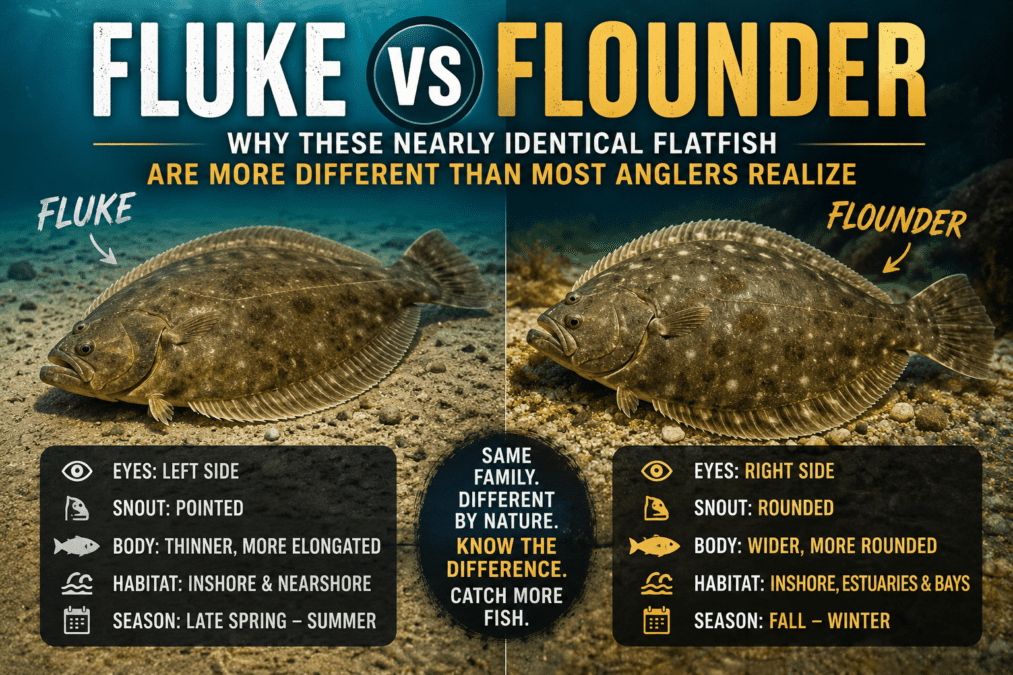

The fluke vs flounder debate is one of the most common sources of confusion among anglers, seafood consumers, marine biology enthusiasts, and coastal fishermen. At first glance, both fish appear nearly identical. They possess flattened bodies, both eyes positioned on one side of the head, remarkable camouflage abilities, and similar habitats along sandy ocean bottoms. Because of these shared traits, many people assume they are simply different names for the same fish.
A deeper examination reveals a far more nuanced reality. The fluke vs flounder comparison involves taxonomy, anatomy, habitat specialization, commercial value, feeding behavior, growth patterns, and regional naming conventions. Understanding these distinctions requires looking beyond superficial appearance and examining how each fish evolved to occupy specific ecological niches.
The central insight emerging from the fluke vs flounder analysis is that “fluke” is actually a specific type of flounder rather than an entirely separate category. While every fluke belongs to the broader flounder family, not every flounder qualifies as a fluke. This seemingly simple distinction explains much of the confusion surrounding these fascinating bottom-dwelling fish and highlights how classification systems often differ from everyday language.
Fluke is a specific species of flatfish commonly known as summer flounder, while flounder is a broader term encompassing multiple flatfish species.
In the fluke vs flounder comparison, the key difference is that fluke refers primarily to summer flounder, whereas flounder can describe dozens of related flatfish species found in oceans worldwide.
While fluke and flounder share flattened bodies and bottom-dwelling lifestyles, fluke generally grow larger, possess distinctive eye-like spots, and are considered a specific species within the larger flounder group.
For most anglers and seafood consumers, the practical answer to the fluke vs flounder question is straightforward: a fluke is a flounder, but a flounder is not necessarily a fluke. The distinction resembles the relationship between a Labrador and dogs in general. Understanding this hierarchy helps clarify differences in appearance, habitat preferences, commercial value, and fishing regulations.
Essential Comparative Metrics
| Attribute | Fluke (Summer Flounder) | Flounder (General Category) |
|---|---|---|
| Scientific Classification | Paralichthys dentatus | Multiple species across several families |
| Taxonomic Scope | Specific species | Broad group of flatfish |
| Average Adult Length | 15–26 inches | Varies from 8–37 inches depending on species |
| Maximum Weight | Up to 26 pounds | Species dependent |
| Eye Position | Typically left-eyed | Can be left-eyed or right-eyed |
| Distinctive Markings | Prominent eye-like spots | Often mottled camouflage patterns |
| Primary Habitat | Atlantic coastal waters | Global marine and estuarine habitats |
| Commercial Importance | High-value sport and food fish | Varies widely by species |
| Growth Rate | Relatively fast | Species dependent |
| Sport Fishing Popularity | Very high | Moderate to high |
| Market Identity | Premium species | General seafood category |
Structural And Biological Foundations
The foundation of any fluke vs flounder comparison begins with taxonomy. Flounders belong to a diverse group of flatfish that evolved one of nature’s most unusual body plans. During early development, juvenile flatfish resemble typical fish. As they mature, one eye migrates across the skull, allowing both eyes to occupy the same side of the body. This adaptation enables efficient bottom-dwelling behavior.
Fluke, scientifically known as Paralichthys dentatus, represent one specific species within this broader flatfish category. Their body shape tends to be more elongated than many other flounder species, and they possess distinct spots that aid identification. The evolutionary advantage of this flattened form is substantial. By lying against sandy or muddy bottoms, these predators reduce visibility while conserving energy.
A major element of the fluke vs flounder distinction involves classification. Flounder functions as an umbrella term, encompassing numerous species with varying biological characteristics. Fluke occupies a narrower position within that hierarchy, making it a specialized representative rather than a separate group altogether.
Behavioral Patterns And Social Intelligence
Unlike schooling pelagic fish such as tuna or herring, both fluke and most flounder species exhibit relatively solitary lifestyles. The fluke vs flounder comparison therefore centers less on social intelligence and more on hunting efficiency, environmental adaptation, and sensory specialization.
Fluke demonstrate highly developed ambush-predation strategies. They frequently bury themselves beneath sediment with only their eyes exposed. This behavior allows them to remain nearly invisible until prey approaches within striking distance. Their attack speed can be surprisingly explosive despite an otherwise sedentary appearance.
Many flounder species employ similar tactics, but behavioral variation exists across regions and habitats. Some species spend more time in estuaries, while others inhabit deeper offshore waters. Feeding schedules, migration patterns, and spawning movements also differ considerably.
In the broader fluke vs flounder discussion, fluke often stand out for their aggressive feeding behavior. Anglers frequently note that summer flounder readily attack baitfish, squid, and artificial lures, making them particularly attractive targets for recreational fishing compared with some less aggressive flounder species.
Habitat Distribution And Environmental Adaptation
Habitat provides one of the most useful lenses for understanding fluke vs flounder differences. Fluke primarily inhabit the western Atlantic Ocean, ranging from Canada to Florida. Their populations are especially abundant along the northeastern United States coastline.
Seasonal migration plays a major role in fluke ecology. During warmer months, they move into shallower coastal environments where feeding opportunities increase. As temperatures decline, many populations migrate offshore into deeper waters.
The broader flounder category occupies an extraordinarily diverse geographic range. Species occur in the Atlantic, Pacific, and Indian Oceans, as well as numerous estuaries, bays, and coastal ecosystems. Some thrive in colder northern waters, while others flourish in subtropical or tropical environments.
This distribution difference highlights an important point in the fluke vs flounder comparison. Fluke possess relatively specific habitat preferences, whereas flounders collectively demonstrate exceptional ecological flexibility. Their success across diverse environments illustrates the adaptability of the flatfish body plan and contributes significantly to their global abundance.
Feeding Strategies And Predatory Efficiency
Feeding behavior reveals another compelling aspect of the fluke vs flounder relationship. Both rely heavily on camouflage and surprise attacks, yet differences emerge in prey selection, aggression, and hunting patterns.
Fluke are active carnivores that consume baitfish, squid, shrimp, crabs, and various crustaceans. Their large mouths and sharp teeth enable them to target surprisingly sizable prey relative to body size. This predatory versatility contributes to rapid growth and high commercial value.
Many other flounder species maintain broader or more opportunistic diets. Depending on habitat and species, prey may include worms, mollusks, crustaceans, and small fish. Some species exhibit more conservative feeding behavior than fluke, focusing on abundant bottom-dwelling organisms.
The fluke vs flounder comparison demonstrates how subtle anatomical differences influence ecological roles. Fluke generally function as more aggressive predators, while the broader flounder category includes species occupying a wider range of feeding niches. This diversity reduces competition and supports coexistence among multiple flatfish species.
Subject A: Strengths And Constraints
Fluke Strengths
In the fluke vs flounder analysis, fluke possess several notable advantages. Their rapid growth rates allow individuals to reach impressive sizes within relatively short periods. This characteristic increases both commercial value and recreational fishing appeal.
Their aggressive feeding behavior enhances survival and enables exploitation of diverse prey resources. Fluke also exhibit exceptional camouflage abilities, allowing them to remain hidden from predators while maximizing hunting success.
Another strength involves market demand. Fluke are widely regarded as premium seafood due to their mild flavor, firm texture, and culinary versatility. Restaurants and seafood markets frequently command higher prices for fluke than for many other flatfish species.
Fluke Constraints
Despite these strengths, fluke face challenges. Their popularity creates significant fishing pressure. Regulatory agencies often establish strict size limits, seasonal restrictions, and catch quotas to maintain sustainable populations.
Their relatively specific geographic distribution also increases vulnerability to environmental changes affecting Atlantic coastal ecosystems.
Subject B: Strengths And Constraints
Flounder Strengths
The broader flounder group demonstrates remarkable evolutionary success. Species diversity allows occupation of habitats ranging from shallow estuaries to offshore continental shelves. This adaptability represents one of the greatest strengths observed in the fluke vs flounder comparison.
Flounders collectively exhibit efficient energy use, excellent camouflage, and effective predator avoidance. Their unique body structure enables survival in environments that might challenge more conventional fish species.
Many flounder species also support important commercial fisheries around the world. Their widespread distribution provides economic value across multiple continents and coastal communities.
Flounder Constraints
The primary limitation associated with the flounder category is variability. Because the term encompasses numerous species, biological characteristics can differ dramatically. Growth rates, reproductive patterns, habitat requirements, and population resilience vary considerably.
This complexity sometimes complicates fisheries management and public understanding. The frequent confusion seen in the fluke vs flounder discussion stems directly from this broad taxonomic scope.
Comparative Advantages In Real-World Scenarios
Examining practical applications offers additional insight into the fluke vs flounder debate.
For Recreational Fishing
Fluke often hold the advantage due to aggressive feeding tendencies and larger average size. Their willingness to strike artificial lures makes them especially appealing to sport fishermen seeking active engagement.
For Biodiversity
Flounders collectively provide greater ecological value because the category includes numerous species occupying diverse habitats and ecological roles.
For Commercial Seafood Markets
Fluke frequently command premium pricing. Their reputation for high-quality fillets creates strong demand among consumers and restaurants.
For Ecosystem Resilience
The broader flounder group demonstrates greater resilience through diversity. Multiple species spread across different environments reduce vulnerability to localized disturbances.
For Scientific Study
The fluke vs flounder comparison offers researchers valuable opportunities to examine adaptation, speciation, camouflage evolution, and fisheries management within a closely related group of organisms.
Economic And Commercial Importance
Economic significance adds another layer to the fluke vs flounder comparison. Coastal fisheries depend heavily on flatfish resources, and fluke occupy a particularly important role in Atlantic markets.
Commercial harvests generate substantial revenue through seafood sales, processing operations, and recreational fishing industries. Charter boats, bait suppliers, equipment manufacturers, and tourism businesses all benefit from healthy fluke populations.
The broader flounder category contributes even greater overall economic value worldwide. Numerous species support regional fisheries across North America, Europe, Asia, and Australia. In many coastal communities, flounder fishing represents a longstanding cultural tradition as well as a source of employment.
Consumer perception also influences market dynamics. Many buyers specifically seek fluke due to familiarity and reputation, whereas “flounder” may be used as a more general seafood label. This distinction illustrates how biological classification and commercial branding can intersect in complex ways.
Scientific And Expert Consensus (2026)
Current scientific consensus provides a clear answer to the fluke vs flounder question. Marine biologists generally agree that fluke represent a specific species of flounder rather than a separate biological category.
Research continues to emphasize the evolutionary success of flatfish adaptations. Eye migration, body flattening, camouflage mechanisms, and sediment-associated lifestyles remain among the most remarkable examples of vertebrate specialization.
Fisheries experts also highlight the importance of distinguishing between species-level and group-level terminology. Accurate identification supports effective conservation measures, sustainable harvest strategies, and public education.
Modern stock assessments indicate that responsible management remains essential for maintaining healthy populations. Regulatory frameworks increasingly rely on scientific monitoring to balance ecological sustainability with economic interests.
The expert view therefore frames the fluke vs flounder discussion not as a rivalry but as a taxonomic relationship. Understanding that relationship improves both scientific literacy and practical decision-making among anglers, consumers, and resource managers.
Frequently Asked Questions
Is a fluke the same thing as a flounder?
Not exactly. A fluke is a specific species known as summer flounder, while flounder is a broader term that includes many different flatfish species. Every fluke is a flounder, but not every flounder is a fluke.
Which tastes better, fluke or flounder?
Taste is subjective, but fluke is often considered superior because of its firm texture, mild flavor, and larger fillets. Many restaurants market fluke as a premium seafood option.
Why do anglers care about the fluke vs flounder distinction?
The distinction affects fishing regulations, identification, seasonal limits, and catch requirements. Different species may have different legal size restrictions and harvest rules.
How can you identify a fluke?
Fluke typically have an elongated body shape and several prominent eye-like spots on the upper side. They are generally left-eyed flatfish and often grow larger than many commonly encountered flounder species.
Final Synthesis And Verdict
The most important conclusion from the fluke vs flounder comparison is that the relationship is hierarchical rather than competitive. Fluke are not an alternative to flounder; they are a specialized member of the larger flounder group.
Fluke distinguish themselves through larger average size, aggressive feeding behavior, strong recreational fishing appeal, premium market value, and identifiable spotting patterns. These characteristics make them one of the most recognized and economically important flatfish species in North America.
Flounders as a collective category demonstrate a different kind of strength. Their diversity, adaptability, global distribution, and ecological versatility showcase the evolutionary success of the flatfish body plan across countless marine environments.
Ultimately, the fluke vs flounder debate reveals how common names can obscure important biological relationships. The deeper insight is not that one fish is better than the other, but that understanding taxonomy provides a clearer picture of how marine species evolve, diversify, and thrive. When viewed through this lens, fluke emerge as a highly successful specialist, while flounders represent one of the ocean’s most adaptable and fascinating groups of fish.