
Every road safety conversation eventually arrives at the same uncomfortable number. The World Health Organization counts about 1.19 million road traffic deaths a year, and puts pedestrians and cyclists at around 21 and 5 percent of that total, close to 310,000 people. Visibility is only one factor among many, but a lane edge that disappears at night or in rain is a problem engineers can actually fix. Road studs are one practical way to keep that edge visible. The interesting engineering question is no longer whether to use them, but which kind: passive reflectors that bounce a car's own headlights back, or active studs that make their own light.
Passive, surface solar and flush solar: three different philosophies
| Type | How it works | Practical notes |
|---|---|---|
| Retroreflective stud | Returns headlight beams to the driver | Works wet and dry, needs no battery, usually specified for regions without snowplows |
| Surface mounted solar stud | Solar charged LED sits on top of the road | Typical datasheets show about 4 mm of projection and up to 240 working hours on a full charge with no sun; snowplow regions often need a protective housing |
| Flush buried solar stud | Solar charged LED sits level with the pavement | Less surface for plows and tyres to catch |
This is a comparison of design logic, not a ranking. Retroreflectors have no electronics to fail. Active studs help most where headlight geometry is unhelpful: tight curves, wet pavement, fog, and places where an approaching driver's low beam never reaches the stud at the right angle.
What a 143 mm buried unit specifies
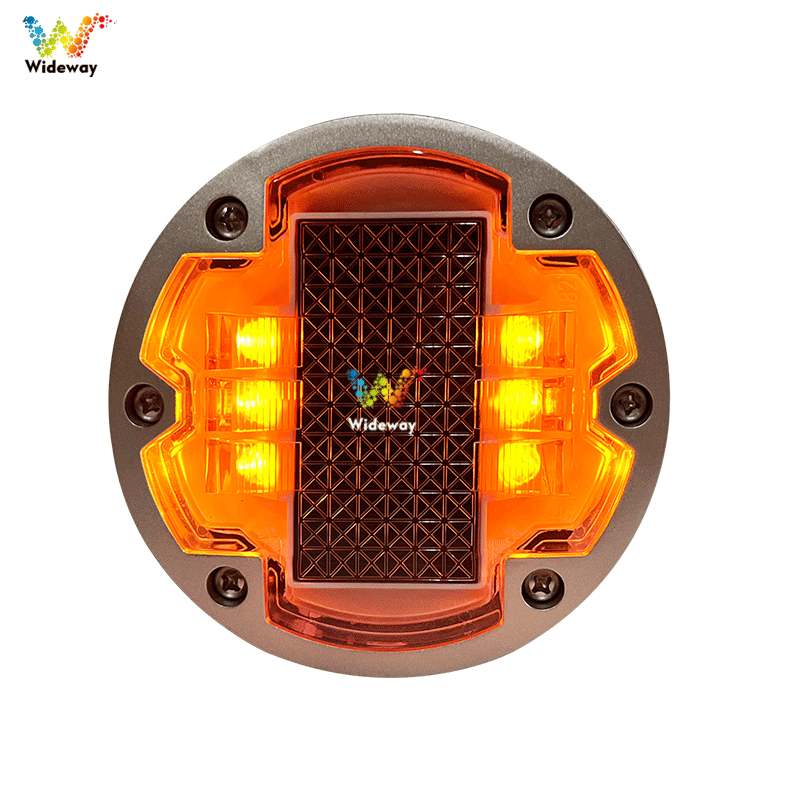
Consider the published specification for a Solar Round Road Stud 143MM:
- Housing: cast aluminium with a polycarbonate lens and epoxy filling
- Size: 143 × 143 × 50 mm, installed buried
- Power: a monocrystalline solar panel (91.7 × 41.7 mm) and an 18650 lithium iron phosphate cell rated 3.2 V
- Light: dual sided illumination from 5 mm round LEDs, yellow by default and customisable
- Operating mode: constant light or synchronised flashing using GPS timing
- Environment: IP68, −40 °C to +65 °C, 10 to 95 percent relative humidity
- Visibility distance: 20 to 300 m
- Rated service life: 100,000 hours or more, with an MTBF of 10,000 hours or more
- Weight: 1,500 g, with a 3 year warranty on the main unit
Two features stand out. The first is GPS synchronisation. Without cables, a row of studs can flash in unison using satellite timing, which matters on a crosswalk approach or a curve where a single stud means little and a chain of them draws the eye along the road. The second is flush mounting. A stud that sits level with the pavement offers less for a plow blade or a tyre to catch.
Where to be sceptical
Read the IP68 line properly. IP68 means dust tight and suitable for continuous immersion, but the depth and duration are set by the manufacturer, not by a universal rule. Ask what depth and time were tested, particularly if the stud will sit in a low point that floods.
Compare brightness in the right unit. Studs and signals are normally compared in candela or millicandela. If a data sheet quotes luminance instead, it cannot be set directly against another maker's figures, so ask for photometric data.
Small panels need autonomy figures. A 91.7 × 41.7 mm panel is compact. In shaded sections or during long overcast spells, the battery carries the load. Ask how many nights of operation the cell supports with no charging, and at what temperature.
Ask for the load certificate. A stud in a vehicle lane takes repeated wheel loads. A certified compression test report is worth more than any tonnage figure in a brochure.
Installation notes
The sequence is simple: mark guide lines so every stud sits on the same alignment, drill a round hole (55 mm deep and 145 mm in diameter), place the studs along a reference line so they sit level, then fix them with cement. The hole is only slightly larger than the body, which keeps the finished surface tight and reduces gaps where water or grit can collect. Because each unit runs on its own battery, there is no trenching or cable work, a significant saving on retrofits.
Short FAQ
Do buried studs survive snowplows? Flush mounting helps, because there is little to catch. Surface mounted studs usually rely on a deflecting housing instead.
Does GPS flashing need a controller? GPS timing keeps studs in step without wiring. Ask how linkage to traffic signals is implemented in your configuration.
Why not just use bigger reflectors? Reflectors are cheaper and have no electronics, but they rely on vehicle lighting. Active studs add a light source of their own, and that is the whole point.
Whichever approach you choose, request the test reports, not the brochure, and confirm the numbers in a table are in units that let you compare them.