
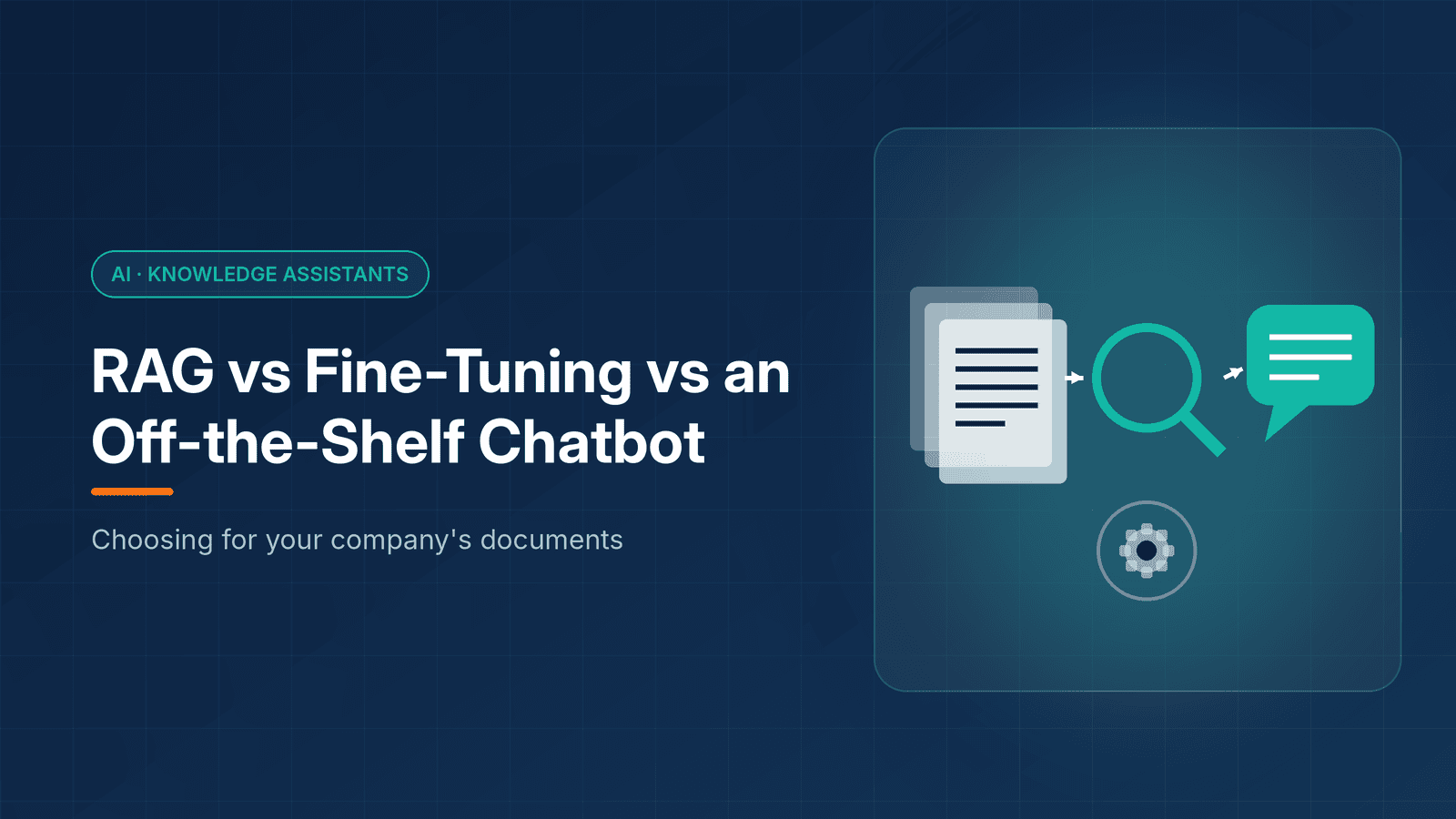
For most companies building an internal knowledge assistant, the RAG vs fine-tuning question has a clear default answer: start with retrieval-augmented generation (RAG). RAG lets an AI model look up your current documents before it answers, so responses stay up to date and can cite their source. Fine-tuning suits narrower jobs, like teaching a model a specific style or format. An off-the-shelf chatbot is the fastest option when your needs are simple and your documents already live in a supported tool. This guide compares all three side by side, explains when each one fits and covers the mistakes that sink most internal chatbot projects.
The Three Approaches in Plain Terms
Off-the-shelf chatbot
A ready-made AI assistant from a software vendor. You connect it to a document store, such as a shared drive or help center, and it answers questions. Setup takes days, and there's little to build.
Retrieval-augmented generation (RAG)
Your documents are split into small sections and indexed. When someone asks a question, the system finds the most relevant sections and passes them to a large language model (LLM), which writes an answer based on them. The model itself isn't changed. You change what it reads.
Fine-tuning
You train an existing LLM further on your own examples, so it learns patterns, terminology or a style of response. The knowledge becomes part of the model. To change it, you have to train again.
RAG vs Fine-Tuning vs Off-the-Shelf: Side-by-Side Comparison
The table below compares the three approaches on the six factors that matter most for an internal knowledge chatbot.
| Factor | Off-the-shelf chatbot | RAG | Fine-tuning |
|---|---|---|---|
| Upfront cost | Low: mostly subscription fees | Medium: build and integration work | High: data preparation, training runs and expertise |
| Setup time | Days | Weeks | Weeks to months |
| Accuracy on your documents | Good for simple questions; weaker on complex or specialized content | High when documents are good and retrieval is tuned | Good for style and patterns; weaker for exact facts |
| Keeping answers up to date | Automatic if the vendor syncs your sources | Easy: update the documents, re-index | Hard: requires retraining |
| Data privacy | Depends on the vendor's terms and hosting | High control: you choose where data and models run | High control, but training data is built into the model |
| Maintenance | Low: vendor handles it | Medium: monitor retrieval quality and document freshness | High: retrain as content and models change |
A few things stand out. RAG is the only approach that combines strong accuracy with easy updates. Fine-tuning costs the most and is the hardest to keep current. Off-the-shelf tools trade control for speed.
A note on fine-tuning LLM cost
Fine-tuning LLM cost goes beyond compute for training. Most of the expense is in preparing high-quality training examples, which often means hundreds or thousands of carefully written question-and-answer pairs. Then the work repeats every time your content or the base model changes. For document Q&A, that ongoing cost is usually hard to justify.
Choose an Off-the-Shelf Chatbot When…
- Your documents already live in a tool the chatbot supports
- Questions are general, like HR policies or how-to guides
- You need something running this month with no engineering time
- The vendor's data handling meets your privacy requirements
Watch out for: limited control over how answers are generated, and per-user pricing that grows quickly as more staff use it.
Choose RAG When…
- Answers must reflect the latest version of your documents
- Users need to see which document an answer came from
- Your content spans several systems, like a wiki, a ticket system and shared drives
- You need to control who can see which information
- Data privacy rules mean you want to choose where data is stored and processed
This is the most common fit for an internal knowledge chatbot. Retrieval augmented generation for business works well for policy manuals, product documentation, support knowledge bases, contracts and technical guides. Building it well takes more than connecting a model to a folder. Good retrieval-augmented generation (RAG) development covers document processing, search tuning, access control and evaluation, which together decide whether answers can be trusted.
Choose Fine-Tuning When…
- You need a consistent tone, format or structure in every answer
- The task is narrow and repetitive, like classifying tickets or extracting fields from forms
- Your field uses specialized language that general models handle poorly
- You have a large set of good examples and the budget to maintain them
Watch out for: fine-tuning doesn't reliably teach a model facts. A fine-tuned model can still give outdated or invented answers, and it can't show where an answer came from. Some teams combine approaches: a lightly fine-tuned model for tone or format, with RAG supplying the facts. For specialized needs like this, custom LLM development can help you decide how much customization is really worth paying for.
Common Mistakes With Internal Knowledge Chatbots
Most internal chatbot projects that disappoint fail for the same few reasons, whatever approach they use.
1. Poor document quality
If your documents are outdated, duplicated or contradict each other, the chatbot will be too. An AI assistant doesn't fix messy knowledge. It repeats it at speed. Fix: Before building, remove outdated files, mark one version as the source of truth and fill obvious gaps.
2. No evaluation
Many teams launch after a few impressive demo questions. Then users ask real questions and trust drops. Fix: Build a test set of 50–100 real questions with known correct answers. Run it before launch and after every major change, and track the percentage answered correctly.
3. No access control
An internal chatbot that can read every document can also reveal salary data, legal files or customer details to the wrong person. Fix: Make sure the system respects existing permissions, so users only get answers from documents they're allowed to see. This is much easier to design in from the start than to add later.
4. No owner after launch
Documents change, new questions appear and answers drift. Without someone responsible, quality slowly declines. Fix: Name an owner who reviews flagged answers, updates content and checks the evaluation results each month.
A Simple Way to Decide
Ask three questions in order:
- Do your documents change often, or do users need sources? If yes, choose RAG.
- Is the task about style or format rather than facts? If yes, consider fine-tuning.
- Are your needs simple and your documents in a supported tool? If yes, try an off-the-shelf chatbot first.
If you start with an off-the-shelf tool and outgrow it, moving to a custom AI chatbot built on RAG is a natural next step. The cleaned-up documents and test questions from your first project carry straight over.
Conclusion
For company documents, RAG is usually the right foundation. It keeps answers current, shows sources and gives you control over privacy. Use fine-tuning only for narrow tasks where style or format matters more than facts, and an off-the-shelf chatbot when speed and simplicity come first. Whatever you choose, clean your documents, test with real questions and respect access permissions from day one.
FAQs
What is the main difference between RAG and fine-tuning?
RAG gives a model your documents to read at the moment it answers, while fine-tuning changes the model itself through extra training. RAG is easier to keep up to date; fine-tuning is better for teaching style or format.
Is RAG cheaper than fine-tuning?
Usually, yes. RAG avoids repeated training runs and large example datasets, and updating it only means updating your documents.
Can an internal knowledge chatbot keep our data private?
Yes, if it's designed for it. With RAG, you can choose where documents are stored and which models process them, and enforce user permissions.
How accurate are RAG chatbots?
Accuracy depends mainly on document quality and retrieval tuning. Measure it with a test set of real questions instead of relying on demos.
Can we combine RAG and fine-tuning?
Yes. Some teams fine-tune a model for tone or output format and use RAG to supply up-to-date facts from company documents.
About the Author
Devansh Desai is CTO at Rushkar Technology, a software development company working with clients in the USA, UK and Australia since 2016. He writes about practical AI systems, knowledge assistants and secure use of company data.