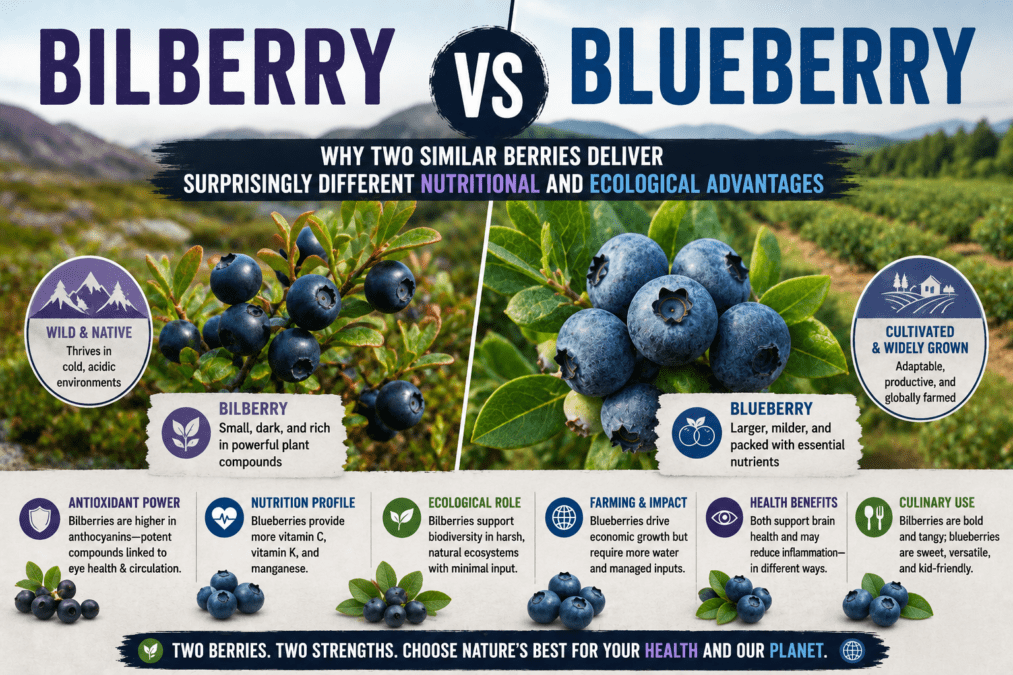

When discussing nutrient-dense berries, the comparison of bilberry vs blueberry often appears straightforward. Both belong to the heath family (Ericaceae), both produce blue-purple fruits, and both are celebrated for their antioxidant content. Yet beneath their visual similarities lies a surprisingly complex story involving botany, ecology, nutrition, cultivation, and human health.
A meaningful bilberry vs blueberry analysis requires more than comparing calories or vitamin content. These berries evolved in different environmental conditions, exhibit distinct growth habits, contain different concentrations of bioactive compounds, and serve different roles in commercial agriculture and traditional food systems. Their differences become even more significant when viewed through the lenses of nutritional science, sustainability, and consumer use.
The central insight emerging from modern research is that bilberries often possess higher concentrations of certain phytochemicals, while blueberries provide superior scalability, availability, and economic accessibility. In other words, the bilberry vs blueberry debate is not about identifying a universal winner but understanding how each berry excels under different biological and practical criteria.
Bilberries are small dark berries native to European and northern Asian forests. Blueberries are a group of cultivated and wild berries primarily associated with North America and modern commercial agriculture.
While bilberries typically contain more anthocyanin pigments per gram, blueberries generally offer greater availability, longer shelf life, and broader agricultural production.
Direct Answer: In the bilberry vs blueberry comparison, bilberries often lead in antioxidant density and pigmentation because their flesh is deeply colored throughout, whereas blueberries are usually superior in commercial production, accessibility, storage performance, and consumer availability. The better choice depends on whether nutritional concentration or practical accessibility is the primary goal.
Comparative Metrics
| Attribute | Bilberry | Blueberry |
|---|---|---|
| Scientific Classification | Vaccinium myrtillus | Multiple Vaccinium species |
| Native Origin | Europe and Northern Asia | North America |
| Typical Fruit Size | Small | Medium to large |
| Flesh Color | Dark purple throughout the fruit | Pale green or white interior |
| Anthocyanin Concentration | Generally higher | Moderate to high |
| Commercial Cultivation | Limited cultivation | Extensive commercial production |
| Shelf Life | Typically shorter | Generally longer |
| Global Availability | Relatively limited | Widely available worldwide |
| Harvest Method | Primarily wild harvesting | Large-scale agricultural farming |
| Average Market Price | Usually higher due to scarcity | Usually lower due to mass production |
Structural And Biological Foundations
The foundation of any bilberry vs blueberry comparison begins with plant biology. Although both berries belong to the Vaccinium genus, they represent distinct evolutionary pathways. Bilberries typically grow as low shrubs across forested and mountainous regions of Europe and northern Asia. Their growth is closely connected to natural woodland ecosystems and acidic soils.
Blueberries, in contrast, have undergone extensive domestication and selective breeding. Modern highbush blueberry varieties were developed to maximize fruit size, yield, disease resistance, and transportation efficiency. This agricultural refinement transformed blueberries into one of the world’s most commercially successful berry crops.
One of the most visible distinctions is fruit anatomy. Bilberries possess intensely pigmented flesh throughout the entire fruit. Blueberries generally have a blue skin but lighter interior flesh. This difference affects not only appearance but also the distribution of anthocyanins, the compounds responsible for many of the berries’ antioxidant properties.
Understanding these biological distinctions helps explain many outcomes observed throughout the broader bilberry vs blueberry discussion.
Behavioral Patterns And Ecological Intelligence
Although berries do not exhibit behavior in the animal sense, plants display ecological strategies that determine survival and reproduction. In the bilberry vs blueberry comparison, ecological adaptation reveals significant differences.
Bilberries evolved in relatively harsh northern environments characterized by forests, hillsides, and nutrient-poor acidic soils. Their survival strategy prioritizes resilience and adaptation rather than maximum fruit production. Because they commonly grow in wild ecosystems, bilberries maintain strong relationships with native pollinators, soil fungi, and forest biodiversity networks.
Blueberries represent a different ecological pathway. Through domestication, they became optimized for agricultural systems. Their growth patterns support large-scale cultivation, predictable harvests, and efficient management. Farmers can cultivate thousands of blueberry plants under carefully controlled conditions, achieving productivity levels impossible with most bilberry populations.
From an ecological perspective, the bilberry vs blueberry contrast mirrors a broader biological tradeoff. Bilberries excel as highly adapted wild organisms integrated into natural ecosystems, while blueberries excel as cultivated plants designed to meet global food demand. Neither strategy is inherently superior; each reflects a different evolutionary and agricultural objective.
Nutritional Composition And Phytochemical Density
Nutritional science is where the bilberry vs blueberry comparison attracts the greatest attention. Both berries are rich in vitamins, minerals, fiber, and polyphenolic compounds. However, bilberries frequently demonstrate higher concentrations of anthocyanins per unit weight.
Anthocyanins are pigments responsible for blue, purple, and red coloration in many fruits. These compounds have been extensively studied for their antioxidant properties. Because bilberry flesh is pigmented throughout, the berry often contains a broader distribution of anthocyanins compared with blueberries, whose pigments are concentrated primarily in the skin.
Blueberries remain highly nutritious despite this difference. They provide vitamin C, vitamin K, manganese, dietary fiber, and a substantial range of polyphenols. Many studies investigating berry consumption and health outcomes focus specifically on blueberries because they are more widely available for research and consumption.
Pitaya vs Dragon Fruit: Why Global Markets Created Two Names for the Same Nutritional Phenomenon
In practical dietary terms, the bilberry vs blueberry debate should not be reduced to a single antioxidant measurement. Overall nutritional value depends on serving size, frequency of consumption, food preparation methods, and broader dietary patterns. Both berries rank among the most nutrient-rich fruits available.
Subject A: Strengths And Constraints Of Bilberries
Bilberries possess several remarkable strengths that make them unique among berries. Their most frequently cited advantage is exceptional anthocyanin density. The deep coloration extending throughout the fruit often indicates a higher concentration of bioactive pigments than those found in many cultivated blueberry varieties.
Another strength is ecological authenticity. Bilberries are often harvested from wild environments, meaning they develop under natural conditions rather than intensive agricultural systems. This characteristic appeals to consumers interested in traditional foods and biodiversity conservation.
However, bilberries also face significant limitations. Their small size makes harvesting labor-intensive. Wild collection limits scalability and creates supply constraints. Transportation is more challenging because the fruit bruises easily and has a relatively short shelf life.
Price is another important consideration. Because production volumes remain limited, bilberries typically command higher market prices than blueberries. As a result, many consumers encounter bilberries primarily through supplements, extracts, powders, or specialty food products.
These strengths and constraints define bilberry’s position within the broader bilberry vs blueberry discussion.
Subject B: Strengths And Constraints Of Blueberries
Blueberries demonstrate strengths that explain their extraordinary global popularity. Their greatest advantage is commercial scalability. Modern blueberry farming supports consistent production across multiple continents, making the fruit available to consumers throughout much of the year.
Large fruit size enhances consumer appeal and harvesting efficiency. Blueberries also tolerate transportation better than bilberries, supporting international trade networks. Their relatively long shelf life reduces food waste and improves retail performance.
From a nutritional standpoint, blueberries remain highly impressive. Although they may contain lower anthocyanin concentrations than bilberries in some comparisons, they still rank among the most antioxidant-rich fruits commonly available.
The main limitation of blueberries is that intensive breeding for size, yield, and durability may sometimes reduce concentrations of certain phytochemicals relative to wild berry species. Additionally, commercial cultivation can require significant land, irrigation, and agricultural inputs depending on production systems.
Nevertheless, in the bilberry vs blueberry comparison, blueberries possess unmatched advantages regarding accessibility, affordability, and integration into everyday diets.
Taste, Texture, And Culinary Performance
Taste differences play a major role in consumer preference during any bilberry vs blueberry evaluation. Bilberries often deliver a stronger, more intense flavor profile. Their taste combines sweetness with noticeable tartness and earthy complexity. Many chefs and food enthusiasts appreciate this concentrated flavor, particularly in desserts, jams, sauces, and traditional European recipes.
Blueberries generally offer a milder and sweeter flavor. Their larger size and lower acidity make them highly versatile. They can be consumed fresh, added to breakfast foods, incorporated into baked goods, or blended into smoothies with minimal preparation.
Texture also differs substantially. Bilberries are softer and more delicate, which contributes to their intense juice content. Blueberries are firmer and better suited for transportation and storage.
From a culinary perspective, the bilberry vs blueberry debate often depends on intended use. Bilberries may provide superior flavor intensity for specialty dishes, while blueberries offer convenience and versatility for everyday cooking and snacking.
Comparative Advantages In Real-World Scenarios
Real-world applications reveal why the bilberry vs blueberry comparison cannot be settled through nutritional statistics alone.
For consumers seeking maximum anthocyanin concentration, bilberries may represent the preferred option. Their phytochemical profile has attracted attention in studies exploring vision health, oxidative stress, and vascular function.
For individuals prioritizing routine fruit consumption, blueberries may provide greater benefits simply because they are more accessible and affordable. A nutrient-rich food that is consistently consumed often delivers more practical value than a theoretically superior alternative that is rarely available.
Athletes may appreciate either berry depending on goals. Bilberries offer concentrated antioxidant content, while blueberries provide a convenient and readily available source of carbohydrates, fiber, and polyphenols.
Food manufacturers often favor blueberries due to reliable supply chains and predictable production volumes. Specialty supplement manufacturers, meanwhile, frequently utilize bilberry extracts because of their concentrated bioactive compounds.
These differing applications demonstrate that context matters enormously in the bilberry vs blueberry discussion.
Sustainability And Environmental Considerations
Environmental factors add another layer to the bilberry vs blueberry comparison. Bilberries typically grow in natural ecosystems and often require minimal agricultural intervention. Wild populations support biodiversity and contribute to forest ecosystem health. However, excessive harvesting pressure can threaten local sustainability if not properly managed.
Blueberry agriculture offers advantages and challenges. Large-scale cultivation efficiently produces significant quantities of nutritious food, supporting food security and economic development. Yet commercial farming may involve irrigation, fertilizer use, land conversion, and transportation-related emissions.
Sustainability outcomes depend heavily on management practices. Responsibly harvested wild bilberries can represent a low-input food source. Similarly, well-managed blueberry farms can achieve impressive efficiency while minimizing environmental impact.
The sustainability question within the bilberry vs blueberry comparison therefore depends less on species identity and more on production methods, harvesting practices, and supply-chain management.
Scientific And Expert Consensus (2026)
Scientific consensus in 2026 does not identify a universal winner in the bilberry vs blueberry comparison. Researchers generally agree that both berries provide substantial nutritional benefits and contribute positively to healthy dietary patterns.
Evidence consistently indicates that bilberries contain exceptionally high anthocyanin concentrations. This characteristic explains their frequent inclusion in studies involving antioxidant activity and specialized nutritional supplements.
At the same time, experts recognize blueberries as one of the most accessible and well-researched functional foods available globally. Their widespread consumption has generated a large body of evidence supporting benefits related to cardiovascular health, cognitive function, and metabolic well-being.
Nutrition scientists increasingly emphasize whole dietary patterns rather than individual superfoods. Within that framework, both berries occupy valuable positions. The practical consensus suggests choosing bilberries when available and desired for their concentrated phytochemicals, while recognizing blueberries as an outstanding everyday fruit choice.
Economic And Agricultural Impact
The bilberry vs blueberry comparison extends beyond nutrition into economics. Blueberries represent a major agricultural commodity supporting thousands of farms worldwide. Breeding programs continue to improve productivity, disease resistance, and climate adaptability.
Bilberries occupy a different economic niche. Because large-scale cultivation remains limited, they often serve specialty markets focused on premium foods, nutraceuticals, and traditional products. Their rarity contributes to higher prices and a perception of exclusivity.
Agricultural economists often view blueberries as a model crop for expanding fruit consumption globally. Bilberries, meanwhile, illustrate the economic value of wild-harvested and regionally distinctive foods.
Both berries contribute meaningfully to rural economies, but they do so through fundamentally different production systems.
Health Applications And Research Directions
Interest in the bilberry vs blueberry debate continues to grow because researchers increasingly examine how specific berry compounds interact with human physiology.
Bilberries are frequently investigated for their anthocyanin profile and potential effects on vascular function, eye health, and oxidative stress regulation. Historically, bilberries have also been associated with traditional medicinal uses in several European cultures.
Blueberries receive substantial research attention due to their widespread consumption and availability. Studies commonly explore cognitive performance, cardiovascular markers, glucose regulation, and healthy aging.
Future research is likely to focus less on determining which berry is superior and more on identifying how different berry compounds interact synergistically within broader dietary patterns. This shift reflects a growing understanding that nutritional outcomes rarely depend on single foods alone.
Frequently Asked Questions
Are bilberries healthier than blueberries?
Bilberries generally contain higher concentrations of anthocyanins, but blueberries remain exceptionally nutritious. Whether one is healthier depends on the specific health objective being considered.
Why do bilberries stain more than blueberries?
Bilberries contain dark pigments throughout the flesh, whereas blueberry pigments are concentrated mainly in the skin. This makes bilberries more likely to stain hands, clothing, and food preparations.
Can bilberries replace blueberries in recipes?
Yes, although flavor and texture differences may alter the final result. Bilberries often provide a stronger flavor and darker color than blueberries.
Why are bilberries harder to find in stores?
Bilberries are primarily wild-harvested and have limited large-scale cultivation. Blueberries benefit from extensive commercial farming, making them far more widely available.
Final Synthesis And Verdict
The most important conclusion from the bilberry vs blueberry comparison is that apparent similarity can conceal profound differences. Both berries belong to the same broader botanical family, yet they diverged through distinct evolutionary and agricultural pathways.
Bilberries excel in phytochemical concentration, pigmentation, flavor intensity, and ecological authenticity. They represent one of nature’s most concentrated sources of anthocyanins and remain highly valued in specialty nutrition and traditional food cultures.
Blueberries excel in availability, affordability, consistency, shelf life, and agricultural scalability. Their global success has made nutrient-rich berries accessible to millions of consumers who might otherwise have limited access to such foods.
Therefore, the verdict in the bilberry vs blueberry debate is nuanced rather than absolute. If the objective is maximizing anthocyanin density and experiencing a highly concentrated wild berry, bilberries often hold the advantage. If the objective is practical daily consumption, convenience, and broad nutritional value, blueberries are difficult to surpass.
Rather than choosing a single winner, modern nutritional science suggests embracing both. The true lesson of bilberry vs blueberry is that diversity within healthy diets frequently delivers greater value than allegiance to any one food.