
When discussing citrus fruits, few comparisons generate as much confusion as clementines vs tangerines. Both belong to the mandarin family, both are easy to peel, and both are commonly sold during the same seasons. Because of these similarities, many consumers assume they are essentially identical fruits marketed under different names. The reality is more complex.
The comparison of clementines vs tangerines involves genetics, cultivation practices, flavor chemistry, nutritional profiles, commercial distribution, and consumer preferences. Although both fruits share a common ancestry, their differences influence sweetness, seed production, shelf life, and overall eating experience.
The most surprising insight in the clementines vs tangerines debate is that neither fruit is inherently superior. Instead, each represents a different balance between convenience, flavor complexity, and agricultural adaptability. Understanding those distinctions provides a more useful framework than simply asking which fruit tastes better.
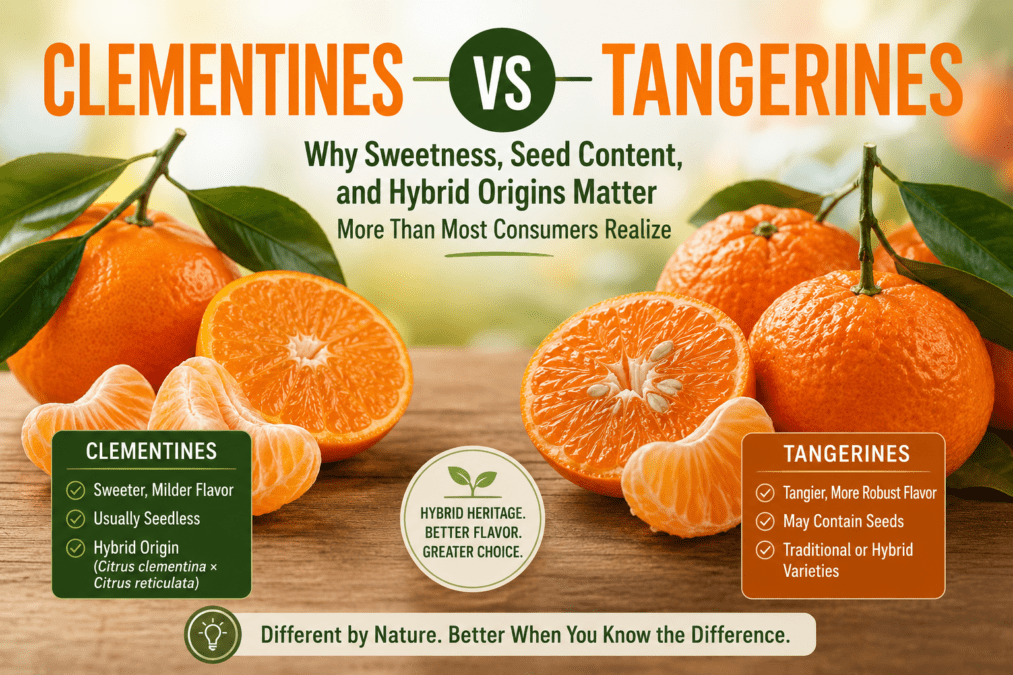
A clementine is a small, usually seedless mandarin hybrid known for its sweetness and easy peeling. A tangerine is a type of mandarin orange characterized by a deeper orange color, richer flavor, and often greater seed content.
While clementines emphasize sweetness and convenience, tangerines often deliver a more intense citrus flavor and aromatic complexity.
Direct Answer: In the comparison of clementines vs tangerines, clementines are generally sweeter, smaller, and more likely to be seedless, making them highly convenient for snacking. Tangerines typically offer a stronger citrus taste, slightly more acidity, and greater flavor complexity. The better choice depends on whether a consumer prioritizes sweetness and convenience or a more traditional citrus experience.
Comparative Metrics
| Attribute | Clementines | Tangerines |
|---|---|---|
| Classification | Mandarin hybrid | Mandarin variety |
| Origin | Hybrid developed from mandarin and sweet orange ancestry | Traditional mandarin subgroup with older cultivation history |
| Average Size | Small and compact | Small to medium |
| Shape | Round and uniform | Slightly flattened at the ends |
| Peel Thickness | Thin | Thin to moderately thick |
| Ease of Peeling | Very easy | Easy |
| Seed Content | Usually seedless | Often contains seeds |
| Sweetness Level | Very high | Moderate to high |
| Acidity | Lower acidity | Higher acidity |
| Flavor Profile | Mild, sweet, and smooth | Rich, tangy, and complex |
| Aroma | Light and delicate | Stronger citrus fragrance |
| Juiciness | Moderate | High |
| Color | Bright orange | Deep orange to reddish-orange |
| Texture | Tender and soft | Firm with juicy segments |
| Vitamin C Content | High | High |
| Fiber Content | Moderate | Moderate |
| Child-Friendly Appeal | Excellent | Very good |
| Snack Convenience | Excellent | Good |
| Cooking Applications | Good for fresh eating and desserts | Excellent for juices, sauces, and baking |
| Shelf Life | Generally longer under proper storage | Slightly shorter depending on variety |
| Commercial Popularity | Extremely high | High |
| Best For | Convenient everyday snacking | Enhanced citrus flavor and culinary use |
Structural And Biological Foundations
Understanding clementines vs tangerines begins with botanical classification. Both fruits belong to the broader mandarin orange group, which itself falls within the citrus genus. However, their evolutionary histories differ in meaningful ways.
Clementines are generally considered hybrid mandarins that emerged through natural or selective breeding processes. Their development favored traits that consumers value highly, including sweetness, thin skins, and reduced seed production. These characteristics made clementines especially attractive for large-scale retail markets.
Tangerines, on the other hand, represent a traditional subgroup within mandarins. They have been cultivated for generations and retain many of the flavor characteristics associated with older citrus varieties. Their deeper color and stronger aroma often reflect a slightly different balance of sugars, acids, and volatile flavor compounds.
From a biological standpoint, the discussion of clementines vs tangerines is not merely about appearance. It reflects distinct breeding priorities that shaped each fruit’s modern identity.
Behavioral Patterns And Social Intelligence
Unlike animals, fruits do not exhibit behavior or intelligence. However, consumer behavior provides an interesting lens for understanding clementines vs tangerines.
Clementines have become a dominant choice among families because they satisfy several modern preferences simultaneously. They are portable, easy to peel, generally seedless, and consistently sweet. These traits reduce friction in the eating experience and make them attractive to children and busy adults.
Tangerines appeal to a somewhat different audience. Many citrus enthusiasts appreciate their stronger aroma and more complex flavor profile. For these consumers, slight acidity and occasional seeds are acceptable trade-offs for a richer sensory experience.
Retail trends often reveal that convenience drives purchasing decisions. Consequently, clementines frequently outperform tangerines in supermarket sales. Nevertheless, specialty fruit buyers and culinary professionals often continue to value tangerines for their distinctive flavor contributions.
The market behavior surrounding clementines vs tangerines demonstrates how consumer preferences influence agricultural production and distribution strategies.
Clementines: Strengths And Constraints
The strongest advantage in the clementines vs tangerines comparison is convenience. Clementines are designed, whether intentionally or through selection pressures, to maximize consumer friendliness.
Their sweetness is one of their defining characteristics. Lower acidity creates a pleasant flavor that appeals to a broad demographic. This balance makes clementines particularly popular among children and individuals who prefer milder citrus fruits.
Seedlessness represents another major advantage. Consumers increasingly favor foods that require minimal preparation or sorting, and clementines align perfectly with this trend. Their thin peels further enhance usability.
However, these strengths come with limitations. Some citrus enthusiasts consider clementines less complex than tangerines. Their sweetness can occasionally overshadow subtler flavor notes. Additionally, because they are bred for consistency, they may lack the variation and character found in traditional citrus varieties.
Therefore, in the discussion of clementines vs tangerines, clementines excel at convenience but may sacrifice some flavor depth.
Tangerines: Strengths And Constraints
Tangerines bring different strengths to the clementines vs tangerines debate. Their most notable advantage is flavor complexity.
Compared with clementines, tangerines often deliver a more balanced interaction between sweetness and acidity. This creates a brighter and more aromatic citrus profile that many consumers find satisfying. The deeper orange coloration also contributes to their visual appeal.
Tangerines tend to produce more juice, making them useful for culinary applications, beverages, desserts, and sauces. Their stronger fragrance can enhance recipes in ways that milder fruits cannot.
The primary drawback is reduced convenience. Seeds remain common in many tangerine varieties, and sweetness levels can vary more significantly from fruit to fruit. Although many consumers appreciate this natural variability, others prefer the predictability of clementines.
As a result, clementines vs tangerines often becomes a choice between consistency and character rather than quality and quality.
Nutritional Comparison
One reason the clementines vs tangerines discussion remains close is that both fruits provide remarkably similar nutritional benefits.
Both are excellent sources of vitamin C, which supports immune function, collagen production, and antioxidant protection. They also contain dietary fiber, potassium, folate, and various plant compounds associated with overall health.
Clementines often contain slightly more sugar relative to acidity, contributing to their sweeter taste. Tangerines may provide marginally different concentrations of certain antioxidants depending on variety and growing conditions.
In practical dietary terms, these differences are relatively minor. Both fruits support healthy eating patterns and can contribute meaningfully to daily fruit intake. Nutritional superiority is therefore not the deciding factor in clementines vs tangerines.
Instead, taste preference and intended use usually determine the better choice.
Comparative Advantages In Real-World Scenarios
The most useful way to evaluate clementines vs tangerines is through real-world applications.
For school lunches, travel snacks, and quick consumption, clementines are difficult to beat. Their seedless nature and easy peeling reduce inconvenience and waste. Parents frequently choose them for these reasons.
For cooking and baking, tangerines often offer advantages. Their stronger citrus flavor can stand out in desserts, marinades, jams, and beverages. Chefs frequently seek fruits that contribute distinctive aromatic characteristics, and tangerines often meet that requirement.
In commercial retail environments, clementines generally possess broader mass-market appeal. In gourmet and specialty food settings, tangerines often receive greater appreciation for their nuanced flavor profile.
The outcome of clementines vs tangerines therefore changes depending on the context. The same fruit that excels as a snack may not be the best ingredient in a culinary application.
Scientific And Expert Consensus (2026)
Current agricultural and nutritional understanding does not support declaring a universal winner in clementines vs tangerines. Experts generally recognize both as valuable members of the mandarin family with overlapping but distinct characteristics.
Research consistently indicates that sweetness perception results from a combination of sugar concentration, acidity, aroma compounds, and texture. Clementines achieve popularity largely through sweetness and convenience, while tangerines maintain relevance through flavor complexity and traditional citrus characteristics.
Agricultural experts also note that consumer demand increasingly favors seedless fruit varieties. This trend benefits clementines in global markets. Nevertheless, biodiversity and flavor diversity remain important considerations, supporting the continued cultivation of traditional tangerine varieties.
Scientific consensus therefore suggests that the comparison should focus on suitability rather than superiority.
Final Synthesis And Verdict
The debate over clementines vs tangerines often assumes that one fruit must be better than the other. A closer analysis reveals a more nuanced reality.
Clementines represent the modern preference for convenience, consistency, sweetness, and seedlessness. They excel as everyday snack fruits and satisfy the expectations of a broad consumer base.
Tangerines represent a more traditional citrus experience. Their stronger aroma, balanced acidity, and richer flavor profile provide qualities that many fruit enthusiasts actively seek.
If convenience is the priority, clementines usually win. If flavor complexity matters most, tangerines often have the advantage.
Ultimately, the most accurate conclusion in the clementines vs tangerines comparison is that each fruit succeeds by optimizing different qualities. Rather than competitors, they are complementary expressions of the remarkable diversity found within the mandarin citrus family.
Frequently Asked Questions
Are clementines and tangerines the same fruit?
No. Although both belong to the mandarin family, clementines are typically hybrid mandarins known for seedlessness and sweetness, while tangerines are a traditional mandarin type with a stronger citrus flavor.
Which is sweeter in the clementines vs tangerines comparison?
Clementines are generally sweeter. Their lower acidity creates a smoother flavor profile that many consumers perceive as more dessert-like.
Are tangerines healthier than clementines?
Not significantly. Both fruits provide vitamin C, fiber, antioxidants, and other beneficial nutrients. Nutritional differences are relatively small.
Which fruit is better for children?
In most cases, clementines are preferred because they are usually seedless, easy to peel, and consistently sweet. However, many children also enjoy tangerines for their juicy texture and vibrant flavor.